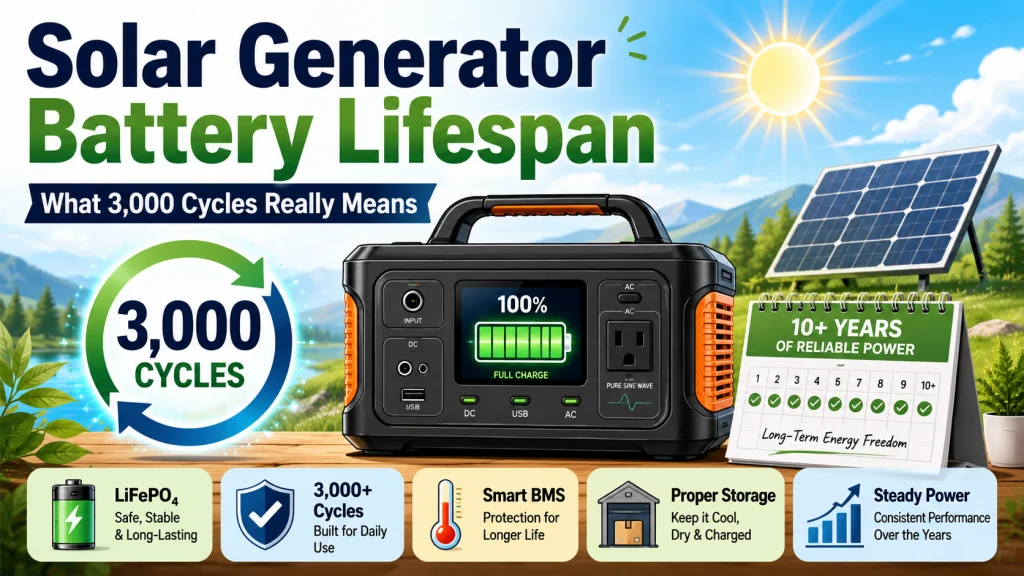
How Long a Solar Generator Battery Actually Lasts
The short answer is anywhere from two years to fifteen, depending almost entirely on battery chemistry and how the unit is used. That range is not vague marketing language. It reflects the real gap between a budget NMC lithium-ion unit that drops to 80 percent of original capacity by 500 cycles and a LiFePO4 unit that maintains that same threshold at 3,000 to 6,000 cycles. For a buyer spending $800 to $3,000, that difference is the difference between replacing in four years or still running strong in twelve.
What makes lifespan harder to answer off a spec sheet is that manufacturers state cycle counts but rarely translate them into years. A unit rated for 3,000 cycles lasts radically different lengths of time depending on whether you use it every day for backup power or four times a year for camping. Both are valid uses. Neither gets the same lifespan from the same rating. Temperature, storage habits, and cycling depth each bend that curve further in either direction.
The full breakdown of how lifespan varies by battery type, use frequency, and component quality is in the dedicated guide on how long solar generators actually last. That article also covers the inverter electronics, which fail before the battery in some budget units, and what brand warranty length actually signals about expected lifespan.
Why Battery Chemistry Is the Spec That Matters Most
Two solar generators sitting side by side on a shelf can look identical. Same watt-hours, same output wattage, similar weight, similar price. The one spec that determines whether either lasts three years or twelve is the battery chemistry listed in the fine print. LiFePO4, also called lithium iron phosphate or LFP, and NMC lithium-ion are not interchangeable options. They are fundamentally different battery architectures with dramatically different cycle lives.
LiFePO4 is chemically stable, handles heat and deep discharge better than NMC, and is far less prone to the thermal runaway that makes NMC lithium-ion a real concern under extreme conditions like overcharging or physical damage. NMC has higher energy density per kilogram, which is why it appears in older and lighter portable units, but it degrades three to four times faster under the same cycling conditions. The buyer communities on Slickdeals have been clear about this for a couple of years: when a deal comes up on a unit with NMC chemistry, experienced buyers filter it out immediately regardless of price.
As of 2024 and 2025, most premium units from the major manufacturers have transitioned to LiFePO4 across their main product lines. NMC is mostly found in older models and budget units under $300. The practical question for any buyer is confirming which chemistry a specific unit uses before committing. The full comparison of LiFePO4 vs lithium-ion is in the dedicated battery chemistry breakdown, including the safety difference, the weight and cost tradeoff, and what the community research confirms about real-world behavior.
Field Note: At the store, battery chemistry questions picked up noticeably around 2022 when buyers started arriving with research already done. They would hand me their phone showing a spec sheet and ask me to confirm the chemistry before they would even consider the price. The ones who had already bought a budget NMC unit and watched it fade to noticeably shorter runtime in year three were the most direct about it. The chemistry question is not enthusiast territory anymore. It is basic due diligence for anyone spending over $300.
What 3,000 Cycles Actually Means for Different Buyers
A cycle is one full round of charge and discharge. Using a battery from 100 percent to 0 and back to 100 equals one cycle. Using it from 100 percent to 50 percent and back to 100 equals half a cycle. The math compounds over time in ways that depend entirely on how often and how deeply you use the unit. A unit rated for 3,000 cycles does not last the same number of years for everyone.
A daily-use owner who runs the battery through one full cycle every day hits 3,000 cycles in roughly eight years. A weekend camper who cycles the unit fifty times a year reaches that same threshold in sixty years. An emergency backup owner who cycles the unit ten to twenty times a year, which is realistic for most households that treat it primarily as outage insurance, reaches 3,000 cycles in 150 to 300 years. For the average buyer, a quality LiFePO4 unit at 3,000-plus cycle rating is effectively a lifetime purchase at moderate use frequency.
Where the cycle math gets nuanced is in partial cycling behavior. Using 30 percent of capacity and recharging is less stressful on the cells than cycling from full to near-empty repeatedly. Manufacturers calculate cycle ratings using full 0-to-100 cycles, which means your actual cycle count in years of normal partial use will be better than the spec sheet suggests. The full math across buyer scenarios, including the outage-only owner, the daily RV user, and the off-grid homesteader, is covered in the article on what battery cycles mean in daily use.

This 1kWh LFP battery station charges from 0 to 80% in just 50 minutes via AC input, and its LiFePO4 chemistry delivers a 3,000 plus cycle lifespan that is roughly 6 times longer than standard lithium batteries. Capacity is expandable up to 3kWh with additional batteries, making it well suited for camping, RVs, or off-grid living. Its 1,800W output powers across 15 outlets, handling around 90% of household appliances, and accepts up to 500W of solar input for clean, fuel-free charging. The package includes a 5-year customer service guarantee.
Check On AmazonIf you click this link and buy, we earn a commission at no additional cost to you.
How to Store a Solar Generator Without Degrading the Battery
The buyers most likely to damage their battery are not the ones using it every week. They are the ones who charge it fully in October, put it in the garage, and pull it out in May to find it either underperforming or failing to hold charge. A lithium battery left at 100 percent state of charge for months sustains voltage stress across the cells. A lithium battery left near zero and ignored self-discharges to a level that can cause permanent capacity loss or cell damage.
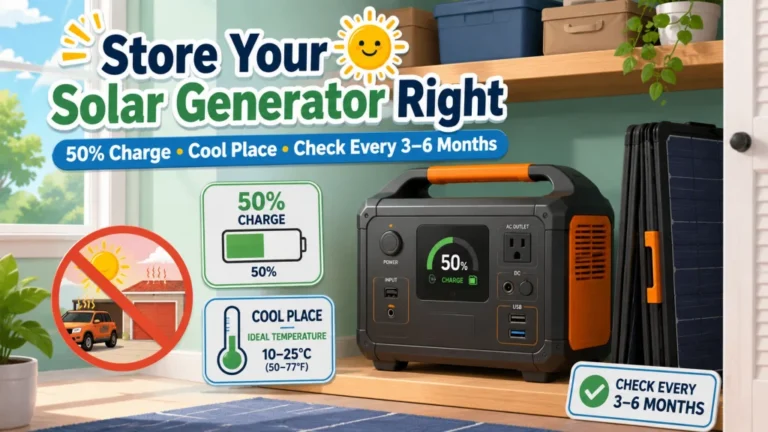
The general rule across LiFePO4 units is to store between 40 and 60 percent charge when not in use for extended periods. Check and recharge to that range every two to three months. Temperature matters at least as much as charge level: storing in a hot garage or car above 104 degrees Fahrenheit causes permanent capacity loss independent of cycling. Cold storage above freezing is fine. Avoid freezing storage when possible, and never charge the unit below freezing unless the manufacturer explicitly allows it.
These practices apply whether the unit is sitting through a winter between camping seasons or stored in a closet as dedicated backup power that rarely gets used. The detailed guide on how to store a solar generator correctly covers charge level targets, temperature ranges, refresh cycle timing, and what to do before putting the unit away for more than a month.
How to Detect Battery Degradation Before It Becomes a Problem
Battery degradation does not announce itself. It shows up gradually as shorter runtimes, which owners tend to attribute to running more devices or forgetting to charge fully rather than capacity loss. By the time it becomes obvious the runtime has dropped meaningfully, the battery may have lost 20 to 30 percent of its original capacity. Catching degradation early gives you useful information about whether the unit is aging normally, whether a warranty claim is appropriate, or whether a change in storage and cycling habits might slow further loss.
The detection method is straightforward. Run the unit at a known constant load and time the runtime to empty. Compare that actual runtime to the theoretical runtime calculated from original watt-hour capacity divided by the load wattage. A 2,000Wh battery running a 200W load should deliver approximately 8.5 hours at full original capacity after accounting for inverter efficiency. If the actual runtime is 6 hours, the battery is at roughly 70 percent of original capacity. The test takes an afternoon and requires no specialized tools.
What to do with that number, including the 80 percent warranty threshold most manufacturers use, when degradation to 70 or 75 percent is acceptable versus when it becomes inconvenient, and how temperature-caused degradation differs from normal cycling loss, is all covered in the article on how battery degradation progresses over time. That article also includes the runtime calculation method in more detail for different load scenarios.

This compact plug-in monitor tracks the energy consumption of any AC 115-volt appliance and displays real-time readings of volts, amps, and wattage at 0.2 to 2.0 percent accuracy. Its large LCD screen lets you calculate electricity costs by the day, week, month, or year, making it easy to spot energy-hungry devices and trim your utility bill. It is also compatible with inverters, adding flexibility for off-grid setups.
Check On AmazonIf you click this link and buy, we earn a commission at no additional cost to you.
Daily Habits That Add Years to Battery Life
Most solar generator owners do nothing deliberate to protect the battery. They charge to 100 percent because that is what the indicator shows, drain it low before recharging because that is what old rechargeable devices trained them to do, and store it wherever it fits. None of those habits are catastrophic for LiFePO4, but all of them accelerate degradation relative to what the battery chemistry is actually capable of.
The habits that make the measurable difference are not complicated. Do not charge habitually to 100 percent when the unit will sit at full charge for days. Most smart units allow a charge ceiling setting, and running the ceiling at 80 to 90 percent for daily or standby use rather than emergency full-charge situations significantly reduces sustained voltage stress. Do not discharge below 20 percent regularly. Recharging from 30 percent is less stressful on the cells than cycling from full to near-empty repeatedly. Keep the vents clear during charging. The fan is removing heat from the cells. Blocking it to reduce noise accelerates the exact degradation you are trying to prevent.
The chemistry-backed explanation for each of these habits and how they interact with LiFePO4 specifically, plus the settings and firmware notes for smart units, is in the full guide on habits that extend solar generator battery life. That article also covers the difference between LiFePO4 best practices and NMC best practices, which are not identical.
Before You Buy: Four Battery Lifespan Specs to Check
Most spec sheets list a cycle count and stop there. Four pieces of information tell you far more about long-term value than the watt-hour capacity or output wattage that dominate the marketing. None of them require technical expertise to find or understand.
- Battery chemistry. Look for LiFePO4, LFP, or lithium iron phosphate. If the spec sheet says lithium-ion without specifying LFP, assume NMC. The difference in cycle life is three to four times.
- Cycle count to 80 percent. Many brands state a cycle number without specifying what capacity threshold it refers to. A unit rated for 3,000 cycles to 80 percent of original capacity is a meaningful claim. A unit rated for 3,000 cycles with no threshold stated is harder to evaluate.
- Warranty length and what it covers. A five-year warranty on a unit with a 3,000-cycle LiFePO4 battery is a signal that the manufacturer expects the battery to outlast the warranty by a wide margin. A two-year warranty on the same claimed cycle count raises a different question.
- Battery replaceability. Some units allow the battery module to be replaced when it reaches end of life. Others require replacing the entire unit. For a purchase in the $1,000 to $3,000 range, knowing whether a degraded battery means a battery swap or a full replacement is worth finding out before buying.

At just 41.7 lbs and measuring 18.1 by 9.8 by 10.1 inches, this station is 25% lighter and 29% more compact than comparable units while still delivering 2,400W of continuous output and 4,000W peak power, enough to run window and RV air conditioners. It charges to 100% in as little as 58 minutes via combined AC and solar, or to full in 3 hours through alternator charging at 8 times the speed of a standard car socket. Standby draw of only 9W keeps a dual-door fridge running for up to 32 hours, and capacity expands to 4kWh with an optional battery for up to 64 hours of refrigeration runtime.
Check On AmazonIf you click this link and buy, we earn a commission at no additional cost to you.
Where to Go From Here
Battery lifespan is not one question. It is six related questions that each pull in a different direction depending on where you are in the buying or owning process. A buyer who has not yet purchased benefits most from the chemistry comparison and the cycle math. An owner who just pulled a unit out of storage needs the degradation test. Someone planning a seasonal storage routine needs the storage guide. The habits article is useful at any stage, including before buying, because the habits that protect a battery are easier to build when they are not retrofitted onto three years of accumulated opposite behavior.
If you are still earlier in your research and want to understand solar generators more broadly before going deep on battery lifespan, the complete solar generator guide is the right starting point. It covers the full lifecycle from basic technology to comparison categories to product selection.

Weighing just 23.8 lbs with a foldable handle, this 1,070Wh LFP power station delivers 1,500W of pure sine wave AC output with a 3,000W surge capacity, capable of running AC units, fridges, and electric pots. Its LFP battery sustains over 70% capacity after 4,000 cycles, translating to a lifespan of more than 10 years. Via the Jackery App, you can enable a full charge in as little as one hour, or switch to a whisper-quiet 30 dB overnight mode. Six output ports including two USB-C with 100W PD charging cover nearly any device simultaneously.
Check On AmazonIf you click this link and buy, we earn a commission at no additional cost to you.
FAQs
🔋 How long does a solar generator battery last on average?
A LiFePO4 solar generator used for moderate backup and occasional outdoor use typically lasts 8 to 15 years before the battery capacity drops to the point of meaningfully shorter runtimes. NMC lithium-ion units, mostly found in older or budget models, reach that threshold in 2 to 6 years under similar use. The main variable beyond chemistry is how often and how deeply the unit is cycled.
⚡ What does a cycle count like 3,000 cycles mean in years?
At one full cycle per day, 3,000 cycles equals roughly eight years. At 50 cycles per year, it equals 60 years. For most emergency backup owners who cycle the unit 10 to 20 times per year, the battery will outlast reasonable ownership expectations by a wide margin. Daily use shortens the timeline significantly. Partial cycling, which most owners do, also extends real-world cycle life beyond the spec sheet number.
🌡️ Does temperature affect solar generator battery lifespan?
Yes, significantly. Storing or charging in temperatures above 104 degrees Fahrenheit causes permanent capacity loss that accumulates over time regardless of how carefully the battery is cycled. Charging below 32 degrees Fahrenheit can also damage cells, though most quality units include low-temperature protection that prevents charging in those conditions. Where you store the unit matters as much as how you use it.
🔌 Is LiFePO4 really that much better than lithium-ion for lifespan?
Yes, for solar generator applications specifically. LiFePO4 reaches 80 percent capacity retention at 2,000 to 6,000 cycles. NMC lithium-ion reaches the same threshold at 500 to 1,500 cycles. That is a three to four times difference in cycle life under comparable conditions. LiFePO4 also is far less prone to thermal runaway than NMC under extreme conditions, which is the primary reason energy storage manufacturers have shifted to it across premium product lines.
🏪 How do I know if my solar generator battery is degrading?
The most reliable method is a runtime test. Run the unit at a constant known load and time how long it takes to reach empty. Compare that actual runtime to the theoretical runtime you calculate from original watt-hour capacity divided by load wattage. If the unit runs meaningfully shorter than expected, the difference reflects capacity loss. A 2,000Wh battery running a 200W load should deliver approximately 8.5 hours at original capacity. Anything significantly under that number points to measurable degradation.
📦 What charge level should I store a solar generator at?
Store between 40 and 60 percent charge for any period longer than a few weeks. Do not store at full charge for months and do not allow the battery to sit near empty. Check and top up to that range every two to three months during long storage periods. Temperature matters too: keep stored units away from hot cars, garages that heat up in summer, and anywhere else that regularly exceeds 104 degrees Fahrenheit.
🛠️ Can I extend my solar generator battery life with settings?
Yes, if the unit supports charge ceiling settings. Setting the maximum charge to 80 or 90 percent for everyday use reduces the sustained voltage stress that occurs when a battery sits at 100 percent charge between uses. Not all units offer this setting. For units that do, it is one of the most effective single changes an owner can make without changing any usage habits, and most daily or standby users never actually need the last 10 to 20 percent of capacity anyway.