Expandable or Fixed? The Question That Settles It Before Anything Else
The best expandable solar generator for your situation depends on a question most buying guides skip entirely: how confident are you that your power needs will actually grow, and by how much? If you can answer that with reasonable certainty, an expandable platform can save money over a resell-and-replace cycle. If the honest answer is “I am not sure,” a well-sized fixed unit is almost always cheaper in total.
The expandable pitch is compelling. Start with a manageable unit, add battery capacity as your needs grow, avoid selling a unit you have already broken in and learned to use. It sounds like the rational long-term approach. The problem is that it only works financially if the cost of expanding is lower than the cost of selling your current unit and buying a larger one. That calculation does not always go the way buyers expect when they run the actual numbers before committing.
If you are still building your overall solar generator buying decision, the guide to solar generator value across the full price tier landscape helps situate where expandable platforms sit relative to fixed-capacity units at different budgets. The expandable question is specific enough to need its own treatment, which is what this article covers.
What Expandable Actually Means and What It Does Not Change
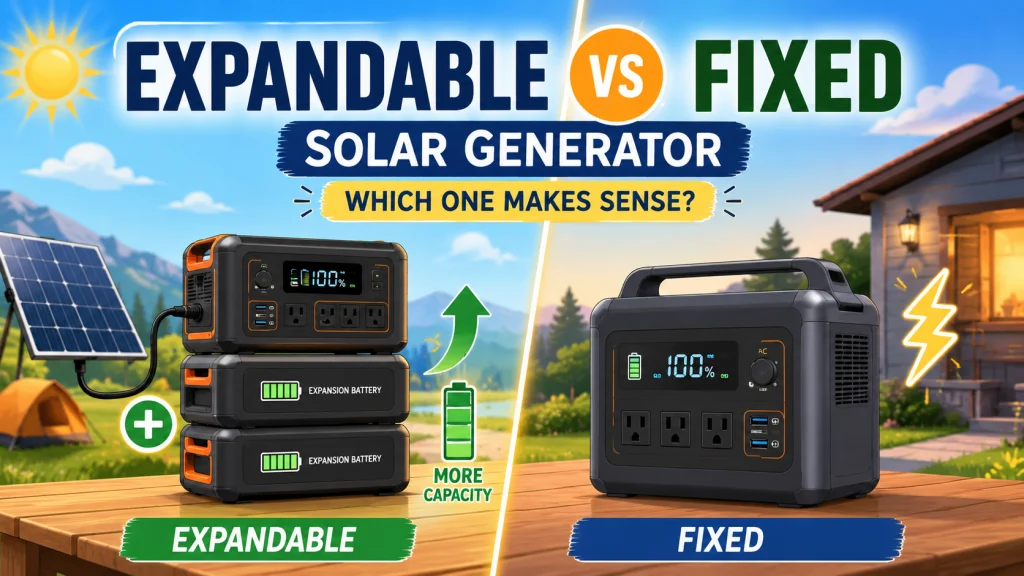
Expandability on a solar generator refers specifically to battery capacity. Expansion batteries connect to the base unit through a proprietary port and increase the total watt-hour storage available. That is the entire scope of what expansion adds. A 3,000Wh base unit with a 3,600Wh expansion battery becomes a roughly 6,600Wh system, with the inverter drawing from the combined storage pool.
What expansion does not do: increase the inverter’s continuous output wattage, add new outlets, or raise the unit’s solar input ceiling. A 3,000-watt continuous inverter is still a 3,000-watt continuous inverter with an expansion battery attached. You can run the same loads for longer. You cannot run more simultaneously. This distinction matters because some buyers assume that going expandable solves both a capacity problem and an output problem at the same time. It solves the capacity problem. The output ceiling is set by the base unit and does not change.
Some expandable platforms allow stacking multiple expansion batteries, with one major ecosystem supporting configurations up to 60kWh of total storage. The inverter capacity remains fixed at whatever the base unit provides regardless of how many expansion batteries are attached.
The Cost Math Every Expandable Buyer Needs to Run First
The numbers on expansion deserve a close look before purchase. The base unit for one of the leading expandable platforms currently runs approximately $1,500. Each expansion battery in the 3.6kWh range adds approximately $1,200. To go from base capacity to double storage, you are spending approximately $2,700 total. A 3,000Wh fixed-capacity unit of similar inverter quality can be found for $800 to $1,200. The premium for keeping the expansion option open is significant and front-loaded, meaning you pay it whether you ever expand or not.
The table below shows how the math changes across different scenarios. The goal is not to declare expandable better or worse across the board, but to show that the financial outcome depends entirely on your actual growth trajectory.
| Your Situation | Fixed Unit Path | Expandable Path | Which Comes Out Ahead |
|---|---|---|---|
| Max need 2,000Wh now and always | $700 to $1,000 | $1,500+ base only | Fixed, by $500 or more |
| Need 1,500Wh now, maybe more someday | $700 with a margin buffer | $1,500+ and waiting | Fixed, clearly |
| Need 1,500Wh now, definitely 5,000Wh in 3 years | $700 + resell loss + new purchase | $1,500 + $1,200 = $2,700 | Expandable if resell loss is substantial |
| Full-time off-grid with documented growing loads | Repeated upgrade cycles over time | Single platform, expand in place | Expandable if the ecosystem remains stable |
The breakeven point is not a fixed number. It shifts based on what you can recover when you sell a fixed unit and how much your specific growth scenario would cost to fulfill through buying larger. Run both paths before you commit.

An upgrade over the AC200MAX, this 2,400W station expands up to 8,192Wh via multiple compatible battery pack options and covers all connections across 11 ports including a 30A RV port and 48V DC output. It charges from 0 to 80% in just 45 minutes via AC, or fully in as little as 1.7 hours with 1,200W of solar input. A D40 voltage regulator enables efficient RV battery charging.
Check On AmazonIf you click this link and buy, we earn a commission at no additional cost to you.
When Buying Into an Expandable Platform Genuinely Pays Off
The expansion decision makes financial sense in one scenario above all others: you know with reasonable confidence that your power needs will grow substantially within a few years, and the resell-and-replace cycle of a fixed unit is genuinely costly in your situation. The cost of reselling is not just the price gap between two units. It includes the time involved in listing and selling, the discount you accept at resale on a used unit, and the gap period where you have neither unit while the transaction is in progress. For buyers who have been through this cycle once already, those friction costs are real and meaningful.
I sold enough fixed-unit buyers who came back two years later wanting to go bigger to understand how that friction compounds. Most of them had paid full retail for their original unit, were selling it for 40 to 60 percent of what they paid, and were spending that recovery plus additional cash on the upgrade. Over two transactions, some of them had spent close to or more than they would have spent buying into an expandable platform at the start. That is the scenario where expandable math pays off.
The key phrase is “know with reasonable confidence.” A documented plan to move to an off-grid cabin in two years, a transition from weekend camping to full-time van life, or a homestead with a clear load growth path are all legitimate reasons. Vague intent to “maybe need more power someday” is not. That framing describes almost every buyer, and it is not a sufficient reason to absorb the expandable premium.

Starting at 4,096Wh and expandable up to 48kWh with additional batteries or smart generators, the DELTA Pro 3 delivers 4,000W of output scalable to 12,000W with X-Boost, capable of running a 3-ton central AC or a 1 HP water pump on 120V or 240V. It supports 7 individual and 18 combination charging methods including solar, AC wall outlets, EV charging piles, gas generators, and the EcoFlow Smart Home Panel 2, eliminating fuel dependency entirely. Automotive-grade LFP cells with an IP65-rated battery pack and a 10-millisecond switchover protect NAS systems, servers, and sensitive electronics during outages. Whisper-quiet X-Quiet technology keeps operation as low as 30dB, and the whole system is backed by a 5-year warranty.
Check On AmazonIf you click this link and buy, we earn a commission at no additional cost to you.
The Proprietary Lock-In Reality Before You Commit
Every expandable solar generator platform uses proprietary expansion batteries. A battery designed for one manufacturer’s ecosystem does not work with another brand’s base unit, and there are no third-party alternatives available in the market. This is not an oversight in product design. Every major manufacturer has built their expandable systems this way, and it shapes the long-term cost picture in ways the purchase-day price comparison does not show.
The practical consequence is that when you buy into an expandable platform, you are committing to that manufacturer’s pricing and continued production for expansion batteries. If the product line changes direction, the expansion batteries can become unavailable or expensive. If the company raises prices on expansion hardware, you have no competitive alternative. You are locked in from the moment you buy the base unit, and the depth of that lock-in grows with every expansion battery you add.
This is the context behind the comment that surfaces reliably in every community discussion about large expandable systems: someone pointing out they could build the same watt-hour capacity cheaper by assembling individual components. That person is usually right on the per-Wh cost. The all-in-one integration, software, warranty support, and physical form factor of a purpose-built expandable unit carry a real cost that DIY avoids. For buyers comfortable with the technical complexity, DIY is genuinely cheaper per watt-hour. For buyers who want a single integrated system with manufacturer support behind it, the premium is what you pay for that peace of mind.
For buyers evaluating where solar generator with expansion battery capability fits relative to the rest of the category, the full overview at how different solar generator categories compare across use cases puts the expandable question in the context of the broader buying landscape.
When an Expandable Platform Is the Wrong Choice
The case against expandable is straightforward in most situations. If your maximum realistic need is 2,000Wh at any point in your foreseeable use, an expandable platform charges you a significant premium for capability you will never activate. The right answer in that scenario is a right-sized fixed unit at substantially lower cost, with no lock-in to any manufacturer’s proprietary ecosystem.
The “maybe I’ll need more someday” framing is not a reason to go expandable. It is a reason to buy a fixed unit with 20 to 30 percent more capacity than your current estimate, which is a much cheaper way to buy margin. Expandability as a meaningful financial decision requires a real, large, and reasonably certain growth path, not a speculative one.
Field Note: Of the buyers who purchased large expandable platforms at the shop and cited future expansion as their primary reason, most had not added an expansion battery within the following year when I followed up with them. Some eventually did. Some never did. The intent to expand is genuine at the time of purchase, but it does not always materialize on the timeline buyers expect. The base unit premium is charged regardless of whether the expansion ever happens.

This 1kWh LFP battery station charges from 0 to 80% in just 50 minutes via AC input, and its LiFePO4 chemistry delivers a 3,000 plus cycle lifespan that is roughly 6 times longer than standard lithium batteries. Capacity is expandable up to 3kWh with additional batteries, making it well suited for camping, RVs, or off-grid living. Its 1,800W output powers across 15 outlets, handling around 90% of household appliances, and accepts up to 500W of solar input for clean, fuel-free charging. The package includes a 5-year customer service guarantee.
Check On AmazonIf you click this link and buy, we earn a commission at no additional cost to you.
Final Thoughts: The Decision in Plain Terms
The expandable vs fixed decision is not complicated once you accept the honest version of the question. It comes down to how real your growth is, not how theoretically possible it is. Expandable solar generators are genuinely excellent products for buyers whose situations fit. They are an expensive mismatch for buyers whose situations do not.
For buyers who have decided expandable is not the right fit and want to find the best value in the $500 to $1,000 range where most home backup and camping buyers land, the breakdown of the best solar generators under $1,000 covers confirmed test data and head-to-head comparisons for that tier. And for buyers whose interest in expandability is driven by a genuine off-grid setup that needs high daily volume, the honest capacity boundaries of portable solar for off-grid use covers where portable units reach their limits and what comes after.
The short version of the framework before you decide:
- Know your maximum realistic need before deciding anything. If it is under 2,000Wh with no documented growth plan, buy a right-sized fixed unit and save the premium.
- If you expect to need 4,000Wh or more within three years, calculate the total cost of both paths including a realistic resale estimate for your current or planned unit. The math may favor expandable, but run it first.
- Understand that expandability adds storage only. It does not increase inverter output or change what you can run simultaneously on the base unit.
- Acknowledge the proprietary lock-in before you buy. You are committing to one manufacturer’s expansion ecosystem for the useful life of the base unit.
- Treat the “I’ll expand someday” intent as something that needs a timeline before it counts as a financial justification. Vague future growth does not offset the premium you pay today.
If all five of those points still point toward expandable after you apply them to your specific situation, it is the right call for you.

This 8-mode power monitor tracks watts, kilowatt-hours, voltage, current, frequency, power factor, unit price, and total cost, making it easy to calculate exact running expenses for any US standard appliance. An overload alert flashes at 1,800W to warn against unsafe loads, and built-in memory retains cumulative data through power interruptions or unplugging. The backlit LCD is readable day or night, and resetting requires just a 5-second button press.
Check On AmazonIf you click this link and buy, we earn a commission at no additional cost to you.
FAQs
⚡ What does “expandable” mean on a solar generator?
It means you can add battery capacity after your initial purchase by connecting proprietary expansion batteries to the base unit. Expandability increases how long you can power your devices, but it does not increase the inverter’s output wattage, number of outlets, or solar input limit. Those specs are fixed by the base unit and do not change with expansion.
💰 Is an expandable solar generator worth the extra cost?
It depends on how certain you are that your power needs will grow substantially. If you have a documented reason to expect significantly higher capacity needs within two to three years, the expandable premium can be cheaper than a resell-and-replace cycle. If you are buying expandable based on a vague sense that you might need more someday, a right-sized fixed unit will almost certainly cost less in total.
🔒 Can I use any brand’s expansion battery with my solar generator?
No. Every expandable solar generator platform uses proprietary expansion batteries that only work with that manufacturer’s base units. There are no cross-brand compatible expansion batteries and no third-party alternatives. This means that buying into an expandable platform is a long-term commitment to one manufacturer’s ecosystem and pricing for expansion hardware.
🔋 Does adding an expansion battery increase what I can run simultaneously?
No. Expansion batteries increase total storage capacity, which means you can run your existing loads for longer. They do not change the inverter’s continuous output wattage. If your base unit has a 3,000-watt inverter, it remains a 3,000-watt inverter with or without an expansion battery connected. The output ceiling is set by the base unit at purchase.
🔄 When does the expandable path cost less than buying a larger fixed unit?
When your expected upgrade path has a high resale friction cost. If you would buy a mid-size fixed unit now, sell it at 40 to 60 percent of its original value in two years, and then buy a larger unit, the two-transaction cost can exceed the cost of buying an expandable base unit and adding one expansion battery. Run both paths as actual numbers for your specific situation before deciding.