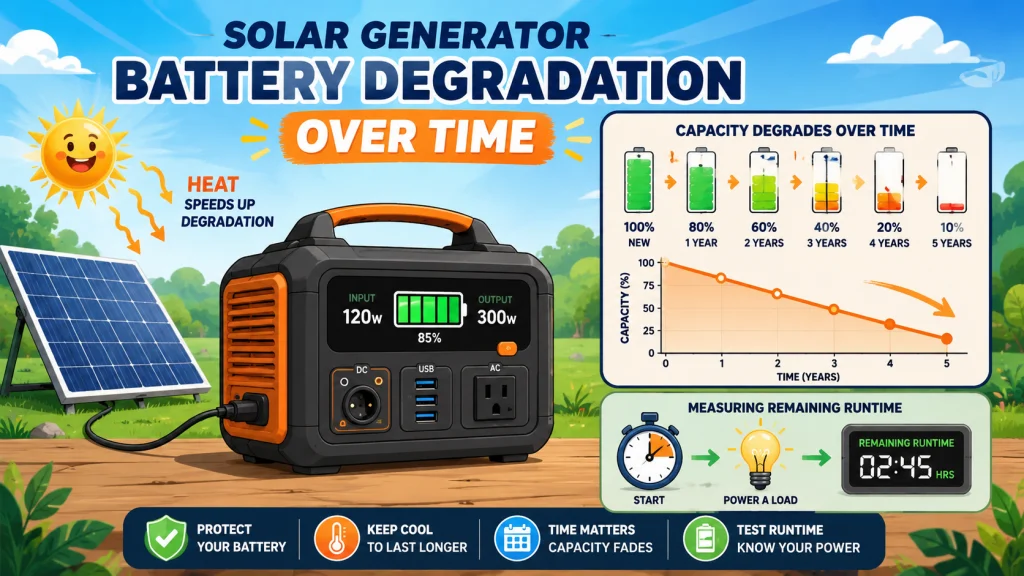
What Degradation Actually Looks Like
A battery does not stop working on a specific day. It holds slightly less charge after each cycle, which means slightly shorter runtime each session, accumulating slowly enough that most owners do not notice for the first year or two. The first signal is usually something like this: the fridge used to run all night on a full charge and now it shuts off at 4am. Or the CPAP used to last three nights without a recharge and now it struggles through two. Runtime has shortened, but the unit still works.
What is happening is straightforward. Each charge cycle causes minor structural changes in the electrode material. Over hundreds of cycles, those minor changes accumulate and the battery holds measurably less energy than it did when new. A 2,000Wh unit that has degraded to 80 percent of original capacity holds 1,600Wh. The same unit at 70 percent holds 1,400Wh. At 60 percent it holds 1,200Wh. Runtime decreases in direct proportion. That is not a guess, just arithmetic. For how these capacity thresholds translate into years of use for different types of owners, how solar generator battery lifespan works across all aging factors covers the full picture.
The BMS percentage display on the unit does not show you this directly. The display reads relative to current capacity, not original capacity. A degraded unit at “100 percent” has fully charged to whatever it can still hold, which may be 75 percent of what it held when new. The display is always accurate about how full the battery is right now. It is not designed to tell you how much the battery has shrunk. That requires a different test.
How Fast LiFePO4 Batteries Degrade Under Normal Use
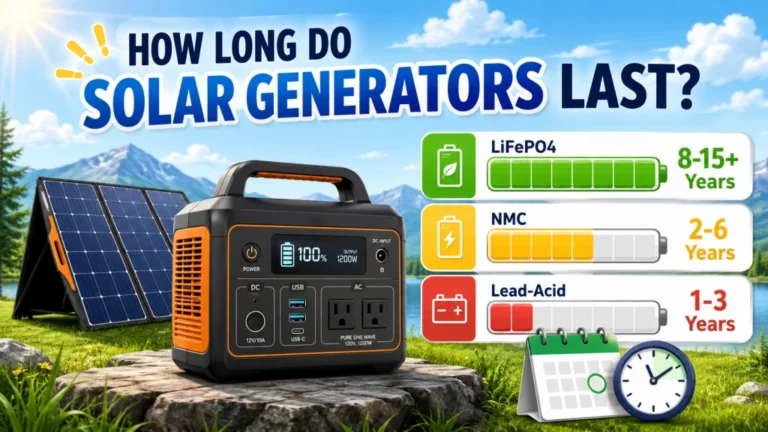
Under normal cycling conditions, LiFePO4 batteries, often shortened to LFP, lose roughly 0.7 to 1 percent of original capacity per 100 cycles. At that rate, reaching 80 percent of original capacity takes somewhere between 2,000 and 3,000 cycles. For a daily off-grid user accumulating about 290 cycles per year, that is between 7 and 10 years of normal use before hitting the warranty threshold. For a weekly camper at roughly 40 cycles per year, cycle wear matters far less to the purchase decision, though age, storage conditions, and heat still matter over the long term.
NMC lithium-ion batteries follow the same degradation pattern but hit 80 percent capacity much sooner, at 500 to 1,000 cycles under similar conditions. At 290 cycles per year, that is 2 to 3 years. The difference is not the mechanism but the rate. The same electrode changes that LFP chemistry resists are more damaging to NMC per cycle, which is why battery chemistry is worth checking before any purchase.
The numbers above assume normal operating conditions. Heat is the variable that changes everything. A unit stored or operated above 104 degrees Fahrenheit accelerates the chemical aging process well beyond the cycle-based rate. A portable solar generator left in a car in summer, or stored in a sun-exposed garage through July and August in a hot climate, can lose 10 to 15 percent of its original capacity from a single season of heat exposure, independent of how many cycles it has actually completed. That is the equivalent of two or three years of normal cycling compressed into a few months.
Field Note: The most common premature degradation I saw came from a single storage situation: the unit lived in the back of a truck bed or SUV cargo area during summer. People used it for weekend camping, threw it back in the vehicle on Sunday, and it sat in 110-to-120-degree heat all week until the next trip. After one or two summers of that, the runtime had dropped enough that the owner came back thinking something was defective. The common denominator was almost always heat from vehicle storage, not cycling. The fix for next time was storing indoors between trips, but there was no recovering the capacity already lost.

Weighing just 23.8 lbs with a foldable handle, this 1,070Wh LFP power station delivers 1,500W of pure sine wave AC output with a 3,000W surge capacity, capable of running AC units, fridges, and electric pots. Its LFP battery sustains over 70% capacity after 4,000 cycles, translating to a lifespan of more than 10 years. Via the Jackery App, you can enable a full charge in as little as one hour, or switch to a whisper-quiet 30 dB overnight mode. Six output ports including two USB-C with 100W PD charging cover nearly any device simultaneously.
Check On AmazonIf you click this link and buy, we earn a commission at no additional cost to you.
The Runtime Test That Tells You Exactly Where You Are
The BMS display tells you how full the battery is, not how large the battery currently is. To find out how much capacity your unit actually still has, you need to run it and time it. This test requires no special equipment beyond whatever appliance you use as the load and a clock. Here is the procedure:
- Choose a load with a known, stable wattage. A single incandescent or halogen bulb at its rated watts works well. An electric fan at its highest speed setting is another option. Resistive loads such as heating elements and simple bulbs are more stable than variable loads like compressor motors that fluctuate as they cycle on and off. The number needs to be consistent and verifiable from the spec on the appliance itself.
- Charge the unit fully to 100 percent, then let it sit for 15 minutes after charging completes. Some units continue balancing cells after the display reads 100 percent. A brief rest period gives the BMS time to settle.
- Start the load and note the time. Leave only this one load running. Do not charge any other devices. The goal is an isolated, known draw.
- Stop when the BMS display reaches 10 to 20 percent remaining, or when the unit shuts off from low battery protection. Note the elapsed time and the ending percentage. If you stop at 20 percent, you used 80 percent of the battery’s current capacity. If you stop at 10 percent, you used 90 percent. If the unit shuts off at low battery protection, you used nearly all of its available capacity.
- Calculate actual current capacity. Multiply elapsed hours by the load wattage, then divide by 0.85 for real-world inverter efficiency. Next, divide by the percentage of the battery you actually used. The result is roughly how many watt-hours the battery currently holds. Divide that number by the unit’s rated watt-hours to get a percentage of original capacity.
The math for a worked example: a 2,000Wh unit running a 200W load from 100 percent to 20 percent should take approximately 6.8 hours at normal efficiency when the battery is still close to original capacity. If it runs for only 5 hours, the actual energy delivered was 5 × 200 = 1,000Wh. Dividing by 0.85 gives roughly 1,176Wh used from the battery. Because the test stopped at 20 percent remaining, that 1,176Wh represents about 80 percent of the battery’s current capacity. Divide 1,176Wh by 0.80 and the current battery capacity is roughly 1,470Wh. Divide by 2,000 rated Wh: approximately 74 percent of original capacity remaining. That is meaningful degradation, but you now know the number rather than guessing from runtime impressions.
Key point: The formula is: (elapsed hours × load watts) ÷ 0.85 ÷ battery percentage used ÷ rated Wh = percent of original capacity remaining. If you run from 100 percent to 20 percent, battery percentage used is 0.80. If you run from 100 percent to 10 percent, battery percentage used is 0.90. Run this once when the unit is new to establish a baseline. The first result will typically come in below the nameplate number because real-world efficiency, BMS limits, and test conditions are never perfectly identical to lab conditions.

This 220V monitor handles up to 16 amps and reads down to 0.01W resolution at Class 1.0 accuracy, detecting loads as low as 0.20W to catch even standby draw. A backlit LCD with built-in memory retains cumulative kilowatt-hour data through power interruptions. Fire-retardant ABS housing and a 1-year warranty round out a reliable package.
Check On AmazonIf you click this link and buy, we earn a commission at no additional cost to you.
What Different Degradation Levels Mean for Runtime
The numbers below use a 2,000Wh unit as the reference point. Substitute your unit’s rated capacity to scale the same relationships proportionally. The 200W load represents a typical combined draw of a small refrigerator, a router, and LED lighting, which is a realistic home backup scenario.
| Capacity Remaining | Actual Storage | Runtime at 200W Load | Runtime at 75W Load (CPAP + lights) | Practical impact |
|---|---|---|---|---|
| 100% (new) | 2,000Wh | ~8.5 hrs | ~22.7 hrs | Baseline |
| 80% (warranty threshold) | 1,600Wh | ~6.8 hrs | ~18.1 hrs | Overnight fridge run may fall short. CPAP still fine for 2+ nights. |
| 70% | 1,400Wh | ~5.9 hrs | ~15.9 hrs | Overnight fridge run routinely falls short. Recharging mid-day becomes necessary. |
| 60% | 1,200Wh | ~5.1 hrs | ~13.6 hrs | Significant daily inconvenience for most home backup loads. |
| 50% | 1,000Wh | ~4.25 hrs | ~11.3 hrs | Unit now performs like a 1,000Wh class product. Most users find this threshold unacceptable. |
One thing the table shows clearly: degradation to 70 or 75 percent does not necessarily end the unit’s usefulness. For a CPAP backup or basic device charging, 70 percent capacity still covers most overnight scenarios comfortably. The threshold where degradation becomes functionally disruptive depends entirely on what the unit was originally sized for. A unit sized tightly for overnight fridge backup will fall short at 70 percent. The same unit used primarily for device charging and small loads will work acceptably at 60 percent.
The 80 Percent Warranty Threshold and What It Actually Triggers
Most solar generator manufacturers warrant 80 percent capacity retention at the rated cycle count. This means if a unit is rated at 3,000 cycles, the manufacturer is guaranteeing the battery will still hold at least 80 percent of its original capacity after 3,000 cycles under normal conditions. Below 80 percent is the trigger for a warranty claim, but only if the unit has not exceeded its rated cycle count and has been operated within the temperature limits.
The practical challenge with warranty claims for capacity degradation is measurement. Most manufacturers require documented evidence that the capacity is actually below threshold. The runtime test described above is your tool for generating that evidence. A time-stamped log of several runtime tests showing consistent results below expected values is far more useful than a subjective report that “the unit does not last as long as it used to.”
“The battery seems like it is not lasting as long as when it was new. Runtime feels shorter.”
“Baseline test in month 1: 200W load ran 8.1 hours from 100% to 15%. Test in month 18: same load ran 5.2 hours. Calculated capacity retention: approximately 63% of original. Unit is 18 months old with approximately 340 cycles.”
Running the baseline test when the unit is new produces the single most valuable data point you will ever have for warranty purposes. It takes only a few minutes to set up, but the actual test can take several hours depending on load size and battery capacity. Almost no buyer does this. The ones who do have an objective record if degradation becomes an issue.
When to Accept the Degradation vs When to Replace
The decision depends on what the unit is being used for and whether its reduced capacity still covers that use case. A unit that has degraded to 75 percent is still a useful product for most owners. It just needs to be recharged more often or powers fewer appliances simultaneously. Degradation at this level is normal for a unit that has seen genuine daily use over several years. Expecting a $1,000 battery to perform at full capacity indefinitely is not realistic for any chemistry.
A Slickdeals commenter in December 2025, discussing a large portable battery unit, summarized it this way: “unfortunately it needs to replace once every 5-plus years.” That is a reasonable expectation for a moderately heavy-use unit. It is not a product failure, just a technology with a finite service life. The timeline is accurate for NMC units at daily or near-daily use, and somewhat conservative for LFP at the same usage intensity. For lighter use, the same LFP unit often serves 10 years before the runtime reduction becomes genuinely inconvenient.
The replace-now threshold for most owners is somewhere around 50 to 55 percent of original capacity. At that point, what was a 2,000Wh unit is performing like a 1,000Wh unit. The inconvenience of recharging frequency outweighs the remaining value of the hardware. Below that level, replacement is the practical choice for anyone relying on the unit for serious home backup or daily off-grid use.
If your test shows the unit is degrading faster than expected for its age and cycle count, the most common cause is avoidable. Heat damage from storage conditions is responsible for a significant share of premature capacity loss. The habits that slow degradation from daily use are covered in the daily habits that extend solar generator battery life, and the storage rules that prevent heat damage are covered in how to store a solar generator to protect battery life.

Starting at 2kWh and expandable to 6kWh with two additional batteries, this LFP station reaches 80% in just 43 minutes via combined AC and solar input. Its 3,000-cycle battery outlasts the industry average by 6 times and includes a 5-year service guarantee. With 2,400W output across 15 outlets and X-Boost pushing to 3,400W, it handles 99% of household appliances at a whisper-quiet 30 dB.
Check On AmazonIf you click this link and buy, we earn a commission at no additional cost to you.
Final Thoughts: Measure It, Then Decide
The owners who get the most out of their units are the ones who run a baseline runtime test when the unit is new and repeat it every year or so afterward. That record tells them exactly what is happening to capacity over time, removes the guesswork from the “is this normal?” question, and gives them documentation if a warranty conversation ever becomes necessary.
Degradation is not a failure. It is the expected behavior of any electrochemical storage device. A unit at 75 percent of original capacity after several years of regular use is a product that is working exactly as designed. What matters is whether 75 percent of your original capacity still covers your use case, and that is a calculation you can make with the test above.
For the complete context of how degradation fits alongside cycle life, storage conditions, and daily use habits as the factors that determine total service life, how solar generator battery lifespan works across all aging pathways puts all three together. The complete solar generator guide covers how to factor expected lifespan into the initial purchase decision alongside watt-hours, output wattage, and battery chemistry.

At 1,024Wh with 2,000W continuous output and 3,000W peak, this station powers up to 10 devices at once across a full suite of ports. HyperFlash charging fills it in just 49 minutes via AC, or 1.8 hours with 600W of solar. The UPS switchover triggers in under 10 milliseconds, and the LiFePO4 battery holds 80% capacity after 4,000 cycles for a 10-year lifespan.
Check On AmazonIf you click this link and buy, we earn a commission at no additional cost to you.
FAQs
📉 How do I know if my solar generator battery is degrading?
The clearest signal is shorter runtime per session on the same loads. If the unit used to run your fridge through the night and now shuts off at 3am, that is runtime reduction. To measure how much capacity remains, run the unit under a known constant watt load and time it from 100 percent to 20 percent, then compare to the expected runtime from the original rated capacity.
🌡️ Can heat permanently damage a solar generator battery?
Yes. Storage or operation above 104 degrees Fahrenheit accelerates chemical aging significantly. A unit stored in a hot car or sun-exposed garage through summer can lose 10 to 15 percent of original capacity from heat alone, independent of how many cycles it has completed. That capacity loss is permanent.
🔋 What does 80 percent battery capacity mean in practice?
A 2,000Wh unit at 80 percent capacity holds 1,600Wh. At a 200W combined load, that is about 6.8 hours of runtime instead of the original 8.5 hours. The unit still works. It just runs shorter. Whether that matters depends on what loads you are powering and for how long.
⚖️ When should I replace my solar generator battery?
For most owners, the practical threshold is around 50 to 55 percent of original capacity. Below that point, what was a 2,000Wh unit performs like a 1,000Wh unit, and the recharging frequency becomes inconvenient enough that replacement makes more sense than continued use. Degradation to 70 to 75 percent is often still acceptable depending on use case.
📊 Does the battery percentage display show actual capacity remaining?
No. The display shows how full the battery is relative to its current capacity, not its original capacity. A degraded unit that reads 100 percent has charged fully to whatever it can still hold, which may be significantly less than when it was new. The runtime test is the only way to measure actual remaining capacity.
🏎️ Does LiFePO4 degrade faster than regular lithium-ion?
No, the opposite. LiFePO4 reaches 80 percent of original capacity at 2,000 to 3,000 cycles under normal conditions. NMC lithium-ion hits the same threshold at 500 to 1,000 cycles. Same degradation mechanism, significantly different rate. LFP chemistry lasts three to four times longer under equivalent cycling conditions.