Most Buyers Open the Box and Never Think About What Is Happening Inside
Understanding how solar generators work is not complicated, but most buyers skip it entirely. They plug in the panels, watch the battery percentage climb, and call it done. That approach works fine for charging a phone on a weekend camping trip. It does not work nearly as well when someone has spent $2,000 on a unit they expect to run a refrigerator through a three-day winter outage, and then finds out mid-outage that they fundamentally misread what the spec sheet was telling them. In my experience, the buyers who take even a few minutes to understand the technology make significantly better decisions at the point of purchase.
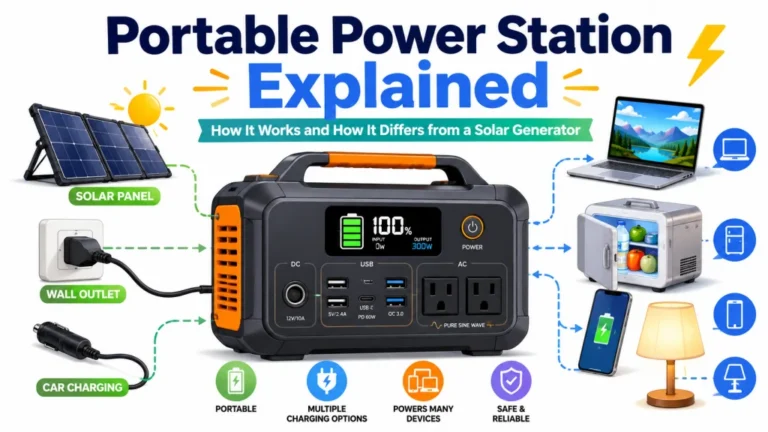
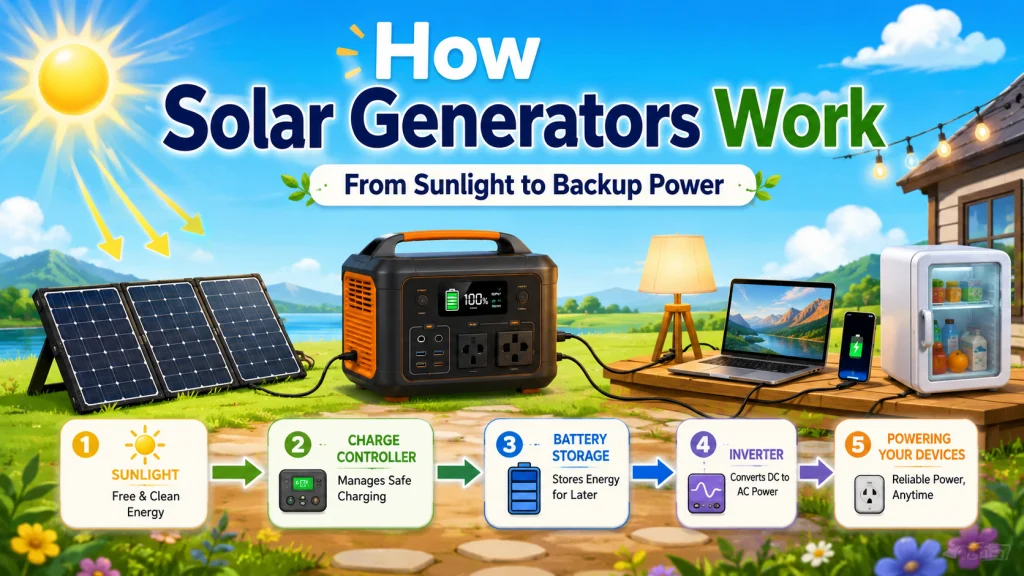
At its core, a solar generator is a battery with four components working together. Solar panels collect energy from sunlight and convert it to direct current electricity. A charge controller regulates how that electricity enters the battery, protecting the cells from overcharging and managing the charge rate. The battery stores the energy until you need it. The inverter converts the stored direct current into the alternating current that household appliances use. The full breakdown of what each component does and which specs actually matter to a buyer is in the guide on what a solar generator actually is.
| Component | What It Does | Why It Matters When Buying |
|---|---|---|
| Solar panels | Convert sunlight to DC electricity | Panel wattage combined with available sun hours determines recharge speed |
| Charge controller | Regulates energy flow into the battery | MPPT controllers are significantly more efficient than PWM, especially in low light |
| Battery | Stores energy for use on demand | Capacity in watt-hours and battery chemistry determine both runtime and how many years the unit lasts |
| Inverter | Converts stored DC to usable AC power | Output watts determine what you can run; inverter type determines what is safe to run |
One component that almost never appears in marketing materials is the charge controller. The difference between a quality MPPT controller and a basic PWM controller can mean a 20 to 30 percent difference in charging efficiency, particularly on overcast days, but you will not find that detail on the box. The full component breakdown is in the guide linked above.
The Spec That Actually Tells You How Long It Will Run
There are two wattage numbers on most solar generator spec sheets, and most buyers only pay attention to one of them. AC output watts is the big number, the one that ends up in product names and marketing headlines. It tells you the maximum rate of power the unit can deliver at any given moment. Watt-hours is the smaller number, usually listed further down the page. It tells you how much total energy is stored. These two numbers measure completely different things, and confusing them is the single most common sizing mistake I watched repeat at the counter, year after year.
Field Note: A buyer came in wanting to run a 1,500W space heater through the night. He had found a unit with “2000W” in the name and figured that covered it. The battery capacity was 500Wh. That heater ran for about 20 minutes before the unit shut down on low battery. The watts told him how fast power could flow. The watt-hours told him how much was available in total. Nobody had explained the difference before he bought the wrong unit.
The math for runtime is straightforward. Take the watt-hour capacity, multiply by roughly 0.85 to account for inverter conversion losses and real-world efficiency, then divide by the wattage of what you are running. A 1,000Wh unit running a 100W load gives you about 8.5 hours of runtime. The same unit running a 400W load gives you around two hours. Push it to an 800W continuous draw and you are looking at roughly one hour before the battery needs a recharge. The full explanation of how to calculate runtime for your specific use case, including where the efficiency losses come from and how depth of discharge affects the math, is in the guide on solar generator watt-hours explained.

This 1kWh LFP battery station charges from 0 to 80% in just 50 minutes via AC input, and its LiFePO4 chemistry delivers a 3,000 plus cycle lifespan that is roughly 6 times longer than standard lithium batteries. Capacity is expandable up to 3kWh with additional batteries, making it well suited for camping, RVs, or off-grid living. Its 1,800W output powers across 15 outlets, handling around 90% of household appliances, and accepts up to 500W of solar input for clean, fuel-free charging. The package includes a 5-year customer service guarantee.
Check On AmazonIf you click this link and buy, we earn a commission at no additional cost to you.
Why the Type of AC Output Changes What You Can Safely Plug In
Not all inverters produce the same quality of AC power. A pure sine wave inverter produces output that closely matches what comes from a household wall outlet: a smooth, continuous waveform. A modified sine wave inverter produces a stepped approximation of that waveform, which simpler resistive loads tolerate without issue but sensitive electronics often do not. This distinction does not affect whether the outlet powers on. It affects whether the device you plug into it stays healthy over time.
CPAP machines are the clearest example. Many medical devices are designed with clean, stable AC power in mind, and modified sine wave output can trigger error codes, reduce motor lifespan, or damage the internal power supply depending on the model. Modern laptops, televisions, and variable-speed power tools can have similar issues in extended use. Most quality solar generators sold today use pure sine wave inverters, so sensitive electronics are usually not a problem as long as the spec sheet confirms clean AC output. That is something worth verifying before purchase, not after. The full breakdown of which devices require clean AC output and how to confirm what a specific unit provides is in the guide on solar generator pure sine wave output.
What Happens When the Sun Goes Down
A solar generator does not stop working when the sun sets. The battery continues to deliver power to whatever is plugged in until the charge runs out. What stops is solar recharging. After dark, the unit runs entirely off whatever was stored during daylight hours. If you sized the battery correctly for your overnight load, that is a non-issue. If you did not, you will find yourself with a depleted unit at three in the morning and a refrigerator that needs to stay cold until the panels can begin recovering the charge at sunrise.
This is why watt-hours matter more than output watts when planning overnight use. A unit with a higher output rating but a smaller battery capacity will run out before sunrise. A unit sized to cover the actual overnight draw of your load will still have charge when you wake up. The full picture of how to plan overnight battery capacity for your specific situation is in the guide on whether solar generators work at night.

Weighing just 23.8 lbs with a foldable handle, this 1,070Wh LFP power station delivers 1,500W of pure sine wave AC output with a 3,000W surge capacity, capable of running AC units, fridges, and electric pots. Its LFP battery sustains over 70% capacity after 4,000 cycles, translating to a lifespan of more than 10 years. Via the Jackery App, you can enable a full charge in as little as one hour, or switch to a whisper-quiet 30 dB overnight mode. Six output ports including two USB-C with 100W PD charging cover nearly any device simultaneously.
Check On AmazonIf you click this link and buy, we earn a commission at no additional cost to you.
What Happens on Cloudy Days
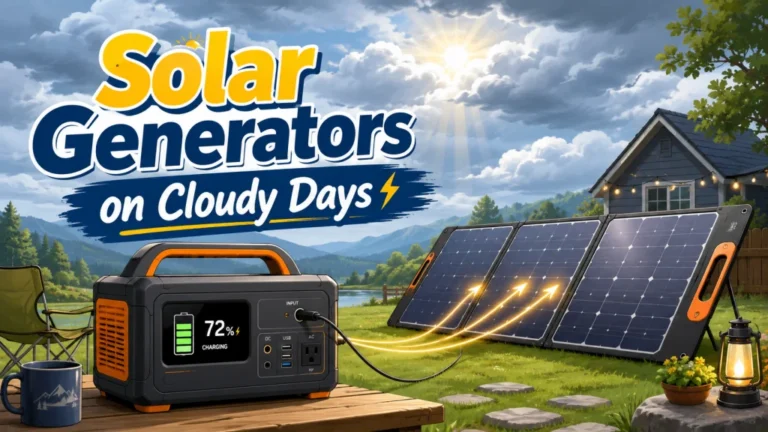
Solar panels still produce electricity in diffuse light, but at a fraction of their rated output. A 200W panel generating close to full capacity in direct summer sun might deliver 20 to 50 watts on a heavily overcast day, sometimes less depending on cloud density. That directly extends recharge time. A system that recovers from 20 percent to full in five hours of strong sun might need 15 to 20 hours of overcast sky to accomplish the same thing.
During extended low-sun periods, battery capacity matters more than panel wattage. The panels can only collect what the sky provides. The battery is what carries you through the gap. This is a point worth understanding before comparing units by solar input rating alone. The specifics of low-light panel performance and how to plan for multi-day overcast conditions are in the guide on how solar generators perform on cloudy days.
Whether Running One Indoors During a Power Outage Is Actually Safe
This question came up constantly in the shop, usually from people who had read something alarming about generators and carbon monoxide. The answer is direct: a solar generator produces no exhaust and no carbon monoxide. There is no combustion of any kind happening inside the unit. Running one indoors during a power outage does not expose anyone to the gas that kills people who run gasoline generators in enclosed spaces. That is one of the most practical advantages a solar generator has over fuel-burning alternatives.
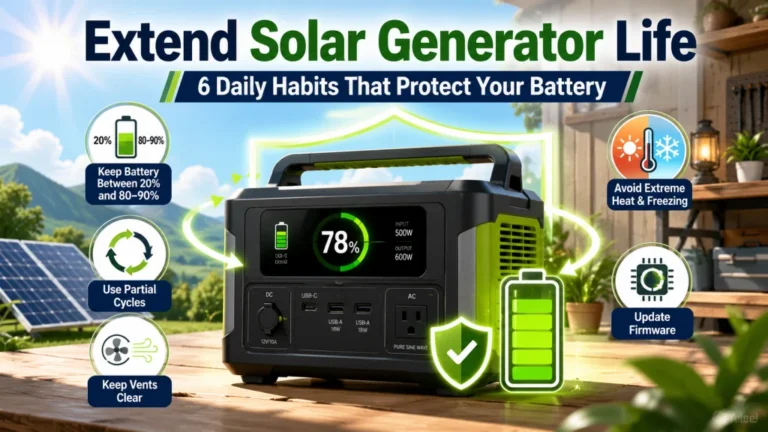
That said, indoor use is not entirely without considerations. Lithium batteries generate heat during heavy charging cycles, and the cooling fan runs to manage that temperature. Blocking the vents reduces airflow, increases cell temperature, and accelerates battery degradation over time. A few simple habits keep indoor operation straightforward:
- Keep several inches of clearance around all vents, particularly during active charging
- Do not place the unit inside a cabinet, closet, or enclosed space while it is operating
- Avoid setting it directly on carpet, which can restrict airflow from bottom-mounted vents
- Keep it away from flammable materials during extended charging sessions
None of these precautions are complicated. They are the same considerations you would apply to most electronics that generate meaningful heat under load. The complete breakdown of indoor safety considerations, including heat management specifics and how lithium battery chemistry compares to fuel alternatives on safety grounds, is in the guide on whether solar generators are safe to run indoors.

At 1,024Wh with 2,000W continuous output and 3,000W peak, this station powers up to 10 devices at once across a full suite of ports. HyperFlash charging fills it in just 49 minutes via AC, or 1.8 hours with 600W of solar. The UPS switchover triggers in under 10 milliseconds, and the LiFePO4 battery holds 80% capacity after 4,000 cycles for a 10-year lifespan.
Check On AmazonIf you click this link and buy, we earn a commission at no additional cost to you.
How a Solar Generator Relates to Rooftop Solar Panels
People sometimes assume a solar generator is just a portable version of a rooftop solar installation. The assumption is understandable and incorrect. A rooftop system is a permanent, grid-tied installation designed to offset your utility bill over a 20 to 30-year horizon. A solar generator is a portable, self-contained battery system designed to work independently of the grid. These are two different tools built for two different jobs, and the distinction matters considerably the moment the grid goes down.
A homeowner with a rooftop solar system and no dedicated battery backup will typically lose power during a grid outage, because grid-tied inverters are required to shut off automatically when the grid fails. This is a safety requirement that prevents back-feeding live power into utility lines while workers make repairs. It is not a design flaw. It is built into how the system operates by regulation. A homeowner with a properly sized solar generator keeps power flowing regardless of grid status. The two technologies can coexist, but they do not replace each other. The full comparison of what each system is designed to do and when each one is the right answer is in the guide on how solar generators compare to rooftop solar panels.
Three Numbers to Check Before You Start Comparing Models
Most buyers fixate on one spec and miss the other two entirely. Getting all three right upfront narrows the field quickly and filters out a lot of mismatches before they cost money. The three numbers that matter most, and what each one actually tells you, are:
- Watt-hours: how much total energy is stored. This determines how long the unit runs your specific load before needing a recharge.
- AC output watts: the maximum power the unit can deliver at one moment. This determines what you can run, and whether you can run multiple things at the same time.
- Solar input watts: the maximum charging rate from solar panels. This determines how fast the battery recovers during daylight, which matters most in multi-day use or extended outage situations.
A unit might look strong on watt-hours and output, then fall short on solar input and take two full days of sun to recover from a single overnight draw. I always look at all three together before making any sizing recommendation. Once you have those three numbers matched against your actual use case, the right capacity range becomes much clearer.

At just 41.7 lbs and measuring 18.1 by 9.8 by 10.1 inches, this station is 25% lighter and 29% more compact than comparable units while still delivering 2,400W of continuous output and 4,000W peak power, enough to run window and RV air conditioners. It charges to 100% in as little as 58 minutes via combined AC and solar, or to full in 3 hours through alternator charging at 8 times the speed of a standard car socket. Standby draw of only 9W keeps a dual-door fridge running for up to 32 hours, and capacity expands to 4kWh with an optional battery for up to 64 hours of refrigeration runtime.
Check On AmazonIf you click this link and buy, we earn a commission at no additional cost to you.
Final Thoughts: The Technology Picture Before the Buying Decisions Start
From what I have seen, most solar generator regrets trace back to a purchase made without a clear picture of what the technology does and does not do. The three specs above are the starting point. The guides linked throughout go deeper on each piece with actual numbers and the specifics that do not fit in an overview. If you want the full scope before going further, including how solar generators compare to gas generators and the meaningful difference between a solar generator and a portable power station, the complete solar generator guide covers all of that in one place.

This 220V-compatible energy monitor handles up to 16 amps and measures consumption down to 0.01W, 0.01V, and 0.001A resolution at Class 1.0 accuracy. It detects loads as low as 0.20W, making it sensitive enough to track standby draw on any device. A backlit LCD with memory retention keeps cumulative kilowatt-hour data even through power interruptions, and the fire-retardant ABS housing ships with a 1-year warranty.
Check On AmazonIf you click this link and buy, we earn a commission at no additional cost to you.
The Full Guides for Each Topic Covered Here
Most sections above are introductions to deeper guides. The table below collects those full guides in one place.
| Guide | What It Covers |
|---|---|
| What Is a Solar Generator | The full component breakdown, how each part works together, and why the marketing name does not match the actual technology |
| Solar Generator Watt-Hours Explained | How to calculate real runtime from your specific appliance draw, where rated capacity diverges from usable capacity, and how to size for overnight use |
| Solar Generator Pure Sine Wave | Which devices require clean AC output, what modified sine wave does to sensitive electronics over time, and how to verify inverter type before buying |
| Do Solar Generators Work at Night | How to plan battery capacity for overnight loads and what happens when stored power runs short before morning recharging begins |
| Do Solar Generators Work on Cloudy Days | Real panel output numbers in diffuse light and what extended overcast periods mean for recharge planning and backup duration |
| Are Solar Generators Safe Indoors | Indoor safety specifics, ventilation and heat management during charging, and how the absence of combustion changes the risk profile entirely |
| Solar Generator vs Solar Panels | Why grid-tied rooftop systems and portable battery systems are built for different problems, and why a rooftop installation does not replace portable backup power |
If you are still deciding where to start, the watt-hours guide tends to be the most immediately useful for anyone in the pre-purchase comparison phase. That is the number most buyers get wrong first.
FAQs
⚡ How does a solar generator actually work?
Solar panels convert sunlight to DC electricity, which a charge controller feeds into the battery. When you plug in an appliance, the inverter converts stored DC to the AC power your devices use. The sun recharges the battery; the battery powers your load.
🔋 What is the difference between watts and watt-hours on a solar generator?
Watts tell you how fast power can flow at any given moment. Watt-hours tell you how much total energy is stored. A 2,000Wh unit can run a 200W appliance for roughly 10 hours. Most buyers focus on the output watt number. The watt-hour number is the one that determines whether the battery lasts through the night.
🏠 Can I run a solar generator inside my house?
Yes. A solar generator produces no exhaust and no carbon monoxide. It is safe indoors as long as there is clearance around the vents during active charging. This is the primary safety advantage over gas generators, which cannot be operated in any enclosed space.
☁️ Do solar generators still work when it is cloudy?
The battery continues to run your devices regardless of weather. Solar panels still produce output in diffuse light, but heavy overcast conditions often reduce output to roughly 10 to 25 percent of rated capacity. Recharge time increases significantly, which is why battery capacity matters more than panel wattage in extended low-sun conditions.
🌙 Does a solar generator keep running after dark?
Yes. After dark the unit runs off stored battery charge until depleted. Solar recharging stops when usable light is gone. How long it lasts depends on the watt-hour capacity and the combined draw of everything plugged in.
🔌 What is pure sine wave and does it matter for my devices?
Pure sine wave describes the quality of AC output the inverter produces. CPAP machines, modern laptops, and televisions generally require it. Modified sine wave is a rougher approximation that simpler appliances tolerate but sensitive electronics often do not, particularly over extended use.
🏡 Is a solar generator the same as having rooftop solar panels?
No. Rooftop solar is a permanent grid-tied system designed to reduce utility bills. A solar generator is a portable battery that works independently of the grid. A standard rooftop installation will not keep your power on during a grid outage without additional battery storage and a transfer switch.