What the Marketing Leaves Out About Solar Generator Limitations
The disadvantages of solar generators are not buried in fine print. They are just things the brands have very little incentive to lead with. From what I’ve seen selling these units at the counter and running my homestead entirely on one, the buyers who understand the limitations before they buy are consistently more satisfied than the ones who absorbed the marketing and filled in the gaps with optimism. Most of the post-purchase problems I watched play out were predictable. Almost all of them were avoidable with a clearer picture going in.
This is that clearer picture. I am not going to soften the limitations or pivot to a product recommendation at the end. The honest look at where solar generators fall short is, in my experience, far more useful to a buyer than another article leading with how great they are for camping and emergency prep.
The Runtime Ceiling: When the Battery Is Gone, It Is Gone
Gas generators run as long as you can supply them fuel. A solar generator runs until its battery is empty, and nothing about the marketing changes what that fundamental ceiling means in practice. A 2,000Wh unit running a 200W combined load, say a refrigerator, router, and a few lights, delivers roughly 8 to 9 hours of usable runtime before hitting the reserve level where you should stop drawing. When it is depleted, your options are a wall outlet or waiting for the next day’s sun.
The ceiling itself is not the problem. The problem is that buyers often do not think through their actual outage history against a real watt-hour number before purchasing. A 2,000Wh unit handles a 12-hour outage for most essential loads with room to spare. It does not handle a 48-hour outage with two cloudy days unless there is a recharging strategy in place beyond solar panels alone. The unit is not failing to perform. The purchasing decision failed to account for what fully discharged means in a real outage scenario.
Field Note: The most common return I handled at the shop was not a defective unit. It was a buyer who watched a demonstration video showing what looked like a fully powered kitchen setup, bought the unit, and then discovered the “kitchen test” in the video had run a coffeemaker for six minutes. What they actually needed was refrigerator runtime through a 72-hour grid failure. The unit was not wrong for the job. The research phase was wrong for the unit.

Starting at 2kWh and expandable to 6kWh with two additional batteries, this LFP station reaches 80% in just 43 minutes via combined AC and solar input. Its 3,000-cycle battery outlasts the industry average by 6 times and includes a 5-year service guarantee. With 2,400W output across 15 outlets and X-Boost pushing to 3,400W, it handles 99% of household appliances at a whisper-quiet 30 dB.
Check On AmazonIf you click this link and buy, we earn a commission at no additional cost to you.
The High-Draw Appliance Wall Most Buyers Hit Unprepared
Portable solar generators under $3,000 typically cap at 2,000 to 4,000 watts of continuous AC output. That sounds substantial. It is not, for several common household appliances that buyers regularly assume are covered. This is one of the solar generator problems that brand content consistently avoids addressing in specific terms, because the specific terms make clear that portable units have a hard output ceiling.
| Appliance | Typical Draw | Runs on Most Portable Units? |
|---|---|---|
| Central air conditioner | 3,500 to 5,000W | No. Exceeds continuous output capacity. |
| Electric dryer | 5,500W | No. Exceeds continuous output capacity. |
| Electric range or oven | 5,000 to 7,000W | No. Exceeds continuous output capacity. |
| Electric water heater | 4,000 to 4,500W | No. Exceeds continuous output capacity. |
| Small window AC unit | 900 to 1,400W | Possible, but depletes capacity fast. |
| Refrigerator | 100 to 200W average | Yes, comfortably. |
| CPAP machine | 30 to 60W | Yes, with minimal draw. |
| Router and modem | 10 to 20W | Yes. |
The pattern becomes clear once you lay it out side by side. Solar generators handle the essential loads of modern life during a power outage well. They cannot replace a whole-home backup system. This is not something next year’s model will fix, because it is not a product flaw. It is the physics of portable battery storage. If central HVAC, an electric dryer, or a range is required during an extended outage, a portable solar generator is not the solution at any price point under $3,000. A whole-home battery system or a gas generator sized for those specific loads is what the situation actually requires.
The buyers I saw most frustrated with a purchase were the ones who had read phrases like “runs most home appliances” in the marketing and assumed that included their primary heating or cooling system. It does not, and understanding that load wall before buying prevents the most common expensive disappointment in this product category.

This wall plug monitor tracks power, voltage, amperage, frequency, power factor, energy consumption, and cost across 7 display modes, making it easy to identify high-energy appliances and reduce your electricity bill. Built-in overload protection alerts you with a visual warning and audible alarm when usage exceeds 1,800W. A data memory function retains your consumption history even after unplugging or during sudden power failures, so your records are never lost. The large LCD screen keeps all readings clear and easy to read at a glance.
Check On AmazonIf you click this link and buy, we earn a commission at no additional cost to you.
Solar Input: The Spec Sheet and the Driveway Are Different Places
Rated Panel Output vs. What You Actually Get
Rated panel wattage is tested under controlled lab conditions: a specific temperature, a specific irradiance level, no shading, and optimal panel angle. These conditions are achievable in a testing facility. In a driveway or at a campsite, they are rarely all present simultaneously. A 200W panel set at a sub-optimal angle, partially shaded by a tree or roofline, on a day that is bright but hazy, may realistically produce 60 to 120W rather than the rated 200W. Charging time extends proportionally, often 1.5 to 2.5 times longer than the spec sheet number.
This is not a deceptive practice. Rated output is a standardized measurement that allows consistent comparison across panel products. But the spec sheet does not explain what that number means in your location with your specific setup. Panel angle, shade from structures or vegetation, cable run length, panel surface temperature, and time of day all factor into actual output. If the marketing says “charges in 10 hours with included solar panels,” planning for 14 to 18 hours under typical real-world conditions is a more accurate expectation.
Three Consecutive Cloudy Days: The Scenario Brands Avoid Mentioning
This is the solar generator limitation I raised most consistently with customers in certain regions, and the one I see almost entirely absent from brand content. On overcast days, solar panels deliver 10 to 25 percent of rated output. On heavy cloud and rain days, sometimes less. If your recharge strategy depends entirely on solar panels and you face three to five consecutive overcast days in winter, a 2,000Wh battery that handles each overnight draw becomes progressively depleted across those days, with only partial recharge happening during each dim daylight window. By day three, available capacity is meaningfully lower than where you started.
This is a real planning problem for buyers in the Pacific Northwest, the Great Lakes region, and northern states during winter months. The fix is practical: every quality solar generator also accepts AC wall charging, which means one short wall charge during a multi-day cloudy stretch maintains a usable buffer. But that solution requires knowing the problem exists before the cloudy week arrives. If you are weighing solar against gas specifically for reliability through extended or weather-uncertain outages, the full solar vs gas generator comparison covers this reliability gap alongside every other angle where each type wins and where each falls short.
Energy Density: Liquid Fuel Still Wins Per Pound Carried
A 2,000Wh solar generator weighs between 40 and 65 pounds depending on the model. Two gallons of gasoline weigh approximately 15 pounds and deliver roughly 8,000 usable watt-hours when run through a typical small portable generator at moderate load. Per pound carried, liquid fuel stores substantially more usable energy than a lithium battery pack. That gap has narrowed over time as battery chemistry has improved, but it has not closed, and it is unlikely to close fully given the physics involved.
For home backup use, where the unit sits in a storage room between outages, the weight difference is completely irrelevant. For car camping, where total load weight is not a primary constraint, it rarely matters either. The weight becomes a real downside of solar generators only for applications where energy per pound is genuinely constraining: remote trail use, long-distance travel without vehicle storage, or any scenario where you are counting what you carry. The use case either makes this limitation meaningful or eliminates it entirely. Most buyers in the home backup and car camping categories will never notice the gap. The few buyers in genuinely weight-constrained field situations should go in knowing this number before committing to the product category.

Built with IBC cells at 25% conversion efficiency, this bifacial panel absorbs sunlight from both sides and bends up to 221 degrees to conform to curved surfaces like car roofs and balconies. At just 4.52 lbs it is 56% lighter than rigid panels, and IP68 waterproofing plus IEC TS 63163 certification across 19 international tests ensure reliable output from -40 to 85 degrees Celsius. A 3-meter flat cable enables flexible installation in under 5 minutes.
Check On AmazonIf you click this link and buy, we earn a commission at no additional cost to you.
Upfront Cost Per Watt-Hour: The Premium Is Real and Does Not Disappear Quickly
Solar generators cost more per stored watt-hour at purchase than gas generators, and the gap is not small. A reasonable estimate across current portable units puts the solar capital cost at $0.40 to $0.75 per watt-hour of stored battery capacity. A gas generator in the same general output range runs $300 to $600 upfront, a meaningfully lower entry price. The comparison does not end there. Running a portable gas generator 100 hours a year at half a gallon per hour and $3.50 per gallon costs roughly $175 in fuel annually, around $875 over five years before factoring in oil changes, spark plugs, and carburetor cleaning. Solar has none of those recurring expenses. The gap narrows as actual use accumulates, but the break-even depends entirely on how often the unit gets used.
A buyer running a solar generator through forty or fifty uses per year, combining outages and camping trips, reaches a cost break-even with gas within a few years. A buyer who uses it twice in emergencies and stores it otherwise does not recover the premium within any realistic time horizon. Neither situation is a reason to avoid the purchase on principle. Both are a reason to be honest about your actual use frequency before committing to a premium-tier unit. In my experience, the buyers most likely to regret the cost were the ones who bought up in capacity for scenarios they then rarely faced. The ones most consistently satisfied were the ones who sized accurately against their real use pattern rather than the worst-case scenario they imagined at the point of purchase.

Weighing just 23.8 lbs with a foldable handle, this 1,070Wh LFP power station delivers 1,500W of pure sine wave AC output with a 3,000W surge capacity, capable of running AC units, fridges, and electric pots. Its LFP battery sustains over 70% capacity after 4,000 cycles, translating to a lifespan of more than 10 years. Via the Jackery App, you can enable a full charge in as little as one hour, or switch to a whisper-quiet 30 dB overnight mode. Six output ports including two USB-C with 100W PD charging cover nearly any device simultaneously.
Check On AmazonIf you click this link and buy, we earn a commission at no additional cost to you.
Which of These Solar Generator Cons Actually Apply to Your Situation
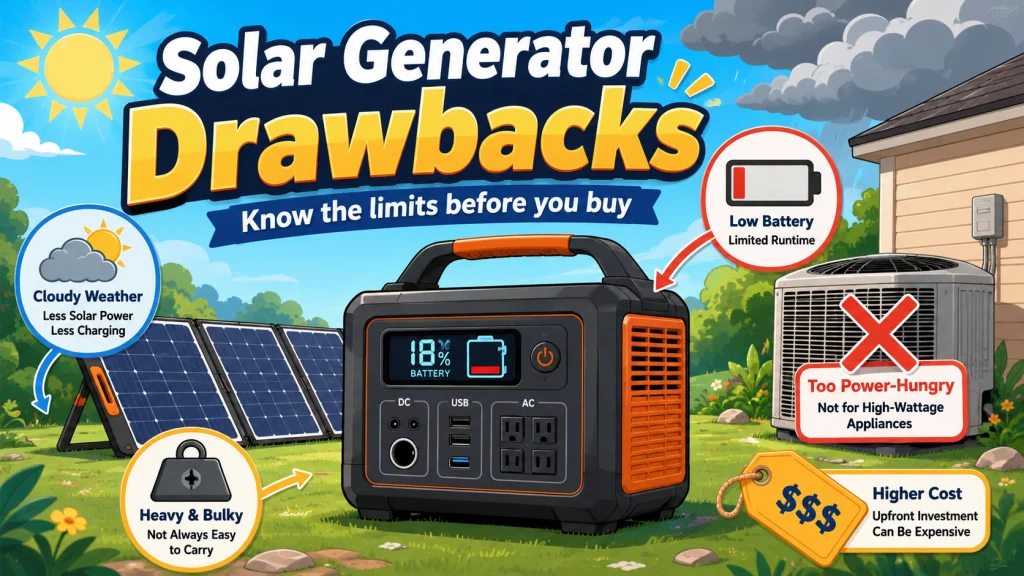
Laid out together, these six limitations can look like a strong case against the product. They are not. They are a case for buying with a clear picture of your actual use case rather than the marketing’s version of it. Most of these constraints are irrelevant for the most common buyer situations. Essential load backup during 12 to 48-hour outages, weekend camping and outdoor power, CPAP overnight backup, and device charging away from the grid are all well within what a properly sized solar generator handles comfortably. The runtime ceiling, weight, and cloudy day vulnerability simply do not register in those situations.
The limitations become meaningful in a specific and smaller set of scenarios.
- Extended off-grid living without supplemental AC charging during multi-day cloud cover periods, particularly in winter-dark or consistently overcast climates
- Running central HVAC, electric dryers, electric ranges, or water heaters during outages, since these loads exceed the output ceiling of portable solar units
- Emergency prep for week-long outages in climates where extended cloud cover or sub-freezing temperatures are normal winter conditions and no wall outlet access is available
- Buyers calculating return on investment against infrequent use, where the upfront cost premium may not recover against fuel and maintenance savings within any realistic timeframe
- Weight-constrained applications such as remote trail use where energy density per pound is the primary constraint rather than convenience or noise
Before you buy, check these five things: Add up the continuous watts of your essential loads. Note which appliances have a motor startup surge. Calculate the total watt-hours you need across 8, 12, or 24 hours. Ask whether your area regularly sees three or more consecutive cloudy days in winter. Identify where you can plug in for a wall charge if solar falls short. Those five answers will tell you the capacity you actually need and whether any of the limitations above are going to affect you in practice.
If your situation appears in that list, a solar generator is either not the complete solution or not the right one for your specific case. If it does not appear in that list, these limitations are unlikely to affect you in practical use. The complete solar generator buyer guide covers how to size correctly and match features to actual use cases, which is the practical next step once you have an honest picture of what these units cannot do.

At 1,024Wh with 2,000W continuous output and 3,000W peak, this station powers up to 10 devices at once across a full suite of ports. HyperFlash charging fills it in just 49 minutes via AC, or 1.8 hours with 600W of solar. The UPS switchover triggers in under 10 milliseconds, and the LiFePO4 battery holds 80% capacity after 4,000 cycles for a 10-year lifespan.
Check On AmazonIf you click this link and buy, we earn a commission at no additional cost to you.
Final Thoughts: Knowing the Limits Before You Buy Beats Discovering Them After
After all of that, here is where I actually stand. I run my homestead on a solar generator and I continue to recommend them to the right buyer. The disadvantages I’ve covered here are real. They are also, for the majority of buyers, not the limitations that will determine whether the purchase was a good decision. For short to medium outages running essential loads, for camping and outdoor power without the noise and fuel logistics of gas, and for apartment or indoor-use situations where a gas generator is simply not an option, these units perform exactly as needed.
The buyer who comes in knowing the limitations ends up with the right unit at the right capacity. Understanding what solar generators cannot do is not a reason to avoid them. For most buyers, it is precisely the information that makes the difference between a purchase they are satisfied with for years and one that gets returned or sits unused in a garage.
FAQs
🔌 Can a solar generator run a central air conditioner?
No. Central air conditioners typically draw 3,500 to 5,000 watts continuously, which exceeds the output capacity of any portable solar generator under $3,000. A solar generator can run a small window AC unit in some configurations, but powering central HVAC requires a purpose-built home battery system or a gas generator sized specifically for that load.
⛅ What happens when a solar generator runs out of power and there is no sun?
You recharge via AC wall outlet. Wall charging is the fastest recharge method available on most solar generators and bypasses the solar dependency entirely. Most units reach full capacity from a wall outlet in 1 to 3 hours depending on battery size and input wattage. Planning for wall charging access during multi-day cloudy stretches is the practical solution for buyers in high-cloud regions.
💰 Why are solar generators so much more expensive than gas generators?
The cost reflects the price of lithium battery cells, inverter electronics, and charge controller components packaged in a certified enclosure. Lithium cell costs have dropped substantially over the past decade but still price out at $0.40 to $0.75 per stored watt-hour for quality units. Gas generators cost less upfront because combustion converts fuel to power on demand rather than storing energy in battery cells first.
🌧️ Are solar generators practical in cloudy climates or during winter?
Yes, with planning. Cloudy day solar output typically runs 10 to 25 percent of rated panel wattage, which means recharge times extend significantly. Buyers in high-cloud regions who combine solar panels with a wall charging strategy during extended overcast periods generally find the units practical year-round. Buyers who plan to rely exclusively on solar recharging through dense winter cloud cover without any AC backup access will run into real capacity constraints by day two or three.
⚡ Can a solar generator power a whole house during an outage?
Not in the way most buyers imagine. A portable solar generator handles essential loads well: refrigerator, router, lights, CPAP, and device charging. It cannot run central HVAC, electric ranges, electric dryers, or electric water heaters. Running a whole home through an extended outage requires a purpose-built home battery system, which is a different product category at a significantly higher price point.
🔋 Does the battery in a solar generator wear out over time?
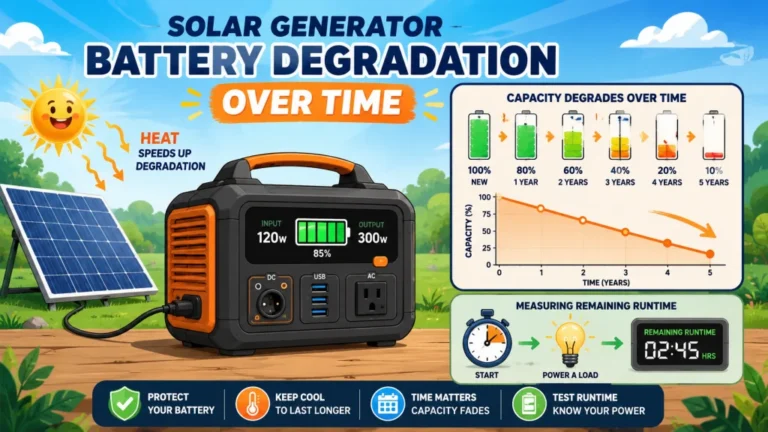
Yes, gradually. LiFePO4 batteries, the chemistry found in most current quality portable units, degrade slowly. Most reach 80 percent of original capacity after 2,000 to 3,000 full cycles, which translates to many years of regular use for the majority of buyers. A unit used for emergency prep a few dozen times per year may go a decade or more before capacity loss becomes noticeable during normal use. Daily off-grid cycling reaches that threshold sooner.
⚖️ Is the weight of a solar generator a problem for portability?
For home backup and car camping use, no. A 2,000Wh unit weighing 40 to 60 pounds stays in a storage room or the back of a vehicle and the weight is rarely a factor. For remote trail use or any application where you are carrying the unit on foot over distance, yes. Energy per pound still favors liquid fuel, and buyers in genuinely weight-constrained field situations should factor this into the decision.