Start Here: Your Situation Determines Everything
From what I have seen, the most consistent mistake buyers make is picking a unit before they have answered a basic question: what are you running, and for how long? It sounds obvious. It is not. After selling these units at the counter and watching buyers come back with the wrong purchase, I can say this mismatch is more common than any spec error. A unit that handles a camping weekend perfectly will not keep a refrigerator alive through a two-day outage. I run my homestead entirely on solar now, so I have seen both sides of that gap up close.
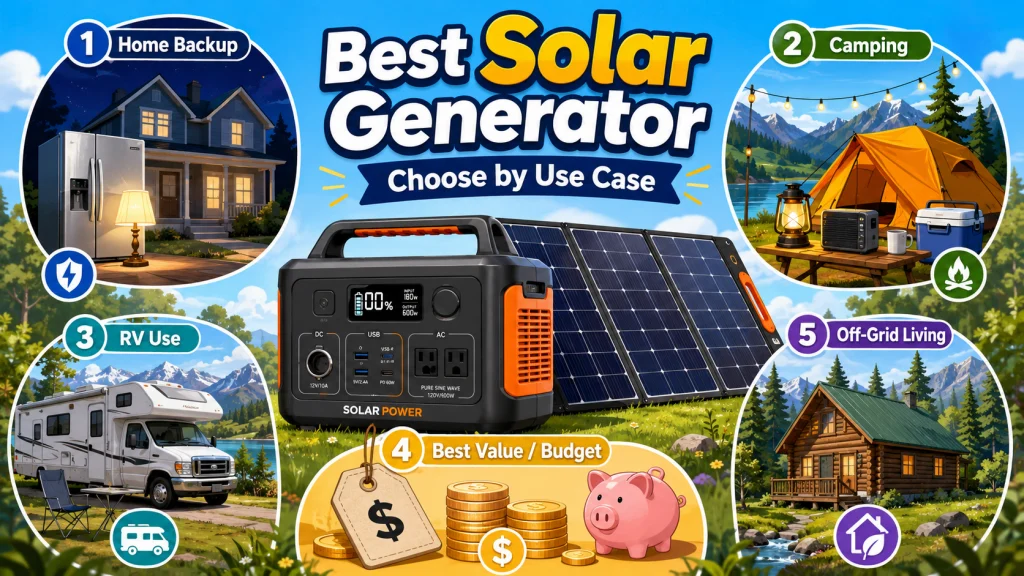
Unlike a typical best solar generator review that opens with a ranked product list, this guide starts with the use case. That is the only filter that matters at this stage. The table below gives you the quick version. Find your situation, check what to prioritize and what mistake to avoid, then follow the link for the full breakdown.
| Your situation | Priority focus | Most common mistake |
|---|---|---|
| Keeping the fridge alive during outages | Usable Wh, inverter surge output, recharge plan | Buying based on watts without checking watt-hours or surge rating |
| Camping trips | Weight, solar input ratio, how far you carry it | Buying a heavy home-backup unit that never leaves the truck |
| RV use without shore power | AC requirement, continuous output, pure sine wave | Assuming any 2,000Wh unit can run the rooftop AC |
| Best value for the budget | Wh per dollar, battery chemistry, realistic use case | Buying the cheapest unit for a use case it cannot handle |
| Off-grid power | Daily Wh consumption, panel input, cloudy-day buffer | Sizing for a perfect sunny day with no contingency plan |
The sections below go one level deeper on each situation. If you already know where you land, skip straight to that section and follow the link to the full guide.
Home Backup: The Fridge Is the Starting Point, Not the Ending Point
For most homeowners, the central question is whether they can keep the refrigerator running through an outage. The math is not complicated, but the marketing makes it easy to get wrong. A modern fridge draws 100 to 200 watts on average, but the compressor surges to 350 to 600 watts at startup. A unit whose inverter cannot handle that surge will trip every time the compressor kicks on. The fridge goes off, you assume the generator failed, but what actually failed was the sizing. This is the most common single mistake I have watched repeat across home backup purchases.
Once you get past the fridge, home backup splits quickly by sub-situation: CPAP users, sump pump owners, and work-from-home setups that cannot drop for even a second all have different minimum specs. The recharge strategy for day two and day three matters as much as what the battery holds on day one. Your first filter here is not brand or price. It is usable Wh, inverter surge rating, and whether you have a plan to recharge if solar is not available. The home backup solar generator guide breaks down all five sub-situations and what unit class fits each one.

Starting at 2kWh and expandable up to 6kWh with two additional batteries, this LFP power station reaches 80% charge in just 43 minutes when combining AC and up to 1,000W of solar input. Its LiFePO4 battery is rated for 3,000 cycles before dropping to 80% capacity, which is 6 times the industry average, and it ships with a 5-year service guarantee. Across 15 outlets it delivers 2,400W of continuous output, with X-Boost mode pushing that to 3,400W to handle high-wattage appliances, covering 99% of household devices. Noise levels start at just 30 dB, and the EcoFlow app adds remote monitoring, automations, and energy management.
Check On AmazonIf you click this link and buy, we earn a commission at no additional cost to you.
Camping: Weight and Recharge Speed Beat Raw Capacity
Camping buyers prioritize differently, and the gap matters more than most people expect before they buy. Capacity still counts, but the weight of the unit and how fast it recharges from panels during the day shape whether it actually works in the field. A 45-pound unit is fine in a truck for car camping. It is a problem if you are hauling gear from a parking lot to a site. This is not an edge case. It is a common mismatch. I watched it play out at the counter more than any other camping purchase mistake.
Camping also breaks down by style. The best portable solar generator for car camping is not the right unit for backpacking, van life, or a weekend festival. Your first filter here is not battery size. It is weight tolerance and solar input ratio. A unit that accepts 200 watts of solar input recovers overnight spend faster than the same capacity capped at 100 watts, and on a multi-day trip that difference can decide whether the setup actually works. If this is your situation, start by filtering for weight class and maximum solar input before you look at anything else. The camping solar generator guide routes by camping style first, then covers what unit class fits each one.
RV Use: The Air Conditioner Is the Variable That Changes the Whole Budget
RV buyers run into a problem that does not exist in most other use cases: the rooftop air conditioner. A standard RV AC unit draws 1,200 to 1,800 watts continuously and surges to 2,500 to 3,500 watts at startup. Most smaller units lack either the inverter surge capacity or the battery runtime to run it reliably. If cooling is a hard requirement, the unit class jumps significantly. If you can live without the AC and just need to run lighting, devices, and a small appliance without shore power, the spec requirements drop considerably.
The second variable worth knowing before you shop: any solar generator running sensitive electronics or modern appliances in an RV needs to produce a pure sine wave output. Modified sine wave units cause problems with variable-speed motors and some chargers. Your first filter here is whether AC is a requirement or a nice-to-have, and then whether your connection setup runs through the shore power inlet or direct plug-in. If AC is non-negotiable, start by filtering for inverter surge rating and continuous output before you look at battery capacity. The RV solar generator guide covers the 30-amp versus 50-amp question and what continuous output is realistically needed if you want to run the AC.

At just 41.7 lbs and measuring 18.1 by 9.8 by 10.1 inches, this station is 25% lighter and 29% more compact than comparable units while still delivering 2,400W of continuous output and 4,000W peak power, enough to run window and RV air conditioners. It charges to 100% in as little as 58 minutes via combined AC and solar, or to full in 3 hours through alternator charging at 8 times the speed of a standard car socket. Standby draw of only 9W keeps a dual-door fridge running for up to 32 hours, and capacity expands to 4kWh with an optional battery for up to 64 hours of refrigeration runtime.
Check On AmazonIf you click this link and buy, we earn a commission at no additional cost to you.
Best for the Money: What the Price Tiers Actually Buy You
The best solar generator for the money is not the cheapest option. It is the one where the specs you are paying for match the specs your use case actually needs. Buying one tier below what the situation requires is one of the most consistent mistakes I have seen. A buyer who needs 2,000Wh for home backup will not find it in the sub-$500 category, and no sale pricing changes that math. The market breaks into three rough tiers, and each one delivers meaningfully different capability.
| Price tier | Typical capacity | Battery chemistry | Best fit |
|---|---|---|---|
| Under $500 | 300 to 1,000Wh | NMC or LFP, varies by model and sale pricing | Camping, device charging, light emergency backup |
| $500 to $1,500 | 1,000 to 2,000Wh | NMC or LFP, varies by brand | Camping with appliances, moderate home backup |
| $1,500 and up | 2,000Wh and above | LFP standard in this range | Home backup, RV with AC, off-grid setups |
Battery chemistry matters beyond the price point. LFP batteries are typically rated for 2,000 to 3,000-plus charge cycles before meaningful degradation. NMC chemistry common in lower-priced units usually tops out at 500 to 800 cycles. If you plan to cycle the unit regularly, the LFP premium pays for itself. Your first filter here is what use case you are buying for, then what Wh class that requires, and then where the chemistry falls within your budget. The value-focused solar generator guide breaks down where the tradeoffs actually land at each price point.
Off-Grid: Knowing Where Portable Solar Ends and a Real System Begins
Off-grid is the use case where buyers most often overestimate what a portable solar generator can do. I run my homestead entirely on solar, so I am not skeptical of the category. But the line between where portable solar is enough and where it is not comes down to one number: daily watt-hour consumption. A well-designed seasonal cabin on a propane-solar hybrid setup can run comfortably on a capable 3,000Wh LFP unit with adequate panel input. A year-round property with an electric water heater and central air conditioning cannot. The daily load gap is too large and no portable unit closes it.
Field Note: The pattern I have watched repeat in the off-grid category is buyers who size for a perfect sunny day and never account for three cloudy days in a row. The system works fine the first week. The second week it hits a cloudy stretch and the battery never fully recovers. The fix is more panel wattage, more battery capacity, or a backup charging option. Planning for your worst week, not your best week, is what separates a system that works from one that almost works.
Your first filter here is a real daily load audit, not a best-case estimate. Add up every load you plan to run, including how many hours per day, then compare that number to what your unit and panel setup can realistically regenerate given your region’s average peak sun hours. If the numbers do not balance on a cloudy week, the system is undersized. The off-grid solar generator guide walks through that calculation and the honest line between where portable solar works and where it does not.

At 3,072Wh with 3,600W output and a 7,200W surge capacity, this station can power a household for up to 15 hours and keep a refrigerator running for 1 to 2 days. Its UL-certified UPS switches in under 20 milliseconds, making it reliable enough for security cameras, medical refrigerators, and other sensitive devices during outages. LiFePO4 batteries rated for 4,000 cycles retain 70% capacity over their lifespan, and ChargeShield 2.0 with AI-driven charging extends battery life further. A full recharge takes just 1.7 hours via hybrid AC and DC input, and its CTB design makes it 47% smaller and 43% lighter than comparable 3kWh units, with a built-in TT-30 RV port for plug-and-play outdoor use.
Check On AmazonIf you click this link and buy, we earn a commission at no additional cost to you.
Final Thoughts: Use Case First, Then Specs
Every question about the best solar generator comes back to the same answer: it depends on what you are trying to do with it. The research tends to go sideways when someone reads a product list before they have answered the use case question. A unit rated highly for camping is not rated highly for home backup. Use the quick selector near the top of this article to find your situation, then go to the guide that covers it in full. That is the shortest path to the right purchase.

This plug-in energy monitor lets you enter your local utility rate and then tracks any 115-volt AC appliance's consumption, projecting costs by the hour, day, week, month, or year so you can pinpoint exactly which devices are draining your budget. The large LCD displays eight units of measure including voltage, line frequency, and power factor, all accurate to within 0.2%. Built-in memory retains accumulated readings even when power is interrupted, and the monitor measures up to 15 amps across a voltage range of 115 to 125 VAC.
Check On AmazonIf you click this link and buy, we earn a commission at no additional cost to you.
Solar Generator Guides by Use Case
Each of the five situations above has its own in-depth guide covering the full spec requirements, the common mistakes specific to that use case, and what to look for at each price tier. If you know your situation, go straight to the one that fits.
| Guide | What it covers beyond this article |
|---|---|
| Best Solar Generator for Home Backup | Fridge runtime math, CPAP and sump pump requirements, UPS-style seamless switchover for work-from-home setups |
| Best Solar Generator for Camping | Weight thresholds by camping style, solar recharge ratios, campground compliance for multi-day trips |
| Best Solar Generator for RV Use | AC surge requirements, 30-amp versus 50-amp shore power alternatives, pure sine wave compatibility by appliance type |
| Best Solar Generator for the Money | Price tier breakdown, LFP versus NMC cycle life tradeoffs, where the value curve lands by use case |
| Best Solar Generator for Off-Grid Use | Daily load audit method, panel-to-battery sizing ratios, and the line between where portable solar is enough and where it is not |
FAQs
🔋 What size solar generator do I need to keep a refrigerator running during an outage?
A 2,000Wh unit with at least 2,000 watts of continuous inverter output is the practical minimum for running a modern refrigerator through an overnight outage. Smaller units often cannot handle the compressor surge at startup, which trips the inverter. If you need to cover multiple appliances or survive multi-day outages, size up and factor in your recharge options for days two and three.
⚡ What is the difference between watts and watt-hours on a solar generator?
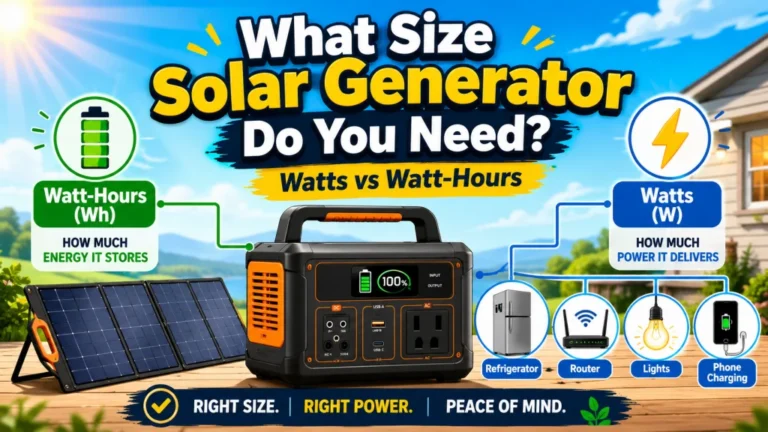
Watts measure how much power the unit can deliver at once, which determines what appliances it can run. Watt-hours measure how much total energy the battery holds, which determines how long it can run them. Most buyers focus on the watt output and ignore watt-hours. Watt-hours is the number that actually tells you runtime.
🏕️ Can I use a home backup solar generator for camping?
Technically yes, but units sized for home backup are often too heavy for convenient camping use. A 2,000Wh home backup unit can weigh 40 to 50 pounds. For car camping with easy vehicle access that is manageable. For carrying gear from a trailhead or parking lot, it is not. Camping-specific units prioritize lower weight and faster solar recharge ratios over raw capacity.
🌞 How many solar panels do I need to fully recharge my solar generator in a day?
Divide your battery capacity in watt-hours by your region’s average peak sun hours, then add 20 to 30 percent for real-world efficiency losses. A 2,000Wh battery in a five peak sun hour region needs roughly 400 to 500 watts of panel input for a full day recharge. Also check your unit’s maximum solar input limit before buying panels. Adding more wattage than that ceiling produces no benefit.
🔌 Do solar generators work as seamless backup during a power outage?
Most do not switch over instantly by default. Keeping a computer or router from dropping during an outage requires a unit with a confirmed UPS function and a switchover time under 30 milliseconds. Not all units that advertise UPS mode actually deliver that. If seamless switchover matters for your setup, verify the confirmed switchover time before buying.
💰 Is LFP battery chemistry worth the higher cost?
It depends on how often you plan to cycle the unit. LFP batteries are typically rated for 2,000 to 3,000-plus charge cycles before meaningful degradation. NMC batteries in lower-priced units usually top out around 500 to 800 cycles. If you are using the unit regularly, the LFP premium pays for itself over time. If it mostly sits on a shelf as an emergency backup, the cycle difference matters less.
🏠 Can a solar generator power a whole house during an outage?
Not in the way most people imagine. An average home uses 28 to 30 kilowatt-hours per day. No portable solar generator holds that much energy. What a solar generator does well is power specific critical loads, such as a refrigerator, lights, devices, and a CPAP, for a defined period. The goal is not replacing the whole house. It is keeping the things that matter most running until the grid comes back.