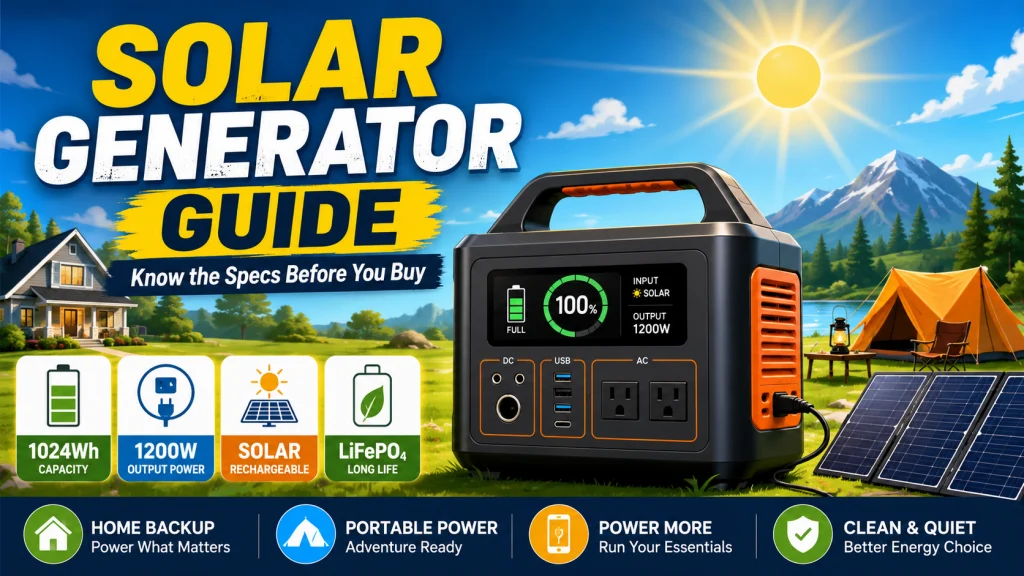
It Is Not a Generator in the Way You Are Thinking
Most bad solar generator purchases start with the name itself. I watched it happen at the counter more times than I can count, and I still see the same confusion in forum posts from people trying to figure out why their unit did not perform the way they expected. A solar generator does not burn fuel to produce electricity. It stores electricity produced by solar panels, which feed current through a charge controller and into the battery. The inverter then converts that stored DC power into the AC power your appliances need. The whole unit is a rechargeable battery system with solar charging built in, not a machine that generates power from nothing.
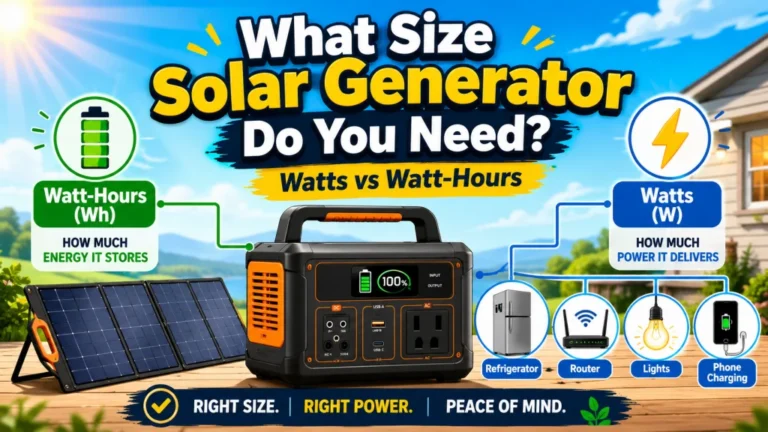
Once that framing lands, the buying process gets a lot cleaner. The question stops being “how many watts does it put out” and becomes “how many watt-hours does it store.” Those two numbers measure completely different things. Watts measure power delivery rate. Watt-hours measure total stored energy. Confusing the two is the most common sizing mistake I saw at the counter, and it still shows up constantly in online forums. Someone sees a unit rated at 2,000 watts, assumes it will run a 1,500-watt space heater through the night, and is back at the store when it shuts off after 45 minutes. The unit did exactly what it was rated to do. The buyer just measured the wrong number.
Understanding what is happening inside the box, from the panels and charge controller to the battery and inverter, is genuinely useful before you start comparing products. My full guide on how solar generators work covers each component in practical terms for buyers, not engineers.
The Four Specs That Actually Matter
Every solar generator comes with a spec sheet that lists ten or twelve numbers. Most of them are irrelevant for the average buyer. The four that carry real weight are watt-hours, AC output watts, solar input watts, and battery chemistry. Understanding solar generators at a practical level means understanding what those four numbers actually tell you.
Watt-hours tells you how much total energy is stored in the battery. A 1,000 Wh unit running a 100-watt load will last roughly 8 to 9 hours before needing to recharge, after accounting for typical inverter losses. Divide the watt-hour capacity by your total connected load and knock off about 10 to 15 percent and you have a working estimate. AC output watts tells you how much power the unit can deliver at one time, and more importantly, whether it can handle the starting surge of appliances like refrigerators, well pumps, or air conditioner compressors. What I check first, before anything else, is whether the surge watt rating exceeds the starting draw of whatever appliance the buyer plans to run. Most buyers skip this entirely and find out the hard way when the unit clicks off and beeps at them.
Solar input watts tells you how fast the battery recovers from sunlight. A 200-watt solar input limit on a 1,000 Wh battery means roughly 5 to 6 hours of strong direct sun to fully recharge from empty under ideal conditions. That recovery rate matters a lot during a multi-day outage where you are drawing the battery down each night. Battery chemistry, the fourth spec, determines how many charge cycles the unit can sustain before performance degrades noticeably. It gets its own section below, but it belongs on this list because buyers who skip it often end up surprised when a unit starts losing runtime capacity in a few years rather than many.
- Watt-hours (Wh): total stored energy. Determines how long it runs your appliances before needing a recharge.
- AC output watts: peak power delivery rate. Determines which appliances it can run at all, especially those with high starting surges.
- Solar input watts: recharge speed from panels. Determines how resilient the unit is during extended outages with limited sun.
- Battery chemistry: determines total cycle life and the long-term value of the investment.

This 1kWh LFP battery station charges from 0 to 80% in just 50 minutes via AC input, and its LiFePO4 chemistry delivers a 3,000 plus cycle lifespan that is roughly 6 times longer than standard lithium batteries. Capacity is expandable up to 3kWh with additional batteries, making it well suited for camping, RVs, or off-grid living. Its 1,800W output powers across 15 outlets, handling around 90% of household appliances, and accepts up to 500W of solar input for clean, fuel-free charging. The package includes a 5-year customer service guarantee.
Check On AmazonIf you click this link and buy, we earn a commission at no additional cost to you.
Solar vs. Gas: Neither Is Always the Right Answer
Solar generators win on silence, indoor safety, zero fuel cost, and zero fuel maintenance. Gas generators win on raw continuous power output, indefinite runtime as long as fuel is available, and the ability to handle high-draw appliances that would overwhelm most portable solar units. Both of those assessments are accurate, and neither technology dominates across every use case. A solar generator overview that tells you one is always better is selling something.
Where buyers get into trouble is assuming the cleaner or newer technology is automatically the better choice. Someone managing a refrigerator, some LED lighting, and device charging through a 48-hour outage will do fine with a solar unit as long as they get reasonable sun during the day. Someone running a sump pump and a window air conditioner through a week-long winter storm under heavy overcast is looking at a very different load and recovery calculation. Those are not the same situation, and they should not produce the same answer.
Field Note: A pattern I ran into regularly at the shop: buyers who had dealt with gas generator failures, stale fuel in the carburetor, pull-start problems in cold weather, dead batteries from sitting all year, would come in wanting to switch to solar for the simplicity alone. Completely legitimate reason. But some of them were also running loads that a solar unit could not realistically handle for an extended outage. That conversation needed to happen before the purchase, not after. The ones who made the best decisions were the ones willing to run the actual math on their load first and let that drive the answer rather than starting with the conclusion they already wanted.
A full comparison with specific use-case breakdowns is in my solar generator vs. gas generator guide, including the situations where one clearly wins and the ones where it genuinely depends on your setup.
Three Names for What Looks Like the Same Product
Solar generator, portable power station, power bank. These terms appear in the same product categories, sometimes on the same listing, and they describe three different things. A power bank is a compact lithium battery built for charging phones and small electronics. A portable power station is a larger battery unit with AC outlets capable of running appliances. A solar generator is, in technical terms, a portable power station designed to pair with solar panels for recharging. In practice, the term solar generator has expanded in marketing to mean almost any portable power station, which creates real confusion at the buying stage.
The confusion causes concrete problems. A buyer searching for a solar generator for home backup ends up with a 100 Wh unit that runs a small fan for about an hour. Someone else buys a large portable power station thinking solar charging is included and then discovers they still need to purchase the panels separately. I saw both of those scenarios play out. The detailed breakdown of solar generators vs. portable power stations, including exactly what each term should mean and what to verify before you buy, is in a separate guide focused entirely on that distinction.
Battery Chemistry: The Spec That Determines Long-Term Value
Of everything on the spec sheet, battery chemistry is the one most buyers skim past. That is a mistake, especially if you are spending more than a few hundred dollars on a unit you plan to rely on regularly. Explaining output wattage and capacity is the easy part. Chemistry is where the long-term story lives.
Two chemistries dominate the portable solar generator market right now: lithium iron phosphate, called LiFePO4, and lithium nickel manganese cobalt oxide, commonly called NMC or just lithium-ion. LiFePO4 units are typically rated for 2,000 to 3,500 charge cycles before the battery degrades to 80 percent of its original capacity. NMC units typically hit that same 80 percent threshold at 500 to 1,000 cycles. If you cycle the unit once per day, that difference works out to roughly 3 years of useful life for NMC versus 8 to 9 years for LiFePO4 before you start noticing a meaningful drop in runtime. Both degrade gradually, not all at once. At 80 percent capacity, a unit that originally held 2,000 Wh now holds 1,600 Wh. You notice it in shorter runtimes before you notice anything else.
There is a cost tradeoff, and it is real. LiFePO4 units cost more upfront for equivalent capacity. NMC offers higher energy density, meaning less weight and volume for the same capacity, which matters for buyers where portability is the main requirement. For home backup and off-grid use where the unit mostly stays put and runs on a regular cycle, LiFePO4 makes more financial sense over the ownership period. The full breakdown of degradation rates, what 80 percent capacity actually feels like in day-to-day use, and how to tell when your unit is approaching replacement territory is in my guide on solar generator battery lifespan.

Weighing just 23.8 lbs with a foldable handle, this 1,070Wh LFP power station delivers 1,500W of pure sine wave AC output with a 3,000W surge capacity, capable of running AC units, fridges, and electric pots. Its LFP battery sustains over 70% capacity after 4,000 cycles, translating to a lifespan of more than 10 years. Via the Jackery App, you can enable a full charge in as little as one hour, or switch to a whisper-quiet 30 dB overnight mode. Six output ports including two USB-C with 100W PD charging cover nearly any device simultaneously.
Check On AmazonIf you click this link and buy, we earn a commission at no additional cost to you.
Before You Compare Models, Write Down Your Power Profile
Spec sheets only mean something when you know what you actually need. A 2,000 Wh unit is a good fit for one situation and completely wrong for another, and the difference has nothing to do with the unit. It has to do with what you plan to run, for how long, and how you expect to recharge it. The buyers I saw make the best decisions came in knowing their load. The ones who left with the wrong unit almost always skipped this step and went straight to comparing prices or output numbers.
Before you open a single product listing, work out these six things. They take ten minutes and they will make every comparison you do afterward faster and more useful.
- Biggest single appliance you need to run: this determines whether surge watt rating matters and how high it needs to be.
- Total watts running at the same time: add up the draw of everything you expect to run simultaneously, not just the largest item.
- Target runtime in hours: how long do you need to run those appliances before a recharge is available?
- Recharge window during the day: how many hours of usable sun do you typically get, and do you have a grid or vehicle charging option as backup?
- Use case: indoor, camping, RV, or outage: this affects what size and weight is practical and whether indoor safety is a factor.
- Weight vs. lifespan priority: if portability matters most, chemistry and form factor trade differently than if the unit will stay in one place for a decade.
Once you have those numbers, the specs on a product listing tell you something. Without them, you are just comparing marketing claims. My homestead unit runs on a setup I sized specifically for my average daily load and my average solar hours in Nevada. That math is straightforward, but it has to come before the product search, not after.

This compact plug-in monitor tracks the energy consumption of any AC 115-volt appliance and displays real-time readings of volts, amps, and wattage at 0.2 to 2.0 percent accuracy. Its large LCD screen lets you calculate electricity costs by the day, week, month, or year, making it easy to spot energy-hungry devices and trim your utility bill. It is also compatible with inverters, adding flexibility for off-grid setups.
Check On AmazonIf you click this link and buy, we earn a commission at no additional cost to you.
Final Thoughts: The Right Frame Changes Everything
The buyers who walked out of the shop with the right unit almost always had two things in common: they understood that these are battery systems, not generators in the traditional sense, and they knew their load before they started comparing specs. Everything else followed from those two things. If you have made it through this guide, you have the first one. The power profile checklist above gives you the second.
If you are still unclear on how the technology works, the guide on how solar generators work is where to go next. If you are deciding between solar and gas, the comparison guide works through that in detail. If you are ready to start looking at units and want to understand what the battery chemistry numbers will mean over time, the battery lifespan guide is the one that will keep you from a costly mistake.

Built with A+ grade monocrystalline cells at 23.5% efficiency, this panel maintains stable output even in low-light and cloudy conditions. It folds into a 25 by 21 by 2 inch briefcase at just 18.96 lbs, and four adjustable kickstands let you angle it at 45 degrees to capture 25 to 30% more energy than flat-laying panels. The ETFE surface and IP67 waterproof rating make it well suited for RV camping and marine environments. A built-in USB-A QC3.0 and USB-C PD 60W port allow direct device charging without a power station, and the included 5-in-1 cable covers compatibility with Jackery, Bluetti, EcoFlow, Anker Solix, and most other major solar generators. It comes backed by a 12-month warranty and 30-day money-back guarantee.
Check On AmazonIf you click this link and buy, we earn a commission at no additional cost to you.
Guides on This Site
Each of the four guides below covers a different part of the buying picture. They are designed to be read in any order depending on what you need to know. If you are still early in the research process, the technology guide is the logical starting point. If you are already between two technology types, the battery and comparison guides are where the decision usually comes down.
| Guide | What it covers |
|---|---|
| How Solar Generators Work | What is inside the box: solar panels, charge controller, battery, and inverter explained in practical terms for buyers |
| Solar Generator vs. Gas Generator | Where each technology wins and loses across noise, safety, fuel cost, power output, and extended outage runtime |
| Solar Generator vs. Portable Power Station | How to tell the three product types apart and what to verify before buying so you get the right one |
| Solar Generator Battery Lifespan | LiFePO4 vs. NMC degradation rates, cycle life math, and what 80 percent capacity means in real daily use |
FAQs
⚡ What is a solar generator?
A solar generator is a rechargeable battery system that stores electricity produced by solar panels. It does not generate power the way a gas generator does. An inverter inside the unit converts stored DC power into AC power for appliances and devices.
🔋 How long does a solar generator run?
Runtime depends on the battery’s watt-hour capacity and the total watt draw of what you are running. Divide watt-hours by your connected load and subtract roughly 10 to 15 percent for inverter losses. A 1,000 Wh unit running a 100-watt load lasts roughly 8 to 9 hours before needing a recharge.
🏠 Can a solar generator power a whole house?
Not a typical whole house. Portable solar generators are designed for selective loads: a refrigerator, lights, devices, and similar appliances. Running an HVAC system, electric range, or water heater falls outside what these units are built for. Sizing for the appliances you actually need, rather than everything in the house, is the practical approach.
☀️ How long does it take to charge a solar generator with solar panels?
Recharge time depends on the unit’s maximum solar input wattage and the panels connected to it, plus available sunlight hours for the day. A 1,000 Wh battery with a 200-watt solar input needs roughly 5 to 6 hours of direct sun to recharge from empty under ideal conditions. Cloud cover, panel angle, and temperature all reduce that number in practice.
🔬 What is the difference between LiFePO4 and NMC solar generators?
LiFePO4 batteries are typically rated for 2,000 to 3,500 charge cycles before reaching 80 percent of original capacity. NMC lithium-ion batteries typically hit that same threshold at 500 to 1,000 cycles. LiFePO4 units cost more upfront but deliver significantly longer service life for regular-use applications like home backup or off-grid power.
🛡️ Are solar generators safe to run indoors?
Yes. Unlike gas generators, solar generators produce no combustion emissions and require no ventilation for carbon monoxide. They can operate indoors during a power outage without the safety risks that make gas generators a serious hazard in enclosed spaces.