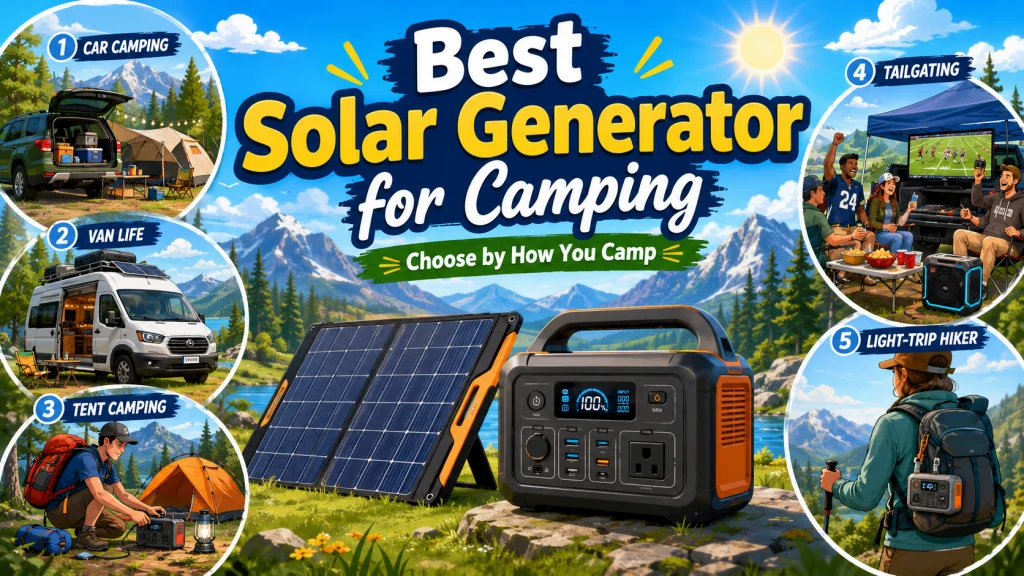
The Best Solar Generator for Camping Depends on How You Camp
The best solar generator for car camping is wrong for backpacking. The best for van life is wrong for tailgating. That sounds obvious, but you would not know it from reading most buying guides, which lead with a product list and let the buyer figure out the rest on their own. What actually determines which unit works for you is your camping style first, and the spec sheet second.
There are two primary axes before you look at any product. The first is weight versus capacity. If you are loading a unit into a truck bed or cargo area, weight matters far less than capacity. If you are carrying the unit any distance on foot, weight becomes the first filter and everything else adjusts from there. The second axis is recharge availability. A car camper can top off via a 12V outlet while driving between sites, or set up a panel for a few hours in the afternoon. A weekend tent camper often does not recharge at all and just needs enough battery to get from Friday to Sunday. Van life sits at the other extreme: the unit needs to sustain itself from solar input day after day without a wall outlet in sight.
Van life also adds a third variable that almost no camping review accounts for: idle drain. Every solar generator draws power through its inverter and battery management system even when nothing is plugged in. At a campsite for two days, that is background noise. Running 24 hours a day for weeks, it is a real daily loss. Some units draw 40 to 50 watts at idle. Others have been engineered down to 6 watts or less. In a weekend context, the difference barely registers. In a van, it determines whether the unit is self-sustaining or slowly bleeding out.
Five Camping Situations, Five Different Unit Classes
Before getting into each situation in detail, here is how the five break down at a glance. Each has its own primary requirement that shapes the buying decision.
- Car camping: weight is not a concern, capacity and solar input rate are the main decisions, multi-day runtime with daily recharge from panels or a 12V outlet
- Van life: continuous 24-hour use, solar as the primary power source, idle drain is the critical spec to check before anything else
- Tent camping: carry weight is the first filter, overnight runtime without guaranteed recharge, the 700 to 1,500Wh range covers most real-world loads
- Tailgating: single-session daytime use starting from a full wall charge, no overnight runtime needed, most buyers size too large and pay for it in weight
- Ultra-portable under 15 lbs: strict weight limit, device-level loads only, designed for travelers and campers who need power without the bulk
The table below puts numbers to each of those requirements so you can see at a glance where your use case lands before reading the detail sections below.
| Camping Style | Weight Priority | Wh Range | Primary Recharge | Key Spec to Check |
|---|---|---|---|---|
| Car camping | Not a concern | 1,500 to 3,000Wh | Solar panels or 12V car outlet | Solar input wattage, AC outlet count |
| Van life | Moderate | 1,500 to 3,000Wh | Solar panels (continuous) | Idle drain in watts |
| Tent camping | High | 700 to 1,500Wh | Pre-charged, limited solar top-up | Total weight, handle design |
| Tailgating | Moderate | 500 to 1,500Wh | Wall outlet before the event | AC outlet count, fan noise level |
| Ultra-portable | Critical | 100 to 500Wh | Solar panel or car outlet | Weight in lbs, output port variety |
Each row points to a fundamentally different buying decision. A unit that is ideal for car camping will be a poor choice for tent camping and almost certainly overkill for a tailgate. The sections below go into each situation individually.
How to Find Your Starting Point in Under a Minute
If you want to skip straight to the right section without reading everything, these five conditions map directly to the five situations below. Most buyers fall clearly into one of them.
If you are loading the unit into a vehicle and plan to run a cooler or fan through the night, start with car camping. If the unit will run every day in a converted van and you depend on solar as your only power source, read the van life section first and look for idle drain specs before anything else. If you need to carry the unit from your car to a campsite, even a short distance, weight is your first filter and tent camping is your section. If you are powering a setup in a parking lot for one game day and then going home, you almost certainly do not need as much capacity as you think, so start with tailgating. And if your trip involves a plane, a long hike, or any scenario where the unit lives in a bag, look at ultra-portable options first and ignore the capacity numbers in every other row.
Those five conditions cover the vast majority of camping solar generator buyers. The sections below go through each one with the specific numbers, the common mistakes, and what to actually look for on a spec sheet.
Car Camping: No Weight Limit Means Capacity Is the Real Decision
When a solar generator goes in a truck bed or SUV cargo area, weight matters far less than it does on foot. Loading even a heavier unit into a vehicle is a one-time lift from the garage to the cargo area. That changes the equation significantly, and most car campers do not take enough advantage of it. I have seen plenty of buyers choose a smaller unit because it was lighter and easier to carry at the store, only to find it tapped out by Saturday night with a small cooler and a fan running.
The realistic car camping power draw is not large, but it is continuous. A 12V cooler or mini fridge at around 50 watts, a fan at 20 watts, device charging at 20 watts, and LED camp lighting at 15 watts adds up to roughly 105 watts of constant draw. Over 24 hours that is about 2,500Wh. A 2,000Wh unit with a 200-watt solar panel set up at camp can recover most of what it uses during daylight and carry you through the night comfortably. A 1,000Wh unit running the same load is tight by day two and empty by day three. Size for the trip length, not just the first night.
One detail that rarely shows up in buying guides: campground noise rules. Many NPS campgrounds and private sites enforce quiet-hour rules that prohibit generators above 60 decibels, commonly between 10 PM and 6 AM. Solar generators run near-silently, well within that threshold for most models, which makes them a practical option when a gas generator would be banned entirely. Confirm the specific rules at any campground before you arrive, but in most cases solar is compliant where combustion is not. For the full breakdown of what specs to prioritize and what load profiles actually look like on a multi-day trip, the right solar generator for car camping covers it in detail.

At 39.5 lbs with 2,042Wh capacity and 2,200W output, this CTB-built station is 41% lighter and 34% smaller than typical 2kWh units. It charges from 0 to 80% in just 66 minutes via AC, operates at under 30 dB in silent mode, and switches to UPS backup in under 20 milliseconds. The LiFePO4 battery is rated for a full 10-year lifespan.
Check On AmazonIf you click this link and buy, we earn a commission at no additional cost to you.
Van Life: The Unit Never Gets a Break, and That Changes Everything
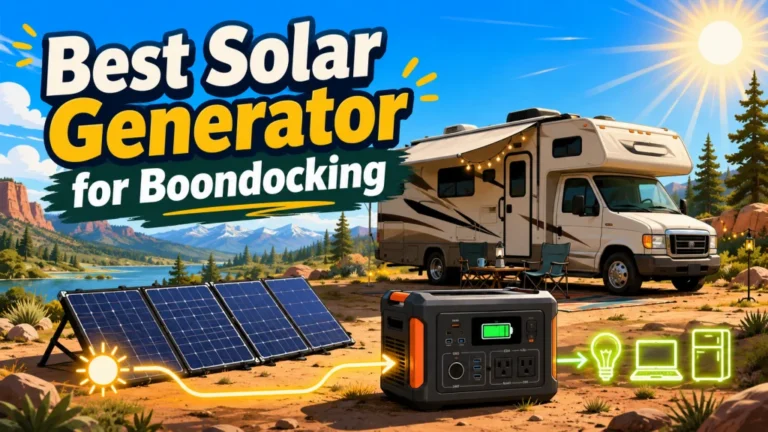
Van life is categorically different from any other camping use case. A car camping unit gets fully charged before the trip and discharged over a weekend. A van life unit runs continuously, 24 hours a day, sometimes for weeks without a wall outlet in sight. That single fact disqualifies a lot of solar generators that perform perfectly well in any other context.
The problem is idle drain. A unit in active mode draws power through its inverter and BMS even with nothing plugged in. At 40 to 50 watts of idle draw, that is 960 to 1,200 watt-hours per day just keeping the unit on. On a 2,000Wh battery, that is 50 to 60 percent of total capacity before a single device charges or a fan turns on. Some newer units have been designed down to 6 watts or less at active idle, which changes the math entirely. At 6 watts, idle draw costs 144 watt-hours per day. That is a rounding error rather than a budget problem. The difference between a 50-watt idle and a 6-watt idle is not a minor spec variation. For full-time van use, it determines whether the system is sustainable.
The other factor unique to van life is DC fridge compatibility. Most van setups use a 12V compressor fridge, not a household refrigerator. Running it directly from the unit’s DC output bypasses the inverter entirely, cutting both conversion losses and the inverter’s idle contribution. Van lifers who make that switch can often extend usable capacity by 20 to 30 percent without changing anything else. For a full look at idle drain specs, DC fridge integration, and how to size solar input for continuous use, what actually matters in a van life solar generator goes through the numbers.

Starting at 2kWh and expandable to 6kWh with two additional batteries, this LFP station reaches 80% in just 43 minutes via combined AC and solar input. Its 3,000-cycle battery outlasts the industry average by 6 times and includes a 5-year service guarantee. With 2,400W output across 15 outlets and X-Boost pushing to 3,400W, it handles 99% of household appliances at a whisper-quiet 30 dB.
Check On AmazonIf you click this link and buy, we earn a commission at no additional cost to you.
Tent Camping: Carry Weight Is the First Filter, Everything Else Follows
Tent camping creates a physical constraint that most reviews treat as an afterthought. Even when the walk from the parking lot to the campsite is only 200 feet, carrying a 60-pound unit in one hand and a full pack in the other is not a comfortable experience. Before any spec sheet question, the first question is how far you will realistically carry this, and how often. Most tent campers find their practical carry limit somewhere around 25 to 35 pounds. That corresponds to the 700 to 1,500 watt-hour range.
Field Note: At the shop, the most consistent frustration I heard from tent campers was not about capacity or runtime. It was about handles. A single center-bar handle shifts awkwardly on anything longer than a 100-foot carry, especially when the unit is not perfectly balanced. Units with side handles or a dual-handle design are noticeably more manageable on uneven ground. That sounds like a minor detail until you are crossing a rocky campsite in the dark with a headlamp and a full arm.
A 1,000Wh unit in the 20 to 25-pound range handles a three-night tent camping trip comfortably for most real loads: CPAP without a humidifier, phone and laptop charging, LED camp lights, and a small fan. That load profile draws around 60 to 80 watts averaged across an 8-hour night, which uses 480 to 640Wh. A 1,000Wh unit reaches Sunday morning with reserve. Panel setup on a fixed campsite is more practical than most people expect. A 100-watt panel staked to the ground and aimed at the sun adds 400 to 600 watt-hours on a clear afternoon, which covers most of what the unit used overnight. The wind issue is real: freestanding panels that are not staked or weighted fall over and stop producing. That is a campsite management detail, not a solar generator problem. For sizing and weight tradeoffs specific to tent camping, what to look for in a tent camping solar generator covers the middle-weight segment in full.

Weighing just 23.8 lbs with a foldable handle, this 1,070Wh LFP power station delivers 1,500W of pure sine wave AC output with a 3,000W surge capacity, capable of running AC units, fridges, and electric pots. Its LFP battery sustains over 70% capacity after 4,000 cycles, translating to a lifespan of more than 10 years. Via the Jackery App, you can enable a full charge in as little as one hour, or switch to a whisper-quiet 30 dB overnight mode. Six output ports including two USB-C with 100W PD charging cover nearly any device simultaneously.
Check On AmazonIf you click this link and buy, we earn a commission at no additional cost to you.
Tailgating: The Easiest Use Case, and the One Where Buyers Most Consistently Overbuy
Tailgating is the simplest solar generator scenario there is. You charge the unit fully from a wall outlet before you leave. You run a modest load for four to eight hours during daylight. Then you go home. There is no overnight runtime to plan for, no recharge strategy to design, and no multi-day capacity requirement to meet. The buying mistake I watch repeat in this category is people treating it like car camping and sizing accordingly.
The typical tailgate load is not heavy. A mini fridge or cooler at 50 watts, a 40-inch television at 80 watts, a Bluetooth speaker at 20 watts, and a couple of device chargers at 10 watts combined adds up to roughly 160 watts. Over six hours that is about 960 watt-hours. A 1,000Wh unit handles it with capacity left over. A 3,000Wh unit handles it while carrying 2,000 watt-hours you will never use, at 65 pounds instead of 22. The weight difference matters when you are loading and unloading from a tailgate or hauling across a parking lot to your spot.
The specs that actually matter for tailgating are outlet count, fan noise, and unit weight. Fan noise is worth checking specifically because a unit running near full load with loud cooling fans is genuinely disruptive at a close gathering. Many people are sitting within four or five feet of the unit and having a conversation. If your tailgate extends into a multi-day camping trip, the capacity math changes and you are in car camping territory. But as a standalone same-day use case, the right sizing is almost always smaller than buyers expect. The right size for a tailgate setup covers the specific capacity range and what outlet and noise specs actually matter in practice.

At 1,024Wh with 2,000W continuous output and 3,000W peak, this station powers up to 10 devices at once across a full suite of ports. HyperFlash charging fills it in just 49 minutes via AC, or 1.8 hours with 600W of solar. The UPS switchover triggers in under 10 milliseconds, and the LiFePO4 battery holds 80% capacity after 4,000 cycles for a 10-year lifespan.
Check On AmazonIf you click this link and buy, we earn a commission at no additional cost to you.
Ultra-Portable: Under 15 Pounds for Light Trips and Travelers Who Need Power Without the Bulk
There is a category of camper, day hiker, festival-goer, or frequent flyer who needs power but has a genuine weight constraint that the other categories do not share. Under 15 pounds is roughly where a solar generator starts functioning like a carry item rather than a haul item. Units in this class typically land between 100 and 500 watt-hours, which is not enough for a refrigerator or a CPAP with a humidifier, but handles phone and tablet charging, camera batteries, a headlamp recharge, and a small fan without any problem.
The tradeoff is real and worth naming. At 300Wh, you are not running appliances. You are keeping devices alive and adding small comfort loads. If that covers your actual needs, the weight savings are significant. If you find yourself wanting more, the next tier up at 700 to 1,000Wh adds meaningful capacity while staying in the 20 to 25-pound range, which is still manageable for most carry situations. The buying mistake in this segment runs in both directions: some people buy too large and regret carrying it, while others buy too small and spend the weekend rationing their phone charge. Be honest about what you are actually going to plug in.
One detail relevant specifically to travelers: individual lithium batteries above 100Wh require airline approval and must fly as carry-on, not checked baggage. Units under 100Wh pass without approval. Most units marketed as ultra-portable fall between 100 and 300Wh, so they need approval but are still permissible. It is worth confirming with your carrier before you travel. For a look at what is available in this weight class and what each unit gives up to get there, the lightest solar generators worth considering covers the sub-15-pound category in full.

Built with A+ grade monocrystalline cells at 23.5% efficiency, this panel maintains stable output even in low-light and cloudy conditions. It folds into a 25 by 21 by 2 inch briefcase at just 18.96 lbs, and four adjustable kickstands let you angle it at 45 degrees to capture 25 to 30% more energy than flat-laying panels. The ETFE surface and IP67 waterproof rating make it well suited for RV camping and marine environments. A built-in USB-A QC3.0 and USB-C PD 60W port allow direct device charging without a power station, and the included 5-in-1 cable covers compatibility with Jackery, Bluetti, EcoFlow, Anker Solix, and most other major solar generators. It comes backed by a 12-month warranty and 30-day money-back guarantee.
Check On AmazonIf you click this link and buy, we earn a commission at no additional cost to you.
Final Thoughts: Start With How You Camp, Then Look at Products
The pattern I have watched repeat across a lot of solar generator sales is that buyers skip the use-case step and go straight to the product. They find the highest-rated unit in their budget and discover later that it was built for a different situation than theirs. A unit that is excellent for car camping will frustrate a tent camper. A van life unit running 24 hours a day will outlast a tailgating unit that was never designed for sustained use. The five situations above are distinct enough that matching your camping style to the right unit class before looking at anything else saves a lot of trouble downstream.
If camping is not the only context you are considering, solar generators cover a wide range of situations beyond the outdoors. The full overview of solar generator categories covers home backup, RV use, and off-grid applications as well, with the same situation-first approach to finding the right starting point. The guides below go into the detail for each camping situation covered here.
Camping Situation Guides
Each camping style covered above has its own dedicated guide that goes into the specific specs to prioritize, the common buying mistakes for that use case, and what the real-world load math looks like. If you identified your situation in the sections above, the relevant guide below is the next step.
| Guide | What It Covers |
|---|---|
| Best Solar Generator for Car Camping | Multi-day capacity sizing, solar panel setup at a fixed campsite, and campground noise compliance |
| Best Solar Generator for Van Life | Idle drain as the primary filter, DC fridge integration, and solar input sizing for continuous daily use |
| Best Small Solar Generator | Sub-15-pound options by weight tier, TSA carry-on rules, and which loads each tier can and cannot handle |
| Best Solar Generator for Tent Camping | The 700 to 1,500Wh sweet spot, handle and carry design, and how to get a useful solar top-up on a fixed campsite |
| Best Solar Generator for Tailgating | Why tailgating needs significantly less capacity than car camping, and which outlet and noise specs matter in a close gathering |
FAQs
⚡ How many watt-hours do I need for camping?
It depends on your camping style and load. Car camping with a mini fridge and fan typically needs 1,500 to 2,000Wh for overnight comfort. Tent camping with CPAP and device charging is comfortable around 700 to 1,000Wh. Tailgating with a TV, speaker, and cooler for six hours uses roughly 900 to 1,000Wh. Start with your actual load in watts multiplied by the hours you need to run it, then add 20 percent buffer for efficiency losses.
🏕️ Can a solar generator replace a gas generator for camping?
For most camping loads, yes. A solar generator handles lights, fans, device charging, a mini fridge, and small appliances with no exhaust and very little noise. It falls short on high-draw loads like a full-size RV air conditioner or a continuous cooking appliance above 1,500 watts. If your camping load stays under 500 continuous watts, a solar generator is a straight replacement for most gas generator use cases at a campsite.
🌤️ Can I recharge a solar generator while camping?
Yes, in two practical ways: solar panels set up at your campsite, or your car’s 12V outlet while driving. Solar is the better option for stationary trips. A 200-watt panel with five hours of direct sun produces roughly 800 to 1,000 watt-hours. Car charging through a 12V port is slower, typically 60 to 100 watts, but adds up meaningfully on a long drive between sites. Most units also support AC wall charging when a campground hookup is available.
✈️ Can I bring a solar generator on a plane?
Units with lithium batteries between 100Wh and 300Wh are generally allowed as carry-on with airline approval. Under 100Wh needs no approval. Checked baggage is not permitted for any lithium battery above 100Wh. Most ultra-portable solar generators fall in the 100 to 300Wh range, so they qualify but require you to check with your airline before traveling. Units above 300Wh are typically prohibited from passenger aircraft entirely.
🔇 Are solar generators quiet enough for campground quiet hours?
Yes. Most campgrounds enforce noise limits during quiet hours, typically banning generators above 60 decibels. Solar generators produce no combustion noise and run at 0 to 30 decibels depending on the cooling fan load. They are usually quiet enough for campground quiet hours, as long as the cooling fan is not unusually loud under load.