There Is No Single Winner. There Is Just the Right Tool.
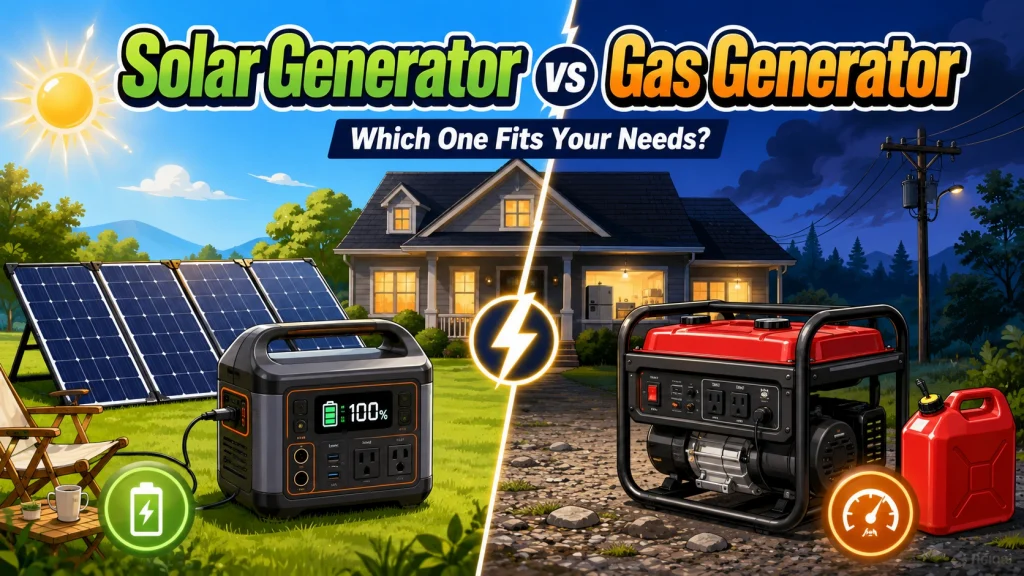
The solar generator vs gas generator question is the one I got most often at the counter, and it is the one that most requires slowing down before answering. I have owned both types, run both through real outages, and watched buyers make confident decisions in both directions that turned out to be wrong because they answered the wrong question first. These are fundamentally different tools. Comparing them without knowing your situation first is like comparing a knife and a screwdriver. Both have their uses. Neither replaces the other across the board.
Before anything else, I ask two questions. How long are your typical outages or use periods? And what is the highest-wattage appliance you need to run at the same time as everything else? If the first answer is one to two days and the second answer is a refrigerator, a router, and lights, solar handles that with room to spare. If the first answer is a week-long winter outage with no sun and the second answer includes a well pump or central air conditioning, gas is the better tool or at minimum part of the answer. Everything else in this comparison flows directly from those two questions. If you want the broader context on how solar generators work before diving into the head-to-head, the complete solar generator guide at pickmysolargenerator.com is the right place to start.
Field Note: The pattern I saw repeat most often was simple: buyers had researched wattage and price extensively, but they had not thought through how long they actually needed power or whether their outages usually happened during sunny weather. Getting those two questions answered first made every subsequent conversation shorter and the final purchase decision far more confident.
A Quick Reference Before You Compare Prices
Before looking at specs and price tags, it helps to know which direction your situation actually points. These six questions cover the criteria that matter most in this comparison. If your answers lean toward one column, that is your starting point before anything else.
| Question | Points Toward Solar | Points Toward Gas |
|---|---|---|
| Do you need power safe to run indoors or overnight in a bedroom? | Yes | No |
| Do you need to run central AC, an electric dryer, or a well pump? | No | Yes |
| Are your typical outages usually under 48 hours? | Yes | Less clear |
| Are week-long winter outages a realistic scenario where you live? | Less clear | Yes |
| Does campground noise compliance or overnight quiet matter for your use? | Yes | No |
| Are you willing to store fuel and maintain an engine annually? | No | Yes |
Most buyers land clearly in one column after these six questions. The ones who split evenly across both columns are often the right candidates for running both types together, using solar for quiet indoor loads and gas for high-draw or extended-outage situations. I touch on that approach at the end of this article.
Where Solar Consistently Has the Advantage
There are specific situations where solar wins clearly, and they are worth naming plainly before the comparison gets complicated. These are not marketing talking points. They are practical facts with real implications depending on how you plan to use the unit.
- Zero fuel cost after purchase. Once you own the unit and the panels, solar recharging costs nothing. Every hour of gas generator operation costs money in fuel. Over years of regular use, this gap compounds into a significant difference in total cost of ownership.
- Silent operation. A solar generator at rest produces no sound at all. This matters for overnight bedroom use, campground quiet hours, suburban noise ordinances, and any situation where a running engine would be a problem.
- Safe to run indoors. No combustion means no carbon monoxide. You can run a solar generator in a living room, a basement, or a bedroom without the exhaust ventilation a gas generator requires. The unit should still have open space around it for heat management during heavy charging, but that is a comfort consideration, not a safety emergency.
- No fuel storage and no maintenance schedule. No oil changes, no carburetor cleaning from stale fuel, no spark plug replacements, no annual tune-ups. You charge it, store it, and it is ready when you need it.
- Recharges from sunlight. On a clear day with adequate solar panels, a solar generator can substantially recharge from sunlight after your loads have drawn the battery down. Gas requires someone to buy, transport, and store fuel before the next use.
- Safe around partially enclosed spaces where gas becomes genuinely dangerous. Garages with the door cracked open, screened porches, covered patios, tent vestibules: these are exactly the spaces where people tend to underestimate gas generator risk. A solar generator avoids that entire category of problem because there is no combustion pathway and no exhaust.
These advantages are real, but they only matter if your situation actually puts them to use, which is what the rest of this comparison covers.

Weighing just 23.8 lbs with a foldable handle, this 1,070Wh LFP power station delivers 1,500W of pure sine wave AC output with a 3,000W surge capacity, capable of running AC units, fridges, and electric pots. Its LFP battery sustains over 70% capacity after 4,000 cycles, translating to a lifespan of more than 10 years. Via the Jackery App, you can enable a full charge in as little as one hour, or switch to a whisper-quiet 30 dB overnight mode. Six output ports including two USB-C with 100W PD charging cover nearly any device simultaneously.
Check On AmazonIf you click this link and buy, we earn a commission at no additional cost to you.
Where Gas Still Wins
Gas generators hold clear advantages in specific areas, and being honest about this is more useful than pretending solar has closed every gap. The brands selling solar generators will not tell you this part. Here it is plainly.
Raw power output is the most significant gap. Most portable solar generators top out at 1,500 to 4,000 watts of continuous AC output. Portable gas generators start there and scale to 5,000, 10,000, even 15,000 watts. A central air conditioner alone draws 3,500 to 5,000 watts. A well pump runs 750 to 1,500 watts continuously with a substantial startup surge on top. An electric dryer operates at 5,500 watts. None of these work reliably on a standard portable solar unit, regardless of how large the battery is. The inverter ceiling is the limiting factor, and no amount of watt-hours changes it.
Runtime is the second gap. Gas runs as long as fuel is available. A gallon of gasoline holds roughly 36 kilowatt-hours of energy in raw terms, and even at 25 to 30 percent real-world generator efficiency that is 9 to 11 kilowatt-hours of usable electricity per gallon. A solar generator is bounded by its battery capacity and by whether the sun can recharge it fast enough. In cloudy winter conditions, recharging can take several times longer than the spec sheet implies, and in heavy overcast weather the practical recharge window may not keep up with daily battery use at all. The third gap is upfront cost per watt of output. A 2,500-watt gas generator costs $250 to $400. A solar generator with comparable continuous output costs $600 to $2,000 depending on battery capacity and features. If you use it very infrequently and need high watt output, gas wins on pure cost efficiency in the short term.
How Each Type Holds Up by Situation
The comparison shifts significantly depending on the actual use case. A framework that works for a weekend camper gives the wrong answer to someone preparing for week-long winter outages. Here is how each type performs across the three most common situations buyers are actually deciding for.
Short to Medium Outages Running Essential Loads
For a 12-hour outage running a refrigerator at around 150 watts average draw, a router at 10 watts, a few LED lights at 20 watts combined, and phone charging at 10 watts, the total load is roughly 190 watts. A 2,000Wh solar generator runs that load for approximately 8.5 to 9 hours at real-world efficiency before hitting the 20 percent reserve threshold. On a clear day with 200 watts of solar panels, a full recharge happens in 10 to 12 hours. For this scenario, solar is sufficient and significantly more convenient than gas. For a 72-hour outage with reasonable daytime sun, the daily recharge cycle works if your panel wattage is adequate. For a 5-day ice storm with heavy cloud cover and freezing temperatures, solar is genuinely strained. The specific math across all three outage lengths lives in the home backup outage comparison, including the wattage and load calculations for each scenario.
Camping and Outdoor Use
This is where solar wins most decisively. Many campgrounds now enforce noise limits during quiet hours, typically 10 p.m. to 8 a.m., that most gas generators cannot meet. Solar generators at rest produce no sound. For car camping, a 1,000Wh unit handles phone charging, a laptop, lighting, and a CPAP machine without issue across two to three days per solar recharge cycle. The panels pack flat. There is no fuel to carry, no fuel to store in a vehicle or tent, no exhaust to manage in a confined space. For RV use with an air conditioner, the math changes and the watt ceiling becomes the constraint again. The camping use case comparison covers organized campground compliance, backcountry logistics, and the specific situations where gas still makes sense outdoors.
High-Draw Loads and Extended Off-Grid Use
If your situation involves running a well pump, a central air conditioner, an electric dryer, or other high-draw appliances regularly, a portable solar generator is not the complete solution. This is not a design flaw. It is physics. A 2,000-watt continuous inverter cannot run a 3,500-watt load regardless of battery size. For buyers considering extended off-grid living, solar can absolutely work, but it requires deliberate sizing, a clear-eyed accounting of local sun hours by season, and a backup plan for multi-day cloudy stretches. The honest breakdown of solar generator limitations covers what the brands leave out of their marketing, including the runtime ceiling, cloudy-week vulnerability, and the energy density gap that still favors liquid fuel per pound carried.

Starting at 2kWh and expandable to 6kWh with two additional batteries, this LFP station reaches 80% in just 43 minutes via combined AC and solar input. Its 3,000-cycle battery outlasts the industry average by 6 times and includes a 5-year service guarantee. With 2,400W output across 15 outlets and X-Boost pushing to 3,400W, it handles 99% of household appliances at a whisper-quiet 30 dB.
Check On AmazonIf you click this link and buy, we earn a commission at no additional cost to you.
The Three Remaining Comparison Angles
Some buyers have already worked through the use case question and know generally which direction they are heading. What they still need is the detail on a specific angle: how quiet solar actually is in measurable decibels, what the true cost looks like over a five-year ownership period, or whether the investment makes financial sense for their particular use pattern. These three areas each have their own dedicated breakdown.
None of these are simple one-answer questions, which is why each one has its own article rather than a paragraph here. The goal of this comparison is to give you the framework. The goal of each linked article below is to give you the data.
Noise Levels with Real Decibel Data
Most buyers know solar is quieter than gas. Fewer know by exactly how much, or what that means for overnight bedroom use, campground compliance, or simply running a unit without drawing attention from neighbors during an outage. A gas generator at 65 to 80 decibels sounds like a running vacuum cleaner at close range, continuously. A solar generator at rest produces zero decibels because there are no moving parts. During charging, the internal cooling fan runs at 20 to 35 decibels, which is quieter than most ceiling fans on a low setting. The solar generator noise level breakdown includes the actual decibel readings, what they sound like compared to familiar references, and how fan behavior changes at different charging rates.
Cost Over Five Years, Not Just Upfront
The upfront price comparison almost always favors gas, and that is a real fact worth acknowledging. A gas generator used 100 hours per year burns approximately $175 in fuel at $3.50 per gallon at typical consumption rates, plus $50 to $150 in annual maintenance. Over five years, that is $1,100 to $1,600 in operating costs added to a $300 to $400 unit, bringing total ownership cost to $1,400 to $2,000. A solar generator at $1,000 to $1,200 carries no ongoing fuel or maintenance cost, making total five-year cost comparable at moderate use rates. At low use rates, gas retains the cost advantage longer. At high use rates, solar breaks even sooner. The complete solar vs gas cost comparison runs the full break-even math with specific numbers across different use frequencies.
When the Investment Is and Is Not Justified
Solar generators are not the right purchase for every buyer. Saying so directly is more useful than hedging. The use cases where the investment clearly pays off are different from the ones where gas, no purchase, or a different approach is the better call. From what I have seen, buyers who feel burned by their solar generator purchase almost always either bought too small for their actual use case or had outage scenarios the unit genuinely could not serve. The solar generator worth-it analysis covers the decision framework, real ownership scenarios, and the specific situations where the honest answer is no.

This 1kWh LFP battery station charges from 0 to 80% in just 50 minutes via AC input, and its LiFePO4 chemistry delivers a 3,000 plus cycle lifespan that is roughly 6 times longer than standard lithium batteries. Capacity is expandable up to 3kWh with additional batteries, making it well suited for camping, RVs, or off-grid living. Its 1,800W output powers across 15 outlets, handling around 90% of household appliances, and accepts up to 500W of solar input for clean, fuel-free charging. The package includes a 5-year customer service guarantee.
Check On AmazonIf you click this link and buy, we earn a commission at no additional cost to you.
Final Thoughts: Answer the Use Case Question Before Anything Else
After owning both types and watching this decision play out from the retail side, the most useful thing I can tell you is this: the comparison only makes sense once you have answered those two baseline questions honestly. How long are your typical outages or use periods? What is the highest-draw appliance you need to run at the same time as everything else? Get those answers right and the direction becomes obvious in most cases. Solar for short to medium outages, quiet overnight use, and outdoor scenarios where noise and fuel logistics matter. Gas for extended runtime needs, very high-draw loads, and regions where weeks of cloudy weather are common in winter.
There is also a third answer worth naming: both. A solar generator handling indoor loads, overnight quiet operation, and daytime recharge from panels, paired with a gas unit for when the battery runs low during a multi-day cloudy stretch or when a high-draw appliance needs to run. This is not the most convenient answer, but it is the most honest one for buyers in demanding situations. A lot of buyers skip the whole decision step and jump straight to spec sheets. That is where the purchase regrets I saw most often actually started, on both sides of the comparison. The six detailed breakdowns below go deep on each specific angle. If you already know your use case, go straight to the relevant one.

At 1,024Wh with 2,000W continuous output and 3,000W peak, this station powers up to 10 devices at once across a full suite of ports. HyperFlash charging fills it in just 49 minutes via AC, or 1.8 hours with 600W of solar. The UPS switchover triggers in under 10 milliseconds, and the LiFePO4 battery holds 80% capacity after 4,000 cycles for a 10-year lifespan.
Check On AmazonIf you click this link and buy, we earn a commission at no additional cost to you.
The Full Solar vs Gas Comparison, Broken Down by Topic
The overall solar vs gas generator comparison is too broad to answer usefully in one place without losing the detail that actually drives individual purchase decisions. Each of the articles below focuses on one specific comparison angle. If your situation falls clearly into one of these categories, that article gives you the specific data to make a confident call rather than a general one.
| Article | What It Covers |
|---|---|
| Solar vs Gas for Home Backup | Three outage scenarios with real watt-hour math: 12 hours, 72 hours, and a full week, including load calculations for essential appliances |
| Solar vs Gas for Camping | Campground noise rules, fuel logistics on multi-day backcountry trips, and the specific outdoor scenarios where gas still makes sense |
| How Quiet Are Solar Generators? | Actual decibel readings at rest and during charging, compared against familiar sounds, with an explanation of when and why the fan activates |
| Solar vs Gas: The Full Cost Comparison | Upfront cost, annual fuel and maintenance, and break-even calculations across low, moderate, and high use frequencies |
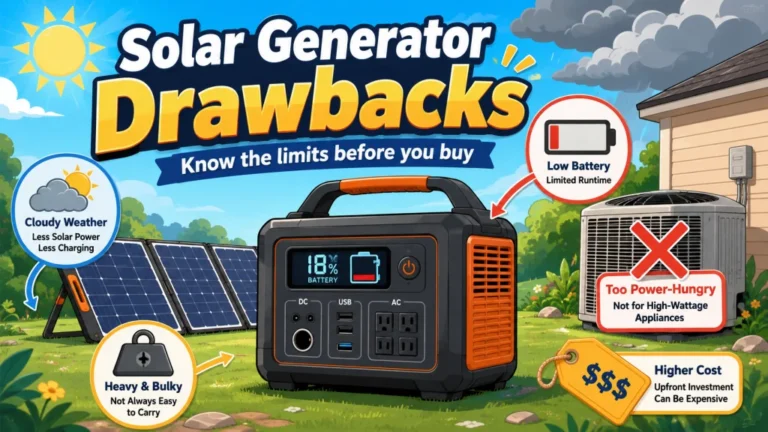
| Solar Generator Disadvantages | Runtime limits, high-draw appliance gaps, cloudy-week vulnerability, and the energy density reality the brands do not put in their marketing |
| Are Solar Generators Worth It? | A decision framework covering which use cases justify the investment and the specific situations where the honest answer is no |
If you are still working through the basics before getting into any specific comparison angle, the complete solar generator guide at pickmysolargenerator.com covers the full lifecycle from understanding the technology through choosing the right unit for your situation.
FAQs
⚡ Can a solar generator fully replace a gas generator?
For short outages, essential-load backup, and camping, yes in most cases. For extended outages in cloudy climates, or for running high-draw appliances like central air conditioning, well pumps, or electric dryers, no. The wattage ceiling and finite battery capacity make solar insufficient for those scenarios without supplemental charging or a purpose-built system well beyond portable unit pricing.
🌧️ What do you do when a solar generator runs out of charge with no sun available?
You recharge from a wall outlet, a 12V car port, or you wait for sun. Most solar generators accept AC wall charging faster than solar input. During a multi-day cloudy outage, wall charging is the practical answer for maintaining a usable battery buffer. The solar in the name refers to the charging capability, not the only recharge method.
🔇 Are solar generators actually quiet enough for overnight indoor use?
Yes, in my experience. A solar generator discharging produces zero sound. If it is simultaneously charging from a wall outlet, the internal cooling fan runs at roughly 20 to 35 decibels, quieter than a ceiling fan on a low setting. Noise is rarely the complaint with solar generators overnight. The more common concerns are battery capacity running short before morning, or the fan cycling on during high-rate charging.
🏕️ Do campgrounds allow solar generators when gas generators are banned?
In almost every case, yes. Campground generator restrictions target combustion engines and noise, neither of which applies to a battery-based solar unit. Solar generators produce no exhaust and operate below typical noise thresholds even during active charging. Always verify the specific campground rules before assuming, but in my experience a gas generator ban has never extended to battery-based solar units.
💰 Is a solar generator worth the higher upfront price compared to a gas generator?
At moderate use rates, typically yes over a five-year horizon, because fuel and maintenance costs for gas accumulate significantly. At very low use rates, say two or three outages per year, the break-even takes longer and gas may retain the cost advantage. The cost comparison article runs the full math with specific numbers at different use frequencies.
🔌 Can a solar generator run a refrigerator through a full overnight outage?
A 2,000Wh unit running a refrigerator at 150 watts average, plus a router and a few lights, runs approximately 8 to 9 hours before hitting the 20 percent reserve level. For a 12-hour overnight outage, a full charge going in covers most of it. For multi-day outages, the unit needs to recharge during daylight, which works well in sunny conditions and becomes a real constraint during consecutive cloudy days.
🔋 Does a solar generator work when there is no sun at all?
Yes. The battery stores energy regardless of how it was charged. A solar generator fully charged from a wall outlet the night before works identically to one charged from solar panels. Sunlight is one charging method, not a requirement for operation. The panels just add a renewable recharging option that does not require a fuel source or a functioning grid.