The Chemistry Question Every Buyer Should Ask Before Spending a Dollar
“How long will this last?” is the most common pre-purchase question about solar generators, and it is the one with the most unsatisfying answer on most product pages. Brand sites typically quote a cycle count and leave it at that. What buyers actually want to know is whether the unit will still be working in five years, in ten, or in fifteen. The cycle count answers that question, but only if you know how to connect it to your actual usage pattern and which chemistry it applies to.
Two solar generators sitting side by side in a store, with identical watt-hour capacity, identical AC output, and identical solar input, can have lifespan profiles that differ by a factor of five. The difference lives entirely in the battery chemistry specification buried in the technical details. A buyer who skips that line is making a thousand-dollar decision with a critical variable missing.
If you are still in the early phase of evaluating what a solar generator is and how to think about all the major specs at once, the complete solar generator guide covers the full pre-purchase picture, including charging, runtime, and the key specifications that actually determine real-world performance. This article focuses specifically on the lifespan side of that picture.
The Three Battery Types and What Each One Means for Lifespan
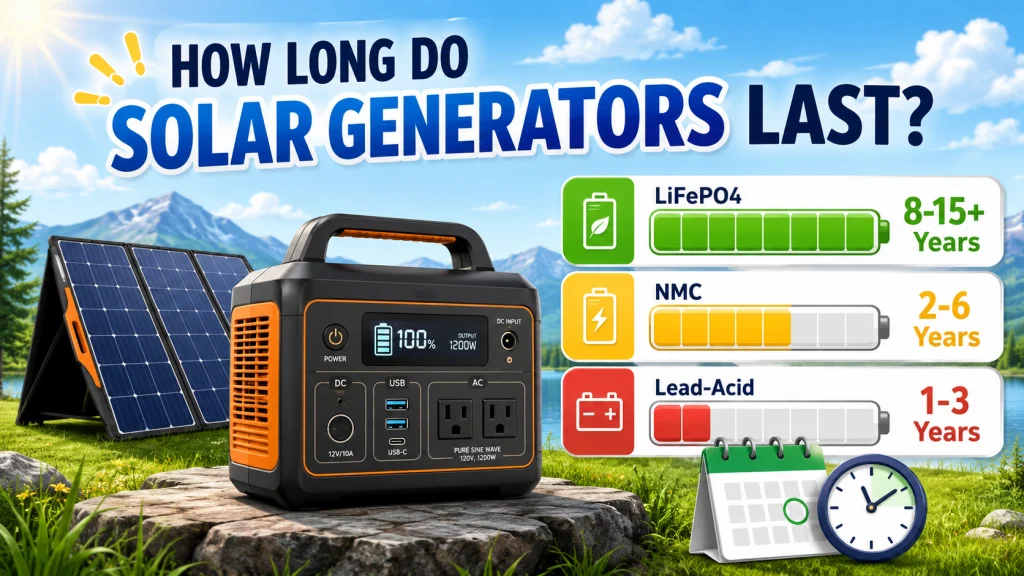
There are three battery chemistries in the portable solar generator market, and they produce very different ownership experiences over time. Understanding them requires no engineering background. The table below shows where each one sits.
| Battery Chemistry | Typical Cycle Rating | Expected Useful Life (Regular Use) | Where You Find It |
|---|---|---|---|
| LiFePO4 (lithium iron phosphate) | 2,000 to 6,500 cycles | 8 to 15+ years | Mid-range to premium units |
| NMC lithium-ion (nickel-manganese-cobalt) | 500 to 1,500 cycles | 2 to 6 years | Budget units, older models |
| Lead-acid | 200 to 500 cycles | 1 to 3 years | Very budget, near obsolete |
LiFePO4 is the current standard in quality solar generators and has been displacing NMC across most product lines since 2023 and 2024. The cycle ratings typically range from 2,000 cycles on the conservative end to 6,500 cycles in top-tier units. For most regular owners who do not fully cycle the unit every single day, that translates to eight to fifteen years before the battery degrades to 80 percent of its original capacity. For buyers spending $800 or more, LiFePO4 is what to confirm before purchasing.
NMC lithium-ion was the dominant chemistry in first- and second-generation solar generators, and it still appears in budget units under $400 and in older models still in circulation. Cycle ratings run from roughly 500 to 1,500, with most falling around 800 to 1,000. At one cycle per day, that is two to three years of daily use before hitting the 80 percent threshold. For emergency prep use where the unit sees 10 to 20 cycles per year, NMC lasts much longer in calendar terms, but for anyone who runs the unit regularly, it fades significantly faster than LiFePO4.
Lead-acid is effectively obsolete in new portable solar generator purchases. Cycle ratings from 200 to 500 and the added weight penalty make it uncompetitive with lithium chemistry at current price points. It still exists in older units and very cheap unbranded products, but it is not a realistic chemistry option for anyone making a current-market purchase.

Weighing just 23.8 lbs with a foldable handle, this 1,070Wh LFP power station delivers 1,500W of pure sine wave AC output with a 3,000W surge capacity, capable of running AC units, fridges, and electric pots. Its LFP battery sustains over 70% capacity after 4,000 cycles, translating to a lifespan of more than 10 years. Via the Jackery App, you can enable a full charge in as little as one hour, or switch to a whisper-quiet 30 dB overnight mode. Six output ports including two USB-C with 100W PD charging cover nearly any device simultaneously.
Check On AmazonIf you click this link and buy, we earn a commission at no additional cost to you.
What “3,000 Cycles to 80 Percent” Actually Means in Practice
The 80 percent endpoint that cycle ratings reference is worth understanding clearly, because it causes more confusion in the pre-purchase phase than any other battery specification. Reaching 80 percent of original capacity does not mean the unit stops working. It means the battery holds 80 percent of what it held when new. A 2,000Wh unit at the 80 percent threshold holds 1,600Wh. It still powers appliances, still recharges from solar, and still performs every function it was purchased for. Runtime per cycle is about 20 percent shorter.
For most use cases, the 80 percent mark is not a cliff. It is a gradual decline that most owners never notice until they run a deliberate test or observe that overnight runtime is slightly shorter than it used to be. The degradation from 100 percent to 80 percent happens slowly across hundreds or thousands of cycles, and for casual use, the battery often stays near original capacity well past the rated cycle count under controlled lab conditions.
Field Note: At the shop, the buyers who came back frustrated almost never came back because their battery had degraded in any noticeable way. The complaints were almost always about the inverter electronics failing in a budget unit, or a charge port developing a loose connection. Battery degradation as a visible problem showed up almost exclusively in units that had been stored wrong for a season or left in a hot vehicle repeatedly. For most owners running a quality LiFePO4 unit under normal conditions, degradation is theoretical for years.
What the cycle rating does tell you clearly is the manufacturer’s confidence in the chemistry under normal use. A unit rated to 3,000 cycles with a five-year warranty is telling you, in the only language that matters for this decision, that the manufacturer expects it to outlast the warranty by a significant margin. A unit rated to 800 cycles with a one-year warranty is telling you something different.
The Component That Can Fail Before the Battery Does
Battery chemistry determines the upper lifespan range, but it does not guarantee that the rest of the unit reaches it. In budget solar generators, the inverter electronics are the component most likely to fail within the first five to seven years, sometimes before the battery shows any meaningful degradation. The inverter handles DC-to-AC conversion every time you run an appliance from the outlets, and in lower-cost units, that conversion circuitry is often built to narrower tolerances than the battery cells.
Quality solar generators from established brands use inverter components rated for ten to fifteen years, which aligns with the expected LiFePO4 battery lifespan in those units. The unit is, in that sense, designed to age as a whole. Budget units do not always offer that alignment. An inverter failure in a $300 unit in year four often costs more to repair than the unit is worth, effectively ending the ownership period regardless of how much battery life remains.
Beyond the inverter, a few other factors shape whether a unit reaches its chemistry-rated useful life. Understanding these helps separate units with genuinely long useful lives from ones that look similar on paper but are not built the same way.
- Inverter component rating: Quality brands publish or confirm inverter component lifespans in their documentation. If a brand does not mention inverter longevity anywhere and offers only a one-year unit warranty, the battery lifespan spec is the most optimistic part of the product description.
- Thermal management quality: A solar generator that runs its fan consistently during charging is doing the right thing. One that never activates thermal management during a charging cycle may be leaving battery temperature unregulated. Active cooling extends both battery and inverter life in units that charge at high wattages.
- Charge port and connection durability: In field use, loose barrel connectors or worn DC input ports often fail before either the battery or inverter. Units designed for regular transport and outdoor use should have reinforced connections. A port that wiggles after a year of use is a design problem, not a use problem.
- Warranty coverage scope: A five-year warranty that covers battery and unit together is a different product commitment than a two-year unit warranty with a separate battery claim process. The warranty structure reflects how confident the manufacturer is that all major components reach the same service life.
Solar Panels Age on a Different Timeline
If your solar generator setup includes a set of panels, their lifespan follows a different curve than the battery. Solar panels degrade at approximately 0.5 to 1 percent of output per year under normal use. After 25 years, a panel that started at 200W is producing somewhere between 150W and 175W. Panels do not fail suddenly, and they do not expire alongside the battery in the unit.
The practical result is that panels typically outlast the first battery unit by a meaningful margin. A set of 200W solar panels bought today alongside a solar generator will likely be delivering close to original output when that generator needs to be replaced or when its battery reaches end-of-useful-life capacity. For buyers planning a long-term solar backup setup, the panels are the most durable part of the investment and can be paired with a replacement unit when the time comes.
The exception is physical durability rather than cell degradation. Panels that get folded, transported, and deployed regularly develop frame and junction box wear that has nothing to do with cell chemistry. A panel that lives on a roof or stationary mount ages differently than one pulled out of a bag every weekend. For portable use, the connector quality and hinge or fold mechanism are the failure points to watch, not the solar cells themselves.
Temperature: The Variable That Determines Whether You Hit the Rated Lifespan
Battery chemistry sets the upper lifespan range. Temperature determines whether you reach it or fall significantly short. Two owners with identical units can see meaningfully different five-year outcomes based entirely on where they store and use them.
Charging or storing above 104 degrees F causes sustained heat stress to the battery cells that accelerates capacity loss well beyond normal cycling wear. A unit stored through a summer in a south-facing garage that reaches 130 degrees F can lose ten to fifteen percent of permanent capacity from heat exposure alone, without a single charge cycle contributing to that loss. This is one of the most common causes of early degradation that owners attribute to other reasons.
Charging below 32 degrees F creates a different problem. Lithium batteries do not accept charge normally below freezing. Forcing charge input in cold conditions can cause lithium plating on the anode, a form of irreversible damage that permanently reduces capacity. Most quality units include low-temperature charge protection that stops charging automatically when battery temperature drops below a safe threshold. Confirming your unit has this protection, rather than assuming it does, is a worthwhile spec check before the first cold-weather use.

Featuring 16BB N-Type cells at 25% efficiency, this panel outperforms standard 200W panels and folds down to backpack size at just 13.89 lbs, with a magnetic closure for tool-free setup. Three built-in ports including USB-C PD 45W, and two USB-A ports charge devices directly, while MC4 output connects to most power stations and 12V battery systems. Four adjustable kickstands offer 40, 50, and 60 degree angles, and IP65 rating plus UL 61730 certification ensure durability and safety backed by a 2-year warranty.
Check On AmazonIf you click this link and buy, we earn a commission at no additional cost to you.
Reading Warranty Terms as a Lifespan Signal
A manufacturer’s warranty is one of the most informative lifespan signals available before purchase, and it is one most buyers treat as boilerplate. The logic of reading it carefully is straightforward: a manufacturer offering a five-year warranty on a LiFePO4 unit rated to 3,500 cycles is making a financial commitment that the product will perform for that period without failure. That commitment only makes sense if the unit is genuinely built to outlast it.
Premium LiFePO4 units currently carry cycle ratings from 3,500 to 6,500 cycles backed by five-year warranties. At one cycle every other day, a 3,500-cycle rating reaches the 80 percent threshold in roughly 19 years. The warranty covers a small fraction of the unit’s expected useful life. By contrast, a unit with a one-year warranty and a claimed 3,000-cycle battery specification carries a notable inconsistency. Either the battery specification is accurate and the manufacturer chose not to stand behind it, or the specification is generous and the manufacturer knows it.
For a thorough breakdown of how chemistry type, use frequency, and cycle math combine to produce a real lifespan estimate for your specific situation, the full guide to solar generator battery lifespan walks through the detailed calculations. The short version for most buyers: a LiFePO4 unit with a five-year warranty will realistically deliver well over a decade of useful service under normal use conditions.

This 1kWh LFP battery station charges from 0 to 80% in just 50 minutes via AC input, and its LiFePO4 chemistry delivers a 3,000 plus cycle lifespan that is roughly 6 times longer than standard lithium batteries. Capacity is expandable up to 3kWh with additional batteries, making it well suited for camping, RVs, or off-grid living. Its 1,800W output powers across 15 outlets, handling around 90% of household appliances, and accepts up to 500W of solar input for clean, fuel-free charging. The package includes a 5-year customer service guarantee.
Check On AmazonIf you click this link and buy, we earn a commission at no additional cost to you.
Final Thoughts: What a Realistic Expectation Looks Like
How long do solar generators last is a question with a wide answer range, and that range is not random. It correlates almost directly with battery chemistry and the care level of the manufacturer. A quality LiFePO4 unit stored at reasonable temperatures and used regularly can deliver ten to fifteen years of meaningful service. A budget NMC unit stored in a hot garage and discharged to zero regularly may be significantly degraded in three to four years.
The purchase decision becomes clearer when you think of it as a dollar-per-year calculation. A $1,200 LiFePO4 unit that lasts twelve years costs $100 per year. A $400 NMC unit that degrades to 60 percent capacity in four years costs $100 per year for a noticeably diminished product at the end. That math does not always favor the premium unit, but it makes the comparison honest. Chemistry is not a feature. For lifespan purposes, it is the product.

This compact plug-in monitor tracks the energy consumption of any AC 115-volt appliance and displays real-time readings of volts, amps, and wattage at 0.2 to 2.0 percent accuracy. Its large LCD screen lets you calculate electricity costs by the day, week, month, or year, making it easy to spot energy-hungry devices and trim your utility bill. It is also compatible with inverters, adding flexibility for off-grid setups.
Check On AmazonIf you click this link and buy, we earn a commission at no additional cost to you.
FAQs
⏳ How long does a solar generator last on average?
It depends entirely on battery chemistry. LiFePO4 solar generators typically last 8 to 15 years under regular use before reaching 80 percent of original capacity. NMC lithium-ion units last 2 to 6 years of equivalent use. The chemistry specification on the product page is the single most important number for answering this question for any specific unit.
🔋 How many years does a solar generator battery last?
LiFePO4 batteries in current solar generators are rated from 2,000 to 6,500 cycles to 80 percent capacity, which often translates to roughly 8 to 15-plus years depending on use frequency. NMC lithium-ion batteries, found in older and budget models, are rated 500 to 1,500 cycles, or 2 to 6 years of similar use. Usage frequency matters as much as chemistry: a backup unit used 10 times per year on a 3,000-cycle battery can outlast the buyer’s typical ownership window.
🌡️ Does temperature affect how long a solar generator lasts?
Yes, significantly. Storage or use above 104 degrees F accelerates permanent capacity loss, and forced charging below 32 degrees F can cause irreversible battery damage. A unit stored in a hot garage through summer can lose 10 to 15 percent of permanent capacity from heat alone. Climate-controlled storage extends lifespan materially for units in hot or cold climates.
🔧 What parts of a solar generator fail first?
In budget units, the inverter electronics often fail before the battery, sometimes within five to seven years. In premium units, inverter components are typically rated for 10 to 15 years, matching the LiFePO4 battery lifespan. Charge port connections are also a common failure point in units used for regular transport and field deployment.
☀️ Do solar panels last as long as the battery?
Solar panels typically outlast the battery. Panels degrade at roughly 0.5 to 1 percent of output per year, meaning a panel bought today will still deliver 75 to 88 percent of original output after 25 years. In most setups, the battery unit will need replacement before the panels show meaningful capacity reduction.
📋 How do I know if a solar generator has LiFePO4 or lithium-ion?
Check the battery specification on the product page or spec sheet. LiFePO4 is also written as LFP or lithium iron phosphate. NMC or lithium-ion without further specification usually indicates nickel-manganese-cobalt chemistry. If the spec sheet does not state the chemistry type clearly, contact the seller before purchasing. A $1,000 unit that does not disclose battery chemistry is a red flag.