Why Storage Damages Batteries When Use Does Not
Most people assume a battery that is sitting quietly on a shelf is not aging. That assumption is wrong. A lithium battery held at maximum charge voltage for weeks or months is under sustained chemical stress regardless of whether anything is plugged into it. The same electrochemical reactions that occur at the end of a full charge cycle keep occurring at a slower rate as long as the battery stays at that high-voltage state. Over a year of storage at 100 percent charge, that sustained stress can cost a unit 15 to 20 percent of its original capacity permanently.
Store the same unit at 40 to 50 percent charge and the same year of sitting costs roughly 4 percent. That gap is the entire argument for storage best practices in a single comparison. Understanding why it exists requires knowing almost nothing about battery chemistry: maximum voltage is stressful, lower voltage is less stressful, and a battery parked at the middle of its range ages far more slowly than one parked at the top.
The second storage risk is the opposite end: storing a unit at or near zero charge. Every lithium battery self-discharges slowly over time, even when nothing is drawing from it. LiFePO4 batteries self-discharge at roughly 1 to 3 percent of capacity per month. A unit left at 10 percent charge and forgotten for six months can drop below the minimum voltage threshold the battery management system needs to operate, triggering a deep-discharge protection lockout that requires a specific recovery charge procedure. In some cases, the unit may not recover fully.
The Right Charge Level for Storage
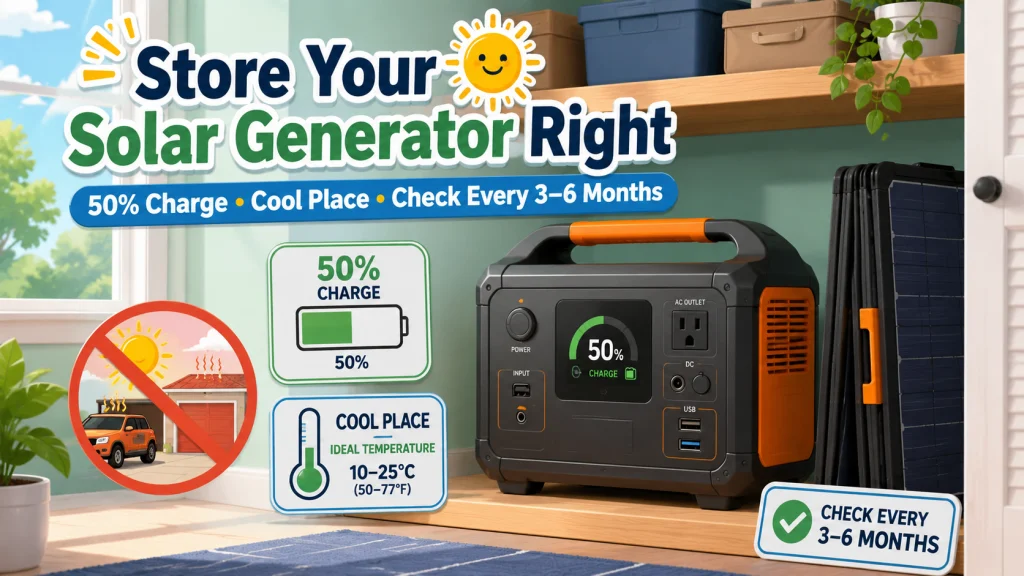
The target is 40 to 60 percent state of charge for any storage period longer than four weeks. This range is confirmed by multiple manufacturers and is consistent across LiFePO4 chemistry at the battery science level. The midpoint of the battery’s voltage range places the minimum stress on the cathode material while leaving enough charge buffer that self-discharge over several months will not bring the unit to a critical low.
| Storage Charge Level | What Happens Over 12 Months | Verdict |
|---|---|---|
| 100% (fully charged) | Sustained maximum voltage stress. Estimated 15 to 20% capacity loss from calendar aging alone. | Avoid for any storage longer than a few days |
| 40 to 60% (recommended range) | Low voltage stress. Calendar aging approximately 4% capacity loss over 12 months under good conditions. | Correct for all storage scenarios |
| 10 to 20% (nearly depleted) | Self-discharge risk. Battery may reach BMS lockout before the storage period ends. | Acceptable for short-term only (days, not months) |
| 0% (fully depleted) | BMS continues drawing parasitic current. Unit may enter deep-discharge lockout within weeks to months. | Never store at zero |
The instinct to top off a unit to 100 percent before storing it is understandable. You want it ready when you need it. The problem is that a unit stored at full charge for three months is doing measurable chemical damage the entire time. Charge it to 40 to 60 percent, put it away, and recharge to full a day or two before you need it. The recovery charge from 50 percent to 100 percent takes under an hour on most mid-range units with a standard wall outlet.
Note: If your unit is designated for emergency-only use and you genuinely cannot predict when you will need it, storing at 80 percent is a reasonable compromise. The voltage stress is lower than full charge, and you have enough capacity to handle most emergency loads immediately without waiting for a full recharge. Reassess the charge level every three months regardless.
Where You Store It Matters Almost as Much as How You Charge It
Temperature and charge level work together to determine how fast a stored battery ages. High temperature accelerates the same chemical reactions that would otherwise occur slowly at the optimal charge range. The rough rule in battery chemistry is that for every 10 degrees Celsius increase in temperature, the rate of chemical aging roughly doubles. A garage that reaches 50 degrees Celsius on a July afternoon in the Southwest is 27 degrees above the ideal storage temperature. That can age the battery much faster than most owners expect during a single summer.
LiFePO4 batteries store best between 32 and 77 degrees Fahrenheit. A climate-controlled basement or interior closet is close to ideal in most US regions. A detached garage in a southern climate is one of the worst storage locations during summer months, particularly if the unit is stored at or near full charge. The combination of maximum voltage and maximum temperature compounds both stressors simultaneously.
Cold storage is a different problem. LiFePO4 chemistry handles freezing temperatures relatively well compared to NMC lithium-ion. A unit stored in an unheated garage in Minnesota at 10 degrees Fahrenheit will not permanently damage the cells from the cold alone. The concern with cold storage is trying to charge the unit when it is below 32 degrees Fahrenheit. Charging LFP below freezing can cause lithium plating on the anode, which permanently reduces capacity. Let the unit warm to room temperature before initiating any charge cycle after cold storage.
Field Note: The storage question I heard most often at the shop was whether a garage was acceptable. The honest answer depended entirely on where the person lived and what season it was. In Nevada in July, a detached garage could reach 130 degrees Fahrenheit. I steered those customers toward an interior room or at least a shaded, ventilated space. In Minnesota in December, the same garage raised no concerns about cold damage to the cells. Only the charging rule applied. Where you live changes the advice significantly.

This indoor temperature and humidity monitor reads at plus or minus 1 degree Fahrenheit and plus or minus 2 to 3 percent RH accuracy, refreshing data every 10 seconds for up-to-date readings in greenhouses, humidors, reptile enclosures, refrigerators, and home rooms. A Dry, Comfort, or Wet wellness icon gives an instant at-a-glance air quality status, while high and low record tracking lets you compare fluctuations over time. The compact design includes both a tabletop stand and a magnetic back for flexible placement, a switchable Fahrenheit and Celsius display, and comes with 1 AAA battery included. Note: product may ship under either the ThermoPro or TempPro brand name.
Check On AmazonIf you click this link and buy, we earn a commission at no additional cost to you.
The Maintenance Charge Most Owners Skip
A unit stored at 50 percent charge is not a unit you can forget about indefinitely. LiFePO4 self-discharge at 1 to 3 percent of capacity per month means a unit at 50 percent in January is down to roughly 38 to 44 percent by June. By December of the same year it could be at 26 to 38 percent. That is still above the critical threshold if storage conditions were good, but it is approaching the lower boundary of the safe range.
The standard recommendation is to check and top up the charge level every three to six months. This does not mean fully recharging. Bring the unit back up to 50 to 60 percent and put it away again. The entire process takes 20 to 30 minutes on most units. Skipping it across a year of storage turns a simple habit into a potential recovery problem.
The PopSci reviewer who wrote about being “disappointed more than once to find that my power station had not held its charge while in storage” was describing exactly this failure mode. The unit was stored and forgotten. The self-discharge did its work. The reviewer plugged it in during an outage and found a unit that had been sitting at critically low charge long enough to behave unpredictably. The fix is not complicated. It is a calendar reminder every three months.
Some units include a storage protection feature that holds the battery at a stable charge level for up to a full year without manual intervention. This addresses the maintenance charge problem entirely for owners who want a true set-and-forget storage option. If long-term storage reliability matters to you as a purchase criterion, it is worth checking whether the specific unit you are evaluating includes this feature before buying.

The DELTA 3 Plus reaches 80% in just 40 minutes via 1,500W AC or EcoFlow Smart Generator input, with solar hitting full charge in 70 minutes, and supports 5 total charging methods including hybrid AC plus solar for maximum flexibility. Its IP65-rated LFP battery is rated for 4,000 cycles to 80% capacity, 25% above industry standard, delivering a 10-year daily use lifespan with triple splash, dust, and oil protection. Capacity expands up to 5kWh by adding DELTA 3, DELTA Pro 3, or DELTA 2 Max battery packs, while 13 simultaneous output ports and X-Boost technology handle resistive loads exceeding 2,200W. A 10-millisecond UPS switchover protects NAS systems, servers, and POS terminals, and the app provides 12-hour storm alerts, Time-of-Use optimization, and full energy scheduling.
Check On AmazonIf you click this link and buy, we earn a commission at no additional cost to you.
Foldable Solar Panel Storage: The Separate Problem Nobody Mentions
If your unit came with or uses foldable solar panels, the storage rules for those panels are different from the unit itself and worth treating separately. Foldable panels are consumer-grade optical and electrical components designed to fold a limited number of times per use cycle, not to be folded and unfolded daily as a routine habit.
A Slickdeals user in January 2025 reviewing a solar generator that included foldable panels wrote that their panels broke after three months of daily use and warned that frequent folding and unfolding can make them fail quickly. This is not an isolated report. The junction points and internal wiring in foldable panels develop stress fractures with repeated bending, and these fractures reduce or eliminate output before any visible external damage appears.
Store foldable panels flat, in the manufacturer’s carrying case if one was included. If no case came with the unit, lay them flat in a dry space rather than standing them upright or storing them in a partially folded position. For users who set up and break down panels daily, a rigid framed panel on a ground stand is a more durable long-term solution than a foldable panel that was designed for occasional deployment rather than daily movement.
A Pre-Storage Routine That Takes Under 15 Minutes
Each of these steps addresses a specific failure mode. None of them requires any special equipment or technical knowledge. Do this every time the unit goes into storage for more than four weeks.
- Discharge or charge to 40 to 60 percent. If the unit is at 90 percent or above, run a load until it drops into range. If it is below 30 percent, charge it up to 50 percent and stop.
- Disconnect all cables and accessories. Anything plugged in draws a small idle current. Even a phone charger left connected adds up over weeks.
- Power the unit completely off. The inverter and BMS draw parasitic power in standby mode on most units. Full power-off is not always the same as standby.
- Choose a storage location between 32 and 77 degrees Fahrenheit. If your only option is a hot garage during summer months, bring the unit inside before temperatures peak.
- Set a calendar reminder for three months from now. When it fires, check the charge level. If it is below 40 percent, recharge to 50 to 60 percent and repeat.
- Store foldable solar panels flat in their case. Do not leave them partially folded or leaned against a wall.
The habits that protect a battery during daily use are different from storage practices and are covered in the daily habits that extend solar generator battery life. The distinction matters because the two sets of practices sometimes point in opposite directions. Daily use benefits from charging to full, while storage benefits from stopping well short of that.

Featuring dual-sided monocrystalline cells at 25% conversion efficiency, this bifacial panel captures sunlight from both sides for up to 30% more output than single-faced panels. Two kickstands allow quick ground setup in seconds, and the TPE rubber handle makes it easy to carry on off-grid trips. IP68 waterproofing and an ETFE-laminated case ensure long-term durability, with compatibility spanning all Jackery Explorer power station models via DC and USB ports.
Check On AmazonIf you click this link and buy, we earn a commission at no additional cost to you.
Final Thoughts: The Storage Decision You Make Today Affects Years of Runtime
A solar generator stored correctly at 50 percent charge in a climate-controlled space for five years comes out of storage with minimal capacity loss relative to the day it went in. The same unit stored at 100 percent in a hot garage for the same period may have lost 30 to 40 percent of original capacity before it is ever used for anything serious. The difference in outcomes is entirely within the owner’s control, and the steps required take about 15 minutes twice a year.
The unit you buy, the chemistry inside it, and how it ages under normal use are covered in how solar generator battery lifespan works across all aging pathways, which covers the relationship between cycle degradation, calendar aging, and storage conditions as a complete picture. If you have a unit that has already been in storage for an unknown period and you are unsure how much capacity remains, how to detect solar generator battery degradation walks through a simple runtime test that gives you a real capacity number without any external equipment.
Storage is one of the lower-effort, higher-return decisions in solar generator ownership. The units themselves are well-built. The chemistry is durable. Most of what causes early capacity loss is avoidable with a handful of habits that take almost no time to maintain. For the broader purchase context, including what to look for before buying and not just after, the complete solar generator guide covers storage chemistry alongside the four specifications that drive every purchase decision.

With a 16 by 12.5 by 7.75 inch padded interior inside a RipStop Nylon reinforced shell, this case protects your power station from water, scratches, and impacts. Adjustable dividers, an external zip pocket, a water-resistant base, padded shoulder strap, and carry handle cover all storage and transport needs. Backed by a 3-year manufacturer warranty.
Check On AmazonIf you click this link and buy, we earn a commission at no additional cost to you.
FAQs
🔋 Should I store my solar generator fully charged or partially charged?
Partially charged. The target is 40 to 60 percent state of charge. Storing at 100 percent keeps the battery at maximum voltage stress continuously, which can cause 15 to 20 percent permanent capacity loss over a year. Storing at 40 to 50 percent reduces that loss to roughly 4 percent under similar conditions.
🌡️ Can I store a solar generator in my garage?
Depends on your climate. A garage that stays below 77 degrees Fahrenheit is acceptable. A garage in a hot southern climate reaching 110 to 130 degrees Fahrenheit in summer significantly accelerates battery aging. In that case, bring the unit indoors for summer storage. An unheated garage in a cold climate is fine for storage. The concern is charging below 32 degrees Fahrenheit, not cold storage itself.
📅 How often should I recharge during long storage?
Every three to six months. Check the charge level when the reminder fires. If it has dropped below 40 percent, recharge back to 50 to 60 percent. This prevents the battery from self-discharging to a critical low over months of storage and keeps the BMS operational.
❄️ Does cold weather damage a stored solar generator?
Cold storage does not significantly damage LiFePO4 chemistry on its own. The critical rule is to not charge the unit while the battery is below 32 degrees Fahrenheit. Let it warm to room temperature first. Charging below freezing can cause permanent capacity reduction from lithium plating regardless of chemistry.
📦 How should I store foldable solar panels?
Store them flat, ideally in the manufacturer case. Do not store partially folded or leaned upright. The junction points and internal wiring develop stress fractures with repeated bending, which reduces output before any visible damage appears. If you are deploying and packing panels daily, a rigid framed panel is more durable for that use pattern than a foldable one.
⚡ Can I leave my solar generator plugged into the wall while in storage?
No. Keeping a unit permanently plugged in at 100 percent charge applies sustained voltage stress. It also exposes the unit to any power surges that come through the outlet. For storage, disconnect all cables, power the unit completely off, and leave it at 40 to 60 percent charge.