Three Ways to Charge a Solar Generator, and Why the Choice Matters
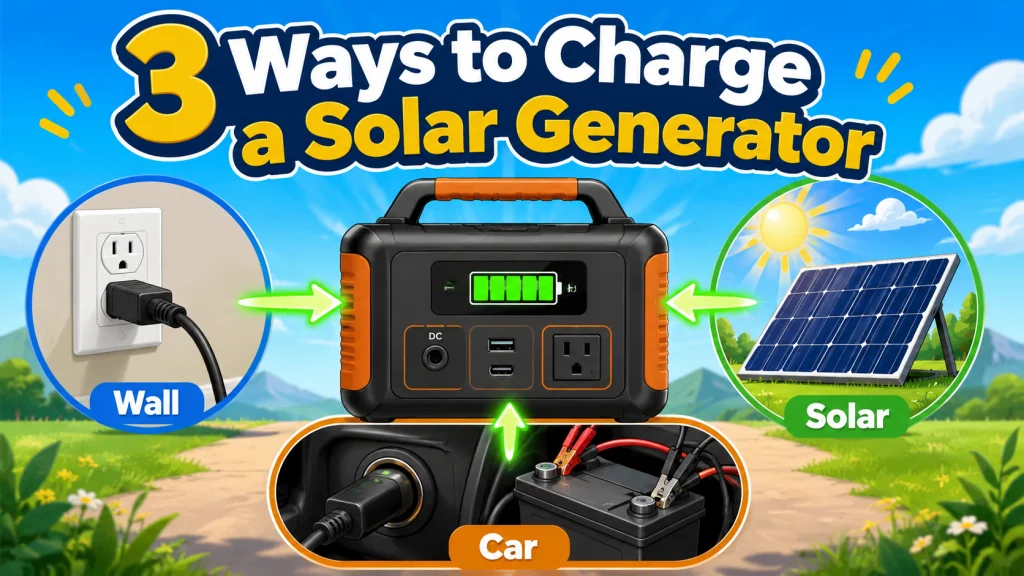
How to charge a solar generator sounds like a simple question until you have done it wrong once. Wall charging is fast and predictable. Solar charging is renewable and independent but almost always slower than the manufacturer spec sheet implies. Car charging is an option, but the actual rate makes it useful only in a narrow set of situations. The choice between these methods is not just a matter of convenience. It affects whether you have a full battery in two hours or you are still charging 14 hours later.
The most common mistake I saw repeat across hundreds of transactions at the shop was owners treating all three methods as roughly equivalent and grabbing whichever was nearby. A 2,000Wh unit charging at 1,800W from the wall fills in about 80 minutes. That same unit on a single 200W solar panel in real-world conditions takes more than 13 hours. If an outage is forecast for that evening, that difference matters a great deal. Knowing which method to reach for, and what the realistic timeline is for each, is the first practical skill worth building for anyone who owns one of these units. For a broader look at how charging fits into the full ownership picture, the guide on how to use a solar generator covers everything from first charge through long-term maintenance.
| Situation | Best method | Why | Watch out for |
|---|---|---|---|
| Outage forecast tonight | AC wall charging | Fastest and most predictable | App charging speed setting accidentally reduced |
| Long drive to a campsite today | Car charging (top-off) | Adds 200 to 300Wh during the drive | Engine must be running to avoid draining car battery |
| Multi-day off-grid use | Solar panel charging | Only renewable method; no fuel required | Plan for 70 to 80 percent of rated panel output, not spec-sheet time |
| Need fastest possible recovery | Simultaneous AC + solar | Both inputs are additive | Confirm your specific model supports combined input |
The table is a quick reference. Each section below covers the real numbers and what to watch out for.
The Charging Specs That Actually Matter
Battery capacity gets most of the attention when people evaluate a solar generator, but it is the wrong number to focus on when you are thinking about charging. Capacity tells you how much energy the unit holds, not how fast it charges or what methods it supports. The specs that drive charging behavior are a different set of numbers, and they are all in the unit’s documentation if you know where to look.
- Maximum AC input wattage: This determines wall charging speed. A unit with a 200W AC input ceiling can only draw about 200W from the wall. A larger battery still takes longer to fill because the input rate has not changed.
- Maximum solar input wattage: This is the hard ceiling for panel charging speed. Adding more panels beyond this number produces no additional input.
- Solar input voltage and current range: Your panel’s open-circuit voltage must stay below the unit’s maximum solar input voltage, and the panel’s working voltage should fall within the unit’s MPPT range. The connector fitting is not enough confirmation. Voltage outside spec can trigger BMS protection or damage the charge controller.
- Car charging input rate: Usually listed as a wattage or amp rating. Most units accept 8 to 10 amps at 12V, which equals roughly 100W. Some units have a higher-rate DC car charging option via a dedicated cable.
- Simultaneous input support: Not all models accept AC and solar at the same time. Check the spec sheet or manual before assuming combined charging is available on your unit.
- Pass-through support: Whether the unit can power loads from the output while charging. Most full-size solar generators support this, but the specific limits on simultaneous draw vary by model.
When comparing units before purchase, these six specs tell you more about day-to-day charging experience than battery capacity alone. A 2,000Wh unit with a 200W AC input ceiling takes roughly 10 hours to fully charge from the wall. A 2,000Wh unit with a 1,800W AC input ceiling takes about 80 minutes. Same battery size, completely different ownership experience. Smaller portable power stations also sometimes list USB-C PD as an input option, but for full-size solar generators, the three practical charging methods are wall, solar, and car, plus combined variations where the unit supports it.
AC Wall Charging: Fastest and Most Reliable, With One Easy Trap to Miss
Wall charging is what you use when speed matters and an outlet is available. The grid delivers consistent voltage, the unit’s internal charger converts it without weather variables getting in the way, and the numbers are predictable. Charge times vary by battery size and the unit’s maximum AC input rating. The following are representative real-world planning numbers across the common capacity classes:
| Unit capacity | AC input rate | Approx. charge time (0% to 100%) |
|---|---|---|
| 500Wh | 200W | ~2.5 hours |
| 1,000Wh | 500W | ~2 hours |
| 2,000Wh | 1,800W | ~80 minutes |
The manufacturer spec sheet sometimes lists slightly shorter times under conditions that do not reflect average use, so I work from these numbers when planning around a charge window. One thing the spec sheet typically does not mention: charging slows noticeably in the final 20 percent of the battery. A unit may fill from 0 to 80 percent relatively quickly, then take a meaningful chunk of additional time to reach 100 percent. This is normal BMS behavior, not a problem with the unit.
The trap with wall charging is less obvious than it sounds. Some units let you control the AC charging speed through an app, and if that setting gets dragged down by accident, the unit draws a fraction of its maximum input rate. I have heard from owners who were convinced their unit was broken because it was pulling 100W from the wall when it should have been pulling 1,800W. The unit was fine. The app setting was wrong. Before concluding there is a problem, open the app and verify the charging speed is set to maximum. A full breakdown of AC charging, including what happens when you charge from a gas generator rather than the grid, is in the article on solar generator AC charging.

Weighing just 23.8 lbs with a foldable handle, this 1,070Wh LFP power station delivers 1,500W of pure sine wave AC output with a 3,000W surge capacity, capable of running AC units, fridges, and electric pots. Its LFP battery sustains over 70% capacity after 4,000 cycles, translating to a lifespan of more than 10 years. Via the Jackery App, you can enable a full charge in as little as one hour, or switch to a whisper-quiet 30 dB overnight mode. Six output ports including two USB-C with 100W PD charging cover nearly any device simultaneously.
Check On AmazonIf you click this link and buy, we earn a commission at no additional cost to you.
Solar Panel Charging: The Only Off-Grid Method, and the Real Numbers Behind It
Solar charging is the method that makes a solar generator genuinely independent. No grid, no fuel, no scheduled delivery. That independence comes with a real tradeoff: charging from solar almost always takes longer than the unit’s spec sheet suggests. The stated charge time is calculated under ideal lab conditions, meaning full rated panel output at the optimal temperature, perfect angle, zero shading, and no line losses. In the field, real-world panel output runs at roughly 70 to 80 percent of the rated wattage. That gap is consistent and it compounds over a full charge cycle.
The formula for a realistic estimate is straightforward. Divide the battery’s watt-hour capacity by the real panel output, which is the panel’s rated wattage multiplied by 0.75. That gives you hours to a full charge. A 2,000Wh unit with a 200W panel at 75 percent real output is pulling about 150W of actual input. Two thousand divided by 150 is 13.3 hours. The spec sheet on the same unit might list 10 hours. Both numbers follow from the math. Only one reflects what most people experience.
Field Note: The most consistent complaint I heard from new solar owners at the shop was that their panels were not performing the way they expected. In most cases, it came down to one of two things: they were comparing their actual charge time against the spec-sheet number without accounting for real-world output losses, or there was a shadow on part of the panel they had not noticed. A single branch, an eave, a corner cast from a parked vehicle. One shaded cell can drop a panel’s output by 20 to 50 percent depending on the bypass diode design. I started checking the shadow line before every setup on the homestead, same as I used to tell buyers to do before they left the counter.
There is also a ceiling that does not move regardless of how many panels you add. Every solar generator has a maximum solar input wattage spec. Adding more panels above that number produces zero additional charging speed. The unit’s input rating is the hard ceiling, not the panel count. The full breakdown of the real charging time formula, what limits solar charging speed, and how ambient temperature affects panel output is in the article on how long it actually takes to charge a solar generator with solar panels.

Built with IBC cells at 25% conversion efficiency, this bifacial panel absorbs sunlight from both sides and bends up to 221 degrees to conform to curved surfaces like car roofs and balconies. At just 4.52 lbs it is 56% lighter than rigid panels, and IP68 waterproofing plus IEC TS 63163 certification across 19 international tests ensure reliable output from -40 to 85 degrees Celsius. A 3-meter flat cable enables flexible installation in under 5 minutes.
Check On AmazonIf you click this link and buy, we earn a commission at no additional cost to you.
Car DC Charging: Useful in One Specific Situation, Impractical for Everything Else
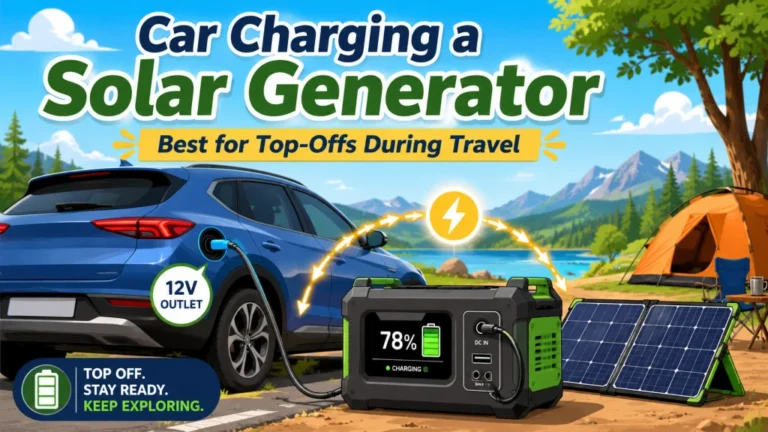
Car charging sounds more useful than it is. The picture people have is plugging the unit into the vehicle on a long drive and arriving with a full battery. The reality is that most solar generators draw about 100W from a car’s 12V cigarette lighter port at 8 to 10 amps. At that rate, a 1,000Wh unit takes roughly 10 hours to fully charge from empty. A 2,000Wh unit takes about 20 hours. Car charging is a trickle method, not a restoration method.
What car charging is genuinely useful for is topping off a partially depleted unit during a long drive. If you leave for a camping trip with the unit at 50 percent charge and you have a three-hour drive, you can reasonably add 200 to 300Wh over that time. You arrive at the campsite with 70 to 80 percent instead of 50 percent. That is a meaningful difference when the next solar charging opportunity is the following morning. The mistake is reaching for car charging as a primary recharge method when wall charging or solar is available within a reasonable timeframe.
Warning: Charging a 100W load from the car’s 12V port with the engine off draws about 8 amps continuously from the vehicle battery. A standard car battery holds roughly 40 to 60 amp-hours at 12V. A three-hour session with the engine off pulls a meaningful share of your starting reserve. Always run the engine when car charging unless the vehicle battery condition is known and tested.
Some units also accept higher-rate DC input from a vehicle through a dedicated cable at 120 to 200W, depending on the unit and what the vehicle’s output port can support. Check your unit’s spec for the maximum car charging input before assuming the cigarette lighter port is the only option. The full breakdown of car charging rates, the vehicle battery drain risk, and the situations where it is actually worth doing is in the article on solar generator car charging.
Simultaneous Charging: How to Combine Methods and Shorten the Recharge Window
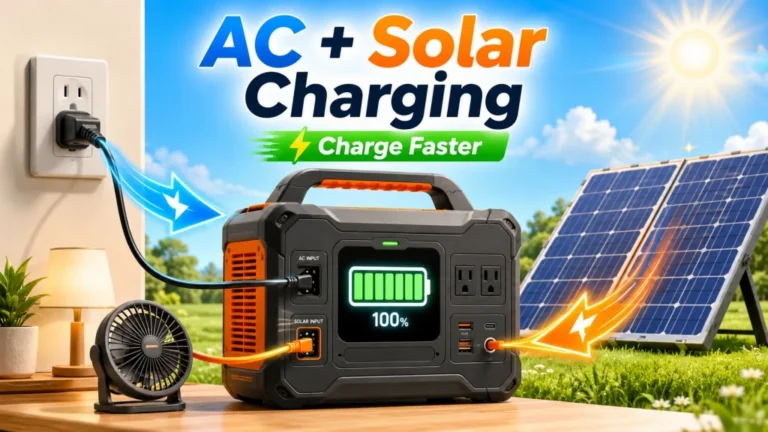
Most solar generators accept two inputs at the same time, and the inputs are additive. A unit drawing 1,800W from the wall and 400W from solar panels simultaneously is pulling 2,200W of combined input. That same 2,000Wh unit that takes 80 minutes on wall power alone fills in considerably faster when solar is running alongside it. When you need to restore capacity quickly and have access to both methods, there is usually no reason to use only one, as long as your model supports combined input. Check your unit’s manual before assuming this feature is available.
The charge-while-using feature works along the same lines. Most major portable solar generators support pass-through use, meaning you can run appliances from the output ports while the battery charges at the same time. The net charge rate is total input watts minus total load watts. If 400W is coming in from solar and a 200W device is running from the output, the battery charges at 200W net. It is slower than charging without a load, but the battery is still gaining capacity, which matters during a sustained outage where you need to run things and refill at the same time. Confirm your specific model’s pass-through limits in the manual, since behavior can vary.
One efficiency point worth knowing: charging via the direct solar DC input port is more efficient than converting solar DC to AC through an inverter and then reconverting that AC back to DC in the battery. The DC path skips one conversion step and loses roughly 10 to 15 percent less energy as heat. For off-grid setups where solar is consistently available, prioritizing the solar input port over the AC input when both sources are accessible is the more efficient approach. The full details on simultaneous charging, the charge-while-using limits, and the efficiency tradeoffs are covered in the article on solar generator simultaneous charging.

This compact plug-in monitor tracks the energy consumption of any AC 115-volt appliance and displays real-time readings of volts, amps, and wattage at 0.2 to 2.0 percent accuracy. Its large LCD screen lets you calculate electricity costs by the day, week, month, or year, making it easy to spot energy-hungry devices and trim your utility bill. It is also compatible with inverters, adding flexibility for off-grid setups.
Check On AmazonIf you click this link and buy, we earn a commission at no additional cost to you.
Final Thoughts: Match the Method to the Situation
Three methods, four distinct situations to match them to. The decision table at the top of this article is a quick reference. The sections above are where the reasoning behind each choice lives. Wall charging when speed and an outlet are both available. Solar when grid and fuel are off the table. Car charging for the top-off during a long drive. Combined input when both AC and solar are within reach and you need the battery back as fast as possible.
The most useful thing I can pass on from both the retail side and from running my homestead on one of these units: do not wait until the power goes out to find out what each charging method actually delivers under your conditions. Run a charge cycle on each method you plan to rely on, time it, and note the result. A unit you understand thoroughly in normal conditions is a significantly more useful tool in an emergency than one you are figuring out for the first time in the dark.

This UL-certified 12-AWG cord handles up to 15 amps, 125 volts, and 1,875 watts across a bright yellow SJTW jacket rated from -40 to 140 degrees Fahrenheit for indoor and outdoor use. Reinforced blade prongs resist bending and cracking, and a lighted end confirms when power is live. Backed by a U.S. veteran-owned business committed to resolving any product issues.
Check On AmazonIf you click this link and buy, we earn a commission at no additional cost to you.
Charging Method Guides
Each charging method has its own mechanics, real-world variables, and failure modes that go beyond what an overview can cover. The four articles below go deeper into each topic, starting from the most commonly used method and working through to the more specialized situations.
| Article | What it covers |
|---|---|
| Solar Generator AC Charging | Real charge times by unit class, the app throttle trap that makes wall charging look broken, and how dirty power from a gas generator affects the charge |
| How Long to Charge a Solar Generator With Solar Panels | The actual charging time formula, why the spec-sheet number is not achievable, and what sets the hard ceiling on solar charging speed regardless of panel count |
| Solar Generator Car Charging | Real car charging rates in watts, how much capacity gets added during a typical drive, and the vehicle battery drain risk when charging with the engine off |
| Solar Generator Simultaneous Charging | How to combine AC and solar inputs for faster charging, the charge-while-using limits, and why the DC input path is more efficient than AC input when solar is available |
FAQs
⚡ What is the fastest way to charge a solar generator?
AC wall charging at the unit’s maximum input wattage is the fastest single method. Combining wall charging and solar panel input simultaneously is faster still, since both inputs are additive. Before assuming wall charging is running at full speed, verify the charging speed setting in the unit’s app has not been accidentally reduced.
🔌 How long does it take to charge a solar generator from a wall outlet?
It depends on the unit’s battery capacity and its maximum AC input wattage. A 500Wh unit at 200W input takes about 2.5 hours. A 1,000Wh unit at 500W takes roughly 2 hours. A 2,000Wh unit at 1,800W takes around 80 minutes. Check the maximum AC input spec, not just the battery size, and expect some slowdown in the final 20 percent as the BMS tapers the charge rate.
☀️ How long does it take to charge a solar generator with solar panels?
Longer than the spec sheet suggests. A 2,000Wh unit with a 200W panel running at 75 percent real output delivers about 150W of input and takes roughly 13 to 14 hours in full sun. Use this formula: battery Wh divided by (panel watts times 0.75) equals hours to full charge. Also confirm your panel setup stays within the unit’s solar input limits, especially the voltage and current ranges. Panel wattage above the unit’s input ceiling will not make charging faster.
🚗 Can you charge a solar generator from a car?
Yes, but the rate is slow. Most units draw about 100W from a car’s 12V cigarette lighter port, which means a 1,000Wh unit takes roughly 10 hours to fully charge. Car charging is useful for topping off during a long drive, not for full recharges. Always charge with the engine running to avoid draining the vehicle battery.
🔋 Can you use a solar generator while it is charging?
Most major portable solar generators support pass-through use, so you can run appliances from the output ports while the battery charges at the same time. The net charge rate is total input watts minus total load watts. As long as input exceeds the load, the battery is still gaining capacity. Confirm your specific model supports pass-through and check its limits in the manual.
🌡️ Is it safe to leave a solar generator plugged into the wall all the time?
Modern units with LiFePO4 batteries include BMS protection that stops charging once the battery is full, which makes extended wall connection reasonably safe in most cases. For long-term storage, charging to around 80 percent rather than 100 percent reduces sustained voltage stress on the cells. Check the unit’s manual for the manufacturer’s specific recommendation on storage charge level.