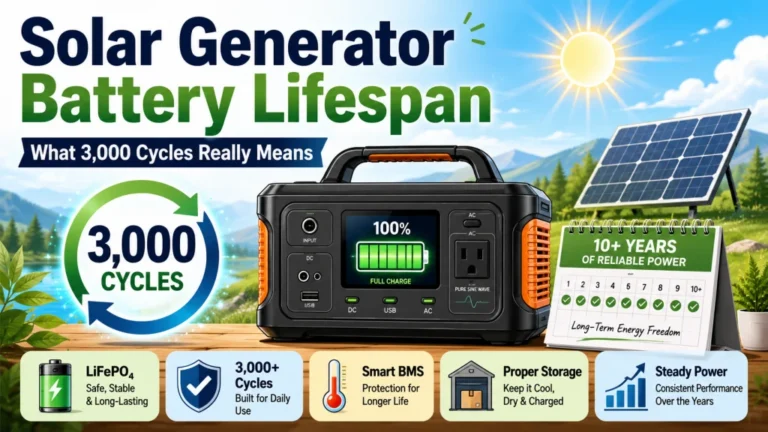
The Spec That Trips Every First-Time Buyer
I saw the same moment of confusion play out at the counter more times than I can count. A buyer would hold up two units, point to the spec sheets, and ask which battery would last longer. One said 3,000 cycles. One said 6,500 cycles. They wanted to know if the second one was worth the price difference. The question they almost never asked first was: how often do you actually plan to use it?
That question is everything. The same 3,000-cycle battery represents a decade of useful life for a daily off-grid user and several generations of ownership for someone keeping a unit charged in a closet for emergencies. The cycle count is not a fixed lifespan number. It is a ratio, and you supply one half of it. Until you know how often you will actually discharge the battery and by how much, the number on the spec sheet is largely decorative.
Understanding the full picture of how battery age, storage, and degradation interact is covered in how solar generator battery lifespan works across all three factors. This article focuses specifically on the cycle count, how to do the math for your situation, and what that 80 percent capacity threshold actually looks and feels like in practice.
What One Cycle Actually Is
A cycle is the cumulative use of 100 percent of the battery’s capacity, regardless of how that use is spread out. You do not need to drain the battery from full to empty in a single session to count as one cycle. The battery management system tracks total discharge over time.
This sounds technical but the practical implication is straightforward. Use 50 percent of the battery today and recharge it, then use 50 percent tomorrow and recharge it again: that is one cycle total, not two. Use 25 percent across four separate days: one cycle. Use 10 percent ten times over two weeks: one cycle. The depth of each individual use is what determines how quickly cycles accumulate, not how many times you plug in the charger.
This is the part most buyers miss. A unit used lightly for short durations accumulates cycles far more slowly than the spec sheet implies when you read it as “one cycle per charge session.” The emergency prep buyer who charges the unit to full after a power outage and then stores it for the next six months barely moves the cycle counter at all. The off-grid homesteader running the battery from 90 percent down to 20 percent every single day is adding roughly 0.7 cycles per day.
The Calculation: Rated Cycles Divided by Your Annual Usage
The formula is simple. Take the rated cycle count at 80 percent capacity. Divide it by your estimated cycles per year. The result is how many years before the battery reaches that threshold.
Key point: Years to 80% capacity = rated cycle count divided by your cycles per year. Your cycles per year = total annual depth of discharge divided by 100 percent.
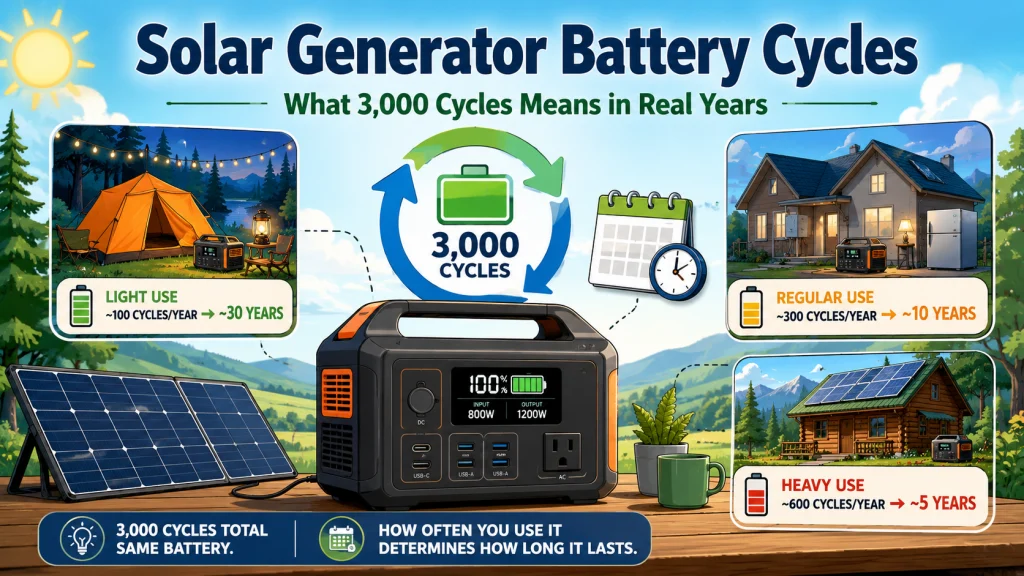
Calculating your cycles per year requires knowing two things: how often you use the battery and how deeply you discharge it on each use. A weekly camper who takes the unit from 95 percent down to 15 percent every Saturday is using about 80 percent of capacity per session. At 52 sessions per year, that is roughly 42 full cycles annually. At 3,000 rated cycles, the math returns about 71 years. For that buyer, the cycle count on the spec sheet is genuinely irrelevant to the purchase decision.
The daily off-grid user runs the same 80 percent depth of discharge, but 365 days a year instead of 52. That is approximately 292 cycles annually. At 3,000 rated cycles, the same battery reaches its 80 percent capacity threshold in just over 10 years. Still a solid service life, but now the cycle count is an actual decision variable worth paying attention to when choosing between a 3,000-cycle unit and a 5,000-cycle unit at different price points.

With a 3,600Wh LFP battery expandable up to 25kWh via extra batteries or smart generators, this station delivers 3,600W across 15 output ports, boosted to 4,500W with X-Boost or 7,200W when two units are paired. A full recharge takes just 1.8 hours via 240V or 2.8 hours with 1,600W of solar input. It may also qualify for the 30% Residential Clean Energy Tax Credit.
Check On AmazonIf you click this link and buy, we earn a commission at no additional cost to you.
Three Buyers, Three Very Different Answers
Run the math across the three most common buyer types and a clear picture emerges. The cycle spec that looks identical on a box translates into wildly different real-world relevance depending on how the unit is actually used.
| Buyer Type | Estimated Usage | Cycles per Year | Years to 80% Capacity at 3,000 Cycles |
|---|---|---|---|
| Emergency prep only | 1 actual use every 1-2 years at ~50% depth, plus occasional maintenance charges | ~0.25 to 0.5 | 6,000 to 12,000+ years. Battery outlasts the entire product lifecycle. |
| Weekly camper | 52 weekend uses per year at ~80% depth | ~42 | ~71 years. Cycle count is not a relevant purchase decision factor. |
| Daily off-grid user | 365 uses per year at ~80% depth | ~292 | ~10 years. Cycle rating directly affects total ownership cost. Worth paying for a higher-rated unit. |
The practical takeaway from that table: if you are buying a unit for emergency preparedness or seasonal camping, the cycle count on the spec sheet is not a meaningful differentiator. A 3,000-cycle battery will not be the reason you replace the unit. For daily off-grid users, the gap between a 3,000-cycle and a 5,000-cycle unit is the difference between 10 years and roughly 17 years of service before hitting the 80 percent threshold. At a meaningful price difference between those units, that math is worth running.
Field Note: Customers who asked most urgently about cycle counts were usually the people who needed it least. Emergency prep buyers would come in worried about whether 2,000 cycles was enough. I would ask how often they expected to actually run the battery to empty. The answer was almost always “maybe once or twice a year if there’s a real storm.” The math for that use case returns numbers that are effectively infinite. The daily users, the ones running homesteads and live-aboard boats, rarely asked about cycle counts at all, which was the one group where the spec actually mattered to the long-term calculation.

This compact plug-in monitor tracks the energy consumption of any AC 115-volt appliance and displays real-time readings of volts, amps, and wattage at 0.2 to 2.0 percent accuracy. Its large LCD screen lets you calculate electricity costs by the day, week, month, or year, making it easy to spot energy-hungry devices and trim your utility bill. It is also compatible with inverters, adding flexibility for off-grid setups.
Check On AmazonIf you click this link and buy, we earn a commission at no additional cost to you.
What “80 Percent Capacity” Looks Like When You Get There
The 80 percent threshold is not a cliff. The battery does not stop working at that point. It holds less charge, which means shorter runtime per session, but it continues to function as a power source. Most buyers who reach this stage simply notice they need to recharge more frequently before performance becomes noticeably inconvenient.
Put actual numbers to it. A 2,000Wh battery at 80 percent capacity holds 1,600Wh. Running a 150W average load, the original unit delivers about 11 hours of runtime at 85 percent real-world efficiency. At 80 percent capacity, that same load runs about 9 hours. The difference is two hours of runtime. For most home backup and camping use cases, that reduction is manageable without replacing anything.
The more telling marker is often 70 percent capacity, not 80. At 70 percent, a 2,000Wh unit holds 1,400Wh and the runtime reduction starts becoming inconvenient for demanding loads. That is roughly 3 hours less overnight runtime on a refrigerator-plus-lights load. Whether that triggers a replacement decision depends entirely on the use case. A CPAP backup unit that originally ran three nights before needing a recharge now runs two. That changes nothing for most users. A daily off-grid setup that sized the original unit tightly may now require mid-day supplemental charging to get through the night.
Depth of Discharge Extends Your Real-World Cycle Count
The rated cycle count on the spec sheet assumes a specific depth of discharge, typically 80 to 100 percent per cycle. If you regularly use less than that, each real-world session counts for a smaller fraction of a full cycle, and the rated number extends accordingly.
Here is what that looks like in practice. A 3,000-cycle battery used at 60 percent depth of discharge per session is only accumulating 0.6 cycles per session rather than 1.0. Divide 3,000 by 0.6 and you get roughly 5,000 partial-use sessions before reaching the rated cycle threshold. At one session per day, that translates to about 14 years instead of roughly 10.
The practical rule: try not to run the battery below 20 percent remaining charge. LiFePO4 chemistry handles deep discharge better than NMC, but sustained deep cycling still accumulates stress faster than partial cycling. Staying between 20 and 90 percent state of charge on most cycles, rather than running 100 to 0 and back repeatedly, measurably extends total lifetime cycle count beyond what the spec sheet states as the rated figure.
- 20% to 100% per cycle (80% depth): counts as 0.8 of a full cycle per session. At this rate, 3,000 cycles takes about 10 years of daily use.
- 20% to 80% per cycle (60% depth): counts as 0.6 of a full cycle. At this rate, 3,000 cycles extends to roughly 14 years of daily use.
- 30% to 80% per cycle (50% depth): counts as 0.5 of a full cycle. 3,000 cycles stretches to approximately 16 to 17 years of daily use.
- Below 10% to 100% (full deep cycle): counts as 1.0 or slightly more due to additional stress on cell chemistry at the low end. Avoid this pattern for any unit you intend to keep long-term.
The tradeoff is that setting a conservative upper charge limit of 80 to 85 percent also means you have slightly less usable capacity for demanding loads. On a 2,000Wh unit, charging to 80 percent instead of 100 leaves you with 1,600Wh available rather than 2,000Wh. For most routine use cases that buffer is fine. For a unit that is being sized tightly for a specific overnight load, charge to full and accept the marginal additional cycling rather than running short on capacity.

Starting at 2kWh and expandable up to 8,448Wh with compatible expansion batteries, this LiFePO4 station delivers 2,400W across 11 ports including a 30A TT-30 RV port, dual 100W USB-C, and a dedicated 48V RV charging port. It reaches 80% in just 60 minutes via AC input and fully charges in under 4 hours with 1,200W of solar. The battery is rated for 3,000 plus cycles across a 10-year lifespan.
Check On AmazonIf you click this link and buy, we earn a commission at no additional cost to you.
Calendar Aging: The Other Clock Running Against Your Battery
Batteries degrade from time, not just cycles. A unit stored perfectly for 10 years will have measurably less capacity than when it was new, even if the cycle counter barely moved. The rate of calendar aging for LiFePO4 under good storage conditions is roughly 2 to 3 percent capacity loss per year. A 2,000Wh unit loses approximately 40 to 60Wh per year to time alone.
For the emergency prep buyer who concluded from the cycle math that the battery will theoretically last thousands of years, this is the more relevant degradation pathway. Calendar aging does not care about cycle count. Proper storage conditions, specifically maintaining 40 to 60 percent state of charge and keeping temperatures below 77 degrees F, slow this process meaningfully. A unit stored at full charge in a hot garage is losing capacity from both elevated voltage stress and elevated temperature, accumulating calendar degradation faster than the numbers above assume.
The right way to think about both clocks together: cycle degradation is the primary concern for frequent users, calendar degradation is the primary concern for infrequent users. For the daily off-grid homesteader, cycle count matters. For the emergency prep buyer storing a unit for a decade, storage conditions matter more than anything on the spec sheet. The practices that protect a stored unit from calendar aging are covered in how to store a solar generator to protect battery life.

This 1kWh LFP battery station charges from 0 to 80% in just 50 minutes via AC input, and its LiFePO4 chemistry delivers a 3,000 plus cycle lifespan that is roughly 6 times longer than standard lithium batteries. Capacity is expandable up to 3kWh with additional batteries, making it well suited for camping, RVs, or off-grid living. Its 1,800W output powers across 15 outlets, handling around 90% of household appliances, and accepts up to 500W of solar input for clean, fuel-free charging. The package includes a 5-year customer service guarantee.
Check On AmazonIf you click this link and buy, we earn a commission at no additional cost to you.
Final Thoughts: Run the Math for Your Situation, Not the Average
The cycle count on the spec sheet is a starting point, not an answer. Divide it by your realistic annual usage and you get the number that actually matters for your purchase. Most buyers will find that a 3,000-cycle LFP battery is more than sufficient for their use case without any further comparison shopping on that specific specification. The daily and semi-daily users are the ones for whom a higher cycle rating is genuinely worth a price premium.
What happens after the battery reaches the 80 percent threshold, how to detect when it is getting there, and whether repair or replacement makes more economic sense at that stage are all covered in how to detect solar generator battery degradation. The runtime test described there is something any owner can run without any special equipment, and it gives you a far more accurate picture of actual remaining capacity than the BMS display alone.
The broader context for how cycle count fits into the full set of solar generator specifications worth evaluating before a purchase is in the complete solar generator guide, which covers watt-hours, output wattage, solar input, and battery chemistry alongside lifespan as the five decisions that separate a well-matched purchase from an expensive mistake.
FAQs
🔋 Does a partial charge count as a full cycle?
No. Cycles accumulate based on cumulative depth of discharge. Draining 25 percent four times equals one full cycle, not four. This is why light users accumulate cycles far more slowly than the spec sheet implies at first glance.
📉 What happens to my solar generator after 3,000 cycles?
The battery holds about 80 percent of its original capacity. A 2,000Wh unit becomes a 1,600Wh unit. It still works: runtime per session is shorter, and you recharge more often. Most users at this stage find the reduction manageable rather than a reason to replace immediately.
🏠 Is cycle count something I need to worry about for emergency backup use?
Effectively no, for most emergency prep situations. If you use the battery once or twice a year for actual outages, you are accumulating a fraction of a full cycle annually. Calendar aging from storage conditions matters far more for that use case than the rated cycle count.
📏 Does discharging less deeply per session extend battery life?
Yes. Shallower cycles count as a smaller fraction of a full cycle, so the rated cycle count stretches further in real time. Staying between 20 and 80 percent state of charge on most cycles meaningfully extends total lifetime cycle count compared to running from 100 to zero repeatedly.
📅 Do batteries age even when not being used?
Yes. Calendar aging causes roughly 2 to 3 percent capacity loss per year under good storage conditions, regardless of how many cycles have accumulated. Heat and maximum charge voltage accelerate this. A unit stored at full charge in a hot garage for 5 years will have measurably less capacity than one stored at 50 percent charge in a climate-controlled space.
⚖️ Should I pay more for a 5,000-cycle unit over a 3,000-cycle unit?
Depends on your usage. For daily off-grid users, the math supports the premium: 5,000 cycles at daily use translates to roughly 17 years versus 10. For weekly campers or emergency prep buyers, the additional 2,000 cycles will never realistically be used, so the premium adds no practical value.