The Spec Most Buyers Skip Over
Every solar generator spec sheet lists a battery type somewhere near the bottom, after the wattage and capacity numbers that dominate the marketing. Most buyers never scroll that far. The ones who do make a fundamentally different purchase decision, and I watched this play out repeatedly behind the counter.
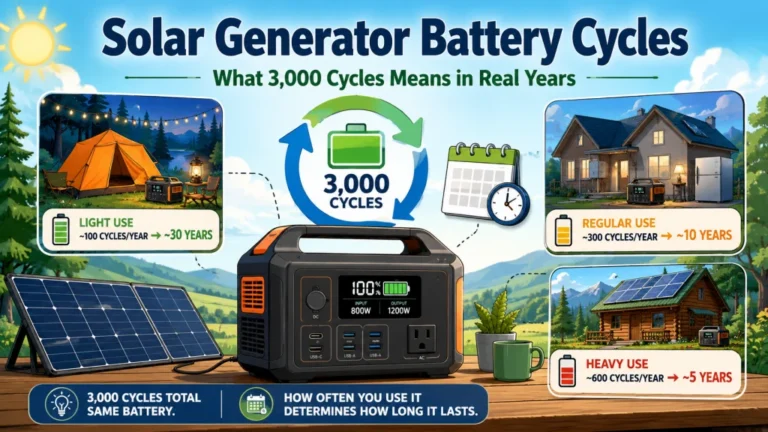
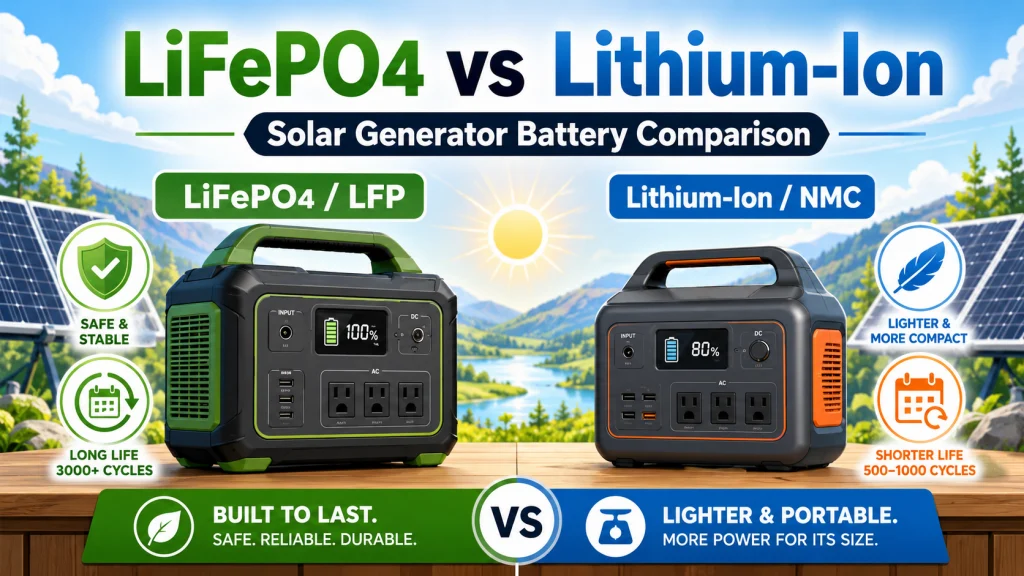
What the battery chemistry tells you is how many charge-and-discharge cycles the battery can handle before it drops to 80 percent of its original capacity. That number, divided by how often you plan to use the unit, gives you the realistic service life. It is the most honest lifespan signal on the page. Two units side by side can have identical watt-hour ratings, identical output wattages, and nearly identical prices, and still have a three-to-four times difference in expected lifespan encoded into the chemistry specification. One uses LiFePO4. One uses NMC lithium-ion. Same-looking box. Very different product from a longevity standpoint.
The reason this matters more than buyers typically expect is the math at realistic usage patterns. A unit used once a week at 3,000-cycle LFP chemistry has a theoretical cycle life of nearly 60 years before hitting 80 percent capacity. A unit used once a week with 800-cycle NMC chemistry reaches that threshold in about 15 years. Both sound fine until you factor in calendar aging and what daily or weekly use actually looks like in practice. For the full calculation across different usage scenarios, what cycle count means in real years of use breaks down the math for emergency prep buyers, weekly campers, and daily off-grid users specifically.

Weighing just 23.8 lbs with a foldable handle, this 1,070Wh LFP power station delivers 1,500W of pure sine wave AC output with a 3,000W surge capacity, capable of running AC units, fridges, and electric pots. Its LFP battery sustains over 70% capacity after 4,000 cycles, translating to a lifespan of more than 10 years. Via the Jackery App, you can enable a full charge in as little as one hour, or switch to a whisper-quiet 30 dB overnight mode. Six output ports including two USB-C with 100W PD charging cover nearly any device simultaneously.
Check On AmazonIf you click this link and buy, we earn a commission at no additional cost to you.
What LiFePO4 Actually Is
LiFePO4 stands for lithium iron phosphate. The iron phosphate part describes the cathode material inside each cell. Instead of cobalt and nickel, LFP uses iron and phosphate compounds. These materials are more abundant, substantially cheaper to source, and more chemically stable under electrical stress than the cobalt-based alternatives.
The stability is what translates into cycle life. LFP cells operate at a lower voltage per cell than NMC, which puts less chemical stress on the cathode material during each charge and discharge. Less stress per cycle means more total cycles before degradation accumulates to the point where runtime becomes noticeably shorter. Manufacturers typically rate LFP batteries at 2,000 to 6,000 cycles before dropping to 80 percent of original capacity. Premium units with conservative cell management often exceed 4,000 cycles. At that level, daily use still translates to more than a decade of serviceable life.
The weight tradeoff is real. LFP has lower energy density per kilogram than NMC, so an LFP unit carries more mass for the same watt-hour rating. A 2,000Wh LFP unit typically weighs 45 to 55 pounds. For car camping or home backup use where you rarely carry the unit more than a short distance, this does not change the calculation. For tent camping beyond the parking lot, it is worth noting before you commit to a unit you will be hauling.
What NMC Lithium-Ion Is
NMC stands for nickel-manganese-cobalt. It is the same chemistry in most smartphones, laptops, and earlier electric vehicle battery packs. Higher energy density per kilogram is its primary advantage, which is why first-generation solar generators used it. When portability and compact form factor were the main engineering targets, NMC made sense.
The cycle life ceiling is the limiting factor. NMC batteries typically reach 80 percent of original capacity somewhere between 500 and 1,500 cycles under real-world conditions. A unit used every day reaches that threshold in somewhere between one and four years depending on where it falls in that range. A unit used once a week does better, but those batteries also age from time and heat independently of cycle count, which compresses the real-world advantage for light users more than the cycle numbers alone suggest.
There is also a thermal behavior distinction worth understanding accurately. Under specific extreme conditions, including a physically damaged cell, a battery management system failure, or sustained use in very high heat, NMC cells can enter thermal runaway. This is a chain reaction where heat generates more heat faster than the system can dissipate it. It is the cause of most lithium battery incidents in the news. LFP cells are far more resistant to thermal runaway under comparable conditions. The iron-phosphate bond is chemically stable enough that the reaction is much less likely to cascade. This is not a marketing claim but a confirmed physical property of the chemistry, and it was the primary reason industrial energy storage manufacturers shifted to LFP before the consumer solar generator market did.

This 1kWh LFP battery station charges from 0 to 80% in just 50 minutes via AC input, and its LiFePO4 chemistry delivers a 3,000 plus cycle lifespan that is roughly 6 times longer than standard lithium batteries. Capacity is expandable up to 3kWh with additional batteries, making it well suited for camping, RVs, or off-grid living. Its 1,800W output powers across 15 outlets, handling around 90% of household appliances, and accepts up to 500W of solar input for clean, fuel-free charging. The package includes a 5-year customer service guarantee.
Check On AmazonIf you click this link and buy, we earn a commission at no additional cost to you.
The Numbers Side by Side
Put the two chemistries against each other on the specifications that actually determine long-term purchase value, and the picture becomes straightforward.
| Specification | LiFePO4 (LFP) | NMC Lithium-Ion |
|---|---|---|
| Cycle life to 80% capacity | 2,000 to 6,000 cycles | 500 to 1,500 cycles |
| Typical service life at regular use | 8 to 15+ years | 2 to 6 years |
| Thermal runaway risk | Very low, chemically stable | Present under extreme stress |
| Energy density per kilogram | ~150 Wh/kg, heavier per Wh | ~220+ Wh/kg, lighter per Wh |
| Cell-level cost (Sep 2024) | ~$59/kWh | ~$69/kWh |
| Market position, current units | Standard across premium and mid-range | Budget units and discontinued models |
The cell cost row is the one most articles have not caught up with. As of September 2024, LFP cells are actually cheaper per kilowatt-hour at the manufacturing level than NMC cells, according to Benchmark Mineral Intelligence pricing data. The narrative that LFP costs more upfront was accurate for several years and is now simply wrong for the mid-range and above. The finished product premium for LFP over NMC has largely closed and in some segments reversed.
The Safety Difference, Explained Without Alarm
I want to be precise here rather than create unnecessary anxiety. NMC batteries in quality solar generators from reputable manufacturers do not spontaneously fail under normal use. The thermal runaway risk requires specific triggering conditions: a physically damaged cell, a charge controller malfunction, or sustained operation in extreme heat. Battery management systems in quality units are specifically designed to prevent all of these.
The distinction becomes most relevant for two use cases. The first is indoor operation during extended power outages, particularly in enclosed spaces with limited ventilation. The second is hot storage environments like vehicles, sheds, and sun-exposed garages during summer. In both cases, LFP’s chemical stability removes a category of concern that simply does not need to exist. I am comfortable recommending LFP for anyone running a unit in a basement bedroom during a winter storm without qualification. NMC from a quality brand is manageable but requires more awareness of the environment.
Field Note: The question I heard most at the shop about indoor use was almost always from people who had seen something about lithium battery fires and were not sure what chemistry was in the unit they were about to buy. Every time, the path through that conversation was the same: confirm LFP, and the concern essentially disappeared. That question came up much less frequently as LFP became the default in branded units, because buyers started checking before they bought instead of after.
How the Market Shifted and What That Means Today
As of 2024 and into 2025, virtually every current-production solar generator from the major brands has moved to LFP chemistry across its main product lines. This was not a gradual drift. It was a deliberate transition driven by two things happening simultaneously: LFP cell costs falling below NMC at the manufacturing level, and buyers becoming educated enough to filter on chemistry before completing a purchase.
What remains on the NMC side is mostly discontinued models still in inventory at retailers, budget no-name units under $300 targeting buyers who will not check the spec sheet, and a handful of older configurations in secondary markets. If you are shopping new from a recognized brand in the $500-and-above range today, there is a good chance you are already looking at LFP without needing to filter for it. Confirm rather than assume, because the transition is not universal and some listings do not make the chemistry easy to find.
I have watched buyer behavior around this shift in deal communities. On a solar generator bundle deal thread in October 2025, one commenter posted: “you probably should be getting LiFePO4 not lithium-ion.” The reply from another user: “Woah yeah lithium ion kills this deal.” These were real buyers walking away from a specific deal specifically because of battery chemistry. The consumer education gap on this specification closed faster than most people in the industry expected.

This 1152Wh LiFePO4 station outputs 1800W across 8 outlets and can be boosted to 2700W through the BLUETTI app for demanding appliances. A full AC charge takes just 1 hour at 1440W input, or 2.8 to 3.3 hours with up to 500W of solar. It doubles as a home UPS with a 20-millisecond switchover for emergency backup. Comes with a 5-year warranty and all essential charging cables included.
Check On AmazonIf you click this link and buy, we earn a commission at no additional cost to you.
How to Confirm Battery Chemistry Before Buying
The spec sheet will tell you. Look for “LiFePO4,” “LFP,” or “lithium iron phosphate” in the battery specifications section. If the listing says “lithium-ion” or “Li-ion” without further qualification, assume NMC. If it says only “lithium battery” with no chemistry name, that is either NMC or an attempt to avoid the question.
- LFP confirmed terms: “LiFePO4,” “LFP,” “lithium iron phosphate,” or “lithium ferro phosphate”
- NMC terms: “NMC,” “NCM,” “lithium-ion” without qualification, or just “Li-ion”
- Chemistry unlisted: check the full technical specifications tab and the user manual PDF before buying
- Best source: the brand’s official product page, not a reseller listing, which may omit or obscure this detail
If you cannot find the battery chemistry after checking the spec sheet, user manual, and brand product page, that absence is itself information. Manufacturers who use LFP list it clearly because it is a selling point. If a seller cannot confirm battery chemistry on a $600 unit they are actively selling, that hesitation tells you something about the support you can expect after the purchase.
The Weight and Cost Tradeoff in Real Ownership Terms
LFP units are heavier for the same watt-hour capacity. The gap is real but not dramatic. A 2,000Wh LFP unit typically weighs 45 to 55 pounds. A comparable older NMC design would be 35 to 45 pounds. That 10-pound difference matters if you are carrying it regularly across a campsite or loading it from ground level into a truck bed as a solo camper. For most home backup and RV scenarios where you move the unit infrequently, it rarely changes the purchase decision.
The cost argument for NMC is now largely historical. The “LFP costs more” framing was accurate for years and drove real purchasing decisions. The cell-level cost reversal confirmed by Benchmark Mineral Intelligence in 2024 means the price premium for LFP at the manufacturing level has not just closed but flipped. Finished product pricing does not always reflect this immediately, but it is directionally moving toward LFP parity and below, particularly at mid-range price points.
The practical way to think about it: a $50 or $100 premium for an LFP unit over an NMC unit of similar capacity is not really a premium at all when you divide it across expected service life. An LFP unit lasting 12 years versus an NMC unit lasting 4 years at the same initial price is about three times the cost per year of service, all else being equal. The upfront number is the wrong frame for this comparison. For a deeper look at how these lifespan differences play out across different ownership situations, how solar generator battery lifespan breaks down across use cases covers what degradation looks like in practice and when replacement makes financial sense.

This compact plug-in monitor tracks the energy consumption of any AC 115-volt appliance and displays real-time readings of volts, amps, and wattage at 0.2 to 2.0 percent accuracy. Its large LCD screen lets you calculate electricity costs by the day, week, month, or year, making it easy to spot energy-hungry devices and trim your utility bill. It is also compatible with inverters, adding flexibility for off-grid setups.
Check On AmazonIf you click this link and buy, we earn a commission at no additional cost to you.
Final Thoughts: Apply the Chemistry Filter First
Battery chemistry is the right starting filter before any other specification comparison. The cycle life gap between LFP and NMC is wide enough that two units at the same price point, same watt-hour rating, and same inverter output can still represent fundamentally different long-term value propositions depending on what is written in the battery type field of the spec sheet.
The practical rule I give anyone researching their first unit: start with LFP as your baseline assumption for any unit you are seriously considering, then verify. If a unit at your price point cannot confirm LFP chemistry in its specification, either ask before buying or account for the shorter expected service life in your cost calculation. For buyers spending $500 or more, the math almost never favors NMC.
Battery chemistry is one piece of the full specification picture. The complete solar generator guide covers how it fits alongside watt-hour sizing, solar input wattage, and output rating as the four specifications that should drive every solar generator purchase decision from the start.

At 1,024Wh with 2,000W continuous output and 3,000W peak, this station powers up to 10 devices at once across a full suite of ports. HyperFlash charging fills it in just 49 minutes via AC, or 1.8 hours with 600W of solar. The UPS switchover triggers in under 10 milliseconds, and the LiFePO4 battery holds 80% capacity after 4,000 cycles for a 10-year lifespan.
Check On AmazonIf you click this link and buy, we earn a commission at no additional cost to you.
FAQs
🔋 Is LiFePO4 the same as LFP?
Yes, they are the same battery chemistry. LFP is shorthand for lithium iron phosphate (LiFePO4). Both terms appear interchangeably on spec sheets and product listings. If you see either one, you have confirmed the chemistry.
⚖️ Does LFP still cost more than NMC in solar generators?
Not at the cell manufacturing level. As of September 2024, LFP cells are cheaper per kilowatt-hour than NMC cells according to Benchmark Mineral Intelligence data. Finished product pricing varies by brand and does not always reflect this immediately, but the “LFP costs more upfront” framing is increasingly outdated at mid-range price points.
🔍 How do I find what battery chemistry is in a solar generator?
Look in the full technical specifications section, not the marketing summary. Search for “LiFePO4,” “LFP,” or “lithium iron phosphate.” If it just says “lithium-ion” or “Li-ion” without qualification, assume NMC. The user manual PDF is often the most reliable source if the product listing is vague or a reseller has omitted the detail.
🛡️ Is NMC lithium-ion unsafe in a solar generator?
Not under normal conditions from reputable brands. Quality battery management systems prevent the extreme scenarios that trigger thermal events. The practical distinction shows up most in confined indoor spaces and high-heat storage environments, where LFP’s chemical stability removes a concern that does not need to exist with the right chemistry.
📦 Why did solar generator brands switch from lithium-ion to LFP?
Two reasons happening together: LFP cell manufacturing costs dropped below NMC costs at scale, and buyers became educated enough to filter on battery chemistry. By 2024, LFP offered better cycle life, better safety margins, and lower cell-level cost. There was no longer a strong engineering or financial argument for NMC in the mid-range solar generator market.
🏕️ Does battery chemistry matter more for camping or home backup use?
It matters for both, but the weight consideration is more relevant for camping and the service life calculation is more relevant for home backup. A daily or weekly home backup unit accumulates cycles fast enough that LFP’s extended cycle life translates to a meaningful difference in years of service. For camping, weight is the more immediate tradeoff to understand.