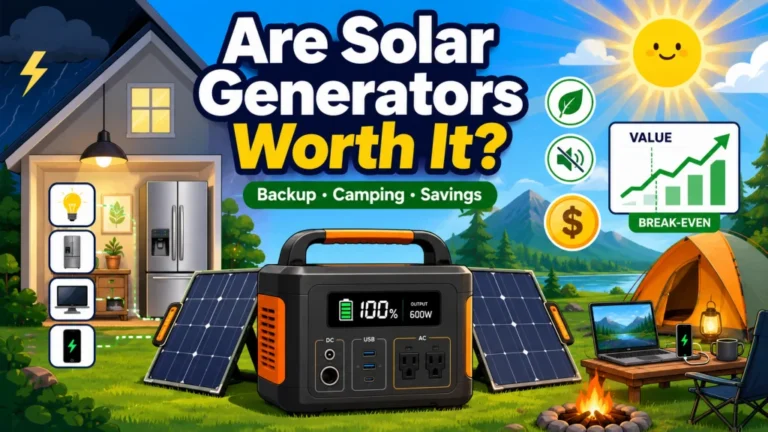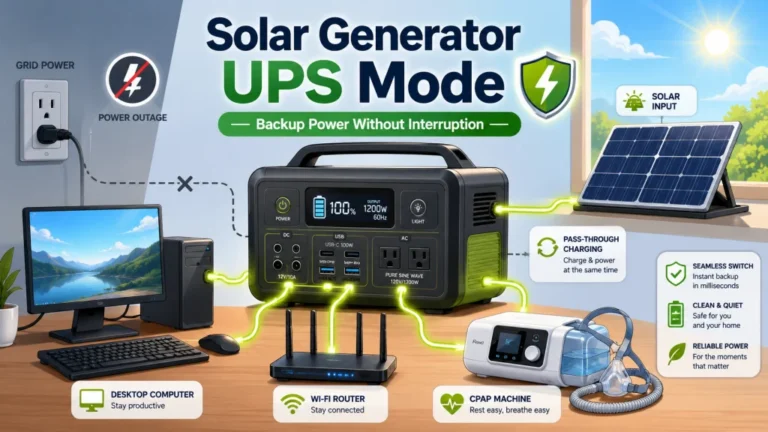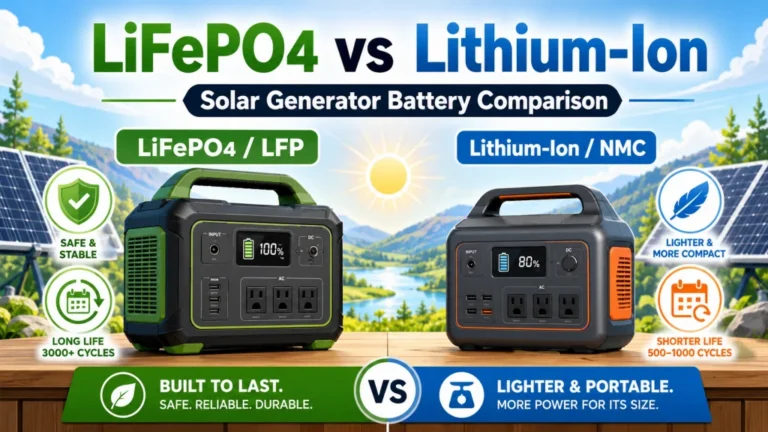
A Solar Generator at Rest Makes No Sound
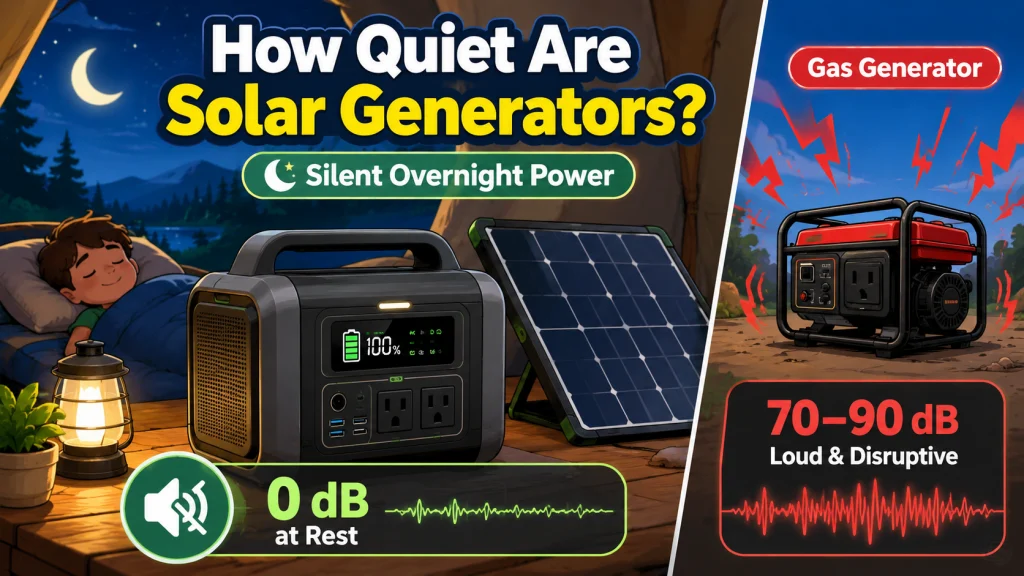
At rest, a solar generator is not merely quiet. The unit itself is silent. No combustion means no exhaust note. No engine means no mechanical vibration. Under typical low-to-moderate discharge loads, there is no fan noise to register from the unit itself. Whether it is running a refrigerator, charging a laptop, or powering a CPAP machine through the night, the power source contributes nothing to the acoustic environment. That surprised more than a few customers I sold to over the years, because the spec sheets do not always make that distinction clearly. They list a noise figure, buyers assume it applies at all times, and then spend months ignoring a unit they could have run in the bedroom from day one.
The noise question becomes real when the cooling fan activates. That fan exists to pull heat away from the battery and inverter electronics, most commonly during high-rate charging, strong solar input, or sustained high AC output loads. It runs because the unit is getting warm, not simply because it is doing something. That distinction matters for how you plan your charging and discharge schedule.
The Decibel Scale You Need to Make Sense of the Numbers
Decibels are logarithmic. A 10 dB increase is not ten percent louder; it is roughly twice as loud to the human ear. That relationship matters when comparing a 30 dB fan to a 70 dB gas generator. They are not separated by a 40 percent difference in volume. They are separated by a perceived loudness gap that is far larger than the arithmetic suggests. Without that context, the numbers on a spec sheet are meaningless.
Here is the reference frame that puts solar generator noise in plain terms:
- 0 dB: threshold of human hearing, effective silence
- 20-30 dB: quiet bedroom at night, rustling leaves outdoors
- 30 dB: a quiet library, a rural setting with no traffic
- 40-50 dB: a quiet conversation across a room, a gentle air purifier on low
- 65 dB: laughing or animated conversation at close range
- 70 dB: a vacuum cleaner running in the next room
- 75-80 dB: a busy restaurant, a lawnmower at moderate distance
- 85-90 dB: heavy street traffic, some older open-frame engines at close range
Keep those reference points in mind when you read solar generator noise figures, because the gap between a 30 dB fan and a 70 dB gas generator is not a minor improvement. It is the difference between ambient background noise and something that wakes up everyone in the house.
Where Solar Generators Actually Land Across Every Operating Mode
The noise varies by what the unit is doing. There are three distinct states, and each produces a different result.
During battery discharge
Running on stored battery power with no simultaneous charging, a solar generator under typical loads produces 0 dB. No fan, no hum, no vibration. If you place one in a bedroom running overnight on stored charge, the appliance it is powering will make more noise than the unit itself. A refrigerator compressor cycling at 45 dB, a CPAP blower at 25-30 dB, a box fan on low at 40 dB: all of these will register before the power source does. The one exception is a sustained very high AC output load near the unit’s continuous watt ceiling, where the inverter generates enough heat to activate the fan briefly. For typical overnight loads well below the unit’s rated ceiling, this does not come up in practice.
During solar panel input
When panels are connected and delivering meaningful current, heat builds up gradually depending on the input wattage. At lower panel inputs of 100-200W, many units do not activate the fan at all, or activate it only briefly in short cycles. At higher solar input above 300-400W, the fan activates more regularly. The noise level when the fan does run during solar charging typically lands in the 20-35 dB range depending on the unit. That is a quiet library. Most people would not describe it as intrusive without specifically listening for it.
During AC wall charging
Wall charging at full rate is where solar generator noise levels are highest. The battery is pulling maximum current, the electronics are working at full load, and heat builds faster than during solar or discharge. In this mode, noise figures from quality units land in the 30-50 dB range depending on charge rate and unit design. The fan at full charge rate on most mid-to-upper tier units stays closer to 30-40 dB. A small number of units push toward 50 dB at maximum wall charge rate, which lands at air purifier or quiet-conversation territory.
| Operating Mode | Typical Noise Range | Comparable Sound |
|---|---|---|
| Battery discharge (no charging) | 0 dB | Silence |
| Battery discharge (sustained high AC output load near ceiling) | 20-35 dB | Quiet library, brief fan cycle |
| Solar panel input (low, fan inactive) | 0 dB | Silence |
| Solar panel input (high, fan active) | 20-35 dB | Quiet library, rustling leaves |
| AC wall charging (moderate rate) | 30-40 dB | Quiet room ambient, low air purifier |
| AC wall charging (full rate) | 40-50 dB | Gentle conversation, soft background noise |
One thing the table does not show: the fan does not run continuously even during wall charging. It cycles on and off based on internal temperature readings. During a four-hour overnight charge, the fan might run actively for 30-45 minutes spread across the session in shorter intervals. If you are sleeping nearby, it is intermittent background noise at worst, not a sustained sound event.

This 600Wh LiFePO4 power station surges to 1200W with X-Boost and switches to UPS backup in under 10 milliseconds, protecting home offices and gaming setups instantly. X-GaNPower technology doubles runtime for appliances under 100W while keeping noise at a whisper-quiet 30 dB. It charges fully in 1 hour via AC or 1.5 hours with solar, lasts 3,000 cycles, and comes with a 5-year warranty.
Check On AmazonIf you click this link and buy, we earn a commission at no additional cost to you.
You Have More Control Over Fan Noise Than You Think
The fan runs harder when the charge rate is higher. Charge rate is often adjustable. That relationship gives you a practical lever for managing noise when it matters.
Field Note: One pattern I saw repeat at the shop: customers who bought a unit for bedroom backup and then complained about fan noise during charging had almost always left the unit plugged in at maximum charge rate on the nightstand. The fix was simple. Charge during the afternoon, disconnect before bed, and wake up to a full battery with no fan noise at all during the night. The unit running silently overnight on stored battery is the use case it was designed for. The noise question almost always came down to when and how fast someone was charging, not the unit itself.
Most units with app connectivity or a front panel display allow you to set a maximum charge rate. Setting wall charging to 200-300W instead of 800-1,000W keeps internal temperatures lower, which means the fan runs less frequently and at lower speed. The tradeoff is a longer charge time, but for overnight or daytime charging when you are not near the unit, that tradeoff costs you nothing practical. At 200W wall input, many quality units produce fan noise closer to 25-30 dB rather than 40-50 dB.
Solar charging is already the quieter default. On a sunny afternoon with the panels doing their job outdoors and the unit sitting inside, you typically get the benefit of a full daytime recharge with minimal or no fan noise indoors depending on the input wattage your panel setup delivers. That is the daily cycle my homestead runs on, and in three years of doing it I have never once thought about noise as a factor during solar charging hours.

Built with IBC cells at 25% conversion efficiency, this bifacial panel absorbs sunlight from both sides and bends up to 221 degrees to conform to curved surfaces like car roofs and balconies. At just 4.52 lbs it is 56% lighter than rigid panels, and IP68 waterproofing plus IEC TS 63163 certification across 19 international tests ensure reliable output from -40 to 85 degrees Celsius. A 3-meter flat cable enables flexible installation in under 5 minutes.
Check On AmazonIf you click this link and buy, we earn a commission at no additional cost to you.
How This Compares to Gas: The Gap Is Larger Than Most Buyers Expect
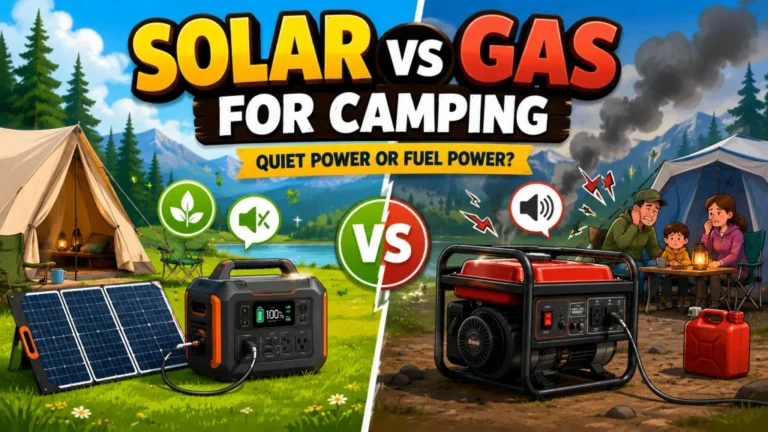
Gas generators occupy a specific noise range depending on design. Standard portable gas generators in the consumer market run 65-80 dB during operation. The premium segment of gas generators, designed specifically for quiet output using inverter circuitry, brings that down to 48-57 dB at the rated distance under stated test conditions. Those are the best-case figures for the quietest gas-powered units available to consumers. For normal consumer comparison purposes, that is about as low as the category gets. Combustion puts a floor on how quiet a gas generator can get.
A solar generator at maximum fan output during full-rate AC charging runs 40-50 dB. That means a solar generator at its noisiest active moment is quieter than the quietest available gas generator in its best-case specification. For the home backup, bedroom, CPAP, and campground scenarios most buyers are deciding about, solar generators are quieter by a wide margin across every operating mode.
Key point: In normal portable-generator comparisons, a solar generator at its loudest is still usually quieter than a quiet gas inverter generator under best-case test conditions. Combustion creates a noise floor that battery electronics do not.
For home backup, the implications are straightforward. A solar generator running inside the house at 0 dB during discharge is invisible acoustically. A gas generator running in the driveway or garage at 70-80 dB is audible through closed windows and, in many suburban neighborhoods, the kind of noise that generates complaints. The right tool depends on your power requirements, and the full picture of how solar and gas generators compare across every use case is covered in the complete solar vs. gas generator comparison. But on noise alone, the result is not close.
The noise compliance angle is worth noting for anyone who uses a generator at organized campsites or in neighborhoods with generator ordinances. Most campground rules cap generator noise at 60 dB during quiet hours, with some sites restricting any generator use between 10 p.m. and 8 a.m. A standard gas generator at 70 dB violates that limit. A solar generator at 0 dB during overnight discharge does not. Solar generators are not just quieter in that context. They are categorically different from a compliance standpoint.

With a 3,600Wh LFP battery expandable up to 25kWh via extra batteries or smart generators, this station delivers 3,600W across 15 output ports, boosted to 4,500W with X-Boost or 7,200W when two units are paired. A full recharge takes just 1.8 hours via 240V or 2.8 hours with 1,600W of solar input. It may also qualify for the 30% Residential Clean Energy Tax Credit.
Check On AmazonIf you click this link and buy, we earn a commission at no additional cost to you.
What the Published Numbers Actually Look Like
Most buyers encounter dB figures on a spec sheet without context for what those numbers mean in practice. A few published benchmarks help anchor the ranges. Several current quality units publish operating noise figures at or below 30 dB under stated charging conditions. That lands in the quiet library range on the reference scale above. Some models document 20 dB or lower at low charge rates, which is near the threshold of perceptible sound in a typical room.
Published figures from the quietest available consumer gas generators, by contrast, start around 48 dB under best-case test conditions. That is the floor for that category. No gas generator gets quieter than that. The gap between the two categories at their closest point is roughly 18-20 dB. Because of the logarithmic nature of the decibel scale, that gap represents a perceived loudness difference that is far larger than the number alone suggests. In a quiet room at night, 30 dB is background ambience. 48 dB is a sound you notice.
When you are comparing spec sheets before buying, one thing to watch for: manufacturers sometimes publish noise figures measured at a specific distance and a specific charge rate, often not at maximum. A unit rated 30 dB at 200W AC input will be louder at 800W AC input. If a spec sheet only lists one number without specifying the operating condition, that number tells you less than it looks like it does.
What to Check Before Buying If Noise Matters to You
Noise is one of the easier specs to evaluate before purchase if you know what to look for. Most buyers skip these questions and then discover the answers after the unit is in the house.
- Does the listed dB figure specify discharge, solar charging, or AC wall charging? These are three different operating states with very different noise levels. A number without that context is nearly useless for planning.
- Is the AC charge rate adjustable? A unit with no charge rate control will run the fan at full speed during wall charging regardless of whether you need fast charging. Adjustable charge rate is worth looking for if the unit will sit near a bedroom.
- Can the fan activate under sustained high AC output? This matters if you plan to run loads near the unit’s continuous watt ceiling. Most spec sheets do not document this clearly. It rarely comes up at typical household loads, but it is worth knowing.
- What are the overnight load requirements? If the unit only needs to discharge overnight without charging, the noise question is already answered: silent. Planning for discharge-only overnight use eliminates the fan question entirely.
- Does the spec say “quiet operation” without a dB number? That phrase means nothing without data behind it. Look for actual decibel figures under stated conditions before accepting a noise claim at face value.
These questions do not require handling the unit before buying. They are answerable from the product page and spec sheet for any unit worth considering. The answers will tell you more about overnight noise than the marketing language will.

This compact plug-in monitor tracks the energy consumption of any AC 115-volt appliance and displays real-time readings of volts, amps, and wattage at 0.2 to 2.0 percent accuracy. Its large LCD screen lets you calculate electricity costs by the day, week, month, or year, making it easy to spot energy-hungry devices and trim your utility bill. It is also compatible with inverters, adding flexibility for off-grid setups.
Check On AmazonIf you click this link and buy, we earn a commission at no additional cost to you.
Final Thoughts: Noise Is the One Spec That Delivers Exactly What the Marketing Promises
Most solar generator specifications require some skepticism. Charging times assume ideal conditions. Capacity figures need an efficiency factor applied. Runtime calculations depend on real-world loads that rarely match the tidy examples on the box. Noise is one of the few areas where the numbers deliver exactly what they say. Zero dB at rest is genuinely zero. The fan noise figures from quality units in the 30-40 dB range match what you actually hear in a quiet room. The gas generator comparison holds up under any test you run.
If your primary concern is overnight use, shared sleeping spaces, indoor backup power, or campground compliance, noise is a resolved question with solar generators. Charge during the day, discharge silently overnight, adjust your charge rate if you prefer to charge while sleeping. Those are the only noise-related decisions the technology requires you to make.
If you are still working through the broader question of whether a solar generator is the right fit for your situation, the complete guide to solar generators covers everything from sizing and battery chemistry to how the technology handles different real-world scenarios from the ground up.

Weighing just 23.8 lbs with a foldable handle, this 1,070Wh LFP power station delivers 1,500W of pure sine wave AC output with a 3,000W surge capacity, capable of running AC units, fridges, and electric pots. Its LFP battery sustains over 70% capacity after 4,000 cycles, translating to a lifespan of more than 10 years. Via the Jackery App, you can enable a full charge in as little as one hour, or switch to a whisper-quiet 30 dB overnight mode. Six output ports including two USB-C with 100W PD charging cover nearly any device simultaneously.
Check On AmazonIf you click this link and buy, we earn a commission at no additional cost to you.
FAQs
🔇 How many decibels is a solar generator?
At rest during discharge: 0 dB. During solar charging with the fan running: roughly 20-35 dB. During AC wall charging at full rate: 30-50 dB depending on the unit and charge speed. Quality units from established manufacturers typically stay in the 30-40 dB range at maximum AC charging.
🌙 Can I run a solar generator in my bedroom at night?
Yes, without any noise concern during discharge. The unit produces no sound while running on stored battery power. If you also charge overnight, the fan will cycle occasionally at 30-50 dB depending on charge rate. Reducing the charge rate or finishing the charge before bed eliminates that.
🔌 Does a solar generator make noise when charging from a wall outlet?
Yes, the internal cooling fan activates during wall charging, especially at full charge rate. The fan is typically 30-50 dB and cycles intermittently rather than running continuously. Lowering the charge rate setting reduces fan frequency and intensity. During solar panel charging at moderate input levels, many units produce no fan noise at all.
⚡ Is a solar generator quieter than a gas generator?
Yes, in the normal operating scenarios most buyers care about. The quietest available consumer gas generators run at 48-57 dB minimum. Solar generators at their loudest active moment run 40-50 dB. During discharge, solar generators produce 0 dB. Gas generators cannot run silently under any conditions because combustion requires moving parts and exhaust.
🎛️ How do I reduce solar generator fan noise during charging?
Lower the charge rate. Most units with app connectivity or a front panel menu allow you to set a maximum input wattage from the wall. Charging at 200-300W instead of maximum rate keeps the battery temperature lower and the fan slower or inactive. The tradeoff is a longer charge time, which rarely matters when charging overnight or during the day while away.
🏕️ Are solar generators allowed in campgrounds that ban generators?
In most cases, yes. Campground generator bans and quiet-hour noise limits typically target gas-powered generators due to exhaust and noise. Solar generators produce neither combustion emissions nor noise above quiet-hour limits during discharge. Check the specific campground rules before assuming, but solar generators are almost universally exempt from gas generator restrictions.