The Solar Generator Sizing Question Everyone Gets Wrong
“What size solar generator do I need?” is one of the most searched questions in this category, and the answers you will find almost everywhere share the same flaw: they tell you to buy more than you think you need without telling you how to figure out what you actually need. That is not a solar generator size guide. That is a nudge toward a larger purchase, dressed up as advice.
I have had this conversation hundreds of times, first at the shop counter and later on my own off-grid setup. The pattern is consistent. Someone has done some research, landed on a watt number, and is trying to work out whether it is enough. The problem is that watts and watt-hours are two separate measurements that tell you two completely different things about a unit, and most buyers never learn to distinguish them. Once that distinction clicks, the sizing question becomes a straightforward calculation instead of a guess.
The other thing worth saying up front: solar generators are not the right tool for every situation. If you need to run an entire home on its normal consumption for three days straight without any solar recharge, you are looking at a different scale of equipment. But for critical loads during short to multi-day outages, for specific appliances, and for apartment and smaller-home backup use, portable solar generators cover a real and well-defined range of needs. The key is matching the unit to those needs accurately, and that starts with two numbers.
Quick starting point: which path fits you?
- I want to do the math myself: start with the step-by-step sizing methodology covering both watt-hours and surge watts.
- I have one specific appliance in mind: go straight to the appliance-by-appliance capability guide.
- I want home backup coverage for essentials: start with the critical loads and home backup sizing section.
- I am not sure yet: read the two-number framework below first, then choose.
Two Numbers, Two Different Problems
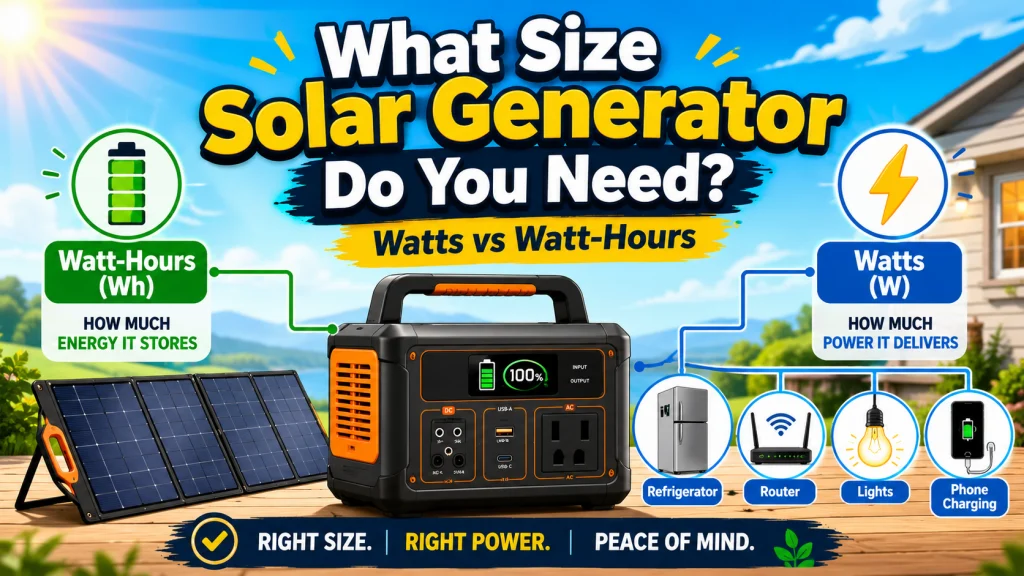
The first number is watt-hours (Wh). This is the battery capacity, meaning how much total energy the unit stores. Think of it as the tank. A 2,000Wh unit stores 2,000 watt-hours of energy. If your combined loads draw 200W, that unit runs for roughly 8.5 hours at 85 percent efficiency before it needs a recharge. If your loads draw 400W, the same unit lasts about 4 hours. Watt-hours determine how long you can run things. This is the number that trips people up most often, because it is not the figure printed largest on the marketing material.
The second number is watts, specifically continuous output watts and peak surge watts. Think of this as the engine. Continuous watts is the maximum load the inverter can handle at any given moment. Peak surge watts is the brief spike of power the unit can deliver for a fraction of a second when a motor-driven appliance starts up. Refrigerators, sump pumps, air conditioners, and power tools all draw several times their running wattage the instant their motor or compressor kicks on. If the unit’s surge watt rating does not exceed that starting spike, the unit trips before the appliance even begins running. Runtime is irrelevant at that point.
Why One Number Is Never Enough
Getting only one of these numbers right is how buyers end up with units that either will not start their intended load or deplete in a fraction of the time they expected. A unit with a large battery and a low-rated inverter may fail on surge. A unit with a powerful inverter and a small battery starts everything fine and runs out of energy within a few hours. Neither outcome is a defective unit. Both are a sizing mismatch.
One of the most consistent things I watched repeat at the shop was buyers who had sized for watts and ignored watt-hours entirely. They would buy a unit with a 2,000W inverter, reasoning that it could run their 1,500W space heater through a winter night. It ran for about an hour and shut down. The inverter was rated high enough for the load. The battery simply did not have the watt-hours for the expected runtime. The unit was technically working correctly the entire time.
The reverse version is less common but equally frustrating. A buyer sizes carefully for battery capacity, gets a unit in the right Wh class, and then plugs in a chest freezer. The unit trips the moment the compressor tries to start. They assume the unit is broken. It is not. The freezer’s starting surge exceeded the unit’s peak output rating. A larger-capacity battery would not have fixed it. A higher surge rating on the inverter would have.
Key point: Watt-hours tell you how long your loads can run. Watts and surge watts tell you whether they can run at all. A correct sizing answer requires both numbers to match your specific loads and runtime needs.

Weighing just 39.5 lbs, this 2,042Wh LiFePO4 station is 41% lighter and 34% smaller than typical 2kWh units thanks to EV-grade CTB construction, making it the most compact option in its class. It delivers 2,200W across three AC ports plus a 100W USB-C PD port, and charges from 0 to 80% in just 66 minutes via AC fast charging. Its UL1778-certified UPS switches in under 20 milliseconds to keep critical devices running through outages, while Silent Charging Mode holds noise to under 30 dB for overnight use. The LiFePO4 battery is rated for a 10-year lifespan, and solar charging is possible in as few as 6 hours with 400W of panels.
Check On AmazonIf you click this link and buy, we earn a commission at no additional cost to you.
The Two Checks Every Sizing Decision Requires
Before any unit is the right unit, two checks need to pass. First: does the unit’s peak surge watt rating exceed the starting surge of the highest-demand motor-driven appliance you plan to run? A refrigerator that runs at 150W might need 600 to 900W to start the compressor. A window air conditioner running at 900W might need 3,000 to 4,500W at startup depending on BTU class. If the surge check fails, the unit will trip on startup regardless of how much battery capacity it has. More watt-hours does not solve a surge problem.
Second: does the watt-hour capacity cover your loads for the duration you need? That requires knowing the real watt draw of each appliance, which loads run simultaneously, and how many hours each one runs, plus an 85 percent efficiency factor and a 20 to 25 percent buffer. Both checks are required. The full walk-through with a worked example is in the sizing formula guide linked in the section below.
Field Note: The most predictable failure I watched play out was buyers running a 1,500W space heater on a 2,000Wh unit and concluding the unit was defective after it shut down in about an hour. It was not defective. A 2,000Wh battery at 85 percent efficiency delivers roughly 1,700Wh of real usable energy. At 1,500W continuous draw, that depletes in about 68 minutes. The unit was the right watts. It was the wrong watt-hours for the intended use.

This plug-in monitor tracks energy consumption for any AC 115-volt appliance and displays real-time readings of volts, amps, and wattage at 0.2 to 2.0 percent accuracy across a large, easy-to-read LCD screen. Four selectable settings let you calculate kilowatt-hour usage and project electricity costs by the day, week, month, or year. It is also compatible with inverters, adding flexibility for off-grid and backup power setups.
Check On AmazonIf you click this link and buy, we earn a commission at no additional cost to you.
Which Section Matches Your Situation
Once the two-number framework is clear, the next step depends on where you are in the decision. The three sections below each cover a different slice of the solar generator sizing problem, and the right starting point depends on whether you want the full calculation method, answers for a specific appliance, or guidance on home backup scenarios.
You Want to Work Through the Full Calculation
If your goal is to do the sizing math from scratch, starting from your own appliance list and working through to both a minimum watt-hour requirement and a surge watt check, the complete methodology is at How to Size a Solar Generator: The Two-Number Method. That guide walks through the full process with a worked example using real numbers, covers how to find accurate watt draws for cycling loads (since nameplate ratings are often misleading), and addresses the most common sizing mistakes. It is the right starting point if you want to understand the math before committing to a purchase.
You Have a Specific Appliance in Mind
If you are starting from one particular appliance and want to know whether a solar generator can handle it, the appliance-by-appliance breakdown is at What Can a Solar Generator Power. That section applies the two-check framework to specific load types: microwaves, space heaters, window air conditioners, oxygen concentrators, and power tools. Each category gets its own surge watt data, realistic runtime numbers by unit class, and the specific tradeoffs buyers face. If your question is “can a solar generator run my window air conditioner” or “what size do I need for an oxygen concentrator,” that section covers it with the actual numbers rather than vague reassurances.
You Are Sizing for Home Backup
If your goal is to cover your home or apartment through a power outage, the home backup sizing section starts at Whole House Solar Generator: What It Would Actually Take. That section separates two scenarios that get conflated regularly: covering your critical loads for 12 to 24 hours, which most households can handle on a 2,000 to 3,000Wh unit, versus powering full normal home consumption for extended periods, which involves a different scale of equipment and a supplemental recharge strategy. There is also a separate section for apartment-specific constraints, where smaller load profiles and the absence of a gas generator option create a meaningfully different sizing situation than a single-family home.
- Want the formula from scratch: Start with the step-by-step sizing methodology, which covers both the watt-hour calculation and the surge watt check with a full worked example.
- Have a specific appliance question: Check the appliance-by-appliance guide for real watt draws, starting surge requirements, and runtime numbers by load type and unit class.
- Planning for home backup: Start with the critical loads section, which covers what most US homeowners actually need to keep running during an outage and what unit class reliably handles it.
If you are genuinely unsure which path applies, the sizing formula section is the better starting point. Understanding how the two numbers interact, and where the common mistakes are, is what makes every other part of the decision faster and more reliable.

At 3,072Wh with 3,600W continuous output and a 7,200W surge capacity, this station powers a household for up to 15 hours and keeps a refrigerator running for 1 to 2 days. Its UL-certified UPS switches in under 20 milliseconds, making it dependable for sensitive equipment like security cameras and medical refrigerators during storms or outages. LiFePO4 batteries with 4,000 rated cycles and ChargeShield 2.0 AI charging technology ensure long-term reliability, while a full recharge takes just 1.7 hours via hybrid AC and DC input. Built with CTB technology, it is 47% smaller and 43% lighter than comparable 3kWh units, and includes a TT-30 RV port alongside dual 100W PD ports for versatile everyday use.<br />
Check On AmazonIf you click this link and buy, we earn a commission at no additional cost to you.
The Sizing Traps That Come Up Over and Over
Beyond the watts-versus-watt-hours confusion covered above, the most consistent mistake I see is using the nameplate wattage of a cycling appliance in the calculation. A frost-free refrigerator might show 300W on the label. Its actual average draw is closer to 100 to 150W, because the compressor only runs 30 to 50 percent of the time. Sizing on the nameplate pushes buyers into a higher capacity class they do not need.
Two more come up regularly: adding up loads one at a time instead of accounting for what runs simultaneously, and planning around full solar recharge every day. Both lead to results that look right on paper and fall apart in use. The first produces runtimes that come up short once the fridge, router, and lights are all running at once. The second fails the moment there is a cloudy stretch or a winter outage. All five of the common sizing mistakes, with the correction math for each, are covered in the sizing methodology guide.

At just 41.7 lbs and measuring 18.1 by 9.8 by 10.1 inches, this station is 25% lighter and 29% more compact than comparable units while still delivering 2,400W of continuous output and 4,000W peak power, enough to run window and RV air conditioners. It charges to 100% in as little as 58 minutes via combined AC and solar, or to full in 3 hours through alternator charging at 8 times the speed of a standard car socket. Standby draw of only 9W keeps a dual-door fridge running for up to 32 hours, and capacity expands to 4kWh with an optional battery for up to 64 hours of refrigeration runtime.
Check On AmazonIf you click this link and buy, we earn a commission at no additional cost to you.
Final Thoughts: Start With the Right Question
The reason most solar generator sizing guides fail buyers is not that the information is hard to find. It is that the question is framed incorrectly from the start. “What size solar generator do I need?” is actually two questions: how many watt-hours do your loads require over your intended runtime, and does the unit’s continuous and surge output match the demands of your specific appliances. Answering both from your actual load list, with real watt draws instead of nameplate guesses and a realistic buffer on top, gets you to a unit that does what you need it to do without paying for capacity you will never use.
From what I have seen, buyers who take the time to work through both numbers before buying are much less likely to end up with a unit that surprises them. Buyers who skip to a product based on a watt number and a good review are the ones posting follow-up questions about why it only lasted an hour. The calculation is not complicated. It just has to be done.

Built with A+ grade monocrystalline cells at 23.5% efficiency, this panel maintains stable output even in low-light and cloudy conditions. It folds into a 25 by 21 by 2 inch briefcase at just 18.96 lbs, and four adjustable kickstands let you angle it at 45 degrees to capture 25 to 30% more energy than flat-laying panels. The ETFE surface and IP67 waterproof rating make it well suited for RV camping and marine environments. A built-in USB-A QC3.0 and USB-C PD 60W port allow direct device charging without a power station, and the included 5-in-1 cable covers compatibility with Jackery, Bluetti, EcoFlow, Anker Solix, and most other major solar generators. It comes backed by a 12-month warranty and 30-day money-back guarantee.
Check On AmazonIf you click this link and buy, we earn a commission at no additional cost to you.
FAQs
⚡ What is the difference between watts and watt-hours in a solar generator?
Watts measures how much power the unit can deliver at any given moment. Watt-hours measures how much total energy the battery stores. A 2,000W unit with a 2,000Wh battery can deliver up to 2,000W, but only for about an hour at that full draw. You need both numbers to evaluate whether a unit fits your specific situation and intended runtime.
🔋 What size solar generator do I need for home backup during a power outage?
For a typical critical load setup (refrigerator, router, lights, and device charging) at roughly 150 to 200W combined draw, a 2,000 to 2,500Wh unit covers about 8 hours. A 3,000Wh unit extends that to around 12 hours. For 24 hours or longer, you need either a larger unit or a reliable daily recharge strategy. The exact answer depends on your specific loads and the outage duration you are planning for.
🏠 How big a solar generator do I need to run a refrigerator?
A modern frost-free refrigerator averages 100 to 150W after accounting for its compressor duty cycle. For a 12-hour overnight period, that is roughly 1,200 to 1,800Wh. With efficiency losses and a buffer, a 2,000 to 2,500Wh unit covers a standard refrigerator overnight. You also need to confirm the unit’s surge watt rating exceeds the compressor’s starting surge, typically 600 to 900W, or the unit will trip when the compressor kicks on.
📊 Is a solar generator capacity calculator accurate enough to replace doing the math myself?
Brand-published calculators route you toward their own product line, so they tend to produce results skewed toward higher-capacity units. The more reliable approach is doing both calculations yourself: watt-hours needed for your loads at your intended runtime, plus a surge watt check for any motor-driven appliances. The process is straightforward and takes about 15 minutes with a list of your actual loads.
🌤️ Can I rely on solar recharging during a multi-day winter outage?
Not as your only recharge plan. A 200W panel that produces 1,000Wh on a clear summer day may produce 100 to 200Wh during heavy cloud cover, and winter output at northern latitudes is significantly lower year-round. For any outage that lasts longer than your battery capacity in isolation, a supplemental charging option, whether from grid power when it returns or from a brief gas generator session, is a necessary part of the plan.
🔌 Why does my solar generator trip when I plug in my refrigerator?
This almost always means the unit’s peak surge watt rating is being exceeded by the refrigerator compressor’s starting current. Even a small frost-free refrigerator can demand 600 to 900W at startup despite running at 150W once the compressor is running. Check your unit’s peak or surge watt spec and compare it to your refrigerator’s starting watt requirement, which is sometimes listed in the appliance manual or on the back label.