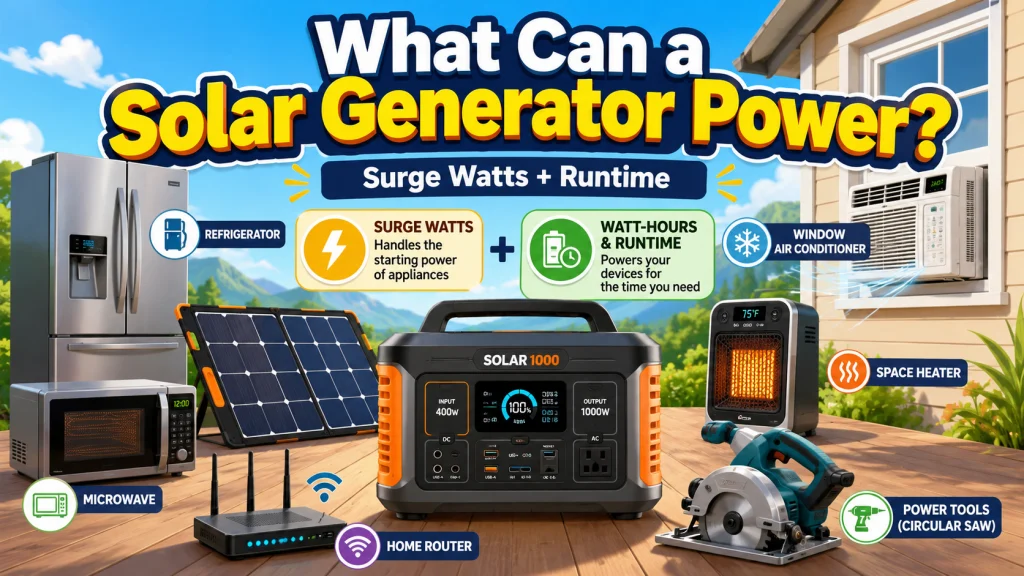
The Two Checks That Determine Every Appliance Pairing
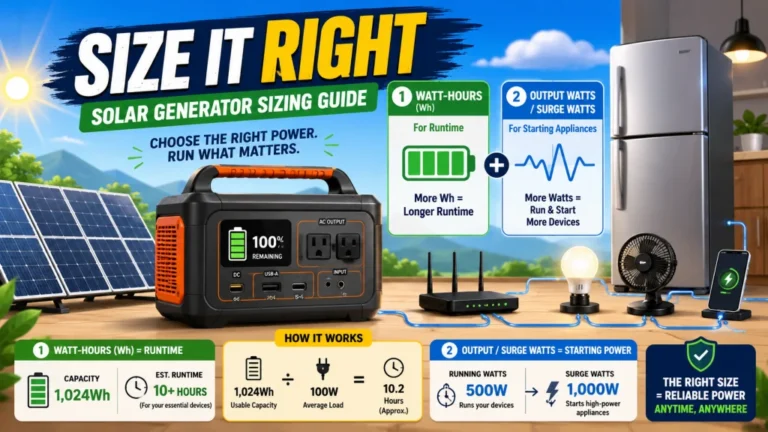
What a solar generator can power is one of the most common questions I’ve seen come up in this space, and the answer is almost never a simple yes or no. It’s really two separate questions that most buyers collapse into one. Can the unit produce enough instantaneous AC output to start the appliance without tripping? And does the battery hold enough watt-hours to keep that appliance running for however long you need it? Getting one right and missing the other is exactly how buyers end up disappointed.
The first check is about your unit’s output rating versus the appliance’s startup demand. The second is about battery capacity and how fast the appliance burns through it. A refrigerator compressor might need 700 watts at startup but only draw 150 watts once it’s running. A microwave has no meaningful surge at all but pulls 1,000 watts every second it’s on. These two appliances have almost opposite profiles on the two checks, which is why the same unit can handle one reliably and struggle with the other depending on how it is specified. Understanding what appliances a solar generator can run starts here, before you ever look at a product page.
Field Note: The most consistent pattern I saw at the counter was buyers who came in with a list of appliances and asked which unit could run all of them. The list was usually fine. The problem was that they had already skipped Check 1 for the fridge or the sump pump, bought a unit sized for the watt-hours they needed, and found out the hard way that the inverter tripped every time the compressor kicked on. The fix is usually not a bigger battery. It’s a higher surge watt rating. Those are not the same number on the spec sheet, and brands do not always make that distinction obvious.
If you want to understand the broader sizing methodology behind these two checks, the full framework for figuring out what size solar generator you need covers the complete calculation from appliance list to minimum unit requirements. This guide stays focused on the appliance side: whether specific load types are actually compatible and what the runtime math looks like by category.
Check 1: Surge Watts and Why Motor-Driven Appliances Are a Different Problem
Surge watts are the brief spike of current that a motor-driven appliance needs to get its compressor or motor turning from a dead stop. The spike lasts less than a second, but during that fraction of a second the draw can be three to six times the appliance’s normal running wattage. A refrigerator that draws 150 watts while running might need 600 to 900 watts to start the compressor. A window air conditioner running at 900 watts might need 3,000 to 4,500 watts at startup. If your unit’s peak surge rating is below that number, the inverter protection circuit trips the moment that appliance tries to start, and nothing runs.
Resistive loads work completely differently. A space heater, a microwave, a toaster, or an LED light fixture draws the same wattage the instant it’s switched on as it does while running. There is no motor, no compressor, no inductive load. What you see on the nameplate is what you get. These loads are the easiest to plan for: if the unit’s continuous output rating exceeds the appliance’s wattage, it starts without issue. The surge check essentially doesn’t apply. The challenge with resistive loads is almost entirely on the watt-hour side, not the surge side.
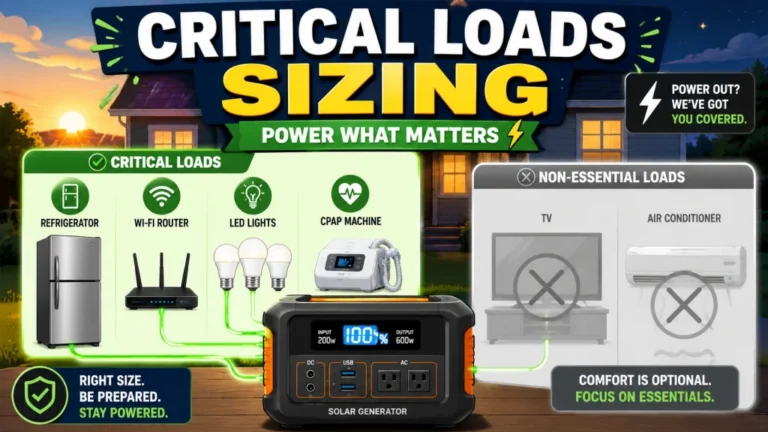
The appliances that require a close surge check are the motor-driven ones: refrigerators, chest freezers, window air conditioners, sump pumps, water pumps, and power tools with induction motors. Each has a starting surge that is meaningfully higher than its running draw. The specific multiplier varies by motor type, age, and efficiency class. If your appliance manual or spec sheet lists a starting wattage directly, use that number. If it doesn’t, three times the running wattage is a reasonable conservative estimate to work from. Check your unit’s peak surge specification and confirm it clears that figure before anything else.
Check 2: Watt-Hours and What Solar Generator Power Capacity Actually Means for Runtime
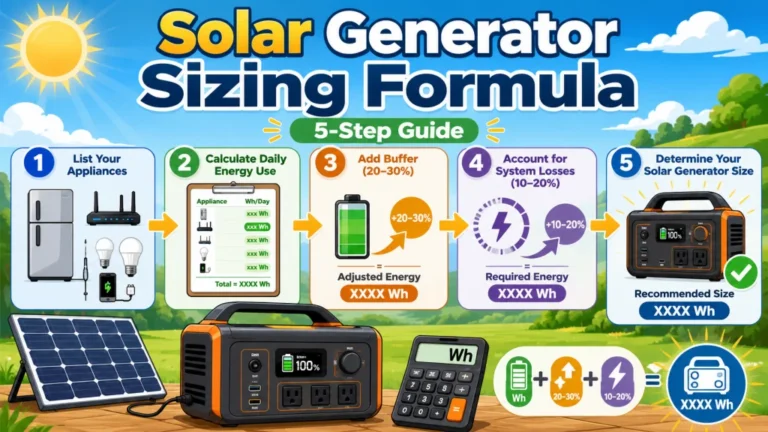
The watt-hour rating on a solar generator tells you the total energy stored in the battery, not the output power available per hour. A 2,000Wh unit holds 2,000 watt-hours. At around 85 percent system efficiency, roughly 1,700Wh of that actually reaches your appliances before the battery protection shuts things down. To estimate runtime, divide usable capacity by the appliance’s running watt draw. A 1,000-watt microwave on a 2,000Wh unit: 1,700 divided by 1,000 equals about 1.7 hours of total microwave-on time from a full charge. A refrigerator averaging 150 watts of draw: 1,700 divided by 150 equals about 11 hours. Same unit, very different results depending on the load.
The table below covers a working solar generator run list for common appliance categories, with typical running watt draws and estimated runtimes on a 1,000Wh and 2,000Wh unit. These are representative averages, not guarantees. Your actual draw will vary depending on the specific model, its age and efficiency, ambient temperature, and whether it’s a cycling load or a constant one. Use these figures as a starting frame for your calculation.
| Appliance | Typical Running Watts | Surge Concern? | Runtime on 1,000Wh | Runtime on 2,000Wh |
|---|---|---|---|---|
| Frost-free refrigerator | 100-150W avg | Yes (3-6x running) | 5.7-8.5 hrs | 11-17 hrs |
| Microwave (1,000W) | 1,000-1,100W | No | ~52 min | ~1.7 hrs |
| Space heater (1,500W) | 1,500W | No | ~34 min | ~68 min |
| Window AC (5,000 BTU) | ~450W avg | Yes (3-5x running) | ~1.9 hrs | ~3.8 hrs |
| Home oxygen concentrator | 300-500W | Minimal | 1.7-2.8 hrs | 3.4-5.7 hrs |
| Circular saw (intermittent, 20% duty) | 1,400-1,800W blade-on | Yes (1.5-2x) | ~2.3-3 hrs work time | ~4.7-6 hrs work time |
| Router + LED lights + phone charging | ~50W combined | No | ~17 hrs | ~34 hrs |
Runtimes assume 85% system efficiency on a fully charged unit with no simultaneous additional loads. Refrigerator draw assumes 30 to 50 percent duty cycle rather than continuous full-draw operation.
Two things stand out in that table. The high-wattage resistive loads, especially space heaters, drain even a 2,000Wh unit inside 70 minutes. That surprises a lot of first-time buyers. The pattern I’ve seen repeat is someone buying a unit specifically to run a 1,500-watt space heater through a winter outage and then finding out the math gives them barely over an hour per full charge. The unit isn’t broken. It isn’t even particularly undersized for most outage use cases. It’s just that resistive heating is one of the most demanding loads you can put on a battery, and the watt-hour math makes that visible in a way marketing copy rarely does.

At 39.5 lbs with 2,042Wh capacity and 2,200W output, this CTB-built station is 41% lighter and 34% smaller than typical 2kWh units. It charges from 0 to 80% in just 66 minutes via AC, operates at under 30 dB in silent mode, and switches to UPS backup in under 20 milliseconds. The LiFePO4 battery is rated for a full 10-year lifespan.
Check On AmazonIf you click this link and buy, we earn a commission at no additional cost to you.
Which Spec to Check First, by Appliance Type
One thing the runtime table above doesn’t show is which of the two checks is actually the deciding factor for a given appliance. For some loads, you can ignore surge entirely and focus on watt-hours. For others, the surge check is the one that kills the pairing before runtime even becomes a question. I’ve put this together as a quick reference based on what I’ve seen matter most in practice, by appliance type.
| Appliance | Check First | Check Second | Most Common Mistake |
|---|---|---|---|
| Refrigerator or freezer | Peak surge rating | Wh for target runtime | Sizing for runtime while ignoring compressor startup spike |
| Microwave | Continuous output watts | Wh for usage pattern | Buying a small unit that can’t meet the 1,000W continuous draw requirement |
| Space heater | Wh capacity | Continuous output watts | Assuming a 2,000W inverter rating means extended runtime at 1,500W |
| Window air conditioner | Peak surge rating | Wh for hours of cooling | Checking running watts only, buying a unit that trips every thermostat cycle |
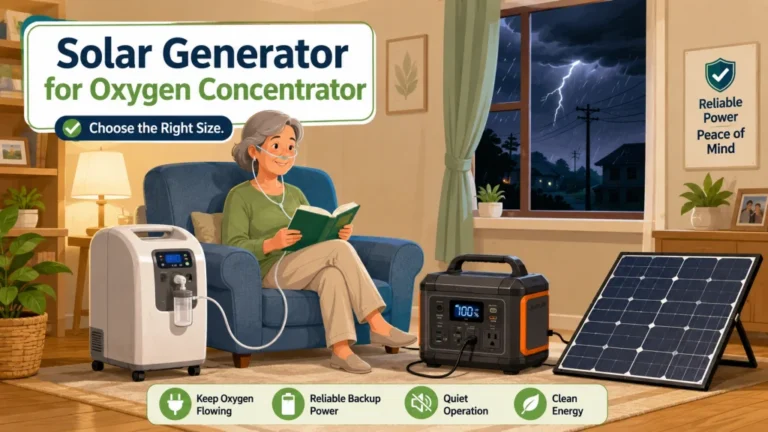
| Oxygen concentrator | Wh for overnight duration + supplemental charging plan | Pure sine wave confirmation | Sizing to the minimum and leaving no margin for a medical emergency |
| Power tools | Peak surge rating per tool | Wh adjusted for duty cycle | Calculating runtime as if the saw runs continuously instead of intermittently |
The table won’t replace reading the detail for your specific appliance, but it tells you immediately which number to pull up on the spec sheet first. For motor-driven loads, that’s the peak surge figure. For resistive high-draw loads, it’s the watt-hour capacity. For the oxygen concentrator, it’s a combination of both plus a backup charging plan. Each of the five detailed articles below runs through the actual numbers for its load type.

This 220V monitor handles up to 16 amps and reads down to 0.01W resolution at Class 1.0 accuracy, detecting loads as low as 0.20W to catch even standby draw. A backlit LCD with built-in memory retains cumulative kilowatt-hour data through power interruptions. Fire-retardant ABS housing and a 1-year warranty round out a reliable package.
Check On AmazonIf you click this link and buy, we earn a commission at no additional cost to you.
When One Check Passes and the Other Doesn’t
Case A: enough Wh, not enough surge. Someone calculates that a 2,000Wh unit should run their refrigerator for 12 hours, which is correct on the watt-hour math. They plug it in, the compressor tries to start, the inverter trips, and nothing runs. The battery capacity was right. The surge headroom wasn’t there. This comes up especially with budget units where the surge-to-continuous ratio is lower than it needs to be for motor-driven loads. More battery does not fix a surge problem.
Case B: enough surge, not enough Wh. A unit with a strong 2,000-watt inverter and a high peak surge rating handles any startup you throw at it, but the battery is only 500Wh and the load needs to run for six hours. The inverter never trips. It just runs out of energy well before the job is done. Running multiple appliances simultaneously accelerates this further: a refrigerator cycling at 150 watts, a router at 10 watts, and lights at 20 watts add up to a combined draw that depletes the bank faster than any single appliance calculation would suggest. Both numbers on the spec sheet have to match your actual load profile, not just one of them.
Five Appliance Categories Where the Calculations Get Specific
This section covers five appliance categories in depth, each in its own article with the actual watt draw data, surge requirements, runtime math, and the unit class that works for each use case. The categories were chosen because they come up most often in real buying decisions and because each one has a meaningfully different profile on the two checks. A microwave, a space heater, a window air conditioner, an oxygen concentrator, and power tools are not the same problem. The limiting factor is different for each, which changes everything about the recommendation.
- Microwaves: No meaningful startup surge, but 1,000 watts of continuous draw means a small unit runs out faster than most people expect. The question with microwaves is almost entirely whether you have enough watt-hours for your actual usage pattern, not whether the inverter can handle the load.
- Space heaters: Similar to microwaves on the surge side, nothing to worry about there. The challenge is that 1,500 watts is an aggressive continuous draw that depletes even a 2,000Wh unit in just over an hour. Runtime math tends to surprise buyers who assume a solar generator can sustain a heater through a cold night.
- Window air conditioners: The surge check is the critical one here. Compressor startup spikes vary significantly by BTU class and can run three to five times the running watt draw. The wrong unit trips every time the thermostat cycles. There is also a soft starter option that changes the compatible unit range considerably.
- Oxygen concentrators: The only category in this guide where undersizing is a health and safety issue, not just an inconvenience. The math requires conservative margins, a confirmed pure sine wave inverter output, and a supplemental charging plan for any outage longer than a few hours.
- Power tools: Duty cycle changes the math here more than any other factor. A circular saw drawing 1,500 watts for 30-second cuts at 15 percent actual duty cycle consumes far fewer watt-hours per hour of work than a naive calculation suggests. This category is more viable on portable solar power than most contractors expect going in.
Each of the five articles in this series applies the same two-check framework to its specific load type. What changes between them is which check is the limiting factor and how the unit class requirement follows from that. If you already know which appliance you’re sizing for, go straight to that article. The math is already done.

Starting at 2kWh and expandable to 6kWh with two additional batteries, this LFP station reaches 80% in just 43 minutes via combined AC and solar input. Its 3,000-cycle battery outlasts the industry average by 6 times and includes a 5-year service guarantee. With 2,400W output across 15 outlets and X-Boost pushing to 3,400W, it handles 99% of household appliances at a whisper-quiet 30 dB.
Check On AmazonIf you click this link and buy, we earn a commission at no additional cost to you.
Final Thoughts: Match the Appliance Before You Buy the Unit
The most common version of getting this wrong plays out the same way each time: a buyer focuses on one number, usually the output wattage or the watt-hour capacity, and overlooks the other entirely. Or they compare battery sizes across units without ever checking whether the inverter can handle the startup surge of the specific appliance they’re buying the unit for. Solar generator power capacity has improved substantially across the board, and there is a practical unit class for almost every common household and work load covered here. The problem isn’t that the tools don’t exist. It’s that buyers don’t know which number to check first for their specific appliance.
Before you look at a single product listing, pull up three numbers: the unit’s continuous output watts, its peak surge watts, and its usable watt-hour capacity. Cross those against your appliance’s starting surge requirement, its running watt draw, and the hours you need it to run. If all three align, you have a pairing that will work. If one is off, no amount of brand reputation or battery chemistry changes the outcome. That sequence takes about five minutes and saves a lot of return shipping.

This soft start device reduces inrush current by up to 70%, eliminating the loud startup thump and flickering lights common when air conditioners kick on, while lowering heat stress on compressor windings to extend motor life. Compatible with all major HVAC brands up to 6 tons and 72,000 BTUs across 110 to 240V systems, it works with generators, RVs, and solar setups. A complete install kit makes DIY setup straightforward in about 15 minutes.
Check On AmazonIf you click this link and buy, we earn a commission at no additional cost to you.
Appliance-Specific Guides in This Series
Each of the articles below applies the two-check framework to a single appliance category with real watt draw figures, startup surge data, and the runtime math for the unit classes that actually work for that load. If you have a specific appliance in mind, start with the article that covers it directly.
| Article | What It Covers |
|---|---|
| Can a Solar Generator Run a Microwave? | Runtime math for 700W and 1,000W microwave draws, and why the watt-hour side matters far more than the surge check for this appliance |
| Can a Solar Generator Run a Space Heater? | Why 1,500W continuous draw depletes most units in under 90 minutes, and what unit size actually produces a meaningful runtime improvement |
| Can a Solar Generator Run a Window Air Conditioner? | BTU-by-BTU startup surge requirements for window AC units, plus the soft starter option that opens up a wider range of compatible unit classes |
| Solar Generator for Oxygen Concentrator | Why this is the one use case where conservative sizing margins, pure sine wave output, and a supplemental charging plan are all non-negotiable |
| Can a Solar Generator Run Power Tools? | How duty cycle changes the watt-hour math for saws, drills, and grinders, and which tool categories push past portable unit surge limits |
FAQs
⚡ What size solar generator do I need to run a refrigerator and some lights?
A frost-free refrigerator averages 100 to 150 watts at a 30 to 50 percent duty cycle. Paired with LED lights and a router, total average draw is typically around 200 watts combined. A 2,000Wh unit handles that load for roughly 8 to 10 hours at 85 percent efficiency. Check that your unit’s peak surge rating also exceeds about three times the fridge’s running wattage, otherwise the inverter may trip when the compressor starts.
🔌 Can a small solar generator run a space heater?
A 500Wh unit running a 1,500W space heater depletes in roughly 28 minutes. A 2,000Wh unit extends that to about 68 minutes. Space heaters are among the most watt-hour-intensive loads you can put on a battery, and no current portable solar generator runs one overnight as a primary heat source. They work as a short-duration supplement during a cold outage, not as sustained heating.
🌀 Why does my solar generator trip when I plug in an air conditioner?
The inverter is tripping on the startup surge from the compressor motor. The air conditioner’s running wattage may be within the unit’s continuous rating, but the startup spike is exceeding its peak surge limit. The fix is either a unit with a higher surge watt rating or a soft starter device installed on the AC unit, which can cut the startup spike by 60 to 70 percent.
🏥 Can a solar generator power an oxygen concentrator through the night?
Most home oxygen concentrators draw 300 to 500 watts continuously. At 300 watts, a 2,000Wh unit provides roughly 5.7 hours of runtime. Overnight use of 10 to 12 hours requires either a unit in the 5,000Wh range or a supplemental daytime charging strategy. Pure sine wave output is also a hard requirement. See the dedicated oxygen concentrator article in this series for the full sizing math.
🔧 Can a solar generator power tools at a job site?
Most residential-grade power tools work on a 2,000W continuous unit with at least 4,000W surge headroom. The key factor is duty cycle: a circular saw cutting intermittently at around 20 percent duty cycle consumes far fewer watt-hours per hour than its rated wattage suggests. At that rate, a 2,000Wh unit covers roughly 3 to 6 hours of practical work time depending on the tool mix and how actively you’re cutting. Large contractor table saws with high-surge induction motors are the exception and generally exceed portable unit limits.
📊 How do I calculate how long a solar generator will run my appliance?
Multiply the unit’s watt-hour rating by 0.85 to get usable capacity, then divide by the appliance’s running watt draw. A 2,000Wh unit delivers roughly 1,700Wh usable. At a 200W load, that is 8.5 hours. For cycling appliances like refrigerators, use the average draw rather than the nameplate maximum to get a realistic runtime estimate.