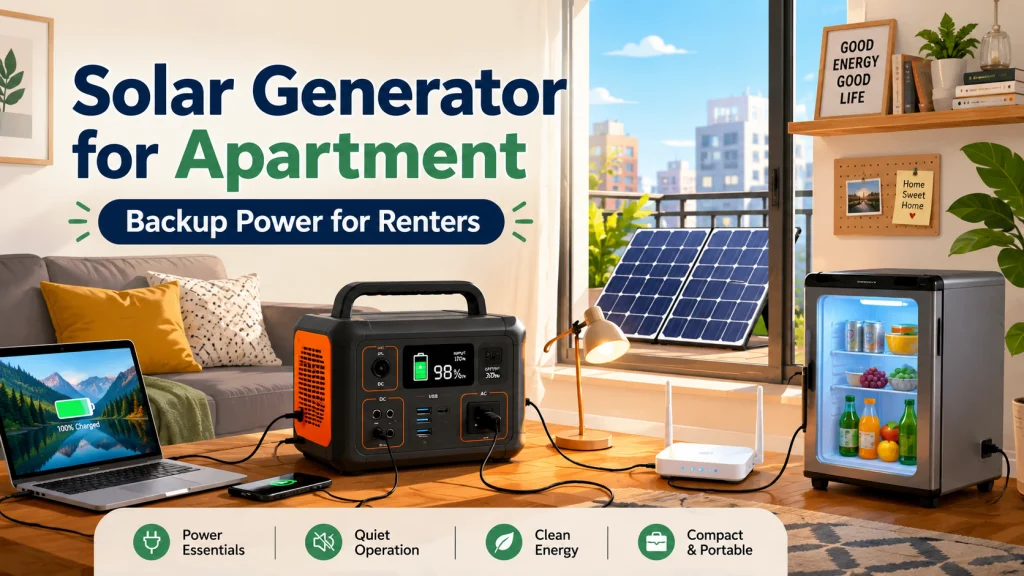
Why the Solar Generator Decision Is Simpler for Apartment Renters
Sizing a solar generator for apartment use is, in most cases, about half as complicated as homeowner-focused marketing makes it appear. The standard imagery in this category is a suburban house, a garage setup, and a whole-home outage scenario. If you live in a 700 square foot apartment, that framework does not apply to your situation, and evaluating units against it will steer you toward capacity you do not need. The real sizing problem for an apartment renter is considerably smaller and considerably more solvable.
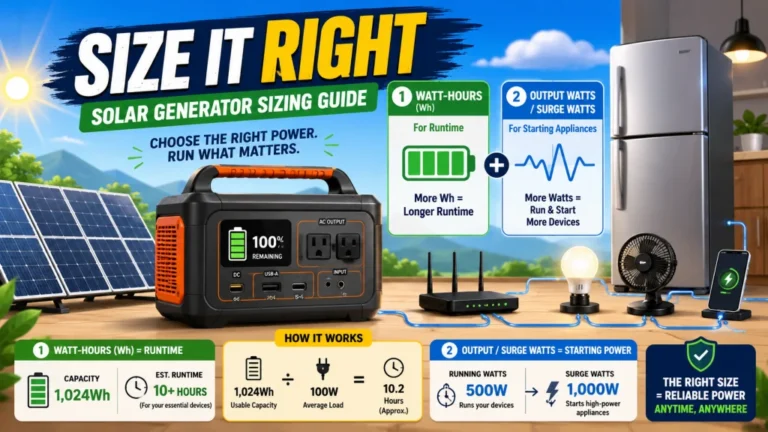
Start with the load. A studio or one-bedroom apartment typically runs a mini-fridge or dorm fridge averaging 50 to 80W, a router at 10W, two LED lights at 5W each, and phone or device charging at around 20W. Combined simultaneous draw lands somewhere between 90W and 120W. At 100W on a 2000Wh unit, applying the 85 percent efficiency factor and leaving a 20 percent reserve rather than running the battery to zero, the conservative usable runtime is approximately 14 hours. A 1000Wh unit at the same draw and the same reserve approach handles around 7 hours. Both cover an overnight outage, which is the scenario most apartment renters are actually planning for.
The second advantage renters have is that the decision between solar and gas is already made. Apartment buildings prohibit gas generators for obvious reasons: exhaust, fuel storage, noise, fire risk. A portable solar generator is not just one option among many for renters who need backup power. It is the only practical backup power option they have. That eliminates an entire category of second-guessing that homeowners routinely spend time on, and it makes the decision considerably more direct.
The Apartment Load Reality: What the Math Actually Shows
The most consistent pattern I see with apartment renters evaluating backup power is that they size from anxiety rather than from the actual load. The unit on the shelf looks large, the numbers on the box sound significant, and the price feels uncertain before any real math has been done. When you run the actual calculation for a typical apartment critical load, the answer almost always lands somewhere in the middle of the product range, not the top.
For a studio or one-bedroom setup, the critical load list is typically short: a dorm or mini fridge at 50 to 80W average (the compressor cycles on and off, so this is not a constant draw), a router at 10W, two LED lights at 5W each, and device charging at roughly 20W. Add those up and the combined simultaneous draw is 90W to 120W. At 100W average on a 1000Wh unit after the efficiency factor and a conservative reserve are applied, runtime is approximately 7 to 8 hours. On a 1500Wh unit at the same draw and reserve approach, runtime extends to 10 to 11 hours. That covers an overnight outage on a single charge without any solar recharging involved.
Field Note: Apartment renters who came into the shop almost always expected to need a larger unit than the load math supported. The assumption was that sizing for a house applied to them too. When I walked through the actual calculation for a 600 square foot apartment running a mini fridge, router, a couple of lights, and phone charging, the recommendation consistently landed in the 1000 to 1500Wh range. More than once the reaction was visible surprise at how manageable the number was.
The scenario that shifts the math meaningfully is a full-size frost-free refrigerator. Some apartments have them, and a full-size fridge averages 100 to 150W with a higher startup surge when the compressor kicks on. If yours fits that description, the sizing calculation moves toward a 2000Wh unit as a comfortable minimum for overnight use. The step-by-step approach to identifying and sizing for those essential loads, including how to handle the fridge compressor cycle correctly, is covered in the guide on sizing a solar generator around your critical loads specifically.
| Apartment Setup | Typical Combined Draw | Recommended Unit Size | Estimated Overnight Runtime |
|---|---|---|---|
| Studio, no refrigerator (lights, router, devices) | 40 to 60W | 500 to 1000Wh | 8 to 18 hours |
| Studio or 1BR with mini or dorm fridge | 90 to 120W | 1000 to 1500Wh | 7 to 12 hours |
| 1BR or 2BR, mini fridge, fan, multiple devices | 130 to 180W | 1500 to 2000Wh | 7 to 11 hours |
| 2BR or larger with full-size refrigerator | 180 to 250W | 2000 to 2500Wh | 6 to 10 hours |
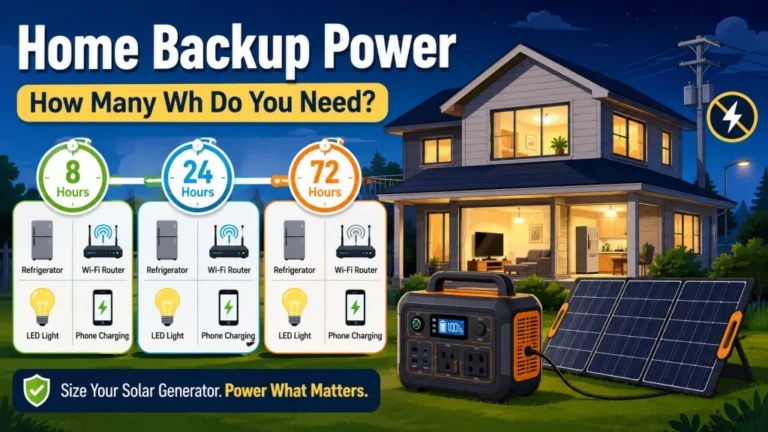
These figures apply the efficiency factor, use a conservative reserve instead of assuming the battery is drained to zero, and assume appliance draws based on typical real-world averages rather than nameplate maximums. Your actual refrigerator model, the ambient temperature in your kitchen, and how many devices you run at once will all shift the numbers somewhat. The table is a starting point for sizing. For the full duration math across different outage lengths, including 24-hour and 72-hour scenarios, the breakdown on how many watt-hours different outage durations actually require runs through each case with the calculation shown.

This 1kWh LFP battery station charges from 0 to 80% in just 50 minutes via AC input, and its LiFePO4 chemistry delivers a 3,000 plus cycle lifespan that is roughly 6 times longer than standard lithium batteries. Capacity is expandable up to 3kWh with additional batteries, making it well suited for camping, RVs, or off-grid living. Its 1,800W output powers across 15 outlets, handling around 90% of household appliances, and accepts up to 500W of solar input for clean, fuel-free charging. The package includes a 5-year customer service guarantee.
Check On AmazonIf you click this link and buy, we earn a commission at no additional cost to you.
Solar Generator With No Outdoor Space: What the Panel Situation Actually Means
The most common hesitation I hear from apartment renters considering solar backup power is the panel question. “I live on the fourth floor with a north-facing balcony” or “I have no outdoor space at all.” This is a real constraint, and it is also the one that matters the least for a typical outage scenario, because for apartment renters the primary charging method is not solar. It is the wall outlet.
Nearly every portable solar generator in this category supports AC wall charging through a standard 120V household outlet. Wall charging is fast, reliable, and needs nothing beyond a standard outlet and a power cord. A 1000Wh unit on a typical 120V outlet recharges in approximately 4 to 8 hours depending on the unit’s charge rate. For the standard outage plan, you charge the unit from the wall before an expected storm, run it overnight, and recharge from the wall once the grid comes back. Solar panels enter the picture only if the outage runs longer than a day and wall power is still unavailable.
For renters who want solar recharging as a multi-day contingency, the realistic output by balcony situation varies considerably. Here is what each scenario actually delivers:
- South or west-facing balcony with direct sun: A 100W panel in 5 peak sun hours generates approximately 500Wh per day. That fully recharges a 500 to 600Wh unit daily and covers roughly half the daily depletion of a 1000Wh unit running at 100W load. Two 100W panels, or a single 200W panel, provides full daily recharge for a 1000Wh unit in good sun conditions.
- North-facing balcony with limited direct sun: A 100W panel in indirect or diffuse light generates 100 to 200Wh per day depending on the season and cloud cover. This extends runtime during a multi-day outage but does not replace full daily consumption at apartment load levels. It is still useful as a slow top-up during an extended grid-down period.
- Solar generator with no outdoor space at all: A foldable panel propped against a south-facing window generates approximately 20 to 40 percent of its rated wattage through glass. A 100W panel in direct window sun produces roughly 20 to 40W of actual output. It is slow, but it works as an emergency recharge source during a prolonged outage when no outdoor access is possible.
- Shared rooftop or courtyard access: Some buildings have common outdoor areas. A 200W portable panel on a clear rooftop or courtyard for 4 to 6 hours generates 800 to 1200Wh, which is a full recharge for most 1000Wh units. If your building allows access, this is the most effective extended-outage recharge strategy available to renters without a private balcony.
The honest framing is this: for a 12 to 18 hour outage, the panel situation is essentially irrelevant because the wall-charging plan handles it entirely. The panel question only becomes important when planning for a multi-day outage, and even then the smaller load profile of a typical apartment means the math is more forgiving than it would be for a house-sized setup. Figure out the wall-charging plan first. Build the solar recharging strategy around whatever your balcony or window situation actually allows.

Built with Grade A+ monocrystalline cells at 23.5% efficiency, this lightweight 9.48-pound panel folds down to 24 by 21 by 1.8 inches and sets up in seconds with adjustable kickstands that angle at 45 degrees to capture up to 25% more sunlight. The included 5-in-1 cable connects to 99% of popular power stations including EcoFlow, Jackery, Anker, and Bluetti models without extra adapters. A built-in controller adds one USB-C PD port and two USB-A ports including QC3.0 for charging devices directly. The ETFE-laminated surface carries IP67 waterproof protection, and the panel is backed by a 12-month warranty with lifetime technical support.
Check On AmazonIf you click this link and buy, we earn a commission at no additional cost to you.
Which Unit Size Makes Sense for a Typical Apartment
Once the load math is clear, sizing comes down to two variables: whether a full-size refrigerator is in the picture, and how many hours of runtime you want before needing to recharge. For most apartment setups, the right unit size lands somewhere between 500Wh and 2000Wh, with the sub-range determined by fridge type and the number of occupants.
A 500 to 1000Wh unit is the correct class for a studio renter with no refrigerator or a very small dorm fridge. Router, LED lights, phone charging, and a small fan draw roughly 40 to 60W combined. At 50W average on a 1000Wh unit after the efficiency factor and a conservative reserve are applied, runtime is approximately 17 hours. That covers an overnight outage with significant margin to spare, on a unit that is smaller and more affordable than the mid-range units most marketing leads with.
A 1000 to 1500Wh unit is the most common correct answer for a studio or one-bedroom apartment with a mini-fridge in the load list. At 100 to 120W average combined draw, a 1500Wh unit provides about 10 to 11 hours of runtime using the same conservative reserve approach. This handles an overnight outage comfortably for most one or two-person apartments without over-buying. From what I’ve seen, this is the range where the actual math and the appropriate purchase line up most cleanly for apartment renters, and it tends to be the range people leave behind in favor of something larger because the marketing has them convinced they need more.
A 2000 to 2500Wh unit makes sense for a two-bedroom apartment with a full-size frost-free refrigerator, multiple people’s devices running simultaneously, and a preference for a longer buffer between recharges. At 200 to 250W average combined draw, a 2000Wh unit provides roughly 6 to 8 hours before needing a recharge using the same conservative reserve approach, which may require a supplemental charging strategy for a full overnight period on the higher end of that draw range. If your situation is larger or more complex than a standard apartment setup, the complete framework for arriving at your two sizing numbers is covered in the guide to calculating what size solar generator you actually need. And if you ever scale up to a house-sized scenario, the sizing math and the recommended unit class shift considerably from what works in an apartment context, and the framing for that is in the overview of what whole-house solar generator backup actually requires.
Key point: Most apartment renters need a 1000 to 1500Wh unit, wall-charged before expected outages, with a solar panel as an optional multi-day contingency. The pull toward over-buying is strong because this category’s marketing is built around house-sized problems. Running the actual load numbers for your apartment first usually brings the recommended size down by one category.

Starting at 2kWh and expandable to 6kWh with two additional batteries, this LFP station reaches 80% in just 43 minutes via combined AC and solar input. Its 3,000-cycle battery outlasts the industry average by 6 times and includes a 5-year service guarantee. With 2,400W output across 15 outlets and X-Boost pushing to 3,400W, it handles 99% of household appliances at a whisper-quiet 30 dB.
Check On AmazonIf you click this link and buy, we earn a commission at no additional cost to you.
If You Add Solar Panels: The Right Size for Apartment Recharging
For renters who want to include solar recharging in the plan, the panel sizing calculation is simpler than the physical constraints might make it feel. The formula is straightforward: panel wattage multiplied by peak sun hours equals daily watt-hours generated. In most of the continental United States, 4 to 6 peak sun hours per day on a clear day is a reasonable planning number. In the Southwest, the figure is higher. In the Pacific Northwest in winter, it drops significantly, and that seasonal variation matters for anyone planning around a winter outage scenario.
For a 1000Wh unit, full daily recharge requires 1000Wh of solar input. One 200W panel in 5 peak sun hours produces exactly that. Two 100W panels produce the same total, with the flexibility to position them separately on a narrow balcony. For a 500Wh unit, a single 100W panel in 5 hours provides full daily recharge with a small margin. At the load levels that apply to most apartments, the panel wattage requirement is modest, and a single portable 200W panel covers the majority of apartment solar generator renter setups in adequate sun conditions.
Storage and portability matter more in an apartment than they do in a house, and that consideration shapes which panel format is worth buying. A 100W foldable panel folds to roughly the size of a large briefcase. A 200W foldable panel takes up about the same footprint as a large piece of carry-on luggage when stored flat. For a 400-square-foot studio, that is a real space tradeoff worth thinking through before buying two separate 100W panels instead of one 200W unit. One 200W folding panel produces the same daily output as two 100W panels, takes up less combined storage space, and requires one fewer item to carry out and deploy on recharging days. Most portable panels in this wattage class are designed with compact apartments and limited balcony space in mind and include carrying handles and a built-in kickstand for angled balcony deployment.

Featuring 16BB N-Type cells at 25% efficiency, this panel outperforms standard 200W panels and folds down to backpack size at just 13.89 lbs, with a magnetic closure for tool-free setup. Three built-in ports including USB-C PD 45W, and two USB-A ports charge devices directly, while MC4 output connects to most power stations and 12V battery systems. Four adjustable kickstands offer 40, 50, and 60 degree angles, and IP65 rating plus UL 61730 certification ensure durability and safety backed by a 2-year warranty.
Check On AmazonIf you click this link and buy, we earn a commission at no additional cost to you.
Final Thoughts: The Right Backup Power Setup for Apartment Living
The pattern that repeats itself with apartment renters is that they arrive having absorbed house-sized marketing, look at units designed for house-sized loads, and talk themselves into either over-buying or doing nothing. The actual math for a typical studio or one-bedroom apartment lands in the 1000 to 1500Wh range, can be charged from a standard wall outlet, and does not require a south-facing balcony to be useful. The fact that gas is already ruled out by building policy is not a constraint. It is a simplification. The decision is already made; the only remaining question is which unit size matches your load.
Run your actual load numbers. A dorm fridge, a router, two lights, and device charging is not a complicated load list, and the math is not a difficult calculation. Match the unit size to what your apartment draws, charge it from the wall before any forecasted outage, and add a foldable solar panel as a contingency for extended situations if your balcony situation supports it. That is the complete setup. It is more affordable and less complicated than the marketing category makes it look.

Weighing just 23.8 lbs with a foldable handle, this 1,070Wh LFP power station delivers 1,500W of pure sine wave AC output with a 3,000W surge capacity, capable of running AC units, fridges, and electric pots. Its LFP battery sustains over 70% capacity after 4,000 cycles, translating to a lifespan of more than 10 years. Via the Jackery App, you can enable a full charge in as little as one hour, or switch to a whisper-quiet 30 dB overnight mode. Six output ports including two USB-C with 100W PD charging cover nearly any device simultaneously.
Check On AmazonIf you click this link and buy, we earn a commission at no additional cost to you.
FAQs
🔌 Can I charge a solar generator from a regular apartment outlet?
Yes. Nearly every portable solar generator in this category supports AC wall charging through a standard 120V household outlet. It is typically the fastest and most reliable charging method available to apartment renters and requires no installation or special equipment. Charging from the wall before an expected outage and recharging once power returns is the standard plan for apartment solar backup power.
☀️ Can I use solar panels in my apartment without a balcony?
Yes, with reduced output. A foldable panel placed against a south-facing window generates approximately 20 to 40 percent of its rated wattage through glass, so a 100W panel produces 20 to 40W of actual output in direct window sun. It is a slow recharging method, but it works as an emergency secondary source during a prolonged outage when no outdoor access is possible. Wall charging remains the more reliable primary plan.
📦 What size solar generator do I need for a studio apartment?
A 500 to 1000Wh unit handles a studio without a full-size refrigerator: router, LED lights, phone charging, and a small fan for 10 to 17 hours on a single charge, depending on the load and how much reserve you leave in the battery. Adding a mini or dorm fridge to the load moves the recommended size to 1000 to 1500Wh for a comfortable overnight runtime without recharging.
🏠 Is a portable power station safe to run inside an apartment?
Yes, when used according to the manufacturer’s instructions. Unlike gas generators, portable power stations produce no exhaust, no carbon monoxide, and no combustion byproducts of any kind. They are designed for normal indoor use, but the vents should stay unobstructed, the unit should not be covered, and it should be kept away from water, heat sources, and surfaces that trap heat. This indoor usability is one of the core reasons a portable power station for apartment backup use makes more sense than any fuel-based alternative.
⚡ How long will a solar generator last during an apartment power outage?
It depends on the unit size and your combined load. A 1000Wh unit at 100W average draw runs approximately 7 to 8 hours after the efficiency factor and a conservative reserve are applied. A 1500Wh unit at the same draw handles 10 to 11 hours using the same reserve approach. A typical studio or one-bedroom apartment running a mini fridge, router, lights, and device charging in the 90 to 120W range is covered overnight on a 1000 to 1500Wh unit without supplemental charging.
🌥️ Does solar recharging work on cloudy days for an apartment setup?
Output drops to 30 to 50 percent of the panel’s rated wattage on overcast days, and lower in heavy cloud cover. For multi-day outages with persistent cloudy weather, the wall outlet is the more reliable recharge source for apartment renters. Solar recharging works best as a clear-weather bonus on top of the primary wall-charging plan, not as the sole recharge strategy in climates with unreliable winter sun.