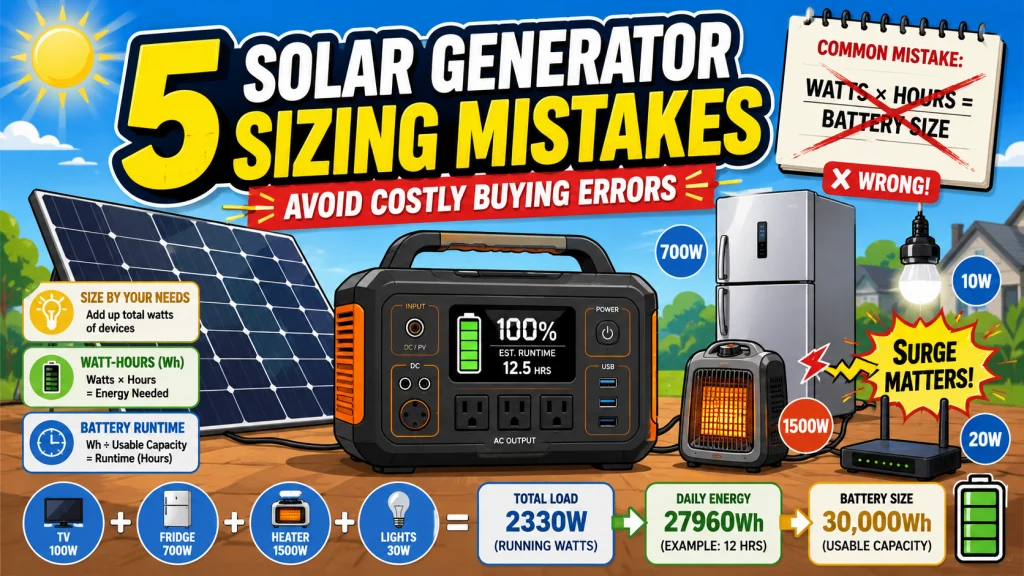
Why Solar Generator Sizing Mistakes Are So Common
Solar generator sizing mistakes are not random errors. They cluster around a few specific gaps in how buyers think about stored power, and those gaps are not accidental. Almost every brand-published guide I have read uses the same structure: identify your use case, then pick from their product lineup. What you rarely find is an honest walkthrough of what can actually go wrong in the calculation itself, before you ever get to a buying decision.
The five mistakes below are the ones I have watched play out most consistently, across buyers at every price point and every use case. Each one has real numbers attached to it, so you can see exactly where the wrong assumption leads and what the correction looks like. If you want the full sizing methodology rather than just the failure modes, the complete two-number calculation framework is in the guide on how to size a solar generator for watt-hours and surge watts together.
Mistake 1: Sizing for Watts Instead of Watt-Hours
This is the most common error, and it has a specific failure story that goes with it. The buyer looks at the unit’s continuous output wattage, matches it to the appliance’s wattage, and concludes the pairing works. They never check whether the battery has enough energy stored to run that appliance for the time they actually need it. Watts and watt-hours sound similar enough that many people assume they measure the same thing. They do not.
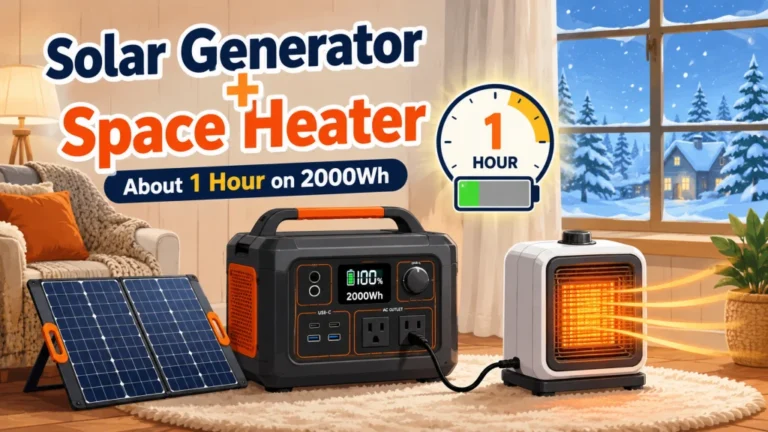
Here is the example that shows this most clearly. A buyer purchases a unit with a 2000W continuous output to run a 1500W space heater through a winter outage. The output rating is more than sufficient for the load. What they do not check is the battery capacity. If that unit carries 2000Wh, it delivers approximately 1,700Wh of usable energy after the 85 percent efficiency adjustment. A 1500W heater draws 1500W the entire time it is on. The math: 1,700 divided by 1,500 equals 1.13 hours before depletion. The buyer was planning to heat a room overnight. The unit died in just over an hour.
Field Note: I ran into this pattern constantly. A buyer would come in, see that the continuous watt rating matched their appliance, and feel like they had done the work. The watt-hour number was right there on the same spec sheet, but most people read past it entirely. Watts is the engine. Watt-hours is the fuel tank. You can have a powerful engine and still run out of fuel in 90 minutes.
The correction: size for watt-hours first, watts second. Multiply your appliance’s real average draw by the number of hours you need it to run. That is your minimum watt-hour requirement before the efficiency adjustment. A 1500W heater for 8 hours straight requires 12,000Wh of stored energy, and no portable solar generator in the consumer price range stores 12,000Wh. Knowing that before you buy eliminates a category of purchases entirely.
Mistake 2: Using the Nameplate Wattage for a Cycling Appliance
A standard frost-free refrigerator might show 300W on its nameplate. If you plug that number into a sizing calculation and multiply by 8 hours, you get 2,400Wh. That would suggest you need a large and expensive unit just to keep your fridge cold overnight. In reality, a frost-free refrigerator draws its rated wattage only when the compressor is actively running, and the compressor cycles on and off throughout the day, running approximately 30 to 50 percent of the time under normal ambient conditions.
A 300W nameplate refrigerator at a 40 percent duty cycle averages 120W of actual consumption. For an 8-hour overnight period, the real calculation is 120W multiplied by 8 hours, which equals 960Wh. That is less than half of the 2,400Wh the nameplate math suggested. Buyers who use the nameplate number for cycling appliances consistently over-buy, sometimes by a factor of 2x on the fridge load alone, and often walk out of the store with a unit they did not need.
The correction is to measure, not estimate. A plug-in power meter costs $20 to $30 and is the only tool that gives you the actual average consumption of a cycling appliance. Let the refrigerator run for 24 to 48 hours with the meter in line and read the accumulated watt-hours directly. No duty cycle estimation required. For quick reference without a meter, modern frost-free refrigerators of average size typically average 100 to 150W over a 12-hour period at normal room temperature. That number rises significantly in hot ambient conditions, which matters if you are sizing for summer use in a warm garage or cabin.

This 220V monitor handles up to 16 amps and reads down to 0.01W resolution at Class 1.0 accuracy, detecting loads as low as 0.20W to catch even standby draw. A backlit LCD with built-in memory retains cumulative kilowatt-hour data through power interruptions. Fire-retardant ABS housing and a 1-year warranty round out a reliable package.
Check On AmazonIf you click this link and buy, we earn a commission at no additional cost to you.
Mistake 3: Skipping the Surge Watt Check
This mistake shows up specifically with motor-driven appliances, and the failure is immediate and hard to miss. The buyer plugs in the appliance, the unit trips or shuts down within a second, and the first assumption is that something is wrong with the unit. Usually nothing is wrong with the unit. It hit its peak surge watt limit and protected itself.
Motor-driven appliances need a brief power spike to start the motor, well above their steady running wattage. The spike lasts less than a second, but it can be three to six times the running draw. A sump pump that runs at 800W continuous may need 2,400 to 4,000W at startup. A refrigerator that averages 150W running may need 450 to 900W to kick the compressor over.
The wrong check: the buyer confirms the sump pump’s 800W running draw fits within the unit’s 2000W continuous output rating and calls it done. The correct check: the buyer compares the sump pump’s startup spike of 2,400 to 4,000W against the unit’s peak surge rating. A unit with a 4,000W peak surge may handle it on paper, but has little margin if the real startup spike lands at the high end of that range. A unit with only 2,500W peak surge does not pass the check at all, even though the running wattage looks fine on paper.
The appliances that carry high startup surge requirements:
- Refrigerators and chest freezers with compressor motors
- Window air conditioners and portable air conditioners
- Sump pumps and well water pumps
- Circular saws, routers, and table saws
CPAP machines with heated humidifiers are a separate case. They are not usually a startup surge problem the way a pump or compressor is, but the heated humidifier can add meaningfully to continuous draw and total watt-hour consumption, so check that load independently against your capacity calculation.
Resistive loads like space heaters, toasters, hair dryers, and LED lights have no meaningful surge. The surge check only applies to motor-driven and compressor-driven appliances. For each one on your list, look up the starting watts in the appliance manual or on the spec label. Then confirm your unit’s peak surge rating exceeds that number before you buy. This check is completely separate from the watt-hour calculation and needs to be done independently. A complete breakdown of how surge affects the sizing decision is in the guide on what size solar generator you actually need for your specific loads.

At 39.5 lbs with 2,042Wh capacity and 2,200W output, this CTB-built station is 41% lighter and 34% smaller than typical 2kWh units. It charges from 0 to 80% in just 66 minutes via AC, operates at under 30 dB in silent mode, and switches to UPS backup in under 20 milliseconds. The LiFePO4 battery is rated for a full 10-year lifespan.
Check On AmazonIf you click this link and buy, we earn a commission at no additional cost to you.
Mistake 4: Sizing for One Appliance at a Time
Buyers often test a unit by taking their biggest intended load, running the math on how long it will run on a given unit, and using that as the benchmark for the purchase. The problem is that during an actual outage you are not running one appliance at a time. The fridge runs continuously whether or not you are awake. The router stays on. The lights are on. You are charging phones and devices. All of this happens at the same time, and the combined draw is what moves the battery down, not the peak appliance in isolation.
A concrete example: a 2,000Wh unit with 85 percent efficiency delivers 1,700Wh of usable capacity. If the calculation only accounts for a refrigerator at 120W average, the projected runtime is just over 14 hours. If the real simultaneous load includes the fridge at 120W, a router at 10W, four LED lights at a total of 20W, and device charging at 20W, the combined draw is 170W. Runtime drops to roughly 10 hours. That is still a reasonable result, but it is meaningfully different from the single-load projection, and it matters when you are deciding between a 2,000Wh and a 2,500Wh unit.
The correction is straightforward. Before running any watt-hour calculation, list every load that will be running simultaneously and sum them. The fridge does not pause because you turned on a light. Use the combined concurrent draw as your wattage figure in the calculation, not the single largest appliance. Most people add 50 to 100W to their estimate once they account for everything they actually leave running during an outage, and that addition makes a real difference in projected runtime.
Mistake 5: Assuming Full Solar Recharge Every Day
A backup plan that requires the solar panels to fully recharge the unit every single day is not a backup plan for winter. It is a plan for summer in a sunny state. Solar output varies enormously by season, latitude, and daily weather, and a plan built around the best-case scenario breaks down exactly when you need it most: during a multi-day storm outage in December.
The numbers behind this are significant. A 200W solar panel in ideal summer conditions with six peak sun hours generates approximately 1,000 to 1,200Wh per day. The same panel at 45 degrees north in December on a clear day might produce 200 to 400Wh. On an overcast day at that latitude in winter, output drops to 30 to 150Wh. A multi-day cloudy stretch can leave a solar generator with essentially no useful recharge for three to five consecutive days. If the plan assumed daily recharge, it fails completely.
| Condition | 200W Panel Output (approximate) | Daily recharge on a 2,000Wh unit |
|---|---|---|
| Summer, 6 peak sun hours | 1,000 to 1,200Wh | 50 to 60 percent |
| Spring or fall, 4 peak sun hours | 600 to 800Wh | 30 to 40 percent |
| Winter, 2 peak sun hours, clear sky | 200 to 400Wh | 10 to 20 percent |
| Overcast, any season | 30 to 150Wh | 1 to 8 percent |
The wrong assumption: the plan counts on 1,000 to 1,200Wh of daily solar recharge because that is what the panel generates in good conditions. The correct assumption: plan around 200 to 400Wh on a clear winter day, and near zero on an overcast one. Size the battery and supplemental charging strategy around that lower number, not the summer peak. The correction is to treat solar recharge as a useful supplement, not a guaranteed daily reset.
If you are planning for extended outages in a region with winter weather, size the battery for the number of days you might go without meaningful recharge, or build in a supplemental charging option. Connecting the unit to shore power for 60 to 90 minutes during a brief grid return, or running a gas generator once per day solely to top up the battery, is a more reliable strategy than depending on the sun. A 2,000Wh unit with a clear supplemental charging plan handles a five-day winter outage more reliably than a 5,000Wh unit with no plan beyond the panels.

Powered by N-Type cells at 25% conversion efficiency, this dual-sided panel captures up to 28% more energy than single-faced panels and weighs just 15.4 lbs for easy transport. A 30 to 60 degree adjustable bracket with a built-in angle guide keeps sunlight hitting at the optimal 90 degrees throughout the day. IP68 waterproofing and ETFE coating ensure long-term durability in harsh conditions, and it pairs seamlessly with EcoFlow power stations via the included MC4 to XT60i cable.
Check On AmazonIf you click this link and buy, we earn a commission at no additional cost to you.
Sizing Mistake Checklist Before You Buy
Before you trust any spec sheet or marketing claim, run these five checks against the unit you are considering. Each one maps to a mistake above. A unit that passes all five is sized correctly for your use case. A unit that fails any one of them will disappoint you in the field, and usually in the exact way the mistake predicted.
| Check | What to verify | Pass condition |
|---|---|---|
| Runtime (Wh) | Usable watt-hours after 85 percent efficiency matches your total load multiplied by hours needed | Usable Wh divided by combined draw exceeds your required runtime |
| Cycling appliances | Average draw used in calculation, not nameplate watts | Refrigerator sized from measured or realistic average draw, often 100 to 150W, not nameplate watts alone |
| Surge watts | Unit’s peak surge rating exceeds startup load of every motor-driven appliance | Peak surge rating is above the highest starting watts on your list |
| Simultaneous load | All concurrent loads summed, not just the largest single appliance | Runtime calculated on combined draw, not peak appliance draw alone |
| Recharge plan | Plan works if solar produces 200 to 400Wh per day, not 1,000 to 1,200Wh | Supplemental charging option exists for multi-day low-sun periods |
The five checks take about ten minutes with a spec sheet in hand. Most of the numbers you need are already on the unit’s product page. The ones that are not, specifically the average draw of your cycling appliances, come from either a power meter measurement or a reference database lookup. Running through this list before you buy is the difference between a unit that works and one that disappoints you the first time you actually need it.

With 1,800W output, a 3,600W surge, and X-Boost pushing usable power to 2,600W, this LiFePO4 station handles refrigerators, microwaves, and heavy appliances with ease. X-Stream AC charging reaches 80% in just 45 minutes, and a 500W solar panel fills it in 2.5 hours. Its sub-10 millisecond UPS switchover protects sensitive electronics, and EV-grade CTC construction ensures a 10-plus year lifespan.
Check On AmazonIf you click this link and buy, we earn a commission at no additional cost to you.
Final Thoughts: The Correction Is Simpler Than the Mistake
Every mistake on this list has the same root cause: the wrong number was used in the calculation. Watts instead of watt-hours for runtime. Nameplate draw instead of average draw for cycling appliances. Running watts instead of surge watts for motor loads. Single-appliance draw instead of combined simultaneous draw for the total picture. And best-case solar output instead of worst-case recharge reality for multi-day outages.
Once you know which number to reach for, none of these calculations are complicated. The reason they trip buyers up is not that the math is hard. It is that most available guides leave one or more of these checks unaddressed. Now you have all five in one place.

Weighing just 23.8 lbs with a foldable handle, this 1,070Wh LFP power station delivers 1,500W of pure sine wave AC output with a 3,000W surge capacity, capable of running AC units, fridges, and electric pots. Its LFP battery sustains over 70% capacity after 4,000 cycles, translating to a lifespan of more than 10 years. Via the Jackery App, you can enable a full charge in as little as one hour, or switch to a whisper-quiet 30 dB overnight mode. Six output ports including two USB-C with 100W PD charging cover nearly any device simultaneously.
Check On AmazonIf you click this link and buy, we earn a commission at no additional cost to you.
FAQs
⚡ What actually happens if I undersize a solar generator?
The most common outcome is runtime that falls well short of expectations. The battery depletes faster than anticipated because the capacity was sized against watts instead of watt-hours, or because simultaneous loads were not accounted for. For motor-driven appliances, an undersized unit may also trip immediately on startup if the peak surge rating is below the appliance’s starting load. In both cases the unit is not broken, it is just not the right fit for what you are asking it to do.
🔋 Why did my solar generator die so much faster than I expected?
The most likely cause is a higher actual load than the estimate. Either you are running more simultaneous appliances than you planned for, or your load calculation used the nameplate wattage of a cycling appliance instead of its real average draw. Both errors produce the same result: actual consumption is higher than the estimate, and the battery runs out sooner. A plug-in power meter on the unit’s output gives you the real-time draw and takes the guessing out of it.
🔌 Why does my solar generator shut off the moment I plug in my refrigerator?
This is almost always a surge watt issue. The refrigerator compressor pulls a brief but large power spike at startup, and if that spike exceeds the unit’s peak surge rating, the inverter trips as a protection measure. Check the unit’s peak surge watt specification in the manual or on the product page. Compare it to the refrigerator’s starting watt requirement, which is typically three to six times the running wattage. If the unit’s surge rating is below that number, the pairing will not work reliably.
☀️ Can I count on solar panels to recharge my unit every day during a winter outage?
Only under favorable conditions. In summer with a south-facing panel array, daily recharge is realistic and useful. In winter, at northern latitudes, or during cloudy stretches, output can drop to 10 to 20 percent of rated capacity on clear days and close to zero on overcast ones. Any extended outage plan that requires full daily solar recharge is vulnerable to exactly the weather conditions that tend to cause multi-day outages. Build in a supplemental charging option for anything longer than a day or two.
📊 How do I calculate simultaneous load correctly?
List every appliance that will be running at the same time during an outage. Use the average draw for cycling appliances like refrigerators, not the nameplate. Sum all the wattages. That total is your simultaneous draw. Divide the unit’s usable watt-hour capacity by that number to get projected runtime. If the result is shorter than you need, either reduce concurrent loads or move up to a higher capacity unit. The key is to run the calculation on the combined real draw, not the biggest single appliance.