Why a Solar Generator for a Sump Pump Is Not the Same as Any Other Home Backup Problem
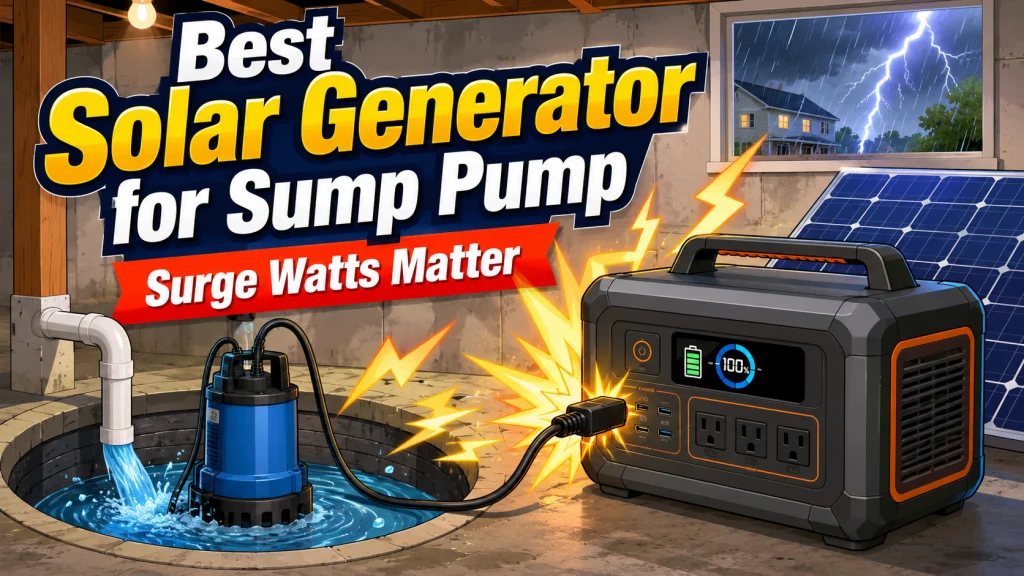
The most common solar generator and sump pump pairing failure I have seen has nothing to do with how much battery capacity the unit holds. The battery could be fully charged and the unit will still shut down, because the inverter cannot absorb the spike of current the motor pulls the instant it starts. That spike lasts under a second. But if the inverter is not rated to handle it, it trips an overload fault, the pump never gets running, and your basement takes on water while a perfectly good solar generator sits there doing nothing.
This is the pattern I ran into at the shop repeatedly, especially in spring after a bad storm season. A homeowner would come in having already bought a unit, having looked at the specs and felt confident. The pump drew 900 watts running, the inverter was rated 1,500 watts continuous, there seemed to be room to spare. What they had never checked was the surge rating. The unit tripped on every startup attempt. They returned it and bought something with a higher surge ceiling, and the problem went away entirely. The fix was not more watt-hours. It was a higher instantaneous rating on the inverter.
Field Note: The sump pump question came up almost every spring without fail. Buyers who had been through one bad outage already would come back looking for something that actually worked. In almost every one of those cases, the unit they owned was not undersized on capacity. It was undersized on surge. They had never seen that number on the spec sheet, and neither the retailer nor the product listing had flagged it as relevant.
What a Sump Pump Actually Draws
The typical residential sump pump is a 1/3 HP or 1/2 HP submersible unit. Running draw for a 1/3 HP model sits somewhere between 800 and 1,200 watts depending on the pump design and the head pressure it is working against. A 1/2 HP unit draws a bit more, usually 1,000 to 1,500 watts while running. Those numbers are manageable for most solar generators with a 1,500-watt-or-larger inverter, which is why the running draw does not tell the whole story.
The startup surge is where things change. A 1/3 HP pump typically pulls 2,400 to 3,500 watts at startup. A 1/2 HP pump can surge to 3,500 to 4,500 watts. That surge lasts a fraction of a second, but the inverter has to absorb it cleanly or it will fault. A unit rated at 1,500 watts continuous with a 3,000-watt surge is right at the margin for a 1/3 HP pump, and real-world motors can pull slightly higher than their nameplate rating. That margin disappears fast. In a flood event, your pump cycles every few minutes. Each cycle hits that surge threshold. One fault, and the load disconnects.
| Pump Size | Typical Running Draw | Typical Startup Surge | Minimum Solar Generator Surge Rating |
|---|---|---|---|
| 1/3 HP | 800 to 1,200W | 2,400 to 3,500W | 4,000W surge minimum |
| 1/2 HP | 1,000 to 1,500W | 3,500 to 4,500W | 5,000W surge minimum |
| 3/4 HP | 1,500 to 2,000W | 4,500 to 6,000W | 7,000W surge minimum |
Check the label on your pump or the manufacturer spec sheet before sizing anything. Most residential pumps installed after 2010 have the horsepower rating stamped on the motor housing. If yours is older and the label is gone, 1/3 HP is the most common size in American homes, and the 2,400 to 3,500-watt startup range is a reasonable working assumption for sizing purposes. If the label shows amps instead of horsepower, multiply amps by 120 volts to get running watts, then add the surge margin from the table above. A pump rated at 9 amps, for example, draws about 1,080 watts running, which puts it near the upper end of a 1/3 HP pump or into smaller 1/2 HP territory. In that case, 4,000W surge is the floor, and 5,000W gives safer margin.
The Only Spec That Determines Whether This Works
For almost every other appliance, I start with watt-hours. How much capacity does the unit hold, and how long will it run the load before depleting. For a sump pump, that question comes second. The surge watt rating of the inverter comes first. If the unit cannot absorb the startup spike, the capacity number is irrelevant. It will fault before the pump ever gets running.
The surge watt rating tells you the maximum instantaneous load the inverter can handle for a very short burst, typically measured in milliseconds. A unit rated at 2,000 watts continuous and 4,000 watts surge can absorb a momentary 4,000-watt hit without faulting. For a 1/3 HP pump that surges to 2,800 watts, that 4,000-watt ceiling clears the bar with real margin. For a 1/2 HP pump that surges to 4,200 watts, you need to be at 5,000 watts surge or above to stay safe.
Most sub-$800 solar generators are rated between 1.5 and 2 times their continuous inverter rating on surge. A unit with a 1,500-watt continuous inverter has roughly 2,250 to 3,000 watts of surge capacity. That is not enough for a standard 1/3 HP pump under real conditions. The units that handle sump pump starts reliably are in the larger inverter class, specifically those with 2,000 watts continuous and 4,000-plus watts surge at minimum. Several units in the 2,000 to 3,000Wh class are confirmed to handle surge ratings above 7,000 watts, which clears any residential sump pump with substantial margin. That is the class you are shopping in for this application, and it is a narrower field than the general home backup category.
Warning: A surge watt rating close to your pump’s startup surge is not close enough. Surge measurements assume ideal conditions. Real motors can pull above nameplate. Size for comfortable margin, not minimum clearance.

Starting at 2kWh and expandable to 6kWh with two additional batteries, this LFP station reaches 80% in just 43 minutes via combined AC and solar input. Its 3,000-cycle battery outlasts the industry average by 6 times and includes a 5-year service guarantee. With 2,400W output across 15 outlets and X-Boost pushing to 3,400W, it handles 99% of household appliances at a whisper-quiet 30 dB.
Check On AmazonIf you click this link and buy, we earn a commission at no additional cost to you.
How Much Capacity Do You Actually Need for a Sump Pump Backup
Once surge is cleared, capacity becomes the second question. A sump pump does not run continuously. During a normal rain event it cycles on and off, typically running a minute or two and then sitting idle. At that kind of moderate duty cycle, the actual energy consumed by the pump over an eight-hour period is roughly 600 to 800Wh. That is a much lower number than most people expect, and it is why a well-matched 2,000Wh unit covers a standard overnight storm event with real margin to spare once you account for other loads like lighting, a router, and phone charging.
The numbers shift when the storm is heavy and the inflow rate is high. A basement that is taking on water fast keeps the pump running far more frequently. At that elevated duty cycle, energy consumption over eight hours can climb to 1,500 to 2,500Wh for the pump alone. Add other loads and inverter conversion losses at around 85 percent efficiency, and a 2,000Wh unit that handles a moderate storm comfortably can be depleted in four to six hours during a severe event with near-continuous pumping. That is not a failure of the unit, it is a sizing mismatch for an extreme scenario.
The practical takeaway is this: 2,000Wh is the right minimum for a typical storm with normal duty cycling. If your basement has known high inflow, if your area gets multi-day heavy rain, or if you have flooded before even with a functioning pump, 3,000Wh is the more appropriate target. Pair either with 200 watts of solar input and you gain roughly 1,000Wh back per usable daylight day, which extends the coverage window substantially across a multi-day outage.

Built with N-Type cells at 25% conversion efficiency, this 15.9 lb foldable panel includes a 30 to 60 degree adjustable bracket with an integrated angle guide for optimal sun tracking throughout the day. ETFE coating and an IP68 waterproof rating ensure durability in harsh weather, and the included protective bag makes transport straightforward for camping, trekking, or road trips.
Check On AmazonIf you click this link and buy, we earn a commission at no additional cost to you.
The Setup That Will Leave You with a Flooded Basement
The combination I see cause the most problems is a 1,000Wh unit with a 3,000-watt surge rating. On paper, it seems like it might work for a modest pump. The surge rating clears a 1/3 HP startup, barely. The running draw fits within the continuous inverter range. It looks adequate when you skim the spec sheet.
In practice, two things go wrong. First, 3,000 watts of surge for a pump that realistically surges to 2,800 to 3,200 watts is cutting it too close. A slightly undersized motor, an older pump with worn bearings pulling a bit more current, or a unit measured at the conservative end of its surge rating, and you get a trip. Second, even if it starts reliably, 1,000Wh of capacity at moderate pump duty cycle lasts one to two hours of active pumping before the battery is depleted. You would need to recharge via AC or solar in the middle of a flood event to keep up, which is exactly the wrong time to be managing that problem.
The minimum setup that works reliably for this specific application is a unit with 4,000-plus watts of surge capacity and 2,000Wh of usable battery. Anything below either of those thresholds introduces real failure risk for a use case where failure has direct consequences. This is one situation where I do not recommend buying at the margin and hoping it holds.
Note: This article covers 120-volt residential sump pumps only. A private well pump is a different problem entirely because most residential well pumps run on 240 volts. Most portable solar generators output 120 volts only. The voltage mismatch means a solar generator that handles your sump pump reliably will very likely not run your well pump at all, regardless of its watt rating. That is a separate buying decision with a much smaller field of compatible units.
What to Check Before Buying for Sump Pump Backup
The spec sheet review for this use case is shorter than most. There are four numbers that determine whether a solar generator works reliably for sump pump backup, and everything else is secondary.
- Surge watt rating: Must exceed your pump’s startup surge by a clear margin. Find your pump’s horsepower, use the table above to estimate the startup surge range, then look for a unit whose surge rating clears that number by at least 500 to 1,000 watts. The higher this ceiling, the more reliable the startup under real conditions.
- Continuous inverter rating: Must comfortably exceed your pump’s running draw. A 1/3 HP pump at 1,000 watts running needs at least a 1,500-watt continuous inverter. A 2,000-watt continuous inverter provides better margin and handles other simultaneous loads without stress.
- Battery capacity: 2,000Wh minimum for a single overnight event at normal storm duty cycle. If your area gets multi-day heavy rain events, or your basement has a high inflow rate that keeps the pump running frequently, 3,000Wh is a more comfortable target. Capacity below 2,000Wh depletes too quickly to cover a full night reliably.
- Solar input ceiling: An outage triggered by a severe storm often lasts longer than a single night. A unit that accepts 200 watts or more of solar panel input can begin recovering capacity during daylight, even under partly cloudy conditions. This matters far more for sump pump backup than it does for CPAP or phone charging, because your storm is still active when the sun comes up.
One spec that does not matter for this specific application is UPS-mode switchover speed. A sump pump tolerates a brief gap when power transfers without any damage. You are not protecting a medical device or a computer that will drop data mid-process. Switchover speed is a real concern for home office setups, but it is irrelevant here. For broader context on how to match a solar generator to the right home backup scenario, the guide to finding the right solar generator for your situation covers the full range of buyer use cases and helps you figure out which features to prioritize based on what you are actually trying to protect.
Surge rating is below 4,000W for a 1/3 HP pump, or below 5,000W for a 1/2 HP pump. Surge rating is not listed anywhere on the spec sheet. Total capacity is under 2,000Wh. The unit is designed primarily as a portable travel charger, where surge ceilings are typically very low and not intended for motor loads.
Surge rating is explicitly confirmed at 4,000W or above. Continuous inverter rating is at least 2,000W. Battery capacity is 2,000Wh or more, with LiFePO4 chemistry preferred for long cycle life. Solar input ceiling is at least 200W. The unit is designed and marketed for home backup use.

With a 3,600Wh LFP battery expandable up to 25kWh via extra batteries or smart generators, this station delivers 3,600W across 15 output ports, boosted to 4,500W with X-Boost or 7,200W when two units are paired. A full recharge takes just 1.8 hours via 240V or 2.8 hours with 1,600W of solar input. It may also qualify for the 30% Residential Clean Energy Tax Credit.
Check On AmazonIf you click this link and buy, we earn a commission at no additional cost to you.
Test Your Setup Before the Storm, Not During It
One thing I always recommended at the shop, and still do at the homestead, is running a live test of the solar generator and sump pump together before you ever need to depend on it. Most people set up the unit, leave it on a shelf, and find out whether it works when their basement is already taking on water. That is the wrong order of operations.
Testing is straightforward. Plug the pump directly into the solar generator, then manually trigger the pump several times in quick succession by lifting the float or using the manual test switch if your pump has one. Watch for overload indicators, fault lights, or automatic shutdowns on the inverter. If the unit trips even once during dry-run testing, do not treat that as a minor quirk to ignore. A single trip under controlled conditions means a reliable trip when the pump cycles every few minutes during an actual flood event. That is not a unit you can trust for this application.
After starting the pump ten to fifteen times, check how much battery capacity has been consumed. This gives you a real-world baseline for how fast the unit depletes under your specific pump load, not the theoretical calculation from a spec sheet. Write that number down. If the unit dropped 10 percent of capacity across fifteen startup cycles plus running time, you can extrapolate roughly how many hours of actual storm duty cycle you have available. Test again when the battery is at 50 percent, not just at full charge. Surge handling can degrade slightly under lower voltage conditions on some units, and it is better to know that before the storm.
Pro Tips: Do this test once at the start of each storm season, not just when the unit is new. Battery performance changes over time, and a unit that handled the pump easily two seasons ago may behave differently after several hundred charge cycles.

Starting at 2kWh and expandable up to 8,448Wh with compatible expansion batteries, this LiFePO4 station delivers 2,400W across 11 ports including a 30A TT-30 RV port, dual 100W USB-C, and a dedicated 48V RV charging port. It reaches 80% in just 60 minutes via AC input and fully charges in under 4 hours with 1,200W of solar. The battery is rated for 3,000 plus cycles across a 10-year lifespan.
Check On AmazonIf you click this link and buy, we earn a commission at no additional cost to you.
Final Thoughts: Get the Surge Right and the Rest Falls Into Place
Most home backup content treats every appliance as roughly the same kind of load, differing mainly in how many watt-hours they consume. A sump pump does not fit that model. The startup surge is a fundamentally different problem, and it is the one that causes failures in basements during real storms. A unit that looks adequate on paper will trip on the first startup cycle if the surge ceiling is too low. No amount of watt-hour capacity compensates for that.
Check your pump’s horsepower, confirm the surge rating on any unit you are considering clears that startup load by a real margin, and run a live test before storm season. Those three steps take the guesswork out of this entirely. For homeowners managing a fuller load list across an extended outage, the complete guide to solar generators for home backup covers how to prioritize appliances and match capacity to your actual scenario. And if multi-day coverage is your concern, the article on planning solar generator backup for a three-day outage walks through the recharge strategy that makes extended coverage work.
FAQs
⚡ Can a solar generator run a sump pump?
Yes, but only if the surge watt rating exceeds your pump’s startup surge. A 1/3 HP pump typically surges to 2,400 to 3,500 watts at startup. Most units under $800 top out at 2,250 to 3,000 watts surge, which is marginal or insufficient. Look for a unit with 4,000-plus watts surge and at least 2,000Wh capacity for reliable overnight coverage.
🔌 What size solar generator do I need for a sump pump?
Minimum 2,000Wh capacity with 4,000-plus watts surge for a standard 1/3 HP pump. If your pump is 1/2 HP, look for 5,000-plus watts surge. Capacity below 2,000Wh depletes too quickly during active storm cycling. A surge rating below 4,000 watts risks tripping on every pump startup.
💧 How many watts does a sump pump use?
A standard 1/3 HP sump pump draws 800 to 1,200 watts while running. The startup surge reaches 2,400 to 3,500 watts for a fraction of a second. Both numbers matter, but the surge figure is what determines whether your solar generator can start the pump at all.
🏠 Will a 1000Wh solar generator run a sump pump?
Probably not reliably. Most 1,000Wh units have surge ratings around 2,000 to 3,000 watts, which is marginal for a 1/3 HP pump’s 2,400 to 3,500-watt startup surge. Even if it starts, 1,000Wh of capacity runs out in one to two hours of active storm pumping. For this use case, 2,000Wh with a high surge ceiling is the practical minimum.
🌧️ How long will a solar generator run a sump pump during an outage?
A 2,000Wh unit running a 1/3 HP pump at normal storm duty cycle covers roughly 8 to 10 hours. At heavy continuous cycling, closer to 4 to 6 hours. Solar recharge during daylight extends this substantially. A 3,000Wh unit with 200 watts of solar input can extend sump pump coverage across a multi-day outage when the pump is cycling normally and daylight conditions are usable.
🔍 What is surge wattage and why does it matter for sump pumps?
Surge wattage is the maximum instantaneous power a solar generator’s inverter can handle for a brief moment, typically a fraction of a second. Sump pump motors pull far more current at startup than while running, a phenomenon called inrush current. If the inverter’s surge rating is below the pump’s startup draw, the inverter trips and the pump never starts. For sump pumps, surge wattage matters more than any other single spec.