The Word “Critical” Does Real Work in Sizing
The most common mistake in solar generator critical loads sizing is the list. It starts practical: the fridge, the router, a few lights. Then it grows to include the garage fridge, the television, the coffee maker. Each addition feels reasonable on its own. Together, they push the required unit from an $800-1,200 purchase to something that costs more than a used car, and the whole project stalls.
Applying a stricter filter to that list is what changes the math. In outage planning, “critical” means specifically: if this stops running, someone’s health is at risk, a significant financial loss occurs, or the home becomes genuinely unsafe. Everything else is a comfort load. That single distinction cuts most people’s sizing requirement in half. I have seen this pattern across hundreds of sizing conversations: once buyers apply the filter honestly, they usually end up needing a 2,000-3,000Wh unit rather than a 5,000-8,000Wh setup.
Sizing your solar generator for essentials rather than the full appliance list is not a compromise. It is the calculation done correctly. The rest of this guide walks through how to build that list and turn it into a number.

Starting at 2kWh and expandable to 6kWh with two additional batteries, this LFP station reaches 80% in just 43 minutes via combined AC and solar input. Its 3,000-cycle battery outlasts the industry average by 6 times and includes a 5-year service guarantee. With 2,400W output across 15 outlets and X-Boost pushing to 3,400W, it handles 99% of household appliances at a whisper-quiet 30 dB.
Check On AmazonIf you click this link and buy, we earn a commission at no additional cost to you.
Three Questions That Sort Every Appliance on Your List
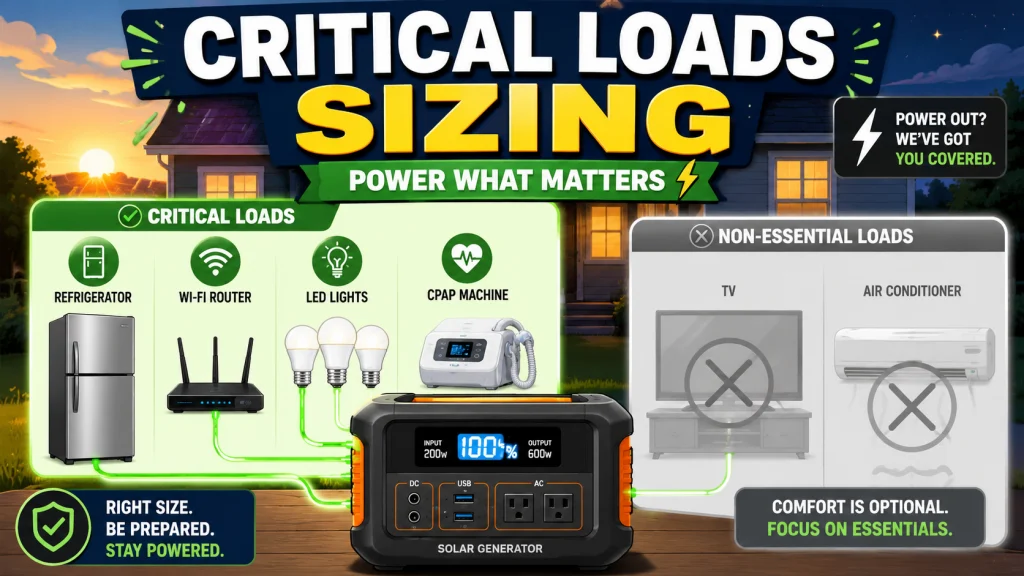
Before touching a single watt-hour figure, run each appliance in your home through this filter. An appliance that answers yes to at least one question belongs on the critical list. An appliance that answers no to all three is a comfort load, full stop.
- Does someone’s health depend on it running? Any oxygen concentrator, CPAP machine, home medical monitor, or life-sustaining device answers yes immediately. The watt draw is what it is. These stay on the list without negotiation.
- Will stopping it cause a significant financial loss? A full-size kitchen refrigerator answers yes. A chest freezer stocked with a season of food answers yes. Replacing the contents of a full fridge typically runs $200-400. That is an economic argument, not a comfort argument.
- Is the home unsafe without it? A sump pump in a basement that floods answers yes. Basic lighting in a home with young children or elderly occupants answers yes. A medical alert system answers yes.
A second refrigerator in the garage, a television, a gaming console, electric cooking appliances, and an air conditioner usually do not pass this filter under typical outage conditions. They are comfort loads. Including them in the critical loads calculation is what makes the project feel unaffordable when it is not.
This three-question filter is also the organizing framework behind the broader home backup sizing question. The guide to solar generator sizing for whole-house backup scenarios covers how critical loads sizing, apartment sizing, and full home backup sizing each use a different approach, and why starting with the critical loads calculation usually produces the most actionable answer first.
What a Typical Critical Load Profile Looks Like
Here is what the solar generator essential loads calculation looks like for a typical US home, using realistic planning figures instead of nameplate maximums. The point is not to pretend every refrigerator behaves exactly the same. The point is to build a conservative enough load profile to choose the right unit class without sizing for the entire house.
| Appliance | Planning Figure | Hours per 12-Hour Period | Wh Required |
|---|---|---|---|
| Frost-free refrigerator | 150W while compressor is active | 8 hrs budgeted runtime | 1,200Wh |
| Router / modem | 10W continuous | 12 hrs | 120Wh |
| 4 LED lights (5W each) | 20W combined | 6 hrs | 120Wh |
| Phone and device charging | 20W combined | 4 hrs | 80Wh |
| Total | 1,520Wh |
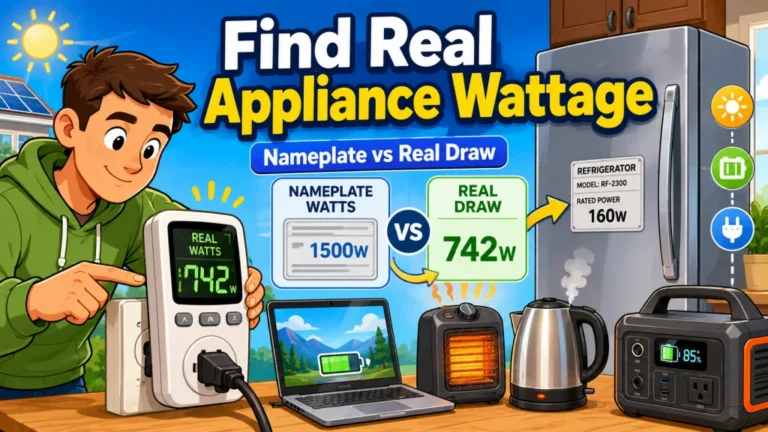
The refrigerator carries almost the entire load. Its nameplate may read 250-300W or more, but that does not mean it draws that wattage every minute of the outage. The compressor cycles on and off, and the real energy use depends on the fridge, room temperature, door openings, and how full the unit is. For planning purposes, budgeting roughly 1,200Wh for a full-size refrigerator across a 12-hour outage period is a practical conservative estimate for many homes.
Everything else on the list is comparatively minor. The router holds a flat 10W continuously. Four LED lights at 5W each add 20W combined. Phone and device charging over four hours rounds out the load. The total comes to 1,520Wh across a 12-hour outage period. That is the number to bring into the sizing calculation.

This compact plug-in monitor tracks the energy consumption of any AC 115-volt appliance and displays real-time readings of volts, amps, and wattage at 0.2 to 2.0 percent accuracy. Its large LCD screen lets you calculate electricity costs by the day, week, month, or year, making it easy to spot energy-hungry devices and trim your utility bill. It is also compatible with inverters, adding flexibility for off-grid setups.
Check On AmazonIf you click this link and buy, we earn a commission at no additional cost to you.
From Load List to Minimum Unit Size
Once you have the critical load total, two adjustment steps turn it into a realistic rated battery capacity. Skip either one and the number you end up with may not cover the actual load.
Step 1: apply the efficiency factor. A solar generator’s rated capacity is not fully available as usable energy. Inverter losses, battery chemistry, and operating temperature all take a cut. A practical planning figure is 85 percent. Divide the load requirement by 0.85: 1,520 divided by 0.85 equals 1,788Wh of raw battery capacity needed.
Step 2: add a safety buffer. The 85 percent figure is an estimate, not a guarantee. Your specific unit’s real-world efficiency will vary with ambient temperature and the specifics of your appliance draws. A 25 percent buffer is reasonable. Apply it: 1,788 times 1.25 equals 2,235Wh minimum rated capacity.
What that translates to in terms of what to look for:
- A 2,000Wh unit covers the critical list but leaves little margin for real-world variance. It is technically adequate, not comfortable.
- A 2,500Wh unit handles the same loads for a full 12-hour period with meaningful headroom.
- A 3,000Wh unit runs those same critical loads for roughly 16-18 hours, depending on reserve settings, temperature, and the actual refrigerator duty cycle.
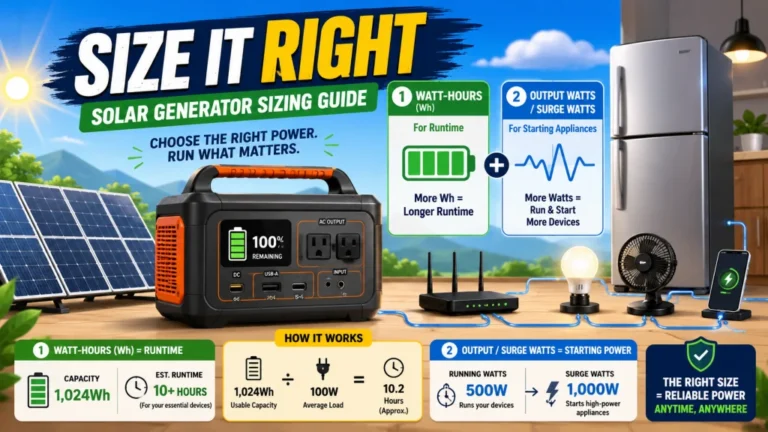
If a medical device is on your list, move up one size class from wherever the math lands you. The calculation sets the floor. A medical requirement raises it. The full sizing methodology, including the separate check for continuous output watts and surge capacity, is covered in the guide on how to size a solar generator using the two-number method.
What Stays Off the Critical List
The boundary between critical and comfort matters as much as the list itself. Three categories of loads inflate the sizing calculation significantly when included, and they usually do not pass the three-question filter under typical outage conditions.
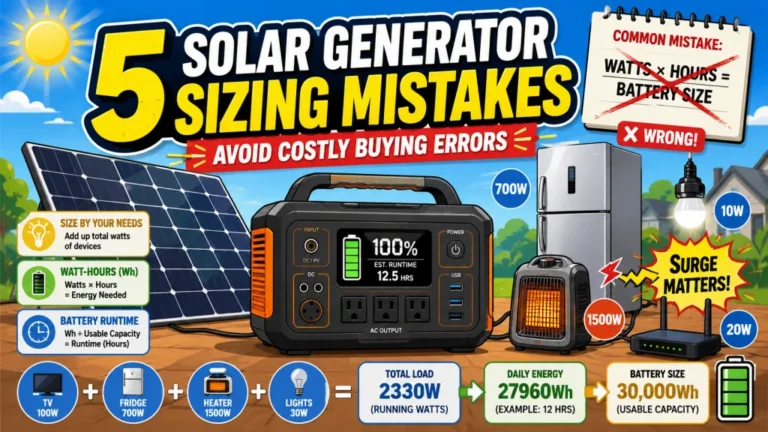
Space heaters consume energy at a rate that is incompatible with any practical portable battery capacity for sustained use. A standard 1,500W space heater draws 1,500Wh per hour. One hour of space heater runtime can consume as much energy as the refrigerator budget across an entire 12-hour critical-load period. Add a space heater to the critical list and the required unit size roughly triples, without meaningfully solving overnight heat at any battery capacity available in the portable solar generator category.
Window air conditioners are a separate calculation from sizing for essentials. The startup surge alone pushes the required unit class higher, and the sustained watt draw adds a significant Wh requirement on top of that. If cooling matters to you during outages, it is worth running the math, but it belongs in a different line item than what genuinely cannot fail.
Electric cooking, televisions, gaming consoles, and power tools are real loads, but they are not usually critical loads. Many gas cooktops can still be lit manually during an outage, depending on the model. Missing a television does not create a health risk or a financial loss. These are real comfort loads worth planning for eventually, but they belong in a separate budget conversation.
Field Note: I used to ask overwhelmed buyers some version of this question: what happens in your house at 2 a.m. on night two of the outage, when the novelty is completely gone? The answer almost always came back to the same three things. The fridge, maybe a CPAP, a light when someone gets up. Everything else had quietly stopped mattering by that point. That is your critical list.
The practical result of holding this boundary: most US homeowners can cover their genuinely critical loads for 12-18 hours on a unit in the 2,000-3,000Wh class. At current pricing, that is a $500-1,500 investment. Whole-home sizing that pulls in comfort loads routinely pushes into the $3,000-8,000 range or higher. The difference between those two numbers is how strictly the word “critical” actually gets applied.

At 3,072Wh with 3,600W output and 7,200W surge capacity, this CTB-built station powers a household for up to 15 hours and keeps a fridge running 1 to 2 days. Its UL-certified UPS switches in under 20 milliseconds, LiFePO4 batteries last 4,000 cycles, and a full recharge takes just 1.7 hours via hybrid input. It is 47% smaller and 43% lighter than comparable 3kWh units.
Check On AmazonIf you click this link and buy, we earn a commission at no additional cost to you.
Final Thoughts: A Smaller Target Than Most Buyers Expect
The useful output of this exercise is not a unit to buy. It is a Wh target, a short list of loads you have thought through honestly, and the confidence that you are solving the right problem. Most buyers who work through this process come out surprised. The number is smaller than they assumed. The unit class it points to is more affordable than the initial whole-home sticker shock suggested.
Once the critical load question is settled, the next question is usually about duration. A 2,500Wh unit covers 12 hours comfortably, but what about 24 hours or 72 hours? At that point the math shifts from battery capacity to recharge strategy, and the calculation for each outage duration works out very differently. That is covered in the guide on how many watt-hours you need for home backup across different outage durations.
Start with the list. Run the three questions. Apply the math. What comes out the other end is a unit class, a budget range, and a clear reason you chose it.

At 39.5 lbs with 2,042Wh capacity and 2,200W output, this CTB-built station is 41% lighter and 34% smaller than typical 2kWh units. It charges from 0 to 80% in just 66 minutes via AC, operates at under 30 dB in silent mode, and switches to UPS backup in under 20 milliseconds. The LiFePO4 battery is rated for a full 10-year lifespan.
Check On AmazonIf you click this link and buy, we earn a commission at no additional cost to you.
FAQs
⚡ What counts as a critical load for a solar generator?
A critical load is any appliance whose failure would cause a health risk, a significant financial loss, or an unsafe home condition. In practice this means medical equipment, a main kitchen refrigerator, a sump pump in a flood-prone basement, and basic lighting. Everything else is a comfort load and belongs in a separate planning conversation.
🧮 How long will a 2,000Wh unit run a refrigerator?
Using the refrigerator budget in this guide, a full-size fridge requires roughly 1,200Wh across a 12-hour outage period. A 2,000Wh unit at 85 percent efficiency delivers about 1,700Wh before any reserve policy is considered, so it can run the refrigerator alone for roughly 13-17 hours depending on how much reserve you keep. Running the full critical load list alongside it brings practical runtime closer to 10-12 hours before the comfortable margin is gone.
🏠 Should a sump pump be on my critical loads list?
If your basement floods without it, yes. A sump pump meets the safety criterion directly. Keep in mind that sump pumps have significant startup surge requirements, so you need to verify that your unit’s peak surge rating exceeds the pump’s starting wattage, not just its running wattage. The surge check is separate from the Wh sizing calculation.
💡 Can I include air conditioning in my critical load calculation?
You can include it, but it changes the sizing math substantially. Window air conditioners have high startup surge requirements and sustained watt draws that push the required unit into a much larger class. For most outage scenarios, air conditioning is a comfort load. Size for genuinely critical loads first, then decide separately whether the budget extends to cooling.
🔋 What size solar generator do I need for critical loads only?
For the typical critical load profile in this guide, meaning a main refrigerator, router, four LED lights, and device charging, the calculation points to a minimum of approximately 2,235Wh of rated capacity. A 2,500Wh unit covers this comfortably for 12 hours. A 3,000Wh unit extends that to roughly 16-18 hours, depending on reserve settings and real-world appliance behavior.
🌤️ What if my critical loads include a medical device like a CPAP?
Add the device’s watt draw and run hours to the critical load table and recalculate. A CPAP without a heated humidifier typically draws 30-60W. With a heated humidifier it can reach 100-140W. More importantly, move up one unit size class from wherever the math lands you. For medical equipment, the comfortable margin matters more than meeting the technical minimum.