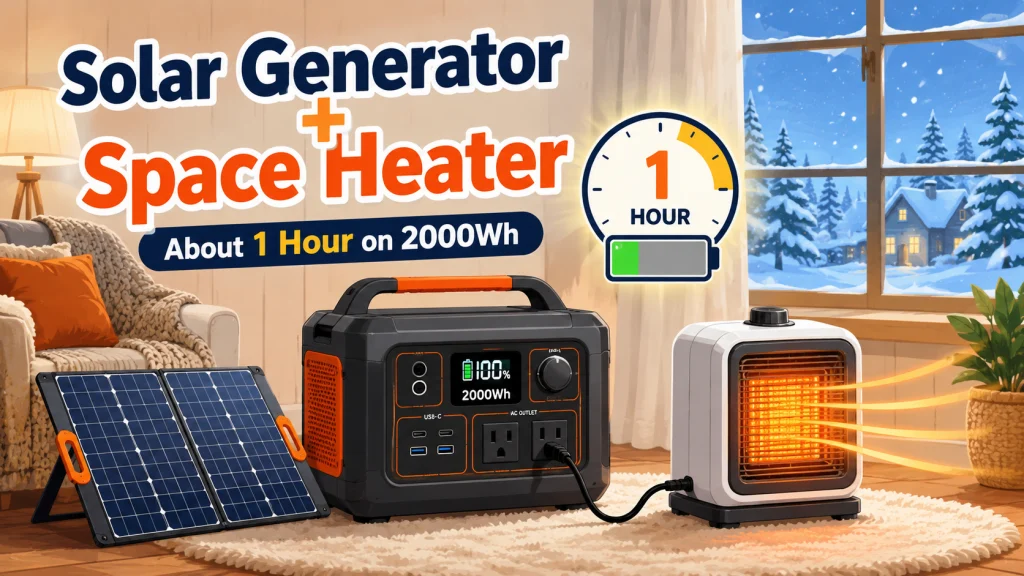
Can a Solar Generator Run a Space Heater?
Yes, and the honest answer about runtime is the part most buyers don’t hear before they find out for themselves. Whether a solar generator can run a space heater comes down to two separate checks: does the unit’s continuous output watt rating exceed the heater’s draw, and does the Wh capacity cover how long you actually need to run it. Both matter. Confusing the output watt rating with runtime is the mistake I’ve watched play out more than once, and it always ends the same way.
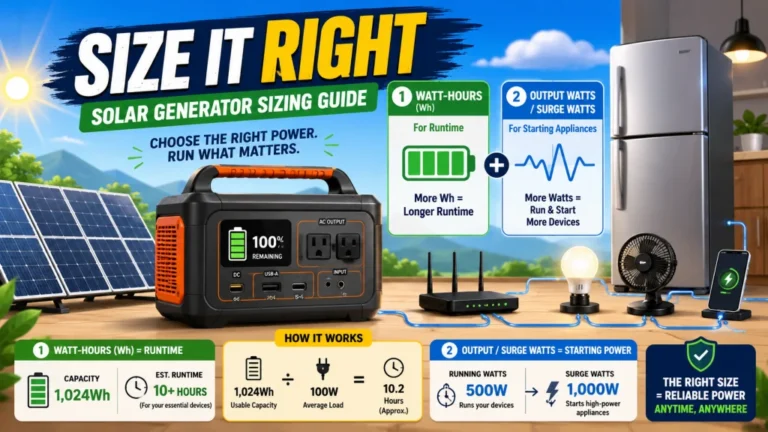
A standard 1500W space heater has no meaningful startup surge. While the heating element is on, it pulls close to its rated wattage continuously. Some models have a thermostat and cycle off once the room reaches temperature, but you should not size the battery around that cycling unless you have actually measured the real average draw in your specific space. For sizing purposes, treat it as a continuous 1500W load and you will not be caught short. A 2000Wh unit delivers approximately 1,700Wh of real usable capacity after the typical 85 percent inverter efficiency. Divide 1,700Wh by 1,500W and you get 1.13 hours. That is the ceiling for a 1500W heater running alone on a 2000Wh battery from a full charge.
The output watt rating and the Wh capacity are two completely separate specs, and both have to be checked independently. A unit with a 2000W inverter handles a 1500W heater load without tripping, but if that same unit has a 500Wh battery, the runtime is under 20 minutes. Watts determine whether the unit can start and sustain the load. Watt-hours determine how long it lasts. Getting only one right does not get you to a working plan. Those two checks answer whether the pairing works at all, and once you run the overnight numbers, the second check becomes the harder constraint.

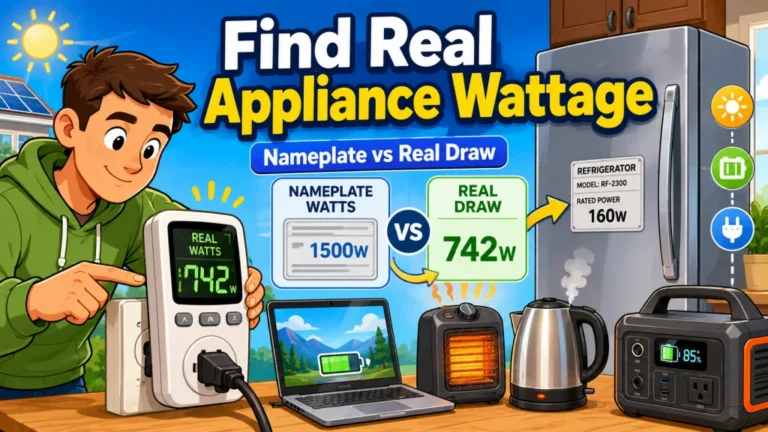
This compact plug-in monitor tracks the energy consumption of any AC 115-volt appliance and displays real-time readings of volts, amps, and wattage at 0.2 to 2.0 percent accuracy. Its large LCD screen lets you calculate electricity costs by the day, week, month, or year, making it easy to spot energy-hungry devices and trim your utility bill. It is also compatible with inverters, adding flexibility for off-grid setups.
Check On AmazonIf you click this link and buy, we earn a commission at no additional cost to you.
The Overnight Heat Calculation
Running a space heater overnight changes the math from “limited but possible” to “not a workable plan on any standard portable unit.” A 1500W heater running continuously for 8 hours consumes 12,000Wh. To sustain that draw through a full night, accounting for inverter efficiency, you would need a solar generator with roughly 14,100Wh of rated capacity. That requirement moves well beyond the standard portable power station category and into expandable home-backup battery territory. The largest single portable units in the consumer class top out at around 5,000Wh, which covers approximately 2.8 hours of continuous 1500W heat, not eight.
| Solar Generator Capacity | 1500W Heater Runtime | 750W Heater Runtime | 500W Heater Runtime |
|---|---|---|---|
| 1000Wh | ~34 min | ~1.1 hr | ~1.7 hr |
| 2000Wh | ~1.1 hr | ~2.3 hr | ~3.4 hr |
| 3000Wh | ~1.7 hr | ~3.4 hr | ~5.1 hr |
| 5000Wh | ~2.8 hr | ~5.7 hr | ~8.5 hr |
Runtimes above assume 85 percent efficiency and a battery run to depletion with no reserve maintained. In practice, stopping at a 20 percent reserve, which is good practice for lithium battery longevity, reduces each number slightly. Adding other loads shortens the runtime further, though the heater so thoroughly dominates the total draw that a router at 10W and a few LED lights add only minutes of difference at the margin.
For a 72-hour winter storm, the full picture becomes even clearer. At 1500W for 8 hours per night over three nights, the raw energy demand for heat alone reaches 36,000Wh. At that scale, a portable solar generator does not solve the problem regardless of battery size. The constraint is energy density, and no portable unit stores what extended cold-weather heating requires. The more useful question shifts from whether a solar generator can technically run a space heater to what role it can realistically fill in a cold outage.
The table above is also a buying guide in disguise. A 1000Wh unit in cold-outage use gives you one short burst and not much more. A 2000Wh unit handles two 30-minute warming sessions while still running your critical loads. A 3000Wh unit adds meaningful margin for lower-draw heaters across a longer evening. A 5000Wh unit is where a 500W oil-filled radiator starts to cover a full night in a small, well-insulated room, though still not with a 1500W heater. If your primary goal is overnight heat from a 1500W heater, no capacity class in the portable category changes that math enough to matter.

At 39.5 lbs with 2,042Wh capacity and 2,200W output, this CTB-built station is 41% lighter and 34% smaller than typical 2kWh units. It charges from 0 to 80% in just 66 minutes via AC, operates at under 30 dB in silent mode, and switches to UPS backup in under 20 milliseconds. The LiFePO4 battery is rated for a full 10-year lifespan.
Check On AmazonIf you click this link and buy, we earn a commission at no additional cost to you.
What Actually Works: Burst Heating Sessions
The runtime numbers above describe continuous heating. Burst heating is a different scenario, and it is where a solar generator and a space heater actually fit together in a practical way. A 30-minute session at 1500W consumes 750Wh. On a fully charged 2000Wh unit, two 30-minute heating bursts across an evening use 1,500Wh total, leaving the remaining capacity for the refrigerator, the router, and device charging. That is a complete picture of the outage load, not just one appliance in isolation.
Field Note: This question came through the shop regularly, usually from someone planning for winter storm prep or a cabin setup without grid access. The ask was almost always some version of “can I run my bedroom heater overnight on a 2000Wh unit.” A lot of the time they had seen the 2000W inverter rating on the spec sheet and read it as 2000Wh of capacity. Two completely different numbers. Once I explained the difference, the follow-up was always the same: “so how long will it actually run?” My answer was always the same: you can warm the room twice. After that, the unit is running the fridge and the lights, not the heater. Once the math was on the table, most people shifted their thinking from overnight heat source to “takes the edge off when it gets really cold.” That is a legitimate and useful role. It is just not the same role as a dedicated heating system.
The insulation factor matters more than most buyers account for. A well-sealed room does not drop back to starting temperature the moment the heater turns off. After a 20-minute burst from a 1500W heater in a small, reasonably insulated space, the room stays noticeably warmer for 45 minutes to an hour in moderate cold. Burst heating is not about maintaining temperature continuously. It is about adding heat in cycles and letting the room hold it between sessions. That reframes the math from “1.1 hours total” to “usable warming sessions across a full evening,” which is a different and more accurate way to think about the actual value of the pairing.
The Room Matters as Much as the Heater
Burst heating only works if the space can hold heat between sessions. This is the variable most buyers skip entirely when they are thinking about solar generator heating, and it changes the practical outcome more than the heater wattage does. A 20-minute burst in a small, well-sealed bedroom raises the temperature and keeps it there for 45 minutes to an hour. The same burst in an open-plan living room with high ceilings and exterior walls on three sides dissipates in 15 minutes and the battery is still depleted. The math is identical. The comfort outcome is completely different.
Choosing the right space is the first step before any heating strategy with a portable unit. A small bedroom with the door closed gives the best result. A bathroom, a hallway, or a closed-off sitting room can work. An open-plan kitchen and living area, a garage, or a cabin with poor wall insulation will drain the battery with little to show for it in terms of sustained warmth. The table below gives a rough sense of how space type affects the real-world usefulness of solar generator heating.
| Space Type | Burst Heating Effectiveness | Notes |
|---|---|---|
| Small closed bedroom (under 150 sq ft) | Good | Best fit; holds heat well between sessions |
| Medium room, door closed (150-250 sq ft) | Moderate | Works with lower-draw heater and reasonable insulation |
| Open-plan living area | Poor | Heat dissipates quickly; battery depletes with little lasting benefit |
| Garage or uninsulated space | Very poor | Resistive heat loss too fast; not a practical use case |
| Cabin with good insulation | Moderate to good | Lower-draw oil-filled radiator is the right heater here |
The practical takeaway is simple: before a winter outage, identify the smallest, best-insulated room in the house and plan to use that as the warm space. Close the door, add a draft stop if needed, and run the burst there. That one decision can double or triple the effective comfort per watt-hour compared to trying to heat a larger open area.
Lower-Draw Heaters: A Better Fit for Solar
Not every electric heater draws 1500W. The choice of heater changes the runtime math significantly, and for solar generator use, lower-draw options are worth thinking through before defaulting to whatever heater is in the closet. Most people reach for a standard ceramic or coil model, which happens to be the most power-hungry option in the common category. Switching to a lower-draw heater is the simplest way to extend useful runtime without buying a larger battery. The tradeoff is heat output speed, not heat quality.
An oil-filled electric radiator at its lowest setting typically draws 400W to 600W continuously. At 500W on a 2000Wh unit at 85 percent efficiency, that is approximately 3.4 hours of runtime. On a 3000Wh unit, around 5.1 hours. Still not overnight on its own, but meaningfully more useful in a burst heating strategy. Oil-filled radiators also respond to thermostat cycling, which means the average draw in a small, well-insulated room often drops to 30 to 50 percent of the nameplate wattage once the space reaches a stable temperature. A 500W oil-filled radiator maintaining heat in a 200-square-foot bedroom may average 200 to 250W over an extended session, pushing actual runtime well beyond the nameplate calculation.
- 1500W ceramic or coil space heater: Continuous resistive draw while the heating element is on. Runtime approximately 1.1 hours on a 2000Wh unit. Fast heat, limited runtime, not well matched to a fixed battery capacity.
- 750W personal ceramic heater: Runtime approximately 2.3 hours on 2000Wh. Practical for a desk area or small enclosed space. Noticeably less heat output than a full-size model.
- 500W oil-filled radiator (low setting): Runtime approximately 3.4 hours on 2000Wh at nameplate wattage, longer with thermostat cycling. Slower to warm a room, steadier temperature once it gets there.
- 400W oil-filled radiator (lowest setting): Runtime approximately 4.3 hours on 2000Wh at nameplate. The most solar-compatible option if slow heat buildup is acceptable for the situation.
The practical question is which situation you are actually planning for. If you need to take the chill off a cold room quickly, the high-draw burst is the right call and the runtime limit is the cost of that speed. If you are trying to keep a small space tolerably warm across a longer stretch, a lower-draw heater working with thermostat cycling makes far better use of a fixed battery. Knowing which problem you are solving before the outage happens saves a lot of frustration during one.

This fanless 1,500W heater uses an exclusive thermal slot design to maximize heat flow while keeping surface temperatures low, reducing dry air and avoiding the circulation of dust, pollen, and dander. ComfortTemp mode automatically maintains optimal temperature and power levels, delivering up to 20% better efficiency than running at max thermostat settings. Smart snap wheels and an integrated handle make it easy to move room to room right out of the box, with no installation required.
Check On AmazonIf you click this link and buy, we earn a commission at no additional cost to you.
When Heat Is the Primary Outage Concern
If staying warm through a multi-day winter outage is the main thing you are trying to solve, a portable solar generator is not the center of that plan. That is not a criticism of the technology. It is a mismatch between what the technology does well and what sustained winter heating requires. A gas or propane heater rated for safe indoor use, operated exactly according to the manufacturer’s ventilation and carbon monoxide safety instructions, is the right tool for hours of continuous warmth. A portable solar generator handles the router, the refrigerator, the lights, phone charging, and medical equipment. Those are the loads it is built to cover well.
What a solar generator does add to a cold outage, even when it is not the primary heat source, is burst heat without fuel management. There is no monitoring of fuel levels, no ventilation concern, no refueling in bad weather. A 20-minute warming session in the middle of the night costs around 500Wh and requires pressing a button. That is a real advantage when the unit is already running everything else, and it stacks cleanly alongside the other loads without requiring any separate setup. The role is supporting, not central, and that distinction matters for sizing and planning.
For a broader look at how different appliance types behave under solar generator power, including which pairings work and which ones hit the same kind of runtime ceiling that space heaters do, the full breakdown by appliance category is in the appliance-by-appliance guide to solar generator power. If you are still working out what battery capacity class fits your total load before thinking about specific appliances, the calculation framework for matching your full list of loads to the right unit size is at the complete solar generator sizing guide.

Powered by IBC bifacial cells at up to 26.7% conversion efficiency, this panel outperforms conventional PERC panels and maintains strong output in low-light conditions. Six panels together can fully charge a 2,042Wh power station in just 2.5 hours, and 10-second setup with an ergonomic handle makes deployment effortless. IP68 waterproofing and an operating range of -4 to 149 degrees Fahrenheit ensure year-round reliability across all weather conditions.
Check On AmazonIf you click this link and buy, we earn a commission at no additional cost to you.
Final Thoughts: Use the Runtime Number Before You Commit to a Plan
The space heater question gets a clear answer once you run the numbers. Yes, a solar generator can run one. On a 2000Wh unit with a 1500W heater, just over an hour is the realistic ceiling. The more useful question is what role you actually need the heater to fill during an outage. Burst sessions of 20 to 30 minutes are genuinely practical, leave enough capacity for everything else running on the unit, and can make a cold night significantly more tolerable. Continuous overnight heating from a portable battery is a different problem, and no unit on the market currently solves it.
Choosing a lower-draw heater, particularly an oil-filled radiator at its low setting, extends runtime meaningfully and works better with the limits of a portable system. The heat output is slower and quieter, but it fits the available energy instead of fighting it. For most outage scenarios where heat is one priority among several, that tradeoff is worth deciding on before the outage rather than during it.
FAQs
🔋 How long will a 2000Wh solar generator run a 1500W space heater?
Approximately 1.1 hours from a full charge, based on the 85 percent efficiency typical of portable solar generator inverters. A 2000Wh unit delivers around 1,700Wh of usable capacity. At 1500W continuous draw, that is just over an hour before the battery reaches depletion.
⚡ Does a space heater have a surge watt requirement?
No. Space heaters are resistive loads with no meaningful startup surge. A ceramic or coil heater draws its rated wattage immediately and continuously, with no spike above the nameplate. Any solar generator with a continuous output rating that exceeds the heater’s watt draw can start and run it without tripping.
❄️ Can a solar generator heat a room overnight?
Not with a standard 1500W heater. Eight hours of continuous 1500W heat requires roughly 14,000Wh, far more than any portable consumer solar generator stores. Even the largest portable units at around 5,000Wh cover under three hours of continuous heat. Burst sessions across the evening are the practical approach for most outage scenarios.
🌡️ What type of electric heater works best with a solar generator?
An oil-filled electric radiator at its lowest setting, typically 400 to 600W, is the best match for solar generator heating. It draws less power, cycles with the room thermostat rather than running at full draw continuously, and delivers longer runtime on a fixed battery. The tradeoff is slower heat buildup compared to a high-watt ceramic model.
🏠 Is a solar generator a good backup heat source for winter outages?
For short burst warming sessions, yes. For sustained overnight or multi-day heating, no. A solar generator works well for 20 to 30 minute warming bursts while handling other critical loads simultaneously. It is not a replacement for a propane or gas heater when sustained warmth over many hours is the primary need.
🔌 Can a 1000Wh power station run a space heater?
Yes, if the unit’s continuous output rating exceeds the heater’s wattage. At 1500W, a 1000Wh unit runs the heater for approximately 34 minutes from a full charge. At 750W, around 1.1 hours. For anything beyond a single short burst, a 1000Wh unit is too small for regular space heater use.
☁️ Can I recharge a solar generator with solar panels fast enough to keep using a space heater?
In most practical scenarios, no. A 1500W heater drains a 2000Wh unit faster than any realistic rooftop-portable panel array can recharge it during daylight hours. A 400W panel setup in 5 peak sun hours generates around 2,000Wh per day. That covers one full recharge of a 2000Wh unit, which buys you one more hour of heat the next evening, not ongoing heating throughout the day.