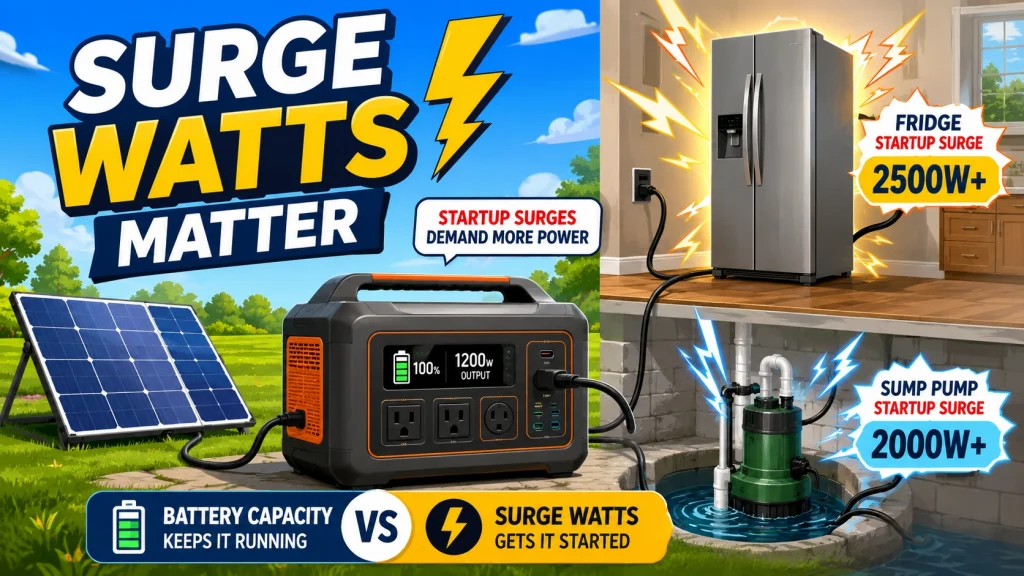
The Spec That Trips Units at the Worst Moment
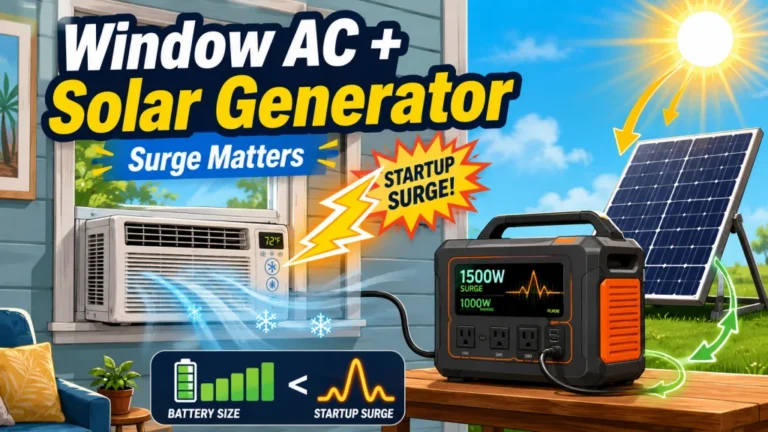
A solar generator with a 2000Wh battery and a 2000W inverter sounds like it should handle a 1500W space heater without blinking. It usually does. That same unit may fail to start a 1500W refrigerator. Not because the battery is too small, not because the inverter is underpowered for normal operation, but because of what happens in the first fraction of a second when the compressor kicks on. That startup spike is the surge draw, and it is the spec most buyers never check.
I saw this pattern more times than I can count at the shop. Someone would come back frustrated, saying their unit kept cutting off every time the fridge tried to restart. Their watt-hour math was fine. Their continuous watt rating looked adequate on paper. But they had never compared the unit’s peak surge rating against the fridge’s actual starting surge requirement. Those are two different numbers, and both of them have to work for the setup to function reliably.
Field Note: One of the most consistent return conversations I had involved buyers who had sized correctly for watt-hours and continuous output, then hit a tripping problem with a refrigerator or sump pump. Almost every time, they assumed the unit was defective. In almost every case, the unit was doing exactly what it was designed to do: protecting its inverter from a load it could not safely handle. The surge ratings were on both spec sheets the whole time. No one had checked them against each other.

At 2,042Wh with 3,000W output, this LiFePO4 station runs air conditioners, RVs, and heavy appliances at a whisper-quiet 30 dB. It fully recharges in just 2 hours via solar or AC, and capacity expands from 2kWh up to 24kWh by adding battery packs or pairing two units in parallel. ChargeShield technology boosts battery life by 50% across a 10-year lifespan, backed by a 5-year warranty.
Check On AmazonIf you click this link and buy, we earn a commission at no additional cost to you.
What the Surge Spike Actually Is
Most electrical loads fall into one of two categories when it comes to startup behavior. Resistive loads like space heaters, toasters, and LED lights draw roughly the same wattage the moment they switch on as they do during continuous operation. There is no meaningful startup spike. You size for the label wattage and the number holds throughout the run.
Motor-driven appliances work differently. The motor inside a refrigerator compressor, a sump pump, a well pump, or a power tool requires a surge of current at the moment it starts from a standstill. The surge lasts less than a second in most cases, often just a few electrical cycles, but it hits hard. For single-phase induction motors, starting surge typically runs between two and six times the running wattage, depending on motor design, age, and the load the motor starts under. A refrigerator compressor that draws 150W at steady state might demand 700W to 900W at startup. A sump pump running at 600W might need 3,000W or more to start.
The solar generator’s inverter has to absorb that spike without triggering its overload protection circuit. If the spike exceeds the unit’s rated peak surge capacity, the inverter shuts down. The appliance never finishes starting, and the unit cuts out. If the unit resets automatically, you try again and the same thing happens. If you are sizing for a sump pump during a flood, that is not a theoretical inconvenience.
Key point: The surge draw is not a flaw in the appliance. It is a fundamental characteristic of induction motors. Sizing for it is part of the buyer’s job, and it is a separate calculation from the watt-hour math.
Which Loads Have Meaningful Surge Requirements
Not every appliance creates a surge problem. Knowing which category each load falls into is the first step in sizing a solar generator for surge watts. Resistive loads do not surge at startup. The appliances that do are all motor-driven or compressor-driven.
| Appliance | Typical Running Watts | Surge Multiplier (estimate) | Estimated Starting Surge |
|---|---|---|---|
| Frost-free refrigerator | 100-200W | 3-5x | 600-900W |
| Chest freezer | 80-150W | 3-5x | 400-700W |
| Window AC (5,000 BTU) | 450-550W | 3-4x | 1,200-2,000W |
| Sump pump (1/3 HP) | 400-600W | 5-7x | 2,000-4,000W |
| Well pump (1/2 HP) | 750-1,000W | 3-5x | 2,500-5,000W |
| Circular saw | 1,400-1,800W | 1.5-2x | 2,100-3,600W |
| CPAP with heated humidifier | 30-60W | 2-3x | 90-150W |
| Space heater | 1,500W | None | 1,500W (no surge) |
| Router / LED lights | 5-15W each | None | Negligible |
The numbers above are working estimates based on observed performance, not marketing specs. Actual starting surge will vary by motor age, ambient temperature, and how much load the motor starts under. A sump pump starting against standing water draws more surge than one cycling on an empty basin. A freezer in a hot garage surges harder than the same unit sitting in a cool basement. These variables are why conservative sizing matters more than a precise calculation.
The appliances that surprise buyers most consistently are sump pumps and well pumps. The running wattage looks manageable. The starting surge is where the math stops working. I have seen buyers size confidently for the 600W running draw of a 1/3 HP sump pump, pick a unit with a 3000W surge rating, and then watch it trip every time the float triggered because the actual starting surge was closer to 3,800W. The running watts math was right. The surge check never happened.
Finding the Numbers on Both Sides of the Equation
The Appliance Side: Finding the Starting Surge
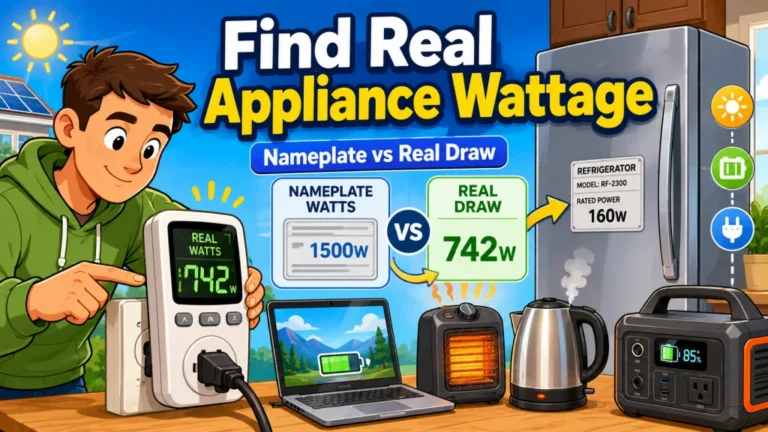
Some appliances list starting watts or locked rotor amps (LRA) directly on the nameplate or in the owner’s manual. LRA is the current drawn at startup with the shaft locked from rotating, which approximates the worst-case starting current. To convert LRA to a startup wattage estimate for inverter sizing purposes, multiply the LRA value by 120 to get the approximate startup VA demand on a 120V circuit. A pump with a 12-amp LRA rating draws approximately 1,440VA at startup, which is the conservative figure to use when checking your unit’s peak surge rating.
If the label does not show starting watts or LRA, the three-times rule is a reasonable first estimate for most household motors. Take the running wattage and multiply by three. For a refrigerator with a 150W running draw, that gives a 450W minimum surge estimate. For pumps and motors that are known to start harder, use a five-times multiplier for the conservative number. Better to have headroom than to find the unit’s actual limit at 2 AM during a storm outage.
The Unit Side: Reading the Surge Rating
Every solar generator spec sheet lists two figures for AC output. One is the continuous watt rating, which is the sustained output the unit can maintain during normal operation. The other goes by different names depending on the brand: peak watts, surge watts, or starting watts. This second number is what matters for surge sizing. It represents the maximum instantaneous draw the unit’s inverter can handle before its overload protection activates.
A common pairing is a 2000W continuous unit with a 4000W peak surge rating. That unit can absorb a starting spike up to 4000W. A 1500W continuous unit might carry a 3000W surge rating. Some budget units have peak ratings only 20 to 30 percent above their continuous rating, which is low enough to fail even a modest compressor load. The ratio between continuous watts and peak watts matters as much as the absolute surge number, and it varies significantly across the market.
Note: Before you compare units, watch for these spec sheet patterns that can mislead surge sizing. Some listings only show peak watts prominently without stating continuous watts clearly, which makes a weak unit look capable. Labels like “boost mode” or “lift mode” are sometimes used for surge capacity but may not apply to the type of sustained motor surge a compressor or pump actually produces. If the peak rating is less than twice the continuous rating, that unit has limited headroom for motor loads. And if you do not see the words “surge watts,” “peak watts,” or “starting watts” stated explicitly, ask the seller what the maximum instantaneous output is before committing.
If you are still working through the full sizing picture from watt-hours to output requirements, the complete walkthrough on how to size a solar generator covers the two-number method that addresses both the capacity side and the output side together, including where surge watt sizing fits into the full process.

This compact plug-in monitor tracks the energy consumption of any AC 115-volt appliance and displays real-time readings of volts, amps, and wattage at 0.2 to 2.0 percent accuracy. Its large LCD screen lets you calculate electricity costs by the day, week, month, or year, making it easy to spot energy-hungry devices and trim your utility bill. It is also compatible with inverters, adding flexibility for off-grid setups.
Check On AmazonIf you click this link and buy, we earn a commission at no additional cost to you.
The Check That Tells You if the Unit Passes or Fails
The surge check has one rule: the unit’s peak surge rating must exceed the starting surge of the highest-surge appliance you plan to run, at the moment that appliance is starting, while everything else you plan to run simultaneously is already drawing its normal running wattage. That last part is where most people miss it.
You are not just asking whether the surge rating exceeds the sump pump’s starting surge in isolation. You are asking whether it exceeds the pump’s starting surge plus the fridge’s running watts plus the router plus anything else already on at that moment. The unit does not get to pause all other loads while one appliance starts. Everything adds up.
Here is the check with real numbers. You plan to run a frost-free refrigerator (150W running, 800W estimated starting surge), a router (10W), and four LED lights (20W total). The fridge is the highest-surge appliance. At the moment it tries to restart, the other loads are drawing 30W combined. The total instantaneous demand at that moment is 800W plus 30W, or 830W. Any unit with a peak surge rating above 830W handles this without issue. Most units at 1000W continuous output or larger clear it easily.
Now run the same check with a 1/3 HP sump pump (600W running, 3,500W estimated starting surge), the fridge cycling at 150W, and the router at 10W. At the moment the pump float triggers, total instantaneous demand is 3,500W plus 160W, or 3,660W. A unit with a 3,000W peak surge rating fails this check. A unit with a 4,000W surge rating passes it with around 340W of headroom. That headroom matters because starting surges can run higher than the estimate, especially with older motors or in cold weather.
Warning: Do not size to exactly pass the surge check. Starting surges can exceed the 3x to 5x estimate, particularly with aging motors, appliances starting under load, or equipment operating in cold temperatures. A unit that passes the check by only 50 to 100W will trip inconsistently. Build in real headroom, not just a number on paper that barely clears.
Putting both numbers together is what separates a setup that works from one that works most of the time. Understanding what size solar generator you actually need means checking watt-hours for runtime and peak surge for reliable startup. Getting one right without the other is how buyers end up with a unit that has plenty of capacity but trips every time the compressor kicks in.
Before buying, run through this checklist for every motor-driven load in your setup:
- List every motor-driven or compressor-driven appliance you plan to run, including any that restart automatically such as refrigerators, freezers, sump pumps, and well pumps.
- For each one, find the starting surge from the nameplate or owner’s manual. If it is not listed, apply the 3x rule for household motors and the 5x rule for pumps.
- Identify the single highest-surge appliance. That is the critical check point for the entire setup.
- Add the running watts of all other simultaneous loads to the starting surge of that highest-surge appliance.
- Confirm the unit’s peak surge rating exceeds that total. Target at least 20 percent headroom above the minimum to account for motor variability and real-world conditions.

With a 3,600Wh LFP battery expandable up to 25kWh via extra batteries or smart generators, this station delivers 3,600W across 15 output ports, boosted to 4,500W with X-Boost or 7,200W when two units are paired. A full recharge takes just 1.8 hours via 240V or 2.8 hours with 1,600W of solar input. It may also qualify for the 30% Residential Clean Energy Tax Credit.
Check On AmazonIf you click this link and buy, we earn a commission at no additional cost to you.
Final Thoughts: The Five-Minute Check That Prevents a Real Failure
Most solar generator buyers spend real time on watt-hour math and almost no time on surge. That is backwards if any of your loads are motor-driven. The watt-hour calculation tells you how long the unit will run. The surge check tells you whether it will run at all when the compressor kicks on in the middle of the night. A unit that shuts down before the fridge finishes starting is not covering you during an outage, regardless of how much battery it has.
The check itself is not complicated. Get the starting surge estimate for your highest-demand motor load, add the running watts of everything else that will be on simultaneously, and confirm the unit’s peak surge rating clears that number with room to spare. That is five minutes of work before a purchase that costs several hundred dollars. The alternative is figuring out the unit’s limits under conditions you cannot control.
If surge watt sizing is the last piece you were missing and you want to review where the other common errors occur across the full sizing process, the article on common solar generator sizing mistakes covers the complete set, including the watt vs watt-hour confusion, nameplate misreading, and the simultaneous load problem that catches buyers who size for one appliance at a time.

At 39.5 lbs with 2,042Wh capacity and 2,200W output, this CTB-built station is 41% lighter and 34% smaller than typical 2kWh units. It charges from 0 to 80% in just 66 minutes via AC, operates at under 30 dB in silent mode, and switches to UPS backup in under 20 milliseconds. The LiFePO4 battery is rated for a full 10-year lifespan.
Check On AmazonIf you click this link and buy, we earn a commission at no additional cost to you.
FAQs
⚡ What is the difference between surge watts and running watts on a solar generator?
Running watts is the continuous output a unit can sustain during normal operation. Surge watts, also listed as peak watts on many spec sheets, is the maximum instantaneous output the inverter can deliver for a fraction of a second. Motor-driven appliances need that brief spike to start the motor from a standstill. The surge rating must be higher than the starting demand of your highest-draw load, not just the running draw.
🔌 Will a solar generator trip when I try to start my refrigerator?
It depends on the unit’s peak surge rating and your fridge’s starting surge requirement. A standard frost-free refrigerator typically needs 600W to 900W to start, even though it runs at 100W to 200W continuously. Most units rated at 2000W continuous output carry a peak surge rating of 4000W or higher, which handles a residential refrigerator without issue. Compact and dorm fridges have lower starting surges and are rarely a problem on any mid-size unit.
🔧 How do I find the starting watts for my sump pump?
Check the motor nameplate for a locked rotor amp (LRA) rating, then multiply by 120 for the approximate starting watts on a North American 120V circuit. A pump showing 12 LRA draws roughly 1,440W at startup. If the nameplate only shows running amps, use a five-times multiplier on the running wattage as a conservative estimate. A 1/3 HP sump pump running at 600W typically surges to 3,000W or more, which is why pump sizing requires a higher-rated unit than the running wattage suggests.
🌡️ Does cold weather affect a motor’s starting surge?
Yes, noticeably. Cold motors are harder to turn from a standstill, which increases the current required to start them. A freezer or refrigerator in an unheated garage in winter will typically surge higher than the same unit in a warm kitchen. If you are sizing for an appliance in a cold environment, or for outdoor use during winter, add extra headroom to your surge estimate beyond the standard 3x to 5x calculation.
📋 Do I need to worry about surge watts for a space heater or CPAP machine?
Space heaters are purely resistive loads with no meaningful startup surge. Size for the running wattage and that is the full picture. A standard CPAP without a heated humidifier also has a minimal surge requirement, typically under 50W above the running draw. A CPAP with a heated humidifier has a modest startup spike, usually under 150W above its running draw, which is within range for virtually any unit at 1000W continuous output or above.
❄️ Can a solar generator handle a window air conditioner?
A 5,000 BTU window AC unit runs at 450 to 550W but typically needs 1,200 to 2,000W to start the compressor. A unit with a 2000W continuous rating and 4000W surge rating handles most window AC units in that size range. Larger units, 8,000 BTU and above, have higher starting surges and need more headroom. Always check the AC unit’s LRA rating or starting watts before selecting a solar generator for air conditioning use.