Yes, a Solar Generator Can Run a Microwave
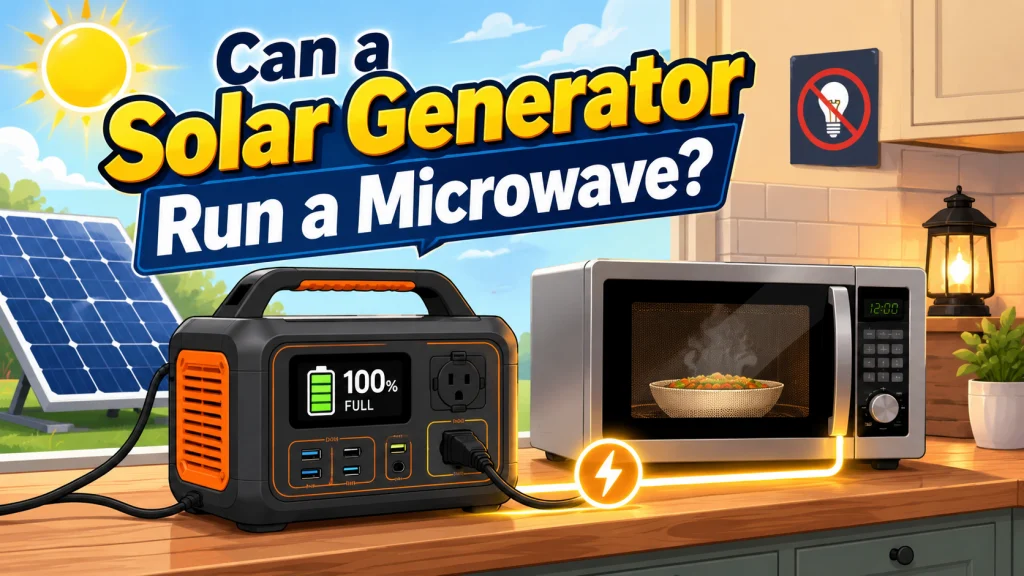
The short answer to whether a solar generator can run a microwave is yes, as long as the unit’s continuous output watt rating clears the microwave’s actual wall draw. What I tell buyers who ask about this is to confirm two numbers before assuming compatibility: the unit’s continuous watt spec and the microwave’s real input wattage, which is not always the number printed on the front of the appliance.
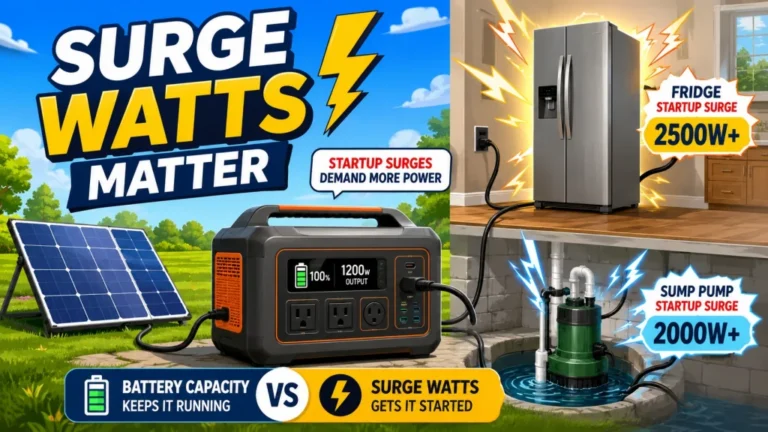
Unlike a refrigerator compressor, a sump pump, or a window air conditioner, a microwave has no meaningful startup surge. It draws its load from the moment it switches on and holds that draw for the full session. That simplifies the math considerably, because the surge watt problem that causes failures with motor-driven appliances does not apply here. The check for microwave compatibility comes down to output headroom and battery capacity, which are both readable off the spec sheet before the purchase.
Cooking Watts vs Input Watts: The Label Detail That Changes the Sizing Math
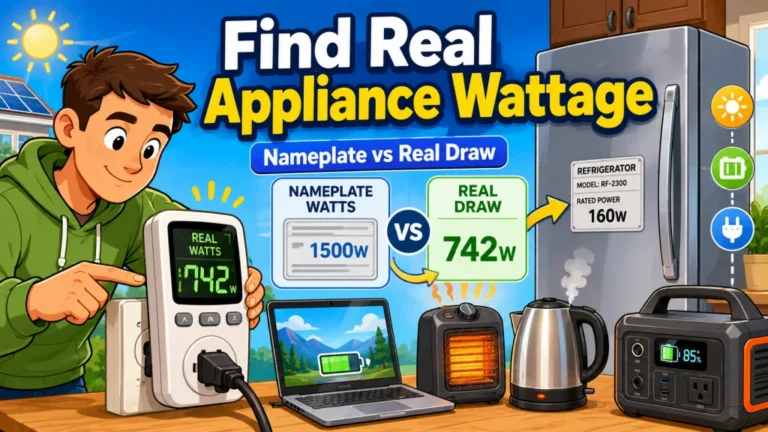
This is the part most sizing guides skip, and it is the reason buyers end up with units that trip when they should not. The wattage number shown prominently in microwave listings, on the front control panel, and in most product descriptions is the cooking output, not the wall draw. A microwave advertised as 1,000W is usually referring to cooking output, not the wattage it pulls from the wall. The actual draw at the outlet is typically higher, often in the range of 1,400W to 1,600W depending on the model.
For solar generator sizing, the number that matters is the input wattage, sometimes labeled as power consumption or rated input on the rear nameplate or in the spec sheet. If that number is not available, a reasonable working estimate is to add 40 to 50 percent above the cooking output figure. A 1,000W cooking microwave drawing 1,450W from the outlet is better paired with a unit around 1,800W continuous or higher, because that leaves practical headroom for inverter load and the small background loads that are almost always running at the same time. The 1,200W figure that a cooking-output-based calculation would suggest cuts it too close.
Key point: Always use the input watts from the rear label or manual when sizing for a solar generator. If that number is unavailable, estimate actual wall draw at roughly 140 to 150 percent of the advertised cooking output.
If the rear label lists amps instead of watts, multiply the amp rating by 120V to get an estimated input wattage for a standard U.S. outlet. A label reading 12.5A works out to roughly 1,500W of actual draw.
This distinction also changes the runtime math. If you size a session based on 1,000W draw but the microwave is actually pulling 1,450W, your runtime estimate will be about 30 percent longer than reality. The corrected numbers are in the table in the next section.

This compact plug-in monitor tracks the energy consumption of any AC 115-volt appliance and displays real-time readings of volts, amps, and wattage at 0.2 to 2.0 percent accuracy. Its large LCD screen lets you calculate electricity costs by the day, week, month, or year, making it easy to spot energy-hungry devices and trim your utility bill. It is also compatible with inverters, adding flexibility for off-grid setups.
Check On AmazonIf you click this link and buy, we earn a commission at no additional cost to you.
The Two Checks That Determine Whether the Pairing Works
Every appliance-and-solar-generator pairing comes down to two questions. The first is whether the unit can start and sustain the load without exceeding its continuous watt rating. The second is whether the battery holds enough capacity to cover the amount of time you actually need the appliance to run. Both checks matter. Passing one and failing the other still means the pairing does not work for your use case.
For a microwave, the first check uses actual input watts, not the cooking output figure. A unit with 1,800W of continuous output running a microwave with a real wall draw of 1,450W has 350W of headroom. That is workable, but not generous. A 2,000W continuous unit has 550W of headroom on the same microwave, which gives more room for simultaneous loads like a cycling refrigerator to not push the total over the inverter limit. The second check, runtime, uses the same input draw number divided into usable battery capacity at 85 percent efficiency.
| Advertised Cooking Output | Typical Wall Draw (Input) | Min. Continuous Output Needed | Runtime on 2,000Wh Unit | Runtime on 1,000Wh Unit |
|---|---|---|---|---|
| 700W (compact) | ~950-1,050W | 1,300W+ | ~1.7 hours | ~0.85 hours |
| 1,000W (standard) | ~1,400-1,500W | 1,800W+ | ~1.2 hours | ~0.6 hours |
| 1,200W (high output) | ~1,600-1,800W | 2,200W+ | ~1.0 hours | ~0.5 hours |
The runtime figures above apply 85 percent efficiency to the rated battery capacity and use the estimated input draw, not the cooking output. They also assume the microwave is the only load running, which in a real outage scenario it never is. Fridge, router, and lights are drawing from the same battery at the same time. The simultaneous load math is covered a few sections down, but the short version is that a 2,000W continuous unit handles the combined load comfortably in most home setups.
What the Runtime Numbers Mean in Practice
People see roughly one hour of microwave time on a 2,000Wh unit and assume that is not enough. In real outage use, it is far more than most households need in a day. A 2-minute reheat of leftovers at 1,450W of actual draw costs about 48Wh. A 5-minute dish costs around 121Wh. On a 2,000Wh unit with about 1,700Wh of usable capacity, that 5-minute dish consumes roughly 7 percent of the total battery. The sessions are short, and short sessions add up slowly.
Here is what the battery capacity looks like in practical microwave terms, using a standard 1,000W cooking output model at approximately 1,450W actual draw:
- A 2-minute reheat session costs roughly 48Wh, which means a 2,000Wh unit can support approximately 35 sessions before microwave use alone depletes the battery.
- A 5-minute frozen meal costs about 121Wh, or roughly 7 percent of a 2,000Wh unit’s usable capacity per meal.
- A full day of outage use with four or five microwave sessions of 3 to 5 minutes each draws somewhere between 290Wh and 600Wh total, leaving the large majority of the battery for the fridge, lighting, and device charging.
- A compact 700W cooking microwave at roughly 1,000W actual input is noticeably more battery-friendly on smaller units, particularly in the 1,000Wh to 1,500Wh class where output headroom is tighter.
What these numbers confirm is that microwave use is not the drain most buyers fear going in. The load is high while the microwave is running, but the sessions are short. A fridge cycling all night at 150W average draw will consume more total energy over 12 hours than a microwave used five times during the day. From what I have seen in practice, the battery rarely runs dry because of the microwave. It is usually the fridge, a space heater someone left on, or a total load no one added up before the outage started.

Starting at 2kWh and expandable to 6kWh with two additional batteries, this LFP station reaches 80% in just 43 minutes via combined AC and solar input. Its 3,000-cycle battery outlasts the industry average by 6 times and includes a 5-year service guarantee. With 2,400W output across 15 outlets and X-Boost pushing to 3,400W, it handles 99% of household appliances at a whisper-quiet 30 dB.
Check On AmazonIf you click this link and buy, we earn a commission at no additional cost to you.
Running a Microwave Alongside Other Loads
The check that gets skipped most often is the simultaneous load calculation. A solar generator during an outage is not powering one appliance at a time. It is running the refrigerator, the router, the lights, and the phone charger all at once. When the microwave is added on top, the inverter sees the combined draw, and that combined number is what determines whether the unit trips or holds.
A 2,000W continuous unit running a fridge at 150W, a router at 10W, two LED lights at 10W combined, and a microwave pulling 1,450W at the wall arrives at 1,620W of simultaneous draw. That is within the 2,000W continuous rating with 380W of headroom. The same stack on a 1,800W continuous unit leaves 180W of margin, which is tighter. Where it gets uncomfortable is if a CPAP machine, a box fan, or another moderate load is also running at the moment the microwave switches on, pushing the total closer to or past the inverter limit.
Field Note: One pattern I ran into at the shop more than once was buyers testing their new unit by plugging in the microwave alone, confirming it worked, and then having the unit trip during an actual outage. What happened was the fridge compressor kicked in at the same moment the microwave was running, and the combined surge pushed the total past the inverter limit. The appliance that trips the unit is almost never the one you were watching. It is usually the one that started quietly in the background at the wrong moment. Always check the combined draw of everything likely to be on simultaneously, not just the microwave in isolation.
For most home backup setups, the combined math works out fine with any unit rated at 2,000W or more of continuous output. The problem only surfaces on underpowered units, or setups where several moderate loads have stacked up without anyone running the total first.
Where Small Units Fall Short
There is a practical lower limit to what works, and it is set by the continuous output spec. A compact unit in the 500Wh to 800Wh class typically carries a continuous output rating of 500W to 1,200W. A standard 1,000W cooking microwave pulling around 1,450W at the wall exceeds the continuous output of most units in that class. The inverter shuts down before the food warms up. This is not a defect in the unit. It is a spec mismatch that is readable on the product page before the purchase is made.
In buyer discussions around compact units in the 700 to 800Wh range with continuous outputs near 1,200W, the consistent finding is that microwave use is unreliable depending on the model’s actual input draw, and any session longer than a short reheat is simply not feasible on a battery that size. The math confirms it. At 800Wh and 85 percent efficiency, usable capacity is about 680Wh. Running a microwave at 1,450W actual draw gives roughly 28 minutes of total microwave-on time before the battery depletes, before any other loads are counted.
If microwave use during an outage is a real priority, the minimum practical class is a unit with at least 1,800W of continuous output and at least 1,500Wh of battery capacity. That combination gives workable headroom and meaningful runtime even with other loads drawing simultaneously. Figuring out the right unit size for your complete load list is exactly what the solar generator sizing framework walks through, starting from the appliances you actually plan to run.
Pro Tips: Before buying, check the rear label or manual for input watts rather than the cooking output. Then add your fridge, router, and lights to that number and confirm the total stays under the unit’s continuous output rating. Size the battery for the actual input draw multiplied by realistic session time, not the cooking output watt number.

At 39.5 lbs with 2,042Wh capacity and 2,200W output, this CTB-built station is 41% lighter and 34% smaller than typical 2kWh units. It charges from 0 to 80% in just 66 minutes via AC, operates at under 30 dB in silent mode, and switches to UPS backup in under 20 milliseconds. The LiFePO4 battery is rated for a full 10-year lifespan.
Check On AmazonIf you click this link and buy, we earn a commission at no additional cost to you.
Final Thoughts: Microwave Compatibility Is Straightforward Once You Use the Right Watt Number
The microwave question worries buyers more than it should, but only once they clear the cooking-watts-versus-input-watts confusion. Use the input draw from the rear label, confirm the unit’s continuous output clears it with headroom, and run the runtime math on realistic session lengths rather than imagining the microwave running continuously for hours. Those three steps are the full analysis.
For a broader look at how the microwave fits alongside every other appliance that matters during a power outage, the appliance-by-appliance compatibility guide covers each category with the same two-check approach applied here, with the specific output and runtime numbers for each load type.

An upgrade over the AC200MAX, this 2,400W station expands up to 8,192Wh via multiple compatible battery pack options and covers all connections across 11 ports including a 30A RV port and 48V DC output. It charges from 0 to 80% in just 45 minutes via AC, or fully in as little as 1.7 hours with 1,200W of solar input. A D40 voltage regulator enables efficient RV battery charging.
Check On AmazonIf you click this link and buy, we earn a commission at no additional cost to you.
FAQs
⚡ How many watts does a microwave actually draw from the outlet?
The number on the front of most microwaves is the cooking output, not the wall draw. A 1,000W cooking microwave typically draws 1,400W to 1,600W from the outlet, depending on the model. For solar generator sizing, use the input watts from the rear nameplate or the manual. If that is not available, estimate actual draw at roughly 140 to 150 percent of the advertised cooking output.
🔋 Can a 1,000Wh solar generator run a microwave?
It depends on the unit’s continuous output rating. Most 1,000Wh units carry a 1,000W to 1,500W continuous output. If that rating clears the microwave’s actual input draw, the unit can start and run it. At 1,000Wh and 85 percent efficiency with a standard microwave pulling around 1,450W, usable run time is roughly 35 minutes before the battery is spent on microwave use alone. Adequate for short reheating, not for cooking sessions.
🍽️ How long can a solar generator run a microwave?
On a 2,000Wh unit with a standard 1,000W cooking output microwave drawing around 1,450W at the wall, you get roughly 1.2 hours of actual microwave-on time at 85 percent efficiency. In practical terms, that is approximately 35 two-minute reheating sessions. Spread across a day of outage use, microwave use rarely makes a significant dent in the battery when sessions are short.
📦 Can a small portable power station run a microwave?
Units in the 500Wh to 800Wh class often have continuous output ratings of 500W to 1,200W. A standard microwave pulling 1,400W or more at the wall will exceed the continuous output of most units in that class, causing an immediate shutdown. If the unit’s continuous output does clear the microwave’s actual input draw, the battery capacity leaves very little run time. Small units and microwaves are a poor match for anything beyond the most occasional short reheat.
🔌 Does running a microwave damage a solar generator?
No. A microwave is a relatively steady high-watt load compared with compressor-driven appliances. It has no startup surge, so it does not stress the inverter the way a refrigerator or sump pump does at startup. As long as the microwave’s actual input draw stays within the unit’s continuous output rating, running a microwave poses no risk to the solar generator. The battery simply depletes at the rate of the draw.
🌞 Can I recharge a solar generator while running a microwave?
Yes, if the unit supports simultaneous charge and discharge, which most modern solar generators do. Solar input during the day offsets some of the draw, but microwave sessions typically draw more than a solar panel can supply in real time, so the battery still depletes during cooking and recovers between sessions. The net effect depends on panel wattage, peak sun hours, and how many sessions you run per day.