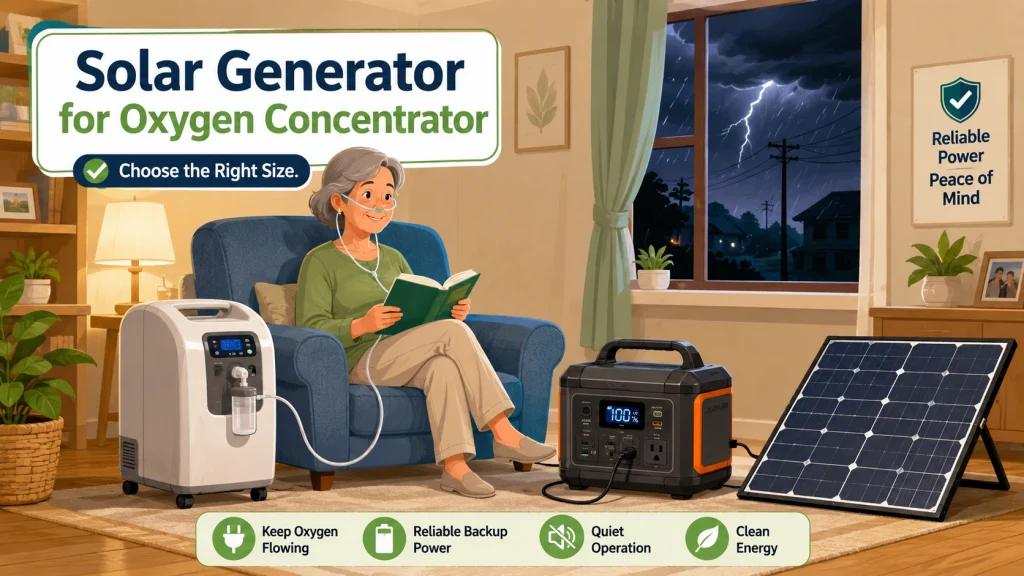
The One Appliance Where the Math Is Not Optional
For most solar generator sizing decisions, a little extra margin covers most mistakes. Buy slightly larger than you think you need, add a buffer, and if the calculation is off by 15 percent you still have working lights and a cold refrigerator. Sizing a solar generator for an oxygen concentrator does not work that way. Undersizing is not a calculation error you discover after the fact. It is a medical emergency that unfolds in the middle of the night.
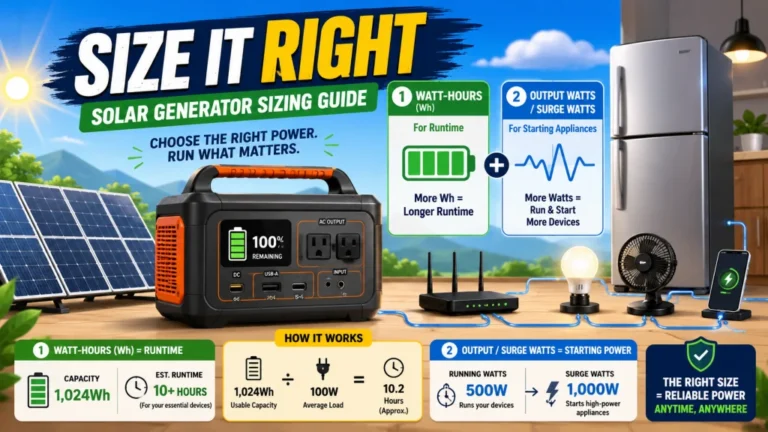
The sizing methodology is the same as any other appliance: watt draw times runtime, adjusted for efficiency, with a buffer added on top. What changes is that every shortcut you might normally take gets removed. No rounding down. No “close enough.” No assuming average conditions instead of worst-case ones. If you are still working through the basic sizing approach before getting into the specifics here, the full framework is covered in the solar generator sizing guide, which walks through the two-number method from the beginning. For an oxygen concentrator, you come back here for the application-specific math once you have the framework.
The good news is that the math is not complicated. The hard part is committing to the number it produces instead of looking for a way to justify a cheaper unit.
How Much Power Does a Home Oxygen Concentrator Actually Use
This is where most people run into trouble, because oxygen concentrator watt draws vary more than almost any other home medical device. The difference between a low-flow unit at 1 LPM and a high-flow continuous model at 5+ LPM is not 10 or 20 percent. It can be more than 300 percent. Sizing from a general estimate rather than your specific machine’s nameplate wattage is not sizing at all. It is guessing with math attached.
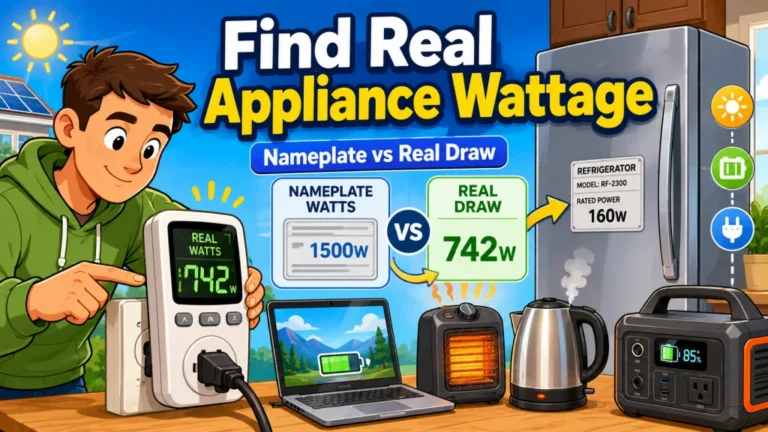
The general draw ranges by flow rate are in the table below. These are typical values across common home concentrator models. Your specific unit may fall outside these ranges, particularly if it is an older model or a high-flow prescription unit. Always check the actual nameplate wattage printed on the back of your concentrator before doing any calculations. If the patient already owns the concentrator and it is safe to test, measuring overnight consumption with a plug-in watt meter gives an even more accurate number than the nameplate alone. Real-world draw can run noticeably higher than the rated figure depending on the unit’s age and condition.
| Flow Rate | Typical Running Wattage | 12-Hour Energy Need (raw) |
|---|---|---|
| 1 to 2 LPM | 150 to 250W | 1,800 to 3,000Wh |
| 3 to 5 LPM | 300 to 500W | 3,600 to 6,000Wh |
| 5+ LPM (continuous flow) | 400 to 600W | 4,800 to 7,200Wh |
A 3 LPM unit running at 300W and a 5 LPM unit running at 500W produce dramatically different runtime numbers on the same battery. The table gives you a starting point. The nameplate gives you the number to actually use. I have had people come into the shop with a concentrator they had owned for years without ever looking at the back panel. The wattage was printed right there. In most cases it fell between 300W and 500W. The high-flow continuous models at 550 to 600W were the ones that surprised people, because that number changes the entire sizing calculation and most buyers did not see it coming.
Field Note: Oxygen concentrator questions at the counter almost always started the same way. The buyer knew they needed backup power. They did not know how many watts their unit drew. Pulling the spec sheet was the first step every time. The ones I worried about were the buyers who had already decided on a unit size based on what a salesperson told them, without ever confirming the actual draw of their specific machine. Those conversations required walking the whole calculation back to the beginning.
Note: If your setup includes a humidifier, a bedside alarm device, or any other accessory plugged into the same backup system, add that wattage separately before finalizing the runtime calculation. Even a small humidifier at 20 to 50W compounds over a 12-hour overnight session and reduces the margin you have built in.

This 220V monitor handles up to 16 amps and reads down to 0.01W resolution at Class 1.0 accuracy, detecting loads as low as 0.20W to catch even standby draw. A backlit LCD with built-in memory retains cumulative kilowatt-hour data through power interruptions. Fire-retardant ABS housing and a 1-year warranty round out a reliable package.
Check On AmazonIf you click this link and buy, we earn a commission at no additional cost to you.
Working Through the Runtime Calculation
At 300W continuous draw, which is a common real-world figure for a 3 LPM concentrator, a 2,000Wh solar generator delivers approximately 5.7 hours of runtime. Here is the math: 2,000Wh multiplied by an 85 percent efficiency factor equals 1,700Wh of usable capacity after accounting for inverter and system losses. Divide 1,700Wh by 300W and you get 5.7 hours. For a short daytime outage, that is workable. For overnight use, it is not enough.
For 12 hours of overnight coverage at 300W, the calculation works backward from the need. Multiply 300W by 12 hours and you get 3,600Wh of raw energy required. Apply the 85 percent efficiency factor: 3,600 divided by 0.85 equals 4,235Wh required at the rated capacity level. Add a 25 percent safety buffer, which matters more here than in any other sizing scenario: 4,235 multiplied by 1.25 equals 5,294Wh minimum. The honest answer is that the calculation lands just above 5,000Wh, so a unit in the 5,000Wh class is the practical floor. Anything below that should be treated as undersized for standalone overnight use at this draw rate.
Key point: A 3,000Wh unit at 300W draw covers approximately 8 hours. That is a workable backup if the grid returns by morning or if the unit can be topped up from another source before the 8-hour mark. It is not a safe standalone overnight solution for someone who cannot manage a middle-of-the-night charging session on their own.
Higher draw units change these numbers significantly. At 500W continuous, a 5,000Wh unit covers only about 8.5 hours: 5,000Wh times 0.85 divided by 500W equals 8.5 hours. For overnight coverage at 500W, the calculation points to a unit in the 6,000 to 7,000Wh class. That is a different product category and a substantially higher budget. The exact draw of your specific concentrator is not a number to estimate low on.
One more practical example worth working through: a 1 to 2 LPM unit drawing 200W is the most forgiving case. At 200W on a 3,000Wh unit, usable capacity is 2,550Wh, giving approximately 12.75 hours of runtime. That is the one scenario where a 3,000Wh unit comfortably covers a full overnight session. Confirm your unit actually draws 200W or less before treating that calculation as applicable to your situation.

With 5,100Wh of LFP capacity and a 3,000W inverter, this station powers a workshop or entire home through a full day or two of outages, with seamless UPS backup protecting sensitive electronics. Its 17 ports cover a NEMA 14-30 dryer outlet, 12V 30A RV port, 100W USB-C, and 15W wireless charging. Combined AC and solar input up to 4,000W delivers a full recharge in as little as 1.8 hours.
Check On AmazonIf you click this link and buy, we earn a commission at no additional cost to you.
Pure Sine Wave Is Not a Nice-to-Have
Oxygen concentrators are sensitive electronic medical devices. They require clean AC power output, specifically pure sine wave. All solar generators from established manufacturers in the mid-to-upper price range use pure sine wave inverters, and the spec sheet will state this explicitly. The concern is with budget units under $200 that use modified sine wave output instead. Modified sine wave is not acceptable for medical equipment. It can cause erratic motor operation, overheating, increased noise from the compressor, and in some cases may void the concentrator manufacturer’s warranty.
If you are evaluating any solar generator for oxygen concentrator backup, confirm the inverter type in the spec sheet before purchasing. Look for the phrase “pure sine wave” stated directly. If the spec sheet does not confirm this clearly, assume it is modified sine wave and do not use it for this application. The pure sine wave requirement is specific to sensitive electronics and motor-driven medical equipment. For context on how it compares across different devices, the full appliance power guide covers which devices require pure sine wave and which tolerate modified sine wave output across a range of common household loads. For an oxygen concentrator, the answer is always pure sine wave, with no exceptions.
Warning: Never use a modified sine wave solar generator or inverter to power a home oxygen concentrator. Even if the unit appears to run initially, the power quality can damage the concentrator’s motor over time and create unpredictable shutdowns.
Planning for Outages Beyond a Single Night
A single overnight outage on a correctly sized, fully charged battery is a manageable scenario. A multi-day outage is a different problem, and battery capacity alone does not solve it. Even a 5,000Wh unit at 300W draw depletes in approximately 14 hours. At 500W, it depletes in about 8.5 hours. Without a recharge plan, the second night is uncovered regardless of how large the battery is.
Solar recharging is a useful supplement but not a reliable primary recharge source in all conditions. A 400W solar panel array in 6 peak sun hours generates approximately 2,400Wh per day under strong conditions. That does not fully replace a 12-hour overnight session at 300W, which consumes 3,600Wh before losses. It can recover a meaningful portion of what was used overnight and extend the time before the next supplemental charge is needed, but it should not be treated as a full daily reset for medical backup planning. During a winter storm with two solid cloudy days, output may be 20 to 30 percent of the ideal figure. The recharge plan has to account for worst-case weather, not best-case weather.
A practical extended outage plan for oxygen concentrator backup combines three components. No single component is sufficient on its own.
- A correctly sized solar generator: 5,000Wh minimum for a 300W concentrator running 12 hours overnight, or 6,000 to 7,000Wh for a 500W unit.
- A supplemental charging source for multi-day outages: grid top-up during any partial power restoration, or a gas generator used for a single 1-hour charging session per day. One hour of gas generator charging can add 1,000 to 2,000Wh depending on the charging rate, which meaningfully extends battery life without running the gas unit continuously.
- Solar panels for partial recharge on clear days, reducing dependence on the supplemental source and providing a useful buffer even when recharge is incomplete.
What the three-component approach does is eliminate the single point of failure. Relying only on the battery assumes the outage ends before depletion. Relying only on solar assumes the weather cooperates. Relying only on a gas generator assumes it is always accessible and operable. The combination is what makes multi-day coverage realistic rather than theoretical.
Before You Rely on Any Solar Generator for Overnight Oxygen Backup
There is one aspect of overnight oxygen concentrator backup that most sizing guides skip entirely: what happens when the power goes out while the patient is asleep. A manually plugged-in backup system requires someone to be awake and aware. Most portable solar generators do not function as automatic UPS devices. They require the concentrator to be physically plugged into the solar generator before the outage, not switched over automatically when grid power drops. If the setup depends on someone noticing the outage and swapping the power source, that plan is not reliable for overnight use.
Some units offer a pass-through charging mode where the concentrator stays plugged into the solar generator continuously, which then stays connected to the wall outlet and charges from it. If grid power drops, the battery takes over immediately with no manual intervention. This is the setup worth looking for if overnight safety is the primary concern. That said, pass-through support is not the same as medical-grade UPS certification. Some units interrupt power briefly during switchover, and some manufacturers do not recommend continuous pass-through use for critical loads. Confirm both the actual switchover behavior and the manufacturer’s operating guidance before relying on that mode overnight. The spec sheet or product documentation should describe whether it supports uninterrupted pass-through or requires manual switching.
Before relying on any portable power station for overnight oxygen concentrator backup, confirm the following:
- The unit outputs pure sine wave power, confirmed in the spec sheet.
- The rated Wh capacity covers your concentrator’s actual draw for the full overnight period, with the efficiency factor and buffer applied.
- The unit supports pass-through or continuous operation mode so that a power outage during sleep does not require someone to manually switch the concentrator over.
- The AC charging rate is fast enough to meaningfully top up the battery during the day between outage nights.
- A supplemental charging source is identified and accessible for multi-day outages when solar recharge is not enough.
One last thing I always told buyers in this situation: confirm your backup plan with your oxygen supplier, DME provider, or care team before relying on any battery system for overnight use. They have seen these setups fail in ways that are not obvious from a spec sheet, and the guidance they provide is specific to the patient’s equipment and prescription flow rate.

With 7,200W rated output, a 14,400W surge, and support for both 120V and 240V, this station runs 5-ton AC units, water heaters, and major home appliances. Its 5,040Wh LFP capacity expands up to 60kWh for up to 13 days of backup, recharges in about 2 hours with 4,000W of solar input, and pairs with the Jackery 60A Smart Transfer Switch to power up to 12 home circuits. ChargeShield 2.0 and LiFePO4 chemistry deliver an 11-year rated lifespan.
Check On AmazonIf you click this link and buy, we earn a commission at no additional cost to you.
Final Thoughts: The Right Answer Here Is Always the Conservative One
Every other sizing calculation I walk through has a range with reasonable options at different budget levels. For a refrigerator, a 2,000Wh unit is marginal but workable. For lights and device charging, a 1,000Wh unit is more than enough. For an oxygen concentrator, I do not give a range with a low end that is “just okay.” The minimum is the correctly calculated minimum with a full buffer applied, and purchasing below that number is not a trade-off worth making.
Do the math from your specific concentrator’s actual watt draw, confirm pure sine wave output, check whether the unit supports pass-through for overnight automatic operation, and build in a supplemental charging plan for anything beyond a single night. That is the whole decision. Buy the size the calculation tells you to buy.

Powered by IBC bifacial cells at up to 26.7% conversion efficiency, this panel outperforms conventional PERC panels and maintains strong output in low-light conditions. Six panels together can fully charge a 2,042Wh power station in just 2.5 hours, and 10-second setup with an ergonomic handle makes deployment effortless. IP68 waterproofing and an operating range of -4 to 149 degrees Fahrenheit ensure year-round reliability across all weather conditions.
Check On AmazonIf you click this link and buy, we earn a commission at no additional cost to you.
FAQs
🔋 Can a 2,000Wh solar generator run an oxygen concentrator overnight?
At a typical 300W draw, a 2,000Wh unit covers approximately 5.7 hours after accounting for inverter and system losses. That is not enough for a full overnight session. A 2,000Wh unit can bridge a short daytime outage or serve as a gap measure while supplemental charging is arranged, but it is not correctly sized for 12 hours of continuous overnight use.
⚕️ Does an oxygen concentrator require pure sine wave power?
Yes, without exception. Oxygen concentrators are sensitive medical devices that require clean AC power. Only use a solar generator that explicitly states “pure sine wave” in its specifications. Modified sine wave units can cause erratic operation, motor overheating, and may void the concentrator’s warranty.
🌤️ Can I rely on solar panels to recharge the battery between outage nights?
Not fully, and not in all conditions. A 400W panel array in 6 peak sun hours generates approximately 2,400Wh per day, which is less than the 3,600Wh raw draw of a 12-hour overnight session at 300W. Solar can recover a useful portion of overnight consumption on clear days, but it should not be treated as a complete daily reset. Always plan a supplemental charging source for days when solar output is low.
💊 Is sizing for a CPAP machine similar to sizing for an oxygen concentrator?
No. A CPAP machine typically draws 30 to 80W, which is dramatically lower than a home oxygen concentrator at 150 to 600W. The sizing method is the same, but the numbers and the resulting unit size are completely different. Do not apply CPAP sizing guidance to an oxygen concentrator situation.
📏 What is the minimum practical unit size for overnight oxygen concentrator backup?
For a 300W concentrator running 12 hours, the calculation produces a 5,000Wh minimum after applying efficiency factors and a 25 percent safety buffer. For a 500W unit, the minimum rises to the 6,000 to 7,000Wh class. Check your specific machine’s nameplate wattage and run the math from your actual draw before purchasing.
⚡ How do I top up a solar generator during a multi-day outage if I have no grid power?
A gas generator used for a single 1-hour charging session per day can add 1,000 to 2,000Wh depending on the solar generator’s input charging rate. This extends usable battery life without running the gas unit continuously. Solar panels contribute on clear days. Combining both sources is more reliable than depending on either one alone.
🔌 Does the solar generator need to be connected to the concentrator before the outage, or will it switch over automatically?
Most portable solar generators require the concentrator to be plugged into them before the outage starts. They are not automatic UPS devices. Some units support a pass-through mode where the battery takes over instantly when grid power drops, with no manual switching required. If overnight automatic operation matters, look for a unit that explicitly supports pass-through or UPS-style operation and confirm it in the product documentation before buying.