The Startup Problem Nobody Warns You About
Running watt ratings are easy to find. Every window AC box has them printed on the side. A 5,000 BTU unit pulls around 450W while running. A 10,000 BTU unit pulls somewhere between 900 and 1,200W. Those numbers look manageable on any mid-range solar generator, and that is exactly why so many buyers get caught off guard when they plug in and the unit immediately trips.
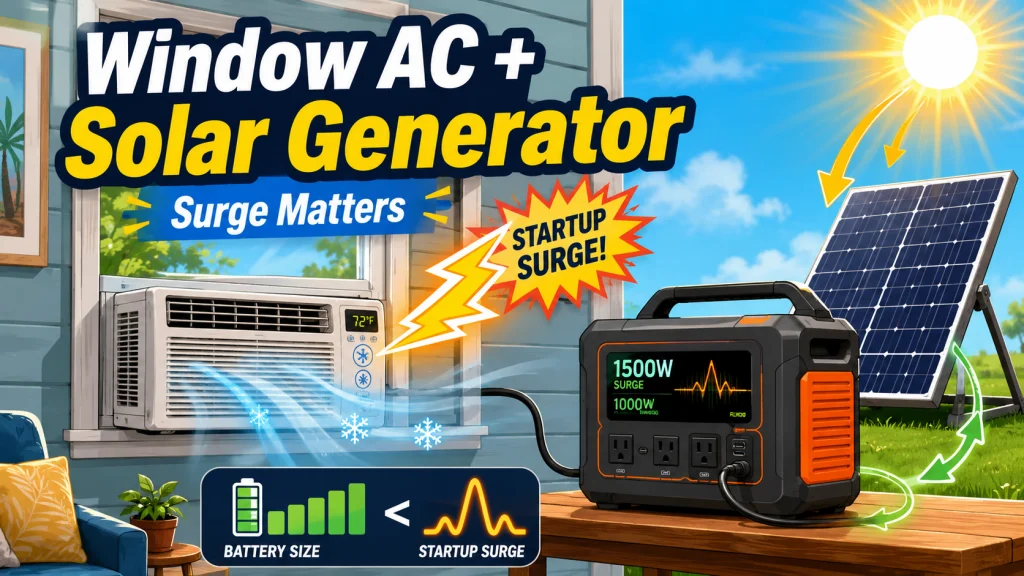
The problem is not the running draw. It is the compressor startup surge. When an AC compressor kicks on, the motor pulls 3 to 5 times its normal running wattage for less than one second. That spike has to fit within the solar generator’s peak surge rating, or the unit shuts itself down to protect the inverter. The compressor does not care that the generator was handling everything just fine the moment before. The surge is the test, and it is the test most buyers skip entirely.
Over time this became the most predictable failure pattern I saw with window AC pairings. Someone would pick a generator with plenty of battery capacity, bring it home, plug in their window unit, and watch it trip immediately on every attempt. Battery size had nothing to do with it. They had passed the runtime check and completely skipped the surge check. Two separate problems, and you need to solve both.
Two Checks, Both Required
Before committing to any solar generator for window AC use, you need to run two independent checks. Both have to pass. If one fails, the pairing does not work regardless of how well the other looks on paper.
- Check 1, Surge: Does your solar generator’s peak surge rating exceed the startup surge of your specific AC unit? If not, the generator trips the moment the compressor kicks on, and nothing in the battery capacity column fixes that.
- Check 2, Runtime: Does your solar generator’s usable watt-hour capacity cover your AC’s running draw for the number of hours you need it? If not, the battery is gone before the outage is over.
Most buyers skip Check 1 entirely, then wonder why the unit trips. Some buyers pass Check 1, feel confident about the setup, and then discover their 2,000Wh battery is depleted in under two hours on a hot afternoon. Running both numbers before spending anything is the only approach that reliably works, and the rest of this article walks through exactly how to do that for each window AC size class.
This two-check framework applies the same way across all high-draw appliances. The broader guide on what appliances a solar generator can actually power covers microwaves, space heaters, and other common loads using the same method.
Window AC Power Draw and Surge by BTU Class
Window air conditioners vary significantly by size. A 5,000 BTU unit cooling a small bedroom pulls a fraction of what a 15,000 BTU unit needs for a large room. The table below shows real draw numbers and the minimum surge rating a solar generator needs to start each unit reliably. These surge estimates use the 3x to 5x multiplier standard for single-phase compressor motors. If your specific unit’s documentation lists a starting watt figure, use that number instead.
| BTU Class | Running Watts | Startup Surge (Estimate) | Practical Minimum Surge Rating |
|---|---|---|---|
| 5,000 BTU | ~450W | 1,350 to 2,250W | 2,500W |
| 8,000 BTU | ~700W | 2,100 to 3,500W | 3,000W |
| 10,000 BTU | ~1,000W | 3,000 to 5,000W | 4,000W |
| 12,000 BTU | ~1,200W | 3,600 to 6,000W | 5,000W |
| 15,000 BTU | ~1,900W | 4,500 to 6,000W | 6,000W |
Note: These are practical working minimums for typical units in normal conditions. If your AC is older, starts under extreme heat, or lacks a listed starting-watt figure in its documentation, size toward the high end of the estimated surge range in the table.
The practical takeaway from these numbers is that BTU class determines which tier of generator is even in play. A 5,000 BTU unit is manageable on most mid-range solar generators with a 2,500W or higher surge rating. A 10,000 BTU unit needs a 4,000W surge rating at minimum, which starts to narrow the options considerably. Anything above 12,000 BTU puts you in territory where you need to read the spec sheet carefully, because not every high-capacity solar generator has the surge headroom to start a large compressor reliably.
Field Note: The surge issue came up most often with 8,000 and 10,000 BTU units at the shop. Buyers would see a solar generator rated at 2,000W continuous output and assume it would handle a 1,000W AC unit without any problem. It could handle that unit once the compressor was running. It could not always start it. The startup spike on a 10,000 BTU compressor easily hits 4,000W, and a 2,000W continuous unit with a 3,500W peak surge rating fails that test before the compressor catches. The runtime math was never the issue. The surge math was.
One thing worth noting: if your unit’s documentation does not list a starting watt figure, size to the higher end of the 3x to 5x range. A 10,000 BTU unit at 1,000W running could theoretically need anywhere from 3,000 to 5,000W at startup depending on compressor age, ambient temperature, and motor design. Older compressors and units starting in hot conditions tend to pull higher on that range. The 4,000W minimum in the table above is a reasonable working floor, not a guaranteed ceiling.

Starting at 1,024Wh and expandable to 5,120Wh with two additional batteries, this LiFePO4 station delivers 2,000W continuous and 4,500W surge via pure sine wave output safe for sensitive electronics. It charges from 0 to 80% in just 36 minutes via AC alone, or an remarkable 26 minutes combining AC and solar simultaneously. UPS transfer kicks in under 20 milliseconds, and the battery is rated for 3,500 plus cycles with 80% capacity retention.
Check On AmazonIf you click this link and buy, we earn a commission at no additional cost to you.
The Runtime Math: How Long Will It Actually Run?
Once the surge check passes, the second calculation is straightforward. Take the AC’s running watts, apply an 85 percent efficiency factor for the inverter and battery losses, and divide the unit’s usable capacity by that draw to get runtime. What the math shows is often less than buyers expect, particularly for larger units.
For a 5,000 BTU window AC at 450W average draw: a 2,000Wh battery at 85 percent efficiency gives you roughly 1,700Wh of usable capacity. At 450W draw, that is about 3.8 hours. Enough for a late afternoon cooling window during a summer outage, but not overnight. For 8 hours of continuous operation at 450W you need 3,600Wh of usable energy, or about 4,235Wh of rated battery capacity after applying the 85 percent efficiency adjustment. In practice that means a 4,500Wh or larger unit for reliable overnight coverage on a 5,000 BTU window AC.
A 10,000 BTU unit at 1,000W average draw on a 2,000Wh battery gives roughly 1.7 hours. Overnight cooling at 1,000W is not realistic on most portable solar generator setups without daily solar recharge or expandable battery capacity. The practical strategy for larger units is to use the generator for 2 to 3 hour cooling blocks, recharge from solar panels or grid power during breaks if available, and cycle through the outage that way. That is a legitimate approach. It just requires planning the charging windows in advance rather than expecting continuous overnight runtime from the battery alone.
One variable that helps in practice is duty cycle. A 10,000 BTU unit does not run the compressor continuously once the room reaches the target temperature. In a reasonably insulated room the compressor might cycle at 50 percent or less, which effectively doubles the runtime from the peak draw number. In a poorly insulated space or during extreme heat the compressor runs near continuously. For sizing purposes I use the full running watt number and treat the duty cycle reduction as a margin rather than a planning assumption. If the duty cycle helps you, consider it a buffer. Do not build the plan around it.
The Soft Starter Fix: Cutting the Surge Down to Size
There is a hardware solution to the startup surge problem that is worth knowing about, particularly if you are set on a larger window AC unit but do not want to buy a generator sized exclusively around its startup spike. A soft starter is a small device installed inside the AC unit that ramps the compressor motor up gradually instead of allowing the full current spike. The result is a startup surge reduced by 60 to 70 percent compared to the unmodified compressor.
In practical terms: a 10,000 BTU unit that normally needs 4,000W at startup might only need 1,400 to 1,600W with a soft starter installed. That brings the same window AC into range for a generator with a 2,000W surge rating, whereas without the soft starter the same generator would trip on every compressor startup. The math shifts substantially.
Installation involves opening the AC unit’s control panel and wiring the soft starter in series with the compressor. Most people comfortable with basic electrical work can complete it in 30 minutes or less. The devices themselves typically run $50 to $100 for residential window unit applications. If the alternative is buying a significantly larger generator specifically to handle the startup surge, the soft starter cost is almost always the better value.
Note: A soft starter reduces startup surge only. It does not affect running watt draw, battery efficiency, or runtime. The watt-hour sizing calculation stays exactly the same whether a soft starter is installed or not. The device solves Check 1. You still need to pass Check 2 independently.
The combination of a correctly sized generator and a soft starter on the AC unit is also the most reliable long-term setup. Generators that operate with generous headroom above their rated surge capacity last longer and run more consistently than units pushed to the edge of their surge rating on every compressor start. Sizing with margin and reducing the compressor’s startup demand are both worth doing if this is going to be a regular use case rather than an occasional one.

This soft start device reduces inrush current by up to 70%, eliminating the loud startup thump and flickering lights common when air conditioners kick on, while lowering heat stress on compressor windings to extend motor life. Compatible with all major HVAC brands up to 6 tons and 72,000 BTUs across 110 to 240V systems, it works with generators, RVs, and solar setups. A complete install kit makes DIY setup straightforward in about 15 minutes.
Check On AmazonIf you click this link and buy, we earn a commission at no additional cost to you.
What to Check Before You Buy a Solar Generator for Window AC Use
Understanding the surge and runtime problems is one thing. Translating them into actual spec-sheet criteria before you buy is where a lot of people still get stuck. The table and math above give you the numbers. This is the list of what to look up for any generator you are considering.
- Peak surge rating: Find the unit’s peak or surge watts in the spec sheet, not the continuous output. Compare it against the startup surge estimate for your AC’s BTU class. This is Check 1. If the surge rating does not clear the compressor’s startup demand, nothing else matters.
- Continuous output with other loads running: During an outage you are rarely running just the AC. Add the fridge, router, and lights to the AC’s running watts and check that the continuous output rating still has headroom. A 2,000W continuous unit running a fridge (150W), router (10W), and 5,000 BTU window AC (450W) is at 610W simultaneous draw. That works. A 10,000 BTU AC (1,000W) in the same stack pushes to 1,160W. Still within 2,000W continuous, but less margin.
- Usable watt-hours after efficiency: Multiply the rated Wh capacity by 0.85 to get the usable figure. Size from that number, not the rated number on the label.
- Recharge speed: If your plan involves cooling blocks with recharges in between, check how fast the unit can accept solar or AC input. A generator that takes 10 hours to recharge from a wall outlet is not useful for a 4-hour recharge window during the day.
- Soft starter as an alternative to oversizing: Before buying a larger generator specifically to clear a high surge threshold, price out a soft starter for your AC unit. At $50 to $100, it frequently eliminates the need for a much more expensive upgrade.
None of these are difficult checks. They are all on the spec sheet, and they take about five minutes to run against your specific AC and outage scenario. The buyers who skip them are the ones who end up with a pairing that trips on startup or depletes before midnight.

Starting at 2kWh and expandable up to 8,448Wh with compatible expansion batteries, this LiFePO4 station delivers 2,400W across 11 ports including a 30A TT-30 RV port, dual 100W USB-C, and a dedicated 48V RV charging port. It reaches 80% in just 60 minutes via AC input and fully charges in under 4 hours with 1,200W of solar. The battery is rated for 3,000 plus cycles across a 10-year lifespan.
Check On AmazonIf you click this link and buy, we earn a commission at no additional cost to you.
Final Thoughts: The Surge Check Comes First
The single most common failure I have seen with window AC and solar generator pairings comes down to one number that was never checked: peak surge rating. Battery capacity, continuous output, and runtime math all matter, but none of them help if the generator trips the moment the compressor starts. That check has to come first, and it has to pass on the spec sheet before anything else gets evaluated.
If you want to build the full sizing framework from scratch rather than working backward from a single appliance, the guide on how to size a solar generator correctly covers both the watt-hour calculation and the surge check as a complete two-part method.

This compact plug-in monitor tracks the energy consumption of any AC 115-volt appliance and displays real-time readings of volts, amps, and wattage at 0.2 to 2.0 percent accuracy. Its large LCD screen lets you calculate electricity costs by the day, week, month, or year, making it easy to spot energy-hungry devices and trim your utility bill. It is also compatible with inverters, adding flexibility for off-grid setups.
Check On AmazonIf you click this link and buy, we earn a commission at no additional cost to you.
FAQs
❄️ Can a 2000W solar generator run a window air conditioner?
It depends on the BTU class and the generator’s peak surge rating. A 2,000W continuous unit with a 2,500W or higher surge rating can start and run a 5,000 BTU window AC. A 10,000 BTU unit typically needs a 4,000W surge rating at minimum, which exceeds what most 2,000W continuous units provide. Check the peak surge spec on the generator, not just the continuous output rating.
⚡ Why does my solar generator keep tripping when I plug in my window AC?
The compressor startup surge is exceeding your generator’s peak surge rating. This has nothing to do with battery capacity or how much charge is left. The fix is either a generator with a higher surge rating or a soft starter installed inside the AC unit, which reduces the startup spike by 60 to 70 percent and brings the requirement back within range.
🌡️ How many watt-hours do I need to run a window AC overnight?
For a 5,000 BTU unit at 450W running for 8 hours, you need at least 4,235Wh of rated battery capacity after the 85 percent efficiency factor. A 10,000 BTU unit at 1,000W for 8 hours requires over 9,000Wh. Most portable solar generator setups will not cover overnight use at 10,000 BTU without daily solar recharge or expandable battery capacity. Plan for timed cooling blocks and charging cycles for larger units.
🔧 Does a soft starter actually work with solar generators?
Yes, and significantly so. A soft starter reduces the compressor startup surge by 60 to 70 percent, which can bring a 10,000 BTU window AC within range of a mid-range generator that would otherwise trip on every startup. It does not change the runtime math at all. It only solves the surge problem.
🏠 What size window AC can a solar generator realistically handle?
A 5,000 BTU unit is the most practical match for most mid-range solar generators with a 2,500W surge rating. An 8,000 BTU unit requires a 3,000W surge rating. A 10,000 BTU unit needs 4,000W surge at minimum. Above 12,000 BTU, you are in large-unit territory where either a high-end generator or a soft starter installation is required for reliable startup.