The Marketing Answer vs the Real Answer
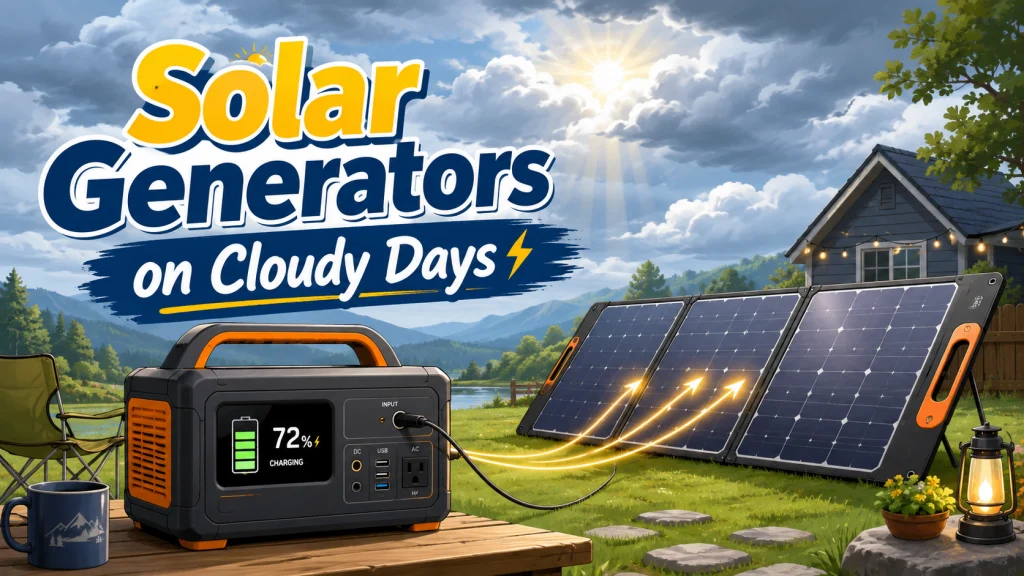
The marketing answer is yes. Solar generators work on cloudy days. Every brand says so, and technically they are not wrong. What they leave out is the number. On cloudy days, most solar generator setups produce roughly 10 to 25 percent of the panel’s rated output, depending on the type of cloud cover above you. That is the figure that actually changes how you set up your system, especially if you live in the Pacific Northwest, the Great Lakes region, or anywhere else where overcast is the default several months of the year rather than the exception.
From what I have seen at the counter and since running my homestead entirely on solar, buyers in cloudy climates tend to make one of two opposite mistakes. The first is writing off the category entirely on the assumption that solar will not work. The second is assuming the rated panel wattage is what they will pull on an average gray day. Both lead to the wrong setup or the wrong expectations. The actual output lands in the middle, and it shifts depending on exactly what kind of clouds you are dealing with.
What Clouds Actually Do to Panel Output
Solar panels do not require direct sunlight to produce power. They convert photons into electricity, and photons reach the panel surface through cloud cover. The difference is how many arrive. A clear sky delivers the full solar spectrum directly. Cloud cover scatters and absorbs a large share of that light before it reaches the cells, so the panel converts whatever is left. Less light in means less power out. That is the entire mechanism.
The practical effect varies by cloud type. Thin overcast, the hazy bright kind where the sun is visible as a diffuse glow, puts output at roughly 25 percent of rated wattage. Heavy overcast with dark storm clouds drops output to 10 to 15 percent. Rain tracks similarly to heavy overcast. On overcast days, nearby shade matters even more because the panel is already working with reduced light. A branch, roofline, or awning can cut into an already weak input stream in a way that barely registers on a clear day.
Field Note: One of the more common things I ran into at the shop was buyers in cloudy regions who had sized their panel array based on the rated wattage. They bought a 200W panel, did the math on recharge time assuming close to 200W of input, and were disappointed when their units were nowhere near recharged by midday on a gray November day. The math works on a clear summer afternoon. Under a thick overcast, the same panel is producing closer to 25 to 30W, which changes the entire calculation.
What the Real Output Numbers Look Like
Put actual figures to it and the picture gets clear fast. A 200W panel under full sun produces around 200W when aimed correctly at the peak of the day. Under thin overcast, that same panel produces roughly 50W. Under heavy overcast or rain, output drops to 20 to 30W. This is not a defective panel. It is not a brand problem. It is what diffuse light delivers to a photovoltaic cell, and knowing those numbers before you buy is what separates a well-sized setup from one that leaves you short on a cloudy week.
Understanding how much power a solar generator can collect in overcast conditions also ties directly into how you calculate runtime. If you want to dig into the runtime math before putting together your setup, the article on what solar generator watt-hours actually mean for runtime walks through the capacity calculation in full. The table below gives the charging time picture by sky condition so you can see where cloudy-day input sits relative to a clear day.
| Sky Condition | Approx. Panel Output | 200W Panel Produces | Approx. Charge Time, 1,000Wh Battery |
|---|---|---|---|
| Full sun, optimal angle | ~100% | ~200W | 5 to 6 hours |
| Thin overcast / hazy | ~25% | ~50W | 20 to 25 hours |
| Heavy overcast / storm clouds | 10 to 15% | ~20 to 30W | 35 to 50 hours |
| Rain | 10 to 15% | ~20 to 30W | 35 to 50 hours |
These figures assume the panel is aimed correctly and not shaded by trees or structures. Real-world output will sit somewhere within these ranges depending on your specific conditions. For context on larger batteries: a 2,000Wh unit that takes about 10 hours to charge in good sun can require 40 to 100 hours of charging under heavy overcast. That single fact should reshape how any buyer in a cloudy climate thinks about panel sizing and backup charging strategy.

This 1kWh LFP battery station charges from 0 to 80% in just 50 minutes via AC input, and its LiFePO4 chemistry delivers a 3,000 plus cycle lifespan that is roughly 6 times longer than standard lithium batteries. Capacity is expandable up to 3kWh with additional batteries, making it well suited for camping, RVs, or off-grid living. Its 1,800W output powers across 15 outlets, handling around 90% of household appliances, and accepts up to 500W of solar input for clean, fuel-free charging. The package includes a 5-year customer service guarantee.
Check On AmazonIf you click this link and buy, we earn a commission at no additional cost to you.
The Multi-Day Cloudy Problem Is the One Worth Planning Around
A single cloudy day is usually fine. Most setups handle it without any drama because the battery carries the overnight load and whatever reduced solar input arrives during the day still helps. The problem is three or more consecutive overcast days. That is exactly what winter delivers to a large portion of the country, and it is the scenario that catches buyers off guard if they sized only for a sunny baseline.
Here is what the math actually looks like. If your typical overnight draw empties 40 to 50 percent of your battery, and you are recovering only 10 to 20 percent of that via reduced solar input during the day, you are running a net deficit every 24-hour cycle. By day three, the battery is significantly depleted with no sun in the forecast. A user on DIYSolarForum documented 8 consecutive weeks with only one sunny day in an off-grid setup and had to run a backup gas generator to maintain the system. Eight weeks is an extreme case. Three to four consecutive cloudy days in November in a northern climate is not extreme at all.
This is the most important planning point for buyers in regions with limited winter sun. The question worth asking is not whether the panels work on a cloudy day. They do. The question is whether your battery capacity is large enough and your recharge strategy flexible enough to survive a run of gray weather without going flat by day three. If you are still in the early research phase weighing whether solar makes sense for your situation, the complete solar generator guide covers the full picture from capacity sizing to real-world use cases in one place.
Key point: The multi-day cloudy problem is a battery capacity and recharge strategy problem, not a panel quality problem. More stored capacity gives you more buffer. A secondary wall charging option gives you a fallback when solar input falls short for days at a time.
The Practical Fix for Extended Overcast
Most quality solar generators charge from a standard wall outlet in addition to the solar panels. That feature is not a consolation option for people who forgot to set up their panels. For buyers in cloudy climates, it is the most important part of the system. The approach I use on my own homestead during gray stretches is straightforward: plug into wall power once a day for a short charge session. The goal is not a full recharge from the grid. The goal is maintaining a comfortable buffer so the battery does not drift toward empty while the sun is absent.
A two-hour wall charge on a 1,000Wh unit pulling 400 to 500W from the outlet puts 600 to 800Wh back into the battery, depending on the unit’s AC input rate. That is enough to offset a full overnight draw and carry a working margin into the next gray day. Once the sun returns, solar takes back over. You are not replacing solar with grid power permanently. You are using wall power as a backup during the days when solar cannot deliver, which is exactly the role it was designed to fill in this type of system.
A few practices that hold up well during extended overcast stretches:
- Keep the battery above 20 percent throughout a cloudy stretch, even if it means a short wall charge to maintain that threshold. Recovering from near-empty puts more stress on the battery than topping up from 30 percent.
- If you have lost sun for more than two consecutive days, a single wall charge session every 24 hours is enough to maintain a usable buffer without running the battery to the bottom.
- Check the unit’s AC input wattage rating in the specs. Some accept 400W from the wall, others accept 800W or more. That number tells you how quickly you can recover during a midday recharge window.
- Do not skip the wall charge on day two hoping day three will be sunny. If the forecast shows gray, charge now. Waiting until the battery is at 10 percent removes your options.
- On partial overcast days, give the panels a clear line of sight and check panel aim. A correctly angled panel in thin overcast produces meaningfully more than one lying flat on a table or aimed at the wrong part of the sky.
Before You Buy in a Cloudy Climate:
- Daily overnight load: estimate your total Wh draw from dark to morning (fridge, router, lights, devices).
- Buffer days target: decide how many consecutive sun-free days you want to survive on stored battery alone. Two to three days is a realistic target for most setups.
- Minimum battery capacity: daily Wh load multiplied by your buffer day target. A 500Wh overnight draw with a 3-day buffer means you want at least 1,500Wh of usable capacity.
- Cloudy solar recovery estimate: rated panel watts multiplied by 10 to 25 percent, then multiplied by available daylight hours. This is your realistic solar input on a gray day, not the number on the panel spec sheet.
- AC input backup: check the unit’s wall-charge input wattage. Know how many hours of wall charging it takes to recover a full daily draw. This is your fallback number for cloudy weeks.
- Panel type: if overcast weather is common in your area, prefer monocrystalline panels over polycrystalline at the same rated wattage.

This compact plug-in monitor tracks the energy consumption of any AC 115-volt appliance and displays real-time readings of volts, amps, and wattage at 0.2 to 2.0 percent accuracy. Its large LCD screen lets you calculate electricity costs by the day, week, month, or year, making it easy to spot energy-hungry devices and trim your utility bill. It is also compatible with inverters, adding flexibility for off-grid setups.
Check On AmazonIf you click this link and buy, we earn a commission at no additional cost to you.
Panel Type and Aim Both Matter More Under Overcast
Not all solar panels respond the same way to diffuse light. Monocrystalline panels, made from a single continuous silicon crystal structure, consistently outperform polycrystalline panels in low-light and overcast conditions. At the same rated wattage, a monocrystalline panel generates noticeably more output under a cloudy sky. The performance gap between the two types narrows in direct sunlight and widens under diffuse light, which is exactly why this matters more for buyers who expect regular cloud cover rather than year-round sun.
Most solar generators at mid-range price points pair with monocrystalline panels by default, so this may already be settled for you. But if you are adding third-party panels or comparing two kits that are otherwise equivalent, and you are buying specifically for a cloudy climate, monocrystalline is the clear choice. The efficiency advantage in diffuse light translates directly to better charging on the days when you need every watt the sky will provide.
Panel orientation is the other variable worth getting right. A correctly aimed panel tracking the strongest part of the day’s sun arc will outperform the same panel lying flat, even under overcast. On a gray day when every watt matters, proper panel angle can add 15 to 20 percent more output compared to a flat or poorly aimed placement. That costs nothing. It just requires paying attention to where the light is coming from and adjusting accordingly.

At 39.5 lbs with 2,042Wh capacity and 2,200W output, this CTB-built station is 41% lighter and 34% smaller than typical 2kWh units. It charges from 0 to 80% in just 66 minutes via AC, operates at under 30 dB in silent mode, and switches to UPS backup in under 20 milliseconds. The LiFePO4 battery is rated for a full 10-year lifespan.
Check On AmazonIf you click this link and buy, we earn a commission at no additional cost to you.
Final Thoughts: Cloudy Climates Are Not a Dealbreaker, Just a Planning Problem
Solar generators work in cloudy climates. They work differently than they do in a high-sun environment, and the buyers who understand the 10 to 25 percent output reality before they purchase are the ones who size correctly, plan their recharge strategy around it, and stay satisfied with the system long-term. The ones who skip that step are the ones who feel misled when a full recharge takes all day instead of five hours.
The technology behind what is actually happening inside the system on those low-output days, including how the charge controller manages reduced input and what the battery management system does during partial cycles, is worth understanding before you finalize your setup. The guide on how solar generators work covers that in full. And if you are also thinking through overnight draws alongside cloudy-day performance, the two questions share the same battery and are worth planning together. That side of the equation is covered separately in the article on what actually happens to a solar generator after dark.

Featuring 16BB N-Type cells at 25% efficiency, this panel outperforms standard 200W panels and folds down to backpack size at just 13.89 lbs, with a magnetic closure for tool-free setup. Three built-in ports including USB-C PD 45W, and two USB-A ports charge devices directly, while MC4 output connects to most power stations and 12V battery systems. Four adjustable kickstands offer 40, 50, and 60 degree angles, and IP65 rating plus UL 61730 certification ensure durability and safety backed by a 2-year warranty.
Check On AmazonIf you click this link and buy, we earn a commission at no additional cost to you.
FAQs
☁️ How much power does a solar generator produce on a cloudy day?
Expect roughly 10 to 25 percent of rated panel output depending on cloud thickness. Thin overcast or hazy skies put output closer to 25 percent. Heavy storm clouds or rain drop it to 10 to 15 percent. A 200W panel under heavy overcast produces around 20 to 30W rather than the rated 200W.
🌧️ Can I rely on solar charging alone during a week of rain?
Not reliably for most setups. Heavy overcast and rain reduce solar input to 10 to 15 percent of rated panel output. A single rainy day is usually manageable off stored battery capacity. A full week without meaningful sun will deplete most units unless you supplement with wall charging every day or two.
🔋 Does operating in low light or overcast damage the panels or battery?
No. Reduced light input does not harm the panels or the battery in any way. The charge controller manages whatever current the panels produce and adjusts to it automatically. There is no minimum sunlight level required for safe operation. The system simply produces less output, not unsafe output.
🗺️ Are solar generators worth buying in a cloudy climate like the Pacific Northwest?
Yes, with realistic expectations and the right sizing. Size your battery for two to three days of use without solar recharge, plan to use wall charging as a backup during extended overcast, and choose monocrystalline panels for better diffuse light efficiency. The setup works, just not the same way it does in Arizona.
🌤️ Does partial cloud cover affect output the same way as full overcast?
Partial cloud cover causes variable output rather than a steady reduced rate. When the sun breaks through gaps, the panel spikes closer to full output. When clouds pass in front, output drops sharply. Most charge controllers handle this variability without issue. Your average input over the full day will still be lower than a clear day, but noticeably higher than heavy overcast.
🏔️ Do monocrystalline panels actually perform better on cloudy days than polycrystalline?
Yes, noticeably so. Monocrystalline panels outperform polycrystalline in diffuse light, which is exactly what overcast produces. At the same rated wattage, monocrystalline will generate more actual power on a gray day. The gap narrows in full direct sun and widens under overcast. For buyers in consistently cloudy climates, this is worth paying attention to when comparing panel options.