What a Solar Generator Actually Does After Dark
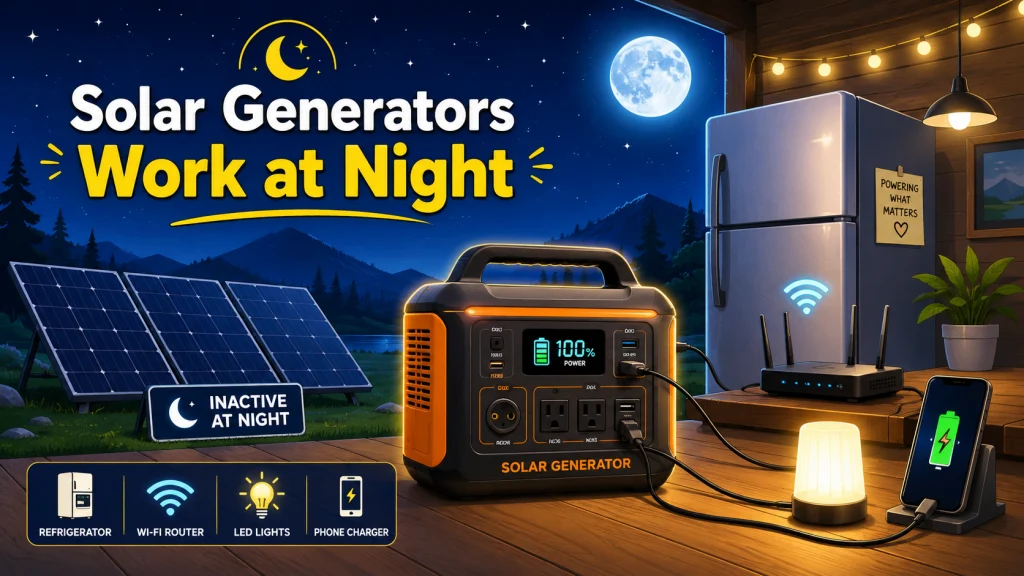
The short answer is yes. A solar generator can run at night as long as the battery has stored energy, and that stored energy does not care whether it came from the sun or a wall outlet. The word “solar” is where the confusion starts. It makes the unit sound like it needs sunlight to operate, as if the panels are the engine and darkness kills the machine. That is not how it works. During daylight, the panels charge the internal battery. After dark, you draw from that battery. The panels contribute nothing at night, but they do not need to.
By the time the sun goes down, a fully charged solar generator is functionally identical to one that someone charged overnight from a wall outlet. The source of the charge does not matter once it is stored. What matters is how many watt-hours are sitting in the battery and what you are pulling through the night. If you want to understand the full system, including how the charge controller, inverter, and battery work together during the day, the article on how solar generators work covers that in detail. For nighttime, the whole conversation is about the battery.
How to Calculate Your Overnight Runtime
The runtime formula is simple. Take the battery’s watt-hour capacity, multiply by 0.85 to account for real-world inverter losses, then divide by your total watt load. That gives you hours of runtime drawing from a full battery. Running a lithium battery all the way to zero accelerates degradation, so most people plan to stop at around 20 percent remaining. To get your practical overnight window with that reserve built in, multiply the calculated result by 0.8.
The table below shows how different loads play out across two common battery sizes using the 85 percent efficiency factor only, before the reserve. If you plan to keep a 20 percent reserve, multiply each figure by 0.8 to get your real usable window.
| Combined Load | Typical Appliances | Runtime on 2000Wh Unit | Runtime on 1000Wh Unit |
|---|---|---|---|
| 200W | Mid-size fridge (150W avg) + router (10W) + LED lights (40W) | ~8.5 hours | ~4.2 hours |
| 100W | Router (10W) + lights (40W) + phone charging (20W) + fan on low (30W) | ~17 hours | ~8.5 hours |
| 500W | Space heater on low (400W) + fridge (100W avg) | ~3.4 hours | ~1.7 hours |
| 60W | CPAP without humidifier (35-55W avg) + phone charging | ~28 hours | ~14 hours |
The fridge number is where most people miscalculate. A mid-size residential refrigerator cycling on and off averages around 100-150W, but the compressor surge on startup can hit three to four times that wattage for a second or two. The 150W average is a reasonable planning number for most household fridges. A compact 12V camping fridge pulls closer to 40-60W on average. That gap alone can mean three to four extra hours of overnight runtime on the same battery.
How Full Does the Battery Need to Be at Sunset?
Every number in the table above assumes a full battery at the start of the night. If the sun was weak that day or the panels did not have enough time to complete a full charge, the effective starting capacity drops and every runtime figure scales down with it. A 2000Wh unit at 60 percent charge heading into the night is effectively a 1,200Wh unit for planning purposes. At a 200W load, that is about 5 hours before hitting empty, or about 4 hours if you keep a 20 percent reserve, not the 8.5 hours in the table. Checking the state of charge display before dark and topping off from a wall outlet when one is available is the simplest way to make sure the table numbers still apply to your night. If wall power is not an option, knowing your actual starting charge level and adjusting the overnight load expectation accordingly is the next best move.

This car fridge draws just 36W in Eco mode and 45W in Max mode, runs at a quiet 45 dB, and handles up to 30 degrees of incline for reliable off-road use. Four tie-down points secure it firmly in any vehicle, and a built-in storage box fits a 266Wh power station and accessories for extended runtime. Includes AC and DC power cords and is backed by 2-year tech support.
Check On AmazonIf you click this link and buy, we earn a commission at no additional cost to you.
What Depletes Overnight Power Faster Than Expected
The most common pattern I saw at the shop was buyers who calculated overnight runtime from one appliance, bought accordingly, and then came back frustrated because the unit shut off around 2am. When I walked through everything they actually had plugged in, it was always more than they had planned for. Every watt that did not make it into the calculation added up over eight hours.
- Fridge compressor startup surge. The average wattage is not the peak wattage. Every time the compressor kicks on, it pulls two to three times its running wattage for a brief moment. The battery handles it fine, but it eats into capacity faster than a flat continuous load would predict.
- Frequent fridge door opening through the evening. Each time the door opens, warm air floods in and the compressor runs longer to recover. An hour of casual access before bed can meaningfully push up the average draw compared to a fridge sitting untouched overnight.
- Fans at high speed. A box fan on low draws 30-50W. The same fan at high speed draws 100-150W. Running it on high through an eight-hour night at 150W adds 1,200Wh of draw. On a 2000Wh unit with other loads, that is more than half the usable capacity gone to the fan alone.
- Multiple devices charging simultaneously. Four phones, two laptops, and a tablet charging through the night can pull 80-150W total depending on battery states and charger draw. It is easy to forget when you are thinking about the big appliances, but it adds up across eight hours.
- CPAP with a heated humidifier. A CPAP alone runs 35-60W. Add a heated humidifier and the draw jumps to 120-180W. Many CPAP users calculate for the machine itself and forget the humidifier entirely. On a 1000Wh unit at 150W average draw, you are looking at roughly 5.5 to 5.7 hours before hitting empty, or about 4.5 hours if you keep a 20 percent reserve, not the 14-plus hours the table shows for 60W. That difference matters significantly for an overnight medical device.
None of these are problems if they are in the plan. They become problems when they are not. Before you commit to a battery size, write down every device you will have plugged in from 9pm to 6am and add them up. Then add 10-15 percent for whatever you forgot. That number is your actual overnight load.
Field Note: The most common return I handled at the shop was someone who had bought a unit for their fridge and nothing else, then ran it through an evening with a box fan, two phones charging, and a router on the whole time. They had sized for 150W and were actually pulling 280-300W. The unit made it to about midnight. When we sat down and added it all up, it was obvious in 60 seconds. But nobody does that math in the store when they are excited about the purchase.

This compact plug-in monitor tracks the energy consumption of any AC 115-volt appliance and displays real-time readings of volts, amps, and wattage at 0.2 to 2.0 percent accuracy. Its large LCD screen lets you calculate electricity costs by the day, week, month, or year, making it easy to spot energy-hungry devices and trim your utility bill. It is also compatible with inverters, adding flexibility for off-grid setups.
Check On AmazonIf you click this link and buy, we earn a commission at no additional cost to you.
The Daily Cycle: Charge During the Day, Run Through the Night
For anyone running a solar generator as a primary power source rather than a backup that sits in the closet, the daily rhythm is what matters. During daylight, the panels fill the battery. After dark, you draw from it. If daytime solar input roughly matches overnight consumption, the cycle sustains itself day after day without touching a wall outlet. That is the exact pattern I run on my homestead.
The math on whether a given setup can sustain the cycle depends on three things: panel wattage, daily sun hours at your location, and overnight load. A 200W panel array in a location averaging six sun hours produces roughly 1,000-1,200Wh per day in real conditions, after factoring panel efficiency and charge controller losses. That covers an overnight load of around 120-150W for eight hours. If your overnight load is heavier or your sun hours are fewer, you need more panel wattage, a larger battery buffer, or wall charging to supplement on short-sun days. The broader framework for sizing a setup around your actual use case is laid out in the complete solar generator guide.
Winter shortens this equation significantly. In northern latitudes during December and January, usable sun hours can drop to three or four instead of six. That cuts daily solar input nearly in half on the same panel array. Anyone planning overnight reliability through a northern winter should either size panels and battery generously or count on wall charging to top off on low-sun days.
What Happens When There Was No Sun That Day
A full overcast day means minimal solar input, sometimes close to none in heavy cloud cover. If you drew normal overnight loads the previous night and the day did not recharge the battery, you head into the following night with a partially depleted unit. Stack two or three cloudy days together and overnight runtime shrinks considerably by the end of the stretch.
The practical options are straightforward: plug into a wall outlet to top off before evening, reduce overnight loads to stretch the remaining capacity, or accept shorter coverage and recharge fully when sun returns. Most units also support car DC charging as a slower backup option when neither solar nor wall power is available. How a solar generator handles a string of cloudy days during the charging window is worth understanding separately, and I cover it in detail in the piece on how solar generators perform on cloudy days. The short version for overnight planning is simple: if the day was unproductive for solar, plan for less overnight capacity than usual and adjust loads accordingly.
What I Actually See Overnight on My Off-Grid Setup
My homestead runs on a 2000Wh unit. My overnight load is a mid-size refrigerator averaging around 130-150W as it cycles on and off, a router at 10W, and two LED lights pulling about 20W combined. Total averaged load is right around 160-180W through the night.
On a typical mild-season night in spring or fall, I start at 100 percent when the panels drop off around 7:30-8pm. By 5:30am the following morning, when the panels begin contributing again, I am sitting at 12-18 percent remaining. That is roughly 9.5 hours of overnight coverage at my combined load, which lines up consistently with the runtime formula. The unit gives low-battery warnings before it cuts off, and because I am consistently above 10 percent at sunrise, the battery is not hitting the deep discharge range that accelerates degradation over time. Winter nights in Nevada run longer, which means more draw time, but daytime solar hours are fewer, so the recovery window tightens and I rely on wall charging more often to start the night full.
The nights where I run shorter are the ones following two consecutive overcast days with no wall charging. In those situations I raise the fridge temperature setpoint by two degrees to cut compressor run time, turn the router off once I am done for the evening, and run lights only where I need them. A disciplined overnight load of 120W or less can stretch the same 2000Wh unit to 11-plus hours. The battery does not care what time it is. It just responds to what you pull from it.

Featuring 16BB N-Type cells at 25% efficiency, this panel outperforms standard 200W panels and folds down to backpack size at just 13.89 lbs, with a magnetic closure for tool-free setup. Three built-in ports including USB-C PD 45W, and two USB-A ports charge devices directly, while MC4 output connects to most power stations and 12V battery systems. Four adjustable kickstands offer 40, 50, and 60 degree angles, and IP65 rating plus UL 61730 certification ensure durability and safety backed by a 2-year warranty.
Check On AmazonIf you click this link and buy, we earn a commission at no additional cost to you.
Final Thoughts: The Battery Is the Power Source at Night, Not the Panels
The most useful reframe for anyone planning overnight use is to stop thinking of a solar generator as a solar-powered device and start thinking of it as a battery-powered device that solar happens to recharge. After dark, the solar part is completely irrelevant. You are managing a battery. How long it lasts depends on what went in during the day and what you are pulling out through the night.
Get the overnight load calculation right first. Add up every watt you plan to run from sundown to sunup, add a buffer for anything you might have missed, and use that number to determine the battery capacity you actually need. Then size your panel input to cover that overnight draw from a day of sun. Do it in that order, and the night use question takes care of itself.
Before you commit to a unit for night use, check three numbers on the spec sheet: battery watt-hours, continuous AC output wattage, and maximum solar input wattage. Runtime comes from watt-hours. Whether the unit can handle your appliances, especially motor-driven loads like a fridge compressor, depends on whether the continuous and surge watt ratings are high enough. And how quickly you recover the following morning depends on the solar input rating relative to your panel array. Those three numbers answer most overnight planning questions before you spend anything.

At 39.5 lbs with 2,042Wh capacity and 2,200W output, this CTB-built station is 41% lighter and 34% smaller than typical 2kWh units. It charges from 0 to 80% in just 66 minutes via AC, operates at under 30 dB in silent mode, and switches to UPS backup in under 20 milliseconds. The LiFePO4 battery is rated for a full 10-year lifespan.
Check On AmazonIf you click this link and buy, we earn a commission at no additional cost to you.
FAQs
🌙 Do solar generators work at night without any sunlight?
Yes. After dark, a solar generator draws from its internal battery, which works the same way regardless of whether it was charged from solar panels or a wall outlet. The panels contribute nothing at night, but the stored battery energy is the full power source until sunrise.
⏱️ How long will a solar generator last overnight?
It depends on battery capacity and your load. A 2000Wh unit running a 200W combined load, fridge plus router plus lights, lasts roughly 8 to 8.5 hours at 85 percent efficiency before hitting zero. If you plan to keep a 20 percent reserve for battery health, budget closer to 6.8 hours. Lighter loads extend that window; heavier loads shorten it proportionally.
🔌 Can I charge a solar generator from a wall outlet at night instead of solar?
Yes, and for many users this is the most reliable way to ensure a full battery heading into the night. Wall charging is typically the fastest charging method available on most units. If daytime solar input was insufficient, plugging in before bed eliminates the shortfall.
🔋 What happens when a solar generator runs out in the middle of the night?
The unit shuts off to protect the battery from deep discharge. Most units give a low-battery warning before cutting out. Once it shuts down, anything plugged in loses power until you recharge the unit from solar, wall, or car DC the following day.
❄️ Does cold weather reduce how long a solar generator lasts overnight?
It can. Cold temperatures reduce a lithium battery’s ability to deliver its full rated capacity. At or below freezing, most units also restrict charging to protect the cells, though discharge performance is the main concern for overnight use. Plan for slightly reduced runtime in cold environments.
☁️ What if it was overcast all day before the night?
You head into the night with whatever partial charge accumulated during the day. Heavy overcast can mean 10-25 percent of normal solar input, so the battery may be well below full. Wall charging before evening is the most reliable fix. If that is not available, reduce overnight loads to stretch what is stored.