
Why Watt-Hours Matter More Than the Wattage on the Front of the Box
Walk into any store and watch how people compare solar generators. They check the inverter wattage. Maybe the solar input rating. Then they pick the bigger number and move on. What almost nobody looks at is the one spec that tells you how long the unit can actually run anything. That spec is watt-hours, and it is usually printed in smaller type somewhere near the bottom of the label.
Wattage tells you how much power a unit can deliver at a single moment. Watt-hours tells you how much total energy the battery holds. I watched the confusion play out constantly at the counter. A buyer would see a 2000W unit and assume it would run a 500W appliance all night. The wattage is fine for that load. The battery might last 90 minutes. Wattage sets the ceiling on what you can run at once. Watt-hours sets the ceiling on how long you can run it. Both matter, but if you only look at one, look at watt-hours.
The confusion is understandable. Marketing puts wattage front and center because it sounds more powerful. A 2000W unit sounds beefier than a 1000Wh unit, even though those numbers measure completely different things. Once you understand the difference, every spec sheet becomes much easier to read.
Watts vs Watt-Hours: The Tank and the Faucet
The garden hose analogy is the clearest way I know to explain this. Watts is the flow rate: how fast water moves through the hose right now. Watt-hours is the size of the tank supplying that hose. You can have a hose that flows very fast, but if the tank is small, it empties quickly. A slow hose on a large tank runs for a long time. The relationship between them is what actually matters for planning.
In practical terms: watts is a rate, measured at any instant. If your laptop draws 65 watts, it is pulling power at a 65W rate. After one hour at that rate, it has consumed 65 watt-hours of stored energy, before accounting for conversion losses. Watt-hours is a total. A battery with 1000Wh of capacity has enough stored energy to power that 65W laptop for roughly 13 hours before it is depleted. The inverter wattage on the unit simply sets the maximum rate at which the battery can release that energy. It does not tell you how much energy exists to release.
This is why two units can have the same watt-hour capacity but different inverter wattage ratings, and why that distinction matters for different use cases. A 1000W inverter with a 2000Wh battery and a 2000W inverter with a 2000Wh battery hold identical amounts of stored energy. The second one can run higher-draw appliances. Both will last the same amount of time under the same total load.
The Runtime Formula Every Buyer Needs Before They Spend a Dollar
Once you have the watt-hour capacity and the appliance wattage, calculating runtime takes less than a minute. The formula is: multiply the battery’s watt-hour rating by 0.85, then divide by the appliance draw in watts. The result is approximate hours of runtime.
Key point: Runtime (hours) = (Wh capacity × 0.85) ÷ appliance wattage. The 0.85 efficiency factor accounts for inverter conversion losses and real-world battery behavior. Always use it. Rated capacity and usable capacity are not the same number.
That 0.85 matters more than most buyers expect. No inverter converts DC battery power to AC outlet power at 100 percent efficiency. Most land between 85 and 92 percent depending on load and temperature. There are also minor losses from battery management overhead and the thermal effects of sustained discharge. If you skip the efficiency factor and run the math on full rated capacity, your estimates will consistently be too optimistic. The unit will run out before your math says it should, and you will assume something is wrong with the product when the real issue was in the calculation.
Here is how those numbers play out across common loads:
| Battery Capacity | Load | Average Draw | Estimated Runtime |
|---|---|---|---|
| 1000Wh | Mid-size refrigerator | 150W | ~5.7 hours |
| 1000Wh | Wi-Fi router + LED lights + phone charging | ~75W combined | ~11.3 hours |
| 2000Wh | Mid-size refrigerator | 150W | ~11.3 hours |
| 2000Wh | Small window AC unit | ~500W average | ~3.4 hours |
| 500Wh | Laptop + phone + small fan | ~100W combined | ~4.25 hours |
| 3000Wh | Mid-size refrigerator + lights + router | ~225W combined | ~11.3 hours |
The refrigerator example is one I walked buyers through constantly. A fridge does not draw a steady 150W every second. The compressor cycles on and off. When it cycles on, the draw spikes. When it is off, the draw drops to nearly zero. The average draw is what the runtime math cares about. Most mid-size refrigerators land in the 100 to 200W average range depending on age, ambient temperature, and how often the door opens. If a seller quotes you a peak wattage of 1200W on the compressor, they are giving you the motor start surge, not the average running draw. Use the average for runtime math, and leave the surge wattage for checking whether the inverter can start it.
Field Note: The most common mistake I saw repeat itself at the counter was buyers sizing on wattage instead of watt-hours. Someone would come in wanting to run their fridge overnight during an outage. They would find a unit with a 1000W inverter, confirm it could handle a 150W refrigerator, and buy it. Technically correct on the wattage side. What they never checked was the battery capacity. A 500Wh unit running a 150W fridge at 85 percent efficiency lasts about 2.8 hours. That fridge hits ambient temperature around 3am. The buyer calls back the next morning convinced the unit is defective. It is not. The inverter did its job. The battery just was not sized for the task.
Finding the Right Wattage Number Before You Run the Formula
The formula only works if you feed it the right wattage number, and this is where most first-time buyers go wrong. Appliance labels often show the maximum or startup draw, not the average running draw. Those two numbers can be very different, and plugging the wrong one into the runtime formula gives you a useless result.
For appliances with a fixed, steady draw like a space heater, electric kettle, or microwave, the label wattage is what you use. Those devices draw close to their rated wattage the entire time they run. A 1500W space heater draws about 1500W. The label is reliable here.
For appliances that cycle on and off like a refrigerator, chest freezer, or window AC unit, the label shows the compressor peak, not the average. A refrigerator labeled 700W might average 150W across a full day of cycling. For runtime math, you need the average running draw, not the peak. If you do not have access to a plug-in watt meter to measure it directly, look for the unit’s energy consumption in kilowatt-hours per year on the Energy Guide label and convert it: multiply by 1000 to get watt-hours, then divide by 8,760 (hours in a year). A refrigerator rated at 600 kWh per year averages about 68W that way. That annual average can be lower than your outage-planning number, since it assumes a conditioned room, a well-stocked fridge, and a closed door. If the unit is older, the room is warm, or the door will open often during an outage, size your estimate up from there. That is a more reliable starting point than the compressor peak on the main label.
For devices with variable modes like a CPAP with a humidifier, a laptop charging under heavy load versus idle, or a fan at different speed settings, calculate based on the mode you will actually use. Picking the lowest number because it makes the math look better is a guaranteed way to undersize the unit.
Pro Tips: When in doubt, calculate worst-case. If your refrigerator’s average draw is somewhere between 100W and 200W and you cannot measure it precisely, use 200W. A unit that runs longer than expected is far less of a problem than one that shuts down at 2am.

This 220V monitor handles up to 16 amps and reads down to 0.01W resolution at Class 1.0 accuracy, detecting loads as low as 0.20W to catch even standby draw. A backlit LCD with built-in memory retains cumulative kilowatt-hour data through power interruptions. Fire-retardant ABS housing and a 1-year warranty round out a reliable package.
Check On AmazonIf you click this link and buy, we earn a commission at no additional cost to you.
The Depth-of-Discharge Rule and What It Means for Overnight Planning
There is one more adjustment worth making before you finalize any runtime estimate, especially for overnight use. LiFePO4 batteries, which is the chemistry in most quality solar generators today, handle deep discharge better than older lithium-ion chemistries. But “better” does not mean “without consequence.” Regularly running any lithium battery down to zero degrades it faster over time. The practical guidance is to stop discharging around 20 percent remaining and recharge from there.
What this means for runtime planning is that your effective usable capacity is closer to 80 percent of the rated figure, not the full 100 percent. A 1000Wh unit used with that habit in mind gives you about 800Wh of working range before you should recharge. Combine that with the 0.85 efficiency factor and the actual math on overnight refrigerator use changes: (1000 × 0.80 × 0.85) ÷ 150W equals approximately 4.5 hours. Not 5.7 hours. That difference is the gap between a fridge staying cold overnight and one warming up by 4am.
If overnight runs are the main goal, size up from what the formula suggests. A unit that covers your load twice over in theory will cover it comfortably once in practice. That is a more honest way to shop than assuming you will get 100 percent of the rated spec in real conditions at 2am in January.
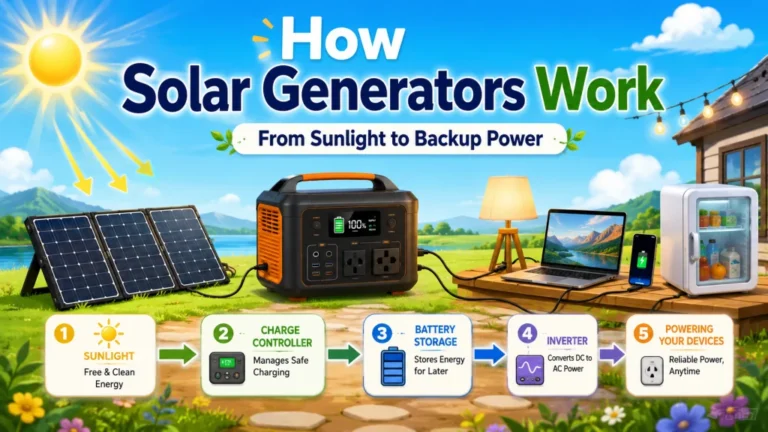
For a broader look at how the technology handles extended use and low-solar conditions, the article covering how solar generators work explains the full charge and discharge cycle, including what the battery management system does when charge drops low and solar input is unavailable.

Starting at 2kWh and expandable to 6kWh with two additional batteries, this LFP station reaches 80% in just 43 minutes via combined AC and solar input. Its 3,000-cycle battery outlasts the industry average by 6 times and includes a 5-year service guarantee. With 2,400W output across 15 outlets and X-Boost pushing to 3,400W, it handles 99% of household appliances at a whisper-quiet 30 dB.
Check On AmazonIf you click this link and buy, we earn a commission at no additional cost to you.
When the Battery Has Energy the Inverter Cannot Deliver
Watt-hours and inverter wattage are independent specs, and mixing them up causes a specific kind of frustrating failure. Even if the battery has plenty of stored energy, the unit cannot run an appliance that exceeds the inverter’s continuous AC output rating. The inverter is a hard ceiling on what can operate at any moment, regardless of how full the battery is.
A 1000Wh unit with a 1000W continuous inverter cannot run a 1500W continuous load. The inverter will either refuse the load or trip its overload protection before the appliance gets going. The one exception worth knowing: if the 1500W figure is only the startup surge of a motor-driven appliance and the continuous running draw is within the inverter’s rating, the surge watt spec decides whether it can start it. That is a separate number from continuous output, and it is on the spec sheet. What you cannot do is run a continuously high-draw appliance, like a 1500W space heater, on a 1000W continuous inverter, full stop. The battery capacity sitting behind it is irrelevant. I have seen buyers return units over this exact mismatch, convinced something was broken. Nothing was broken. The spec sheet was just not read carefully.
Before committing to any unit, check these four numbers together. Each one does a different job, and none of them substitutes for the others.
- Watt-hours (Wh): total stored energy in the battery, determines runtime under a given load
- AC output watts (continuous): maximum load the inverter can sustain at one time, sets the ceiling on what appliances can run
- Surge watts: higher burst rating the inverter can briefly handle for motor-start loads like refrigerator compressors and power tools
- Solar input watts: maximum charging rate from panels, a separate spec that has no effect on what the inverter delivers or how long the battery lasts per use
Getting these four straight is the foundation of every sizing decision. The runtime formula handles watt-hours. The appliance compatibility check handles inverter wattage and surge ratings. Solar input wattage determines how fast you can top the battery back up. They are connected but they answer different questions, and conflating them is the root cause of most purchasing mistakes I have seen.
Note: Runtime math uses average running watts. Inverter compatibility uses continuous and surge watts. Do not plug the same number into both jobs.

Weighing just 23.8 lbs with a foldable handle, this 1,070Wh LFP power station delivers 1,500W of pure sine wave AC output with a 3,000W surge capacity, capable of running AC units, fridges, and electric pots. Its LFP battery sustains over 70% capacity after 4,000 cycles, translating to a lifespan of more than 10 years. Via the Jackery App, you can enable a full charge in as little as one hour, or switch to a whisper-quiet 30 dB overnight mode. Six output ports including two USB-C with 100W PD charging cover nearly any device simultaneously.
Check On AmazonIf you click this link and buy, we earn a commission at no additional cost to you.
Final Thoughts: One Formula That Changes How You Read Every Spec Sheet
Watt-hours is not the most prominent number on the box. Inverter wattage usually is. That is partly marketing and partly because most buyers have no frame of reference for what 2000Wh actually means in a living room at midnight. Now you do. It is roughly 11 hours of refrigerator runtime with a conservatively sized load, or about 4.5 hours if you are being careful with battery depth of discharge and working with a 1000Wh unit. The formula is simple enough to run in your head: take the watt-hour capacity, multiply by 0.85, divide by the average draw of what you want to run. That number will not lie to you the way the box might.
One thing to carry forward from here: watt-hours tells you how long, but inverter wattage tells you what. You need both to make a decision that holds up under real conditions. A unit with the right watt-hours and the wrong inverter ceiling will still fail you. Check them together every time.
If you are still working through the bigger picture, the complete solar generator guide covers everything from the naming confusion to battery chemistry to how these units compare against gas generators, written from the same retail-and-ownership perspective. That is where to go if you want the full context before making a final call.

This 1kWh LFP battery station charges from 0 to 80% in just 50 minutes via AC input, and its LiFePO4 chemistry delivers a 3,000 plus cycle lifespan that is roughly 6 times longer than standard lithium batteries. Capacity is expandable up to 3kWh with additional batteries, making it well suited for camping, RVs, or off-grid living. Its 1,800W output powers across 15 outlets, handling around 90% of household appliances, and accepts up to 500W of solar input for clean, fuel-free charging. The package includes a 5-year customer service guarantee.
Check On AmazonIf you click this link and buy, we earn a commission at no additional cost to you.
FAQs
⚡ What does 2000Wh mean on a solar generator?
It means the battery holds 2000 watt-hours of stored energy. To estimate real runtime, multiply by 0.85 for efficiency losses and divide by your appliance’s average wattage draw. A 200W load runs for approximately 8.5 hours. A 400W load runs for about 4.25 hours.
🔋 Is watt-hours the same as watts?
No. Watts is a rate of power at any given instant. Watt-hours is a total amount of stored energy. Watts is how fast water flows through a hose. Watt-hours is the size of the tank. Both appear on solar generator spec sheets and they measure completely different things.
🌙 How long will a 1000Wh solar generator last?
It depends on your load. At 100W draw, about 8.5 hours. At 150W, roughly 5.7 hours. At 300W, around 2.8 hours. Use the formula (1000 × 0.85) divided by your appliance wattage to get a realistic estimate. If you want to protect battery longevity, apply 80 percent depth of discharge as well.
❄️ How many watt-hours do I need to run a refrigerator overnight?
A mid-size refrigerator averages roughly 100 to 200 watts across full cycling. For an 8-hour overnight run with buffer for efficiency losses and depth-of-discharge limits, plan for at least 1500Wh of battery capacity. A 1000Wh unit will cover it but leave very little margin.
🤔 Why does my solar generator run out faster than the rated capacity suggests?
Two main factors: inverter efficiency losses reduce usable capacity to roughly 85 percent of the rated figure, and protecting battery longevity means stopping discharge around 20 percent remaining. Together, your real working capacity is typically 68 to 75 percent of the number printed on the label. This is normal and expected behavior, not a defect.
🧮 Can I run two appliances at the same time and how does that affect runtime?
Yes, as long as the combined wattage stays under the inverter’s continuous output rating. For runtime math, add the average wattage of both appliances and use the combined total in the formula. A 150W refrigerator and a 75W collection of lights and router running together draw 225W combined, which roughly halves the runtime compared to running each alone.