The Carbon Monoxide Problem That Solar Generators Do Not Have
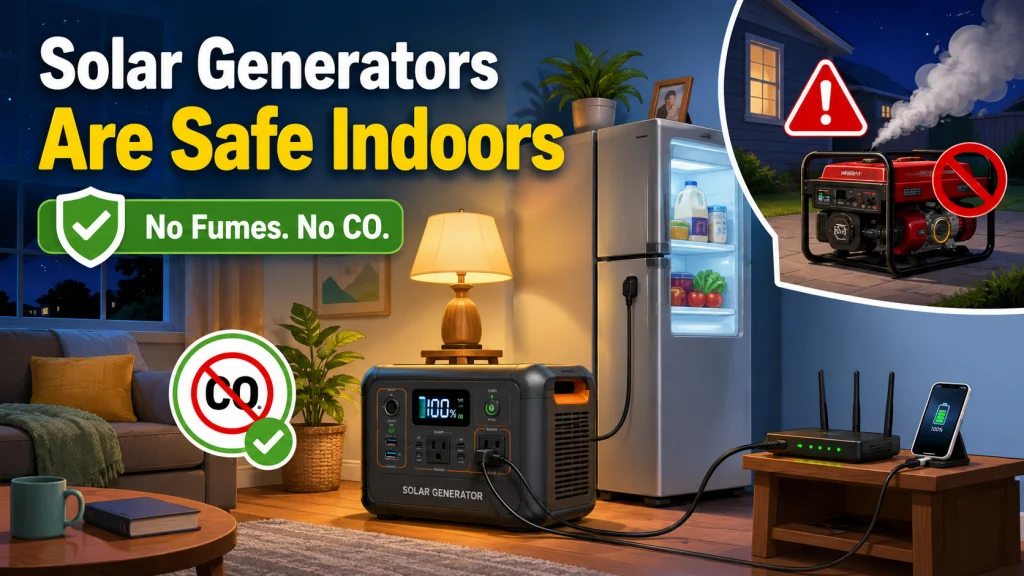
Every year in the United States, approximately 80 people die from carbon monoxide poisoning caused by portable gas generators run indoors or in attached garages. Most of those deaths happen during power outages, when people bring the generator inside to keep it out of rain or closer to the appliances they are trying to run. Carbon monoxide builds up silently. There is no smell, no visible smoke, and often no warning before someone loses consciousness.
A solar generator produces none of this. There is no engine, no combustion, and no exhaust. The unit converts stored battery energy into AC power through an electronic inverter, which generates heat but zero gas emissions. The Consumer Product Safety Commission data on generator-related CO deaths applies exclusively to fuel-burning equipment. No CO deaths have been attributed to properly used battery-based solar generators. That distinction matters enormously if you are planning to run one in a bedroom, a living room, or a finished basement during an outage.
Key point: A solar generator is a battery with an inverter, so the CO hazard that defines gas generator indoor use simply is not present. It will not trigger a CO detector because it does not produce CO, but your home CO detectors should still stay installed for any other combustion appliances in the house. You still need to keep the vents clear, but exhaust ventilation is not a requirement.
What Indoor Use Actually Looks Like for Each Type
The CDC’s position on portable gas generators is not a suggestion. Gas generators cannot be safely operated indoors, in attached garages, or within 20 feet of any window, door, or vent, even with ventilation running. Cracking a window does not resolve the CO accumulation problem. The prohibition exists because the rate at which CO concentrations rise in semi-enclosed spaces with combustion equipment running is faster than most people expect, and the symptoms of poisoning can impair the judgment needed to get out.
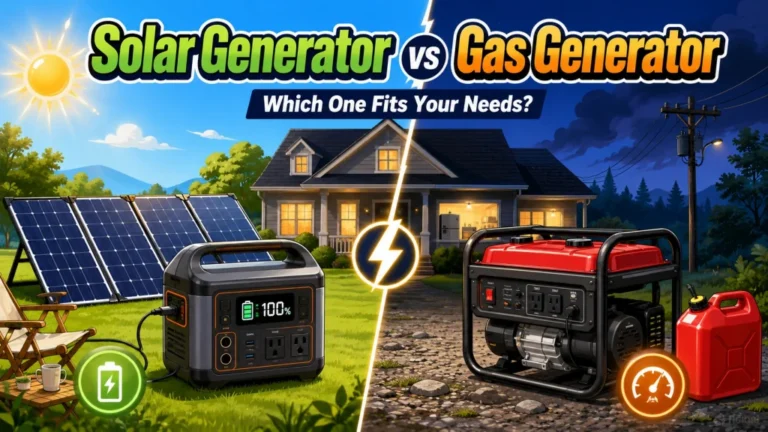
For a solar generator, none of that applies. The table below shows how the two compare across the considerations that matter for indoor emergency use.
| Consideration | Gas Generator | Solar Generator |
|---|---|---|
| Carbon monoxide output | Yes, deadly at indoor concentrations | None |
| Indoor use permitted | No, prohibited by CDC guidance | Yes |
| Minimum distance from windows/doors | 20+ feet | No requirement |
| Noise at full load | 60 to 80+ dB (comparable to a vacuum cleaner) | 0 to 50 dB depending on charging state |
| Fuel spillage risk | Yes, fire hazard | None |
| Exhaust ventilation required | Yes | No |
The gap in the noise column is something gas generator owners rarely expect when they first use a solar generator indoors. Running appliances silently from a battery in the corner of a room, with no engine cycling, no fuel smell, and no exhaust, is a genuinely different experience. Understanding the full picture of how solar generators work makes the safety profile easier to understand at a component level, because the reason there is no CO is the same reason there is no engine noise: there is no combustion to begin with.
Field Note: At the shop, the indoor safety question came up almost every time someone had a close call with their gas generator, or had read a news story after a bad storm. Someone would come in and ask if there was any way to run backup power safely inside. The answer for fuel-burning equipment was always no. The answer for battery-based equipment was completely different, and once buyers understood that the mechanism for the danger simply did not exist in a solar generator, the conversation shifted quickly to sizing and capacity rather than safety.

Starting at 2kWh and expandable up to 8,448Wh with compatible expansion batteries, this LiFePO4 station delivers 2,400W across 11 ports including a 30A TT-30 RV port, dual 100W USB-C, and a dedicated 48V RV charging port. It reaches 80% in just 60 minutes via AC input and fully charges in under 4 hours with 1,200W of solar. The battery is rated for 3,000 plus cycles across a 10-year lifespan.
Check On AmazonIf you click this link and buy, we earn a commission at no additional cost to you.
The One Real Indoor Consideration: Charging Heat and Fan Noise
Solar generators are safe indoors, but that does not mean there are zero considerations. When you charge a unit at maximum rate from a wall outlet, the battery and electronics generate heat. In a well-ventilated room this is not an issue. In a very small, sealed space, sustained fast charging can raise the ambient temperature noticeably over several hours.
This is a comfort consideration, not a safety emergency. The unit’s battery management system will throttle the charging rate before temperatures approach anything dangerous. What most people notice first is the internal fan. Quality units run a cooling fan during AC wall charging, typically in the 30 to 50 decibel range, which is roughly comparable to a quiet conversation or a running air conditioning unit. If you need to sleep in the same room while the unit fast-charges overnight, that fan is the practical issue worth thinking about, not the safety aspect.
During normal discharge, when you are actually running appliances from the battery, most units run nearly or completely silent. There is no engine startup cycle, no fuel smell, and no exhaust. A 2,000Wh unit running a refrigerator, a CPAP machine, and a few lights in a living room during an outage produces essentially no noise from the unit itself. That is one of the more striking differences for anyone coming from gas generator experience.
Note: If you charge the unit in a very small space like a utility closet or cabinet shelf, leave the vents clear. The fan needs airflow to cool the battery during charging. Blocking the vents to muffle the sound defeats the cooling system and adds heat stress to the battery during every charge cycle.
Battery Fire Risk and What LiFePO4 Chemistry Actually Means
The fire question comes up most from people who have read about lithium battery fires in phones, laptops, or electric vehicles. It is a reasonable thing to ask. The important distinction is battery chemistry. Many quality solar generators sold in the past several years now use LiFePO4 chemistry rather than the NMC lithium-ion found in older consumer electronics. It is still worth checking the battery chemistry in the spec sheet before buying, especially on cheaper or older models.
NMC lithium-ion can enter a condition called thermal runaway under extreme stress: overcharging, physical damage, or sustained high heat exposure. Thermal runaway is self-sustaining. Heat from one cell damages adjacent cells and the process accelerates. LiFePO4 chemistry is significantly more stable at the molecular level. The chemical structure resists the conditions that trigger thermal runaway, which is one of the primary reasons the portable power industry shifted toward LiFePO4 across nearly all quality product lines in recent years.
That does not mean LiFePO4 is completely risk-free. A unit that has been dropped hard, punctured, or left in extreme ambient heat for extended periods can still develop problems. But operating a properly functioning unit in a living space during an outage, running a refrigerator and some lights, is orders of magnitude safer from a fire standpoint than running any gas generator anywhere near the building.
What the Battery Management System Does on Your Behalf
Every quality solar generator includes a battery management system that monitors cell voltage, temperature, and current in real time. Over-voltage protection, over-temperature cutoff, short-circuit protection, and over-current limits are standard. If any parameter moves outside safe bounds, the BMS cuts the charging or output before damage occurs. This is the layer that lets you plug a unit into a wall outlet, leave it charging overnight, and come back to a full battery rather than a problem.
The BMS also explains why the charging heat issue described above stays in the comfort range rather than the danger range. The system is actively watching the battery temperature and will pull back the charge rate if temperatures climb. The fan is the first line of response. The rate throttle is the second. Both operate automatically.
What to Check Before Buying a Solar Generator for Indoor Backup
Knowing that solar generators are safe indoors is the first step. Knowing what to look for in the spec sheet before you buy is the step that follows. Not every unit is built the same, and a few specific details make a real difference for indoor backup use.
- Battery chemistry: LiFePO4. Check the spec sheet explicitly. If the listing only says “lithium” without specifying chemistry, ask or look for another source. The chemistry determines fire stability and lifespan, not the brand name or price point.
- Pure sine wave AC output. Confirm this is stated explicitly. CPAP machines with humidifiers, variable-speed refrigerators, and most modern electronics require it. If the listing only says “sine wave” without the word pure, verify with the manufacturer.
- Continuous watt rating that covers your intended loads. Battery capacity tells you how long it runs. The continuous watt rating tells you what it can run at the same time. A 2,000Wh unit with a 1,000W continuous inverter cannot run a 1,500W appliance regardless of how full the battery is.
- BMS protections listed clearly. Look for over-temperature cutoff, over-current protection, short-circuit protection, and over-voltage protection. These should be listed explicitly, not just referenced as “BMS included.”
- Noise rating during charging. If the unit will sit in a bedroom or a small living space overnight, the fan noise during wall charging matters. Look for dB ratings in the spec sheet. Below 40 dB during charging is livable for most people. Some units list this clearly, others do not, which is itself a useful signal.
- Vent placement that works with where you plan to keep it. Units with rear or side vents need clear space in those directions. A unit with rear vents placed flush against a wall charges at reduced efficiency and higher temperature. Check the vent locations before deciding on placement.
None of this requires expertise to evaluate. Most of these specs appear on the product page or in the manual. The ones that do not appear are worth treating as a flag.

This compact plug-in monitor tracks the energy consumption of any AC 115-volt appliance and displays real-time readings of volts, amps, and wattage at 0.2 to 2.0 percent accuracy. Its large LCD screen lets you calculate electricity costs by the day, week, month, or year, making it easy to spot energy-hungry devices and trim your utility bill. It is also compatible with inverters, adding flexibility for off-grid setups.
Check On AmazonIf you click this link and buy, we earn a commission at no additional cost to you.
Practical Setup for Indoor Use During an Outage
Getting the most from a solar generator indoors during a power outage does not require much, but a few habits make the experience meaningfully better. The most common mistake I see is placing the unit in a confined spot because it seems out of the way, then wondering why it runs warm during charging or why the fan is louder than expected.
- Place the unit on a hard, flat surface with the vents unobstructed on all sides. A few inches of clearance around each vent opening is enough for the cooling fan to do its job.
- Use extension cords to reach appliances rather than moving the unit into tight or enclosed spaces. A 25-foot heavy-duty extension cord is far cheaper than dealing with heat-stressed charging cycles.
- Plug directly into a properly rated wall outlet when charging from the grid. Avoid cheap power strips or heavily loaded extension cords during fast charging.
- If you have solar panels, run the cable through a window or under a door seal to reach the panels outside during daylight hours. The panels belong outside; only the main unit needs to stay indoors.
- For overnight runs, prioritize your highest-draw appliance such as a refrigerator, and reduce other loads to extend battery capacity through the night. A 2,000Wh unit running a 150W fridge and a 30W router will last roughly 9 to 10 hours before hitting the 20 percent reserve threshold at real-world efficiency.
The extension cord point comes up repeatedly. I have seen people drag a heavy unit into a cramped closet just to get the cord close enough to reach a CPAP in the next room, when a single $15 extension cord would have solved the problem cleanly and left the unit in open space where it runs cooler and quieter. Small setup choices make a meaningful difference across a multi-day outage.

This grounded 16AWG extension cord converts a single AC outlet into three three-prong outlets, rated for 125VAC, 13A, and 1,625W for reliable indoor and outdoor use. Backed by a limited lifetime replacement pledge and free U.S.-based technical support available Monday through Friday.
Check On AmazonIf you click this link and buy, we earn a commission at no additional cost to you.
Final Thoughts: The Indoor Safety Answer Is Straightforward
Solar generators are safe to run indoors. No combustion means no carbon monoxide. LiFePO4 chemistry means low fire risk from normal operation. A properly functioning battery management system means the unit handles its own temperature protection without you needing to monitor it. The real considerations that exist, fan noise during fast charging and basic vent clearance, are minor in comparison to what you would manage with any fuel-burning alternative.
If you are coming from gas generator experience and want a fuller picture before committing to a solar-based backup system, the complete solar generator guide covers everything from how the technology works to how to size a unit for your specific load requirements and situation.

Starting at 2kWh and expandable to 6kWh with two additional batteries, this LFP station reaches 80% in just 43 minutes via combined AC and solar input. Its 3,000-cycle battery outlasts the industry average by 6 times and includes a 5-year service guarantee. With 2,400W output across 15 outlets and X-Boost pushing to 3,400W, it handles 99% of household appliances at a whisper-quiet 30 dB.
Check On AmazonIf you click this link and buy, we earn a commission at no additional cost to you.
FAQs
💨 Do solar generators produce carbon monoxide?
No. Solar generators have no engine and burn no fuel of any kind. They produce zero carbon monoxide, which is why they can be used safely indoors in situations where running a gas generator would be dangerous or prohibited.
🏠 Can you run a solar generator in a closed room?
Yes, with basic airflow around the unit. The main generator body generates some heat during fast charging and the internal fan will run, so a tightly sealed space is not ideal for extended charging. During discharge when you are running appliances from the battery, most units produce very little heat and minimal noise.
😴 Is it safe to sleep in the same room as a running solar generator?
From a safety standpoint, yes. There are no fumes and no CO risk. The practical issue is fan noise, which typically runs 30 to 50 dB during active wall charging. If the unit is running on battery power overnight without simultaneously charging, most quality units operate close to silently.
🔋 Can a solar generator battery catch fire indoors?
The risk from a properly functioning LiFePO4 unit under normal use is very low. LiFePO4 chemistry resists the conditions that trigger thermal runaway significantly better than older NMC lithium-ion. The battery management system adds another layer of protection. Normal indoor operation during an outage does not create a meaningful fire risk.
🔌 Do you need special ventilation to charge a solar generator indoors?
No special ventilation is required. A normally ventilated room is sufficient. Keeping a few inches of clearance around the unit’s vents is enough to support the cooling fan. This is a practical setup habit, not a safety requirement the way exhaust ventilation is for fuel-burning equipment.
🌡️ Will a solar generator overheat if used indoors in summer?
Not under normal ambient conditions. The battery management system monitors temperature continuously and reduces charging or output power before unsafe temperatures are reached. Sustained use in a very hot room above 95 to 100 degrees Fahrenheit will cause the BMS to throttle performance, but the unit will protect itself before damage occurs.