What Sine Wave Actually Means and Why the Word “Pure” Matters
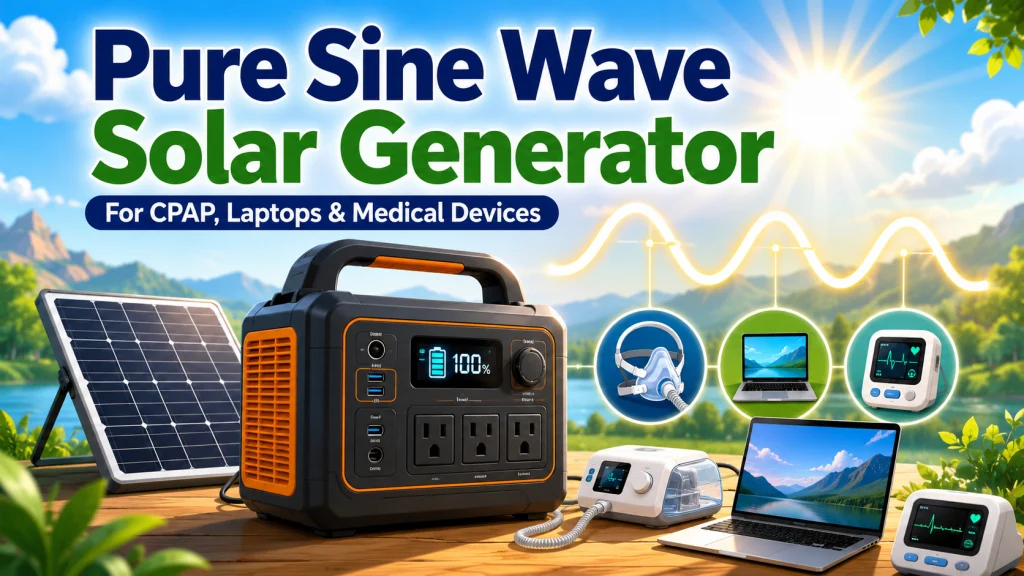
AC electricity, the kind that comes out of your wall and out of a solar generator’s AC outlet, does not flow in a straight line. It oscillates back and forth in a wave pattern, cycling 60 times per second in the U.S. A pure sine wave is a smooth, rounded wave that matches what your utility company delivers. A modified sine wave is a blocky, stair-stepped approximation of that shape. It carries the same voltage and frequency on paper, but the waveform itself is crude, and that crudeness is exactly what causes problems with certain devices.
The reason this distinction exists comes down to cost. Producing a true pure sine wave inverter requires more components and tighter engineering than a modified version. Budget manufacturers cut that cost and pass the savings along, which sounds fine until you plug in something the rough waveform cannot handle cleanly. For simple resistive loads like a space heater coil or an incandescent bulb, the waveform shape barely registers. For anything with a motor, a switching power supply, or digital control circuitry, the difference can show up as heat, noise, reduced efficiency, or damage over time.
Which Devices Require Pure Sine Wave and Which Ones Do Not
The most common mistake I saw at the shop was from CPAP users who bought a budget unit based on wattage and capacity alone, never checking the inverter type. The machine would power on and technically run, but the humidifier would either fail silently or cause the unit to fault. Nine times out of ten, those returns came back within a week. CPAP machines, especially models with heated humidifiers, rely on precise power regulation that modified sine wave cannot provide consistently. Some CPAP manuals and warranty terms may restrict use with non-pure sine wave power sources, so it is worth checking your device documentation before assuming any inverter output will do.
Beyond CPAP machines, the devices most sensitive to waveform quality fall into a few clear categories. Variable-speed appliance motors, the kind in newer energy-efficient refrigerators and air conditioners, can run hotter than intended on modified sine wave because the motor controller is reading a degraded signal. Switching power supplies, which are inside virtually every laptop charger, phone brick, and modern TV, are designed to operate on clean sine wave. They often work on modified sine wave but run warmer, which shortens component life over years of repeated use. LED dimmer switches and some audio equipment also react poorly, sometimes producing a persistent audible hum.
Modified sine wave is not automatically bad for everything. It is simply the wrong match for certain loads. If your use case is emergency LED lighting, a basic USB charger, or a simple heating element, it may work without issues. The problem is that most real solar generator buyers eventually plug in more than that, which is why pure sine wave is the safer default regardless of what the price difference looks like on the spec sheet.
| Device Type | Pure Sine Wave Required? | Why |
|---|---|---|
| CPAP with heated humidifier | Yes | Heated humidifier and digital controller need clean, stable AC power; warranty terms may restrict non-pure sine wave use |
| Variable-speed refrigerator or air conditioner | Yes | Inverter-driven motor reads degraded waveform and runs inefficiently or hot |
| Laptop charger | Recommended | Switching power supply runs warmer on modified sine wave; reduces lifespan over repeated use |
| Modern flat-screen TV | Recommended | Internal power supply designed for clean sine wave; modified may cause hum or flicker |
| Medical devices (oxygen concentrators, nebulizers) | Yes | Safety-critical; many manufacturer specs require or strongly recommend clean pure sine wave power |
| Basic phone charger (USB-A brick) | No | Most basic USB wall chargers tolerate modified sine wave, though pure sine wave is still cleaner |
| Incandescent or halogen bulbs | No | Resistive load; waveform shape has no meaningful effect |
| Resistive space heater (coil type) | No | Pure resistive load; not sensitive to waveform quality |
If your load list includes a CPAP, a variable-speed fridge, a laptop used daily, or any medical device, pure sine wave is not a nice-to-have. It is the first filter to apply when evaluating any unit. For understanding how the inverter fits into the broader picture of what a solar generator can actually do, the breakdown of what a solar generator is and how its components work together gives the full context.
Field Note: Once I started asking CPAP users specifically about the humidifier before they picked a unit, the returns dropped to near zero. It is a one-sentence question that saves a significant amount of frustration for everyone involved.

At 288Wh with 300W output and a 600W surge, this compact station powers 8 devices simultaneously across three AC outlets, a 120W car socket, and dual 140W USB-C ports. It reaches 80% in just 50 minutes via wall outlet and accepts up to 100W of solar input for off-grid use. LiFePO4 batteries last 3,000 cycles over a 10-year lifespan, operate at just 25 dB, and come backed by a 5-year warranty.
Check On AmazonIf you click this link and buy, we earn a commission at no additional cost to you.
Where Modified Sine Wave Still Shows Up and How to Spot It
For any established, brand-name solar generator, modified sine wave is essentially a non-issue. From what I have seen across hundreds of units sold, most major manufacturers now use pure sine wave inverters across their mainstream portable power stations. The cost difference at scale became negligible enough that brand-name units below $300 now routinely include it. The problem lives almost entirely in unbranded units under the $200 mark, often sold under unfamiliar names through marketplace listings with minimal spec documentation.
What complicates the picture is that some sellers are not transparent about which type they are offering. A spec sheet might say “sine wave inverter” without specifying pure or modified. That omission is itself a warning sign. Most manufacturers confident in their inverter output state it explicitly, because pure sine wave is a selling point worth advertising. If a listing only says “sine wave,” contact the seller and ask directly before committing. The quality of that answer often tells you something about how forthcoming they are about other specs as well.
How to Confirm the Inverter Type Before You Buy
The first place to check is the product’s official spec sheet on the manufacturer’s website. Look for the phrase “pure sine wave” stated explicitly. If the page lists AC output wattage, watt-hour capacity, and charging inputs but never addresses sine wave type, that is unusual for a legitimate brand-name unit and worth investigating further. Well-known brands almost always state this specification directly because it is a feature they want buyers to see before purchase.
If you are buying through a third-party retailer or marketplace listing, cross-reference the manufacturer’s official product page rather than relying on the listing description alone. Reseller descriptions sometimes omit or misstate technical specs. A listing claiming “pure sine wave” for an unbranded unit under $150 with no verifiable manufacturer information deserves skepticism. For anything you plan to run a CPAP or medical device on, verify the inverter type directly with the manufacturer before purchase rather than after.

This 8-mode power monitor tracks watts, kilowatt-hours, voltage, current, frequency, power factor, unit price, and total cost, making it easy to calculate exact running expenses for any US standard appliance. An overload alert flashes at 1,800W to warn against unsafe loads, and built-in memory retains cumulative data through power interruptions or unplugging. The backlit LCD is readable day or night, and resetting requires just a 5-second button press.
Check On AmazonIf you click this link and buy, we earn a commission at no additional cost to you.
Pure Sine Wave Is One Spec. Do Not Let It Overshadow the Others.
Confirming clean inverter output is necessary but not the whole picture. I have watched buyers fixate on this one specification after learning about it, then overlook a unit that had a pure sine wave inverter but not nearly enough capacity to run their load through the night. The inverter type tells you whether your devices will run cleanly. The watt-hour rating tells you how long they will run. Both matter, and in my experience the capacity math is where most first-time buyers make the more expensive mistake. For the full breakdown of how to calculate real runtime from watt-hour ratings, understanding what watt-hours mean in practical terms covers that step in full.
The point is not that inverter type is unimportant. For the devices in the table above, it is genuinely important. But it belongs as one item in a complete specification review, not the only item. Once you have confirmed pure sine wave, move immediately to capacity and AC output wattage. Those two numbers tell you whether the unit can handle your load and for how long.
Confirming “pure sine wave” on the spec sheet, then buying the cheapest unit that has it without checking watt-hour capacity or continuous AC output. The inverter type is correct. Everything else is wrong for the use case.
Confirming pure sine wave first, then checking watt-hour capacity against your load and runtime needs, then verifying continuous AC output exceeds your device’s running wattage. All three in sequence.
Pro Tips: Before trusting any solar generator with sensitive electronics, work through this checklist: Does the spec sheet explicitly say “pure sine wave”? Does the unit have enough watt-hours for your device’s runtime? Does the continuous AC output rating exceed your device’s running wattage? For CPAP specifically, check the humidifier watt draw separately from the base machine draw. For variable-speed refrigerators, confirm the compressor type before assuming any inverter output will do.

Weighing just 23.8 lbs with a foldable handle, this 1,070Wh LFP power station delivers 1,500W of pure sine wave AC output with a 3,000W surge capacity, capable of running AC units, fridges, and electric pots. Its LFP battery sustains over 70% capacity after 4,000 cycles, translating to a lifespan of more than 10 years. Via the Jackery App, you can enable a full charge in as little as one hour, or switch to a whisper-quiet 30 dB overnight mode. Six output ports including two USB-C with 100W PD charging cover nearly any device simultaneously.
Check On AmazonIf you click this link and buy, we earn a commission at no additional cost to you.
Final Thoughts: Ten Seconds on the Spec Sheet
Pure sine wave is not a premium feature anymore. It is a standard expectation for any solar generator worth buying. This spec mostly matters now only when evaluating unbranded or very low-cost units, or when a listing is vague enough that you cannot confirm what you are getting. For anyone running a CPAP, a variable-speed refrigerator, a laptop, or medical equipment, knowing to check this spec and knowing what to do when a listing does not state it clearly is the kind of thing that prevents a frustrating return.
Buyers who ask the right questions before purchasing almost never regret their purchase. This particular spec takes about ten seconds to verify on a manufacturer’s product page. Spend the ten seconds.

This 1kWh LFP battery station charges from 0 to 80% in just 50 minutes via AC input, and its LiFePO4 chemistry delivers a 3,000 plus cycle lifespan that is roughly 6 times longer than standard lithium batteries. Capacity is expandable up to 3kWh with additional batteries, making it well suited for camping, RVs, or off-grid living. Its 1,800W output powers across 15 outlets, handling around 90% of household appliances, and accepts up to 500W of solar input for clean, fuel-free charging. The package includes a 5-year customer service guarantee.
Check On AmazonIf you click this link and buy, we earn a commission at no additional cost to you.
FAQs
💤 Can I run my CPAP on a solar generator?
Yes, but confirm the unit uses a pure sine wave inverter first. CPAP machines with heated humidifiers require clean, stable AC output to function correctly. Most brand-name solar generators include pure sine wave, but verify the spec before buying and check your CPAP manual for any power source restrictions.
⚡ What is the difference between pure sine wave and modified sine wave?
A pure sine wave is a smooth electrical waveform identical to grid power. A modified sine wave is a stepped approximation that works for simple resistive loads but causes problems with motors, switching power supplies, and sensitive electronics. For any serious solar generator use, pure sine wave is the right standard to require.
🖥️ Will a modified sine wave inverter damage my laptop?
Not immediately, but laptop chargers run warmer and less efficiently on modified sine wave output. Over repeated use this can shorten component lifespan. For occasional use the risk is low. For daily use, clean sine wave is the better choice.
🔍 How do I verify a solar generator has pure sine wave output?
Check the manufacturer’s official product spec page for the phrase “pure sine wave” stated explicitly. If the listing only says “sine wave” without the word “pure,” contact the seller to confirm before buying. Most reputable manufacturers state this clearly because it is a feature worth advertising.
🏕️ Do I need pure sine wave for camping use?
It depends on what you are powering. Phone charging and basic LED lighting tolerate modified sine wave. A CPAP, a laptop, or a variable-speed mini fridge require pure sine wave. Since most brand-name units include it by default, this is rarely a meaningful tradeoff when buying from a recognized manufacturer.
🌡️ Can a modified sine wave solar generator run a refrigerator?
Older refrigerators with simple single-speed compressors may run on modified sine wave. Newer energy-efficient models with variable-speed inverter compressors typically require pure sine wave. Running a variable-speed refrigerator on modified sine wave can cause the motor to run hotter than designed, reducing efficiency over time.