The Noise Problem Is Not Hypothetical
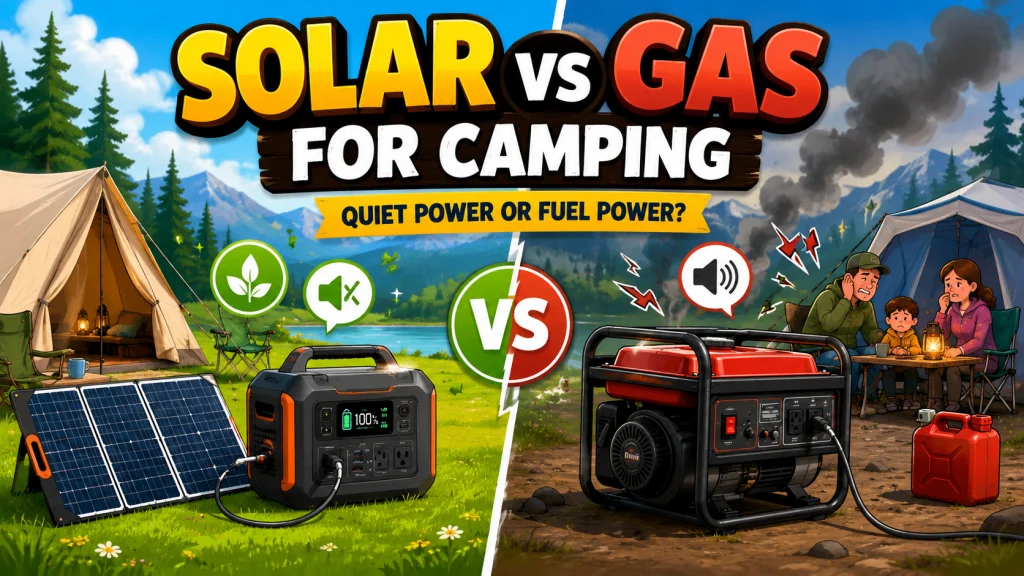
A gas generator at a campsite announces your presence to everyone within 300 feet. I’ve watched it happen at the counter more times than I can count: someone buys a portable gas unit for a camping trip, uses it once, and comes back two weeks later saying they almost got evicted from the campground on the first night. Most US campgrounds enforce a 60 dB noise limit during quiet hours, typically from 10pm to 8am. Most gas generators operate between 65 and 80 dB. That’s not a gray area. That’s a policy violation.
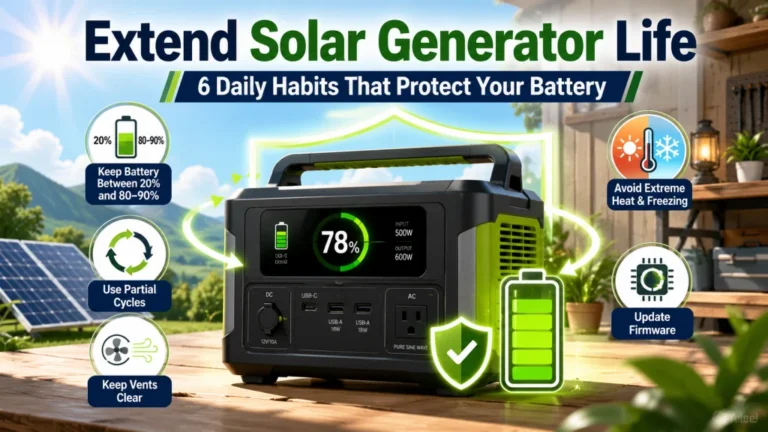
Solar generators land in a completely different range. At rest, during discharge, a solar generator produces zero noise. There are no moving parts, no combustion, nothing running. The internal cooling fan activates during high-rate charging or under sustained load, and when it does, it typically runs at 20 to 35 dB. That’s quieter than a whisper at close range. A solar generator running at its loudest charging state is still within the noise limits of most organized campgrounds at any hour. This single fact ends most of the comparison for regulated campground use.
The practical effect of this is that most campers with solar never have a conversation with a campground host about their equipment. There’s nothing to discuss. No noise complaint arrives, no ranger knock at 10:15 p.m., no awkward negotiation about quiet hours. That absence of friction is something gas generator owners who switch to solar notice immediately, usually on the first night.
Fuel in the Field Is a Real Logistics Problem
Car camping from a paved lot to a designated site is one thing. Any trip that adds distance, time, or complexity changes the fuel equation quickly. A gas generator needs a consistent fuel supply, which means carrying extra containers, managing fuel storage safely, and figuring out resupply if your trip extends. On a 5-day trip into an area with limited access to fuel stations, those logistics add meaningful weight and real safety considerations. A full 5-gallon fuel container weighs over 30 lbs and cannot be stored inside a tent, a vehicle with people sleeping in it, or anywhere that heat accumulates.
Solar panels, by contrast, add negligible logistical burden. Set them out during daylight hours, angle them toward the sun, and walk away. A 200W portable panel setup weighs 10 to 15 lbs and folds flat for transport. It has no fumes, no storage requirements, and no refill schedule. I ran my off-grid homestead setup on panels for three consecutive weeks during a summer with no grid access, and the recharge routine takes less attention than making coffee in the morning.
This gap matters most on longer trips and in remote areas. For a one-night car camp where a gas station is three miles away, fuel logistics are barely an issue. Extend that to four nights in a backcountry-adjacent site, and the solar setup earns every penny of its cost before the second morning.
Field Note: One customer came back from a 6-day rafting base camp trip and described spending the first afternoon hunting for a gas station after realizing their generator burned through fuel faster than expected at altitude. They switched to a solar unit for the next trip. No fuel run, no interruption, panels out during the day while they were on the river.
Weight and Portability: The Numbers Are Not Close
A 1,000Wh solar generator with a matched panel setup weighs between 22 and 35 lbs total. That’s the battery unit plus the folding panel. A 2500W gas generator weighs 55 to 65 lbs before you account for fuel. Add two gallons of gas at roughly 7 lbs per gallon, and you’re looking at 70 lbs of combined weight for the generator alone. For car camping, both setups fit in a truck bed or large SUV without much trouble. For anything beyond that, including canoe trips, motorcycle camping, or carrying gear more than a few hundred feet, the weight difference becomes a real constraint.
Portability also affects where you can legally use each option. A solar generator works inside a tent, inside a vehicle, inside a cabin, or in a poorly ventilated space. A gas generator cannot be run within 20 feet of any opening to an enclosed space, which effectively means you’re always running a cord to wherever you actually want power. That 20-foot rule is not a suggestion from an abundance of caution. It’s a CDC guideline based on carbon monoxide accumulation patterns. Solar eliminates this constraint entirely.
The weight advantage of solar also scales differently than gas. As you add capacity, a solar setup grows in panel area, which stays flat and relatively lightweight. Adding generator capacity means a larger, heavier engine block. For most camping use cases under 2,000Wh, solar keeps the total weight lower and the setup simpler.
| Category | Solar Generator (1,000Wh) | Gas Generator (2500W) |
|---|---|---|
| Operating noise level | 0 dB at rest, 20-35 dB fan | 65-80 dB continuous |
| Combined weight with fuel/panels | 22-35 lbs | 70+ lbs with 2 gal fuel |
| Campground quiet-hour compliance | Yes, any time | No, typically banned after 10pm |
| Safe for indoor/tent use | Yes | No, 20-foot clearance required |
| Fuel logistics | None | Requires carry, storage, resupply |
| Recharge method | Solar panels, wall outlet, car port | Refuel only |
| Runtime limit | Fixed Wh capacity | Unlimited with fuel supply |
The table above covers the practical split clearly. For noise and safety, solar wins without contest at organized campgrounds. For raw runtime where fuel is available, gas has the advantage.

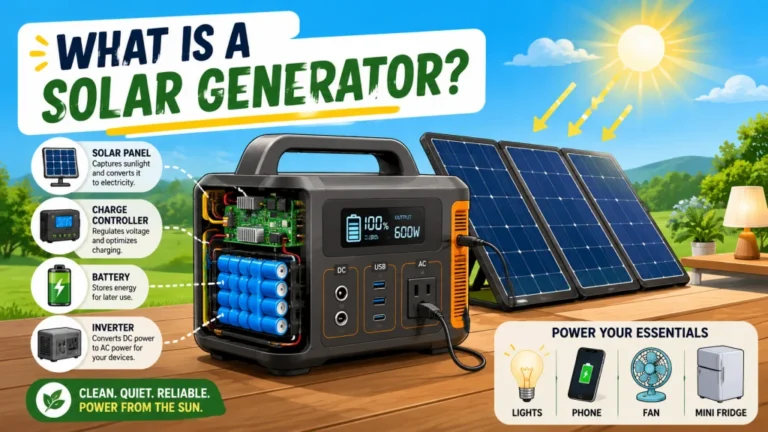
Weighing just 23.8 lbs with a foldable handle, this 1,070Wh LFP power station delivers 1,500W of pure sine wave AC output with a 3,000W surge capacity, capable of running AC units, fridges, and electric pots. Its LFP battery sustains over 70% capacity after 4,000 cycles, translating to a lifespan of more than 10 years. Via the Jackery App, you can enable a full charge in as little as one hour, or switch to a whisper-quiet 30 dB overnight mode. Six output ports including two USB-C with 100W PD charging cover nearly any device simultaneously.
Check On AmazonIf you click this link and buy, we earn a commission at no additional cost to you.
What Camping Power Needs Actually Look Like
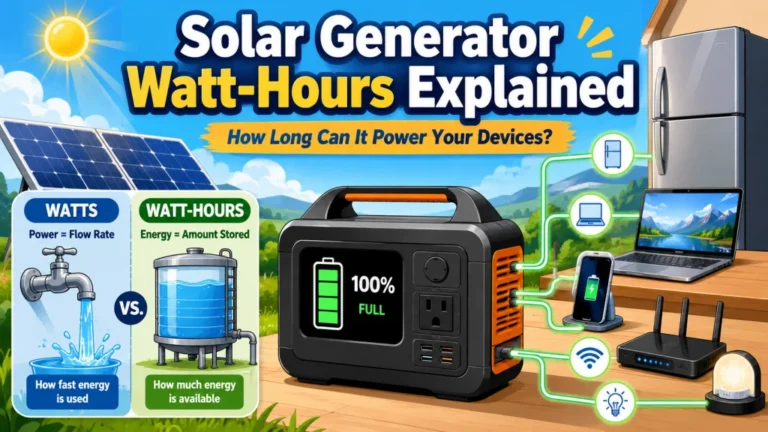
Most campers dramatically overestimate how much power they need. I watched this happen consistently at the shop: someone would walk in convinced they needed a 2000W unit for camping, and after we talked through their actual devices, they needed less than half that capacity. A typical camping power list looks like this: phone charging at 5 to 20W, a laptop at 30 to 65W, LED camp lights at 10 to 30W, a CPAP machine at 30 to 60W, and possibly a small USB fan at 10 to 20W. Total combined draw: 100 to 200W. On a 1,000Wh solar unit running at 150W average load with 85% real-world efficiency, that’s about 5.5 hours of combined runtime from a full charge.
Now add a 200W solar panel set receiving 5 to 6 hours of direct sunlight during the day. You’re bringing in 1,000 to 1,200Wh while your daytime draw is minimal because you’re outdoors. By nightfall, the battery is full or close to it. If your overnight load averages closer to 60 to 100W because lights, laptops, and fans cycle on and off instead of running continuously, you wake up with battery to spare before the sun comes up again. This is the daily cycle that works without fuel, without noise violations, and without extension cords strung across a campground.
The one exception worth planning for is a portable refrigerator or a cooler with a compressor. A 12V compressor cooler draws 40 to 80W on average, with surge spikes at startup. Add that to the power list above, and your combined load moves to 190 to 280W. A 1,000Wh unit will handle this, but the margin gets tighter on days with minimal sun. For camping trips with a compressor cooler in areas with reliable sun, a 1,500Wh unit removes most of the math anxiety.
- Phone charging (2 phones): 10-40W, negligible drain on any unit above 500Wh.
- Laptop: 30-65W depending on whether it’s under load. A full workday of use draws roughly 150-300Wh from a 1,000Wh battery.
- CPAP without humidifier: 30-45W. A night’s worth of runtime draws 240-360Wh. A 1,000Wh unit covers 2 to 3 nights before needing solar recharge.
- CPAP with humidifier: 60-100W. Cuts available runtime in half compared to non-humidifier use. Plan for a 1,500Wh minimum if this is your use case.
- Compressor cooler/fridge: 40-80W average. The highest consistent draw on a camping load list. Pair with at least 200W of solar panels to maintain balance over a multi-day trip.

This 22.27 lb compressor fridge cools from 77 to 32 degrees Fahrenheit in just 15 minutes and reaches -5 degrees in 50 minutes, with no ice needed. ECO mode draws under 36W and MAX mode stays below 45W, consuming less than 1kWh per day. Three-level battery protection prevents vehicle battery drain, and a 45 dB noise level plus 30-degree incline tolerance make it reliable for RVs, trucks, and off-road use. Includes AC and DC power cords with 2-year tech support.
Check On AmazonIf you click this link and buy, we earn a commission at no additional cost to you.
When Gas Still Makes Sense for Camping
There are scenarios where gas genuinely wins, and I’d rather say so plainly than pretend otherwise. If you’re running a large RV with roof air conditioning, you need a generator capable of 3,500W or more continuous output, and most portable solar units top out well below that threshold. A solar generator can supplement power for devices and lighting while the RV’s shore power hookup or a larger gas generator handles the air conditioning, but solar alone won’t run a central RV AC system without purpose-built equipment at a different price point entirely.
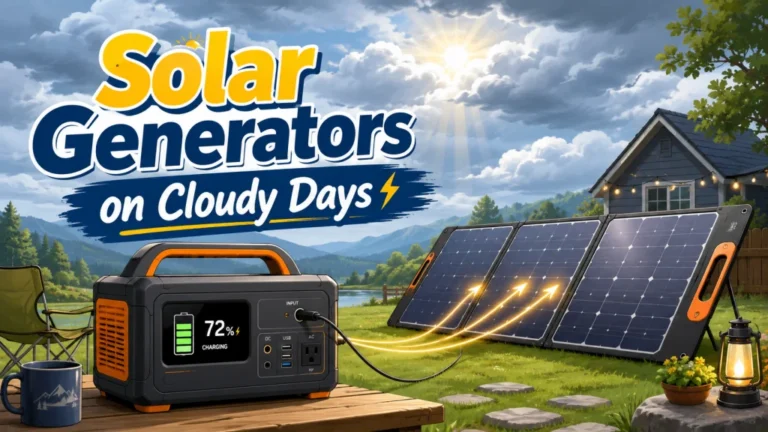
Extended trips in dense forest or consistent heavy overcast also change the math. If your solar panels are receiving 2 hours of meaningful direct sunlight instead of 5 to 6, your daily recharge drops from 400Wh to roughly 150 to 200Wh. On a 1,000Wh battery with a 150W average load, you’re running a deficit each day. Three or four days of that and the battery is depleted. Gas doesn’t have this constraint. Fuel availability aside, a gas generator running in an open clearing delivers the same output on a cloudy day as a sunny one.
Power tools at a remote work site are another case where gas wins outright. A circular saw, a compressor, or a larger drill draws 1,200 to 1,800W. A portable solar generator with a 2,000W inverter can technically run a single tool at a time, but not all of them simultaneously, and not with the duty cycle a work site demands. For a remote cabin build or any trip where power tools are part of the plan, gas is the appropriate tool. Solar works well for the lighting, phone charging, and overnight comfort at that same site, which is where the dual-approach comes in for serious off-grid work use cases. The full solar versus gas comparison covers these tradeoffs in more detail if you’re still working through the decision at a broader level.
What to Check Before You Book (and Why It Matters for Your Power Choice)
This is the piece of information that changes the calculation for a lot of buyers, and it almost never appears in brand marketing. Many campgrounds have moved beyond general quiet-hour noise rules and now list explicit generator policies. Some ban gas generators outright after a certain hour. Others restrict them to designated generator loops, which are typically located in a separate section of the campground away from the main tent and cabin sites. In some National Park areas, generators are prohibited in certain zones entirely regardless of time. The host at a campground I stayed at in Nevada last summer flagged this to a group that arrived with a gas unit on the first evening. They spent two nights running a cord 80 feet from a shared outlet by the bathhouse. Solar avoids most of this friction.
Before booking, it takes about 30 seconds to find out what you’re dealing with. Most campground booking pages, including those on Recreation.gov and private campground reservation systems, post generator hour restrictions in the site details or rules tab. What to look for: generator-free loops, generator hours (typically 8 a.m. to 10 p.m.), and whether electric hookups are available at your specific site. A few things worth knowing by campground type:
- Developed tent loops in National Parks and state parks: Often no-generator zones or restricted to specific hours. Check the individual park’s rules page, not just Recreation.gov’s general listing.
- RV loops with electric hookups: Shore power is available. Gas generators usually still have quiet-hour restrictions. Solar is generally unrestricted, though placement and cord safety rules still depend on the specific site.
- Generator-designated loops: Gas generators are permitted only here. If you book in a standard tent loop and show up with a gas unit, you may be asked to move or shut it down.
- Dispersed camping on public land: Often no formal generator rules, but no hookups either. Solar with a car port charging backup is a practical setup for multi-day dispersed trips.
- Private campground networks: Policies vary widely. Some are stricter than National Parks. Check the specific location, not just the brand or franchise.
Solar generators generally fall outside all of these restrictions because there’s nothing for the policy to target: no noise, no exhaust. A solar unit on a picnic table is indistinguishable from a large cooler from 20 feet away. That said, checking the specific campground policy before arrival is still worth doing regardless of what equipment you bring.
Key point: Generator hours, generator-only loops, and no-generator zones are listed in campground booking details. Gas generators are subject to all of them. Solar generators are generally not. Checking before you book saves the conversation on arrival.
Which Camping Setup Are You Actually Buying For?
The comparison between solar and gas gets much shorter once you know what kind of camper you are. Most buyers fall into one of five situations, and the right answer is different for each. This isn’t a pitch for any specific unit. It’s a way to identify which of the two options fits before you spend the money.
- Tent camper at an organized campground: Solar is the practical choice here in almost every scenario. Quiet-hour restrictions on gas generators apply directly to you. Look for a unit with a low fan noise rating and enough capacity to cover your CPAP or cooler overnight. Pure sine wave output matters if you run a CPAP with a humidifier or sensitive electronics.
- Car camper for 2 to 5 nights with access to sun: A 1,000 to 1,500Wh unit paired with 200W of solar panels handles a standard camping load list and recharges during the day. The main spec to check is solar input wattage, which determines how fast the panels refill the battery. Higher input wattage means a shorter recharge window on a partial cloudy day.
- CPAP user who camps: Your first filter is pure sine wave output, which virtually all current name-brand units provide. Your second filter is capacity: CPAP without humidifier needs 240 to 360Wh per night; with humidifier, closer to 480 to 720Wh. A 1,000Wh unit covers two nights without humidifier before needing solar recharge. With humidifier, budget 1,500Wh and confirm the unit’s fan noise level if you run it near your sleeping area.
- RV camper with rooftop air conditioning: Gas or shore power is the practical choice for the AC. Solar can cover device charging, lighting, and anything that doesn’t draw above 1,500W, but it won’t replace a 3,500W rooftop AC without purpose-built equipment well outside the portable generator price range. A dual approach, gas for AC and solar for everything else, is what off-grid RV owners often end up with after trying solar alone.
- Remote or dispersed camper in dense forest or cloudy regions: Solar works if you have a clearing with direct sun for 5 or more hours per day. Without it, your daily recharge drops to 150 to 200Wh from a 200W panel in heavy cloud, and a 1,000Wh battery runs a deficit by day 3. In this scenario, car port charging as a backup, arriving with a full battery, or a smaller gas generator for supplemental use are worth factoring into the plan.
The spec that matters most varies by situation. For campground compliance, it’s noise level. For multi-day solar dependence, it’s input wattage and capacity. For CPAP and medical devices, it’s pure sine wave output and fan noise. Knowing your situation before browsing units keeps you from buying the wrong thing for reasons that have nothing to do with the brand.

Featuring 16BB N-Type cells at 25% efficiency, this panel outperforms standard 200W panels and folds down to backpack size at just 13.89 lbs, with a magnetic closure for tool-free setup. Three built-in ports including USB-C PD 45W, and two USB-A ports charge devices directly, while MC4 output connects to most power stations and 12V battery systems. Four adjustable kickstands offer 40, 50, and 60 degree angles, and IP65 rating plus UL 61730 certification ensure durability and safety backed by a 2-year warranty.
Check On AmazonIf you click this link and buy, we earn a commission at no additional cost to you.
Final Thoughts: Match the Tool to Where You Actually Camp
For most campers, the decision follows directly from where they camp and what they power. Organized campgrounds with quiet-hour noise policies, car camping trips under 5 days, CPAP users, anyone running lighting and device charging, and anyone who doesn’t want to think about fuel: solar covers all of this with less weight, less noise, and less logistical friction than gas. The upfront cost is higher, but the ongoing cost is zero, and you won’t be the person the campground host talks to at 10:45 p.m. about your generator.
Gas makes sense at RV sites with high-draw appliances, in forested or heavily overcast areas where solar input is consistently low, and anywhere power tools are part of the trip. These are real use cases and real limitations worth knowing before you spend $500 to $2,000 on something that doesn’t match your actual camping situation. The honest answer is that for the majority of camping use cases in the US, a properly sized solar unit wins on most of the axes that matter at a campground. The minority of cases where gas wins are specific enough that if you’re in one, you likely already know it. If you’re still working through the broader solar versus gas decision beyond camping, the complete solar generator guide covers the full picture from sizing to battery chemistry.

With 1,800W output, a 3,600W surge, and X-Boost pushing usable power to 2,600W, this LiFePO4 station handles refrigerators, microwaves, and heavy appliances with ease. X-Stream AC charging reaches 80% in just 45 minutes, and a 500W solar panel fills it in 2.5 hours. Its sub-10 millisecond UPS switchover protects sensitive electronics, and EV-grade CTC construction ensures a 10-plus year lifespan.
Check On AmazonIf you click this link and buy, we earn a commission at no additional cost to you.
FAQs
⛺ Can I use a solar generator inside my tent?
Yes. A solar generator produces no exhaust, no carbon monoxide, and no combustion. It’s safe to run inside a tent, a vehicle, or any enclosed space. Keep the solar panels outside to charge it, but the unit itself can live anywhere.
🔇 Will a solar generator bother other campers at night?
At rest during discharge, it produces zero noise. The internal fan activates during heavy charging and runs at 20 to 35 dB, which is quieter than a whisper at conversational distance. Most nearby campers are unlikely to notice it.
☁️ What happens if it’s cloudy for multiple days while camping?
Solar input drops to roughly 10 to 25 percent of rated panel output under heavy cloud cover. A multi-day cloudy stretch limits recharge significantly. The best backup is arriving with a full battery and supplementing with a wall charge or car port charge if needed. Plan conservatively on Wh capacity if your camping area has unpredictable weather.
🏕️ Do campgrounds ban solar generators the way they ban gas generators?
Rarely. Solar generators produce no noise or emissions, which are the two things campground generator policies target. Gas generator bans and quiet-hour rules generally do not apply to battery-based solar units, though it’s worth confirming with the specific campground if you’re unsure.
⚡ Can a solar generator run a camp air conditioner?
Small portable AC units designed for camping draw 300 to 700W and can run on a 1,000 to 2,000Wh unit for several hours. Standard RV rooftop air conditioners draw 3,500W or more and require a gas generator or shore power. Know which category your AC falls into before assuming solar covers it.
🔋 What size solar generator do I need for a 3-day camping trip?
For typical camping loads including phone charging, a laptop, LED lights, and a CPAP without a humidifier, a 1,000Wh unit with 200W of solar panels handles a 3-day trip comfortably in areas with 5 or more hours of direct sun per day. Add a compressor cooler or a CPAP humidifier, and step up to 1,500Wh.