It Does Not Generate Anything. That Is the Point.
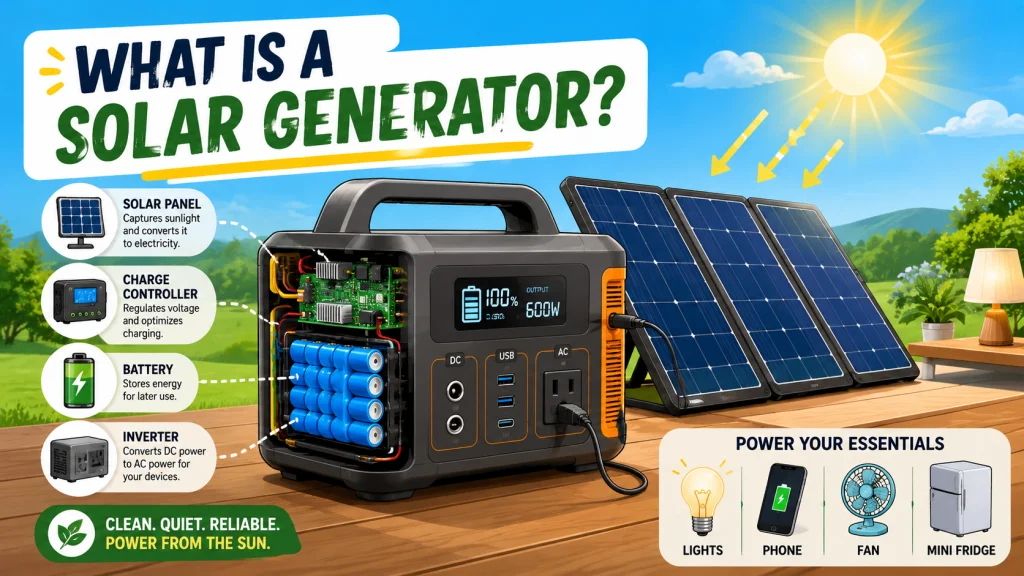
The most useful reframe I can offer anyone new to this product category is a simple one: ignore the word “generator.” A solar generator does not generate power from scratch. Set one in the middle of a field on a cloudy day with no panels attached, and it will simply sit there, slowly losing its charge. What you are actually looking at is a battery: a well-engineered, solar-rechargeable battery system with an inverter built in. The “generator” in the name refers to what it does during a power outage. It keeps things running when the grid goes down. The similarity to a gas generator ends there, and that is where the confusion usually starts.
I heard a version of this same moment of confusion regularly at the shop. A customer would come in having seen the word “generator” and picture something with fuel, an engine, a pull cord. Something that made power from raw materials. I would walk them through what was actually inside the box and the response almost always landed the same way: “Oh. So it is basically a really big battery.” He was right. And once that lands, everything about how these products are marketed, described, and compared starts making a lot more sense. Most owners who take the time to understand what they bought describe it the same way: a battery first, solar-rechargeable second, and useful only when sized correctly.
Field Note: One of the more memorable conversations I had at the counter was with a buyer who had driven two hours specifically because he had seen a solar generator marketed as a whole-home backup solution. He had a 3,000-square-foot house with electric heat. I did not even get to the specs before I had to explain the most fundamental fact: this product stores energy, it does not create it. We ended up having a genuinely useful conversation about what it could actually handle versus what his home required. He did not buy that day, but he came back a month later with realistic expectations and left with a unit that was right for what he actually needed.

Weighing just 23.8 lbs with a foldable handle, this 1,070Wh LFP power station delivers 1,500W of pure sine wave AC output with a 3,000W surge capacity, capable of running AC units, fridges, and electric pots. Its LFP battery sustains over 70% capacity after 4,000 cycles, translating to a lifespan of more than 10 years. Via the Jackery App, you can enable a full charge in as little as one hour, or switch to a whisper-quiet 30 dB overnight mode. Six output ports including two USB-C with 100W PD charging cover nearly any device simultaneously.
Check On AmazonIf you click this link and buy, we earn a commission at no additional cost to you.
What Is Actually Inside the Box
Every solar generator, regardless of price, contains four core components. Understanding each one takes about two minutes and completely changes how you read a spec sheet.
| Component | What It Does |
|---|---|
| Solar Panel | Harvests sunlight and converts it to DC electricity |
| Charge Controller | Regulates incoming DC power to protect the battery from overcharging |
| Battery | Stores the energy until you need it |
| Inverter | Converts stored DC power to AC electricity for standard outlets and appliances |
The solar panel is the only part that touches sunlight directly. The charge controller acts as a gatekeeper, keeping incoming power within safe limits before it reaches the battery. The battery holds everything. The inverter is what makes it useful for household devices: most appliances run on AC power, and the inverter handles that conversion every time you plug something in. Nothing in this system is generating energy from nothing. It is capturing, regulating, storing, and delivering energy that originally came from the sun.
Your smartphone does the same thing at a smaller scale. A solar charger captures light, a circuit manages the flow, the phone battery stores it, and the device delivers it to your screen. Same process, completely different scale. A 2,000Wh solar generator stores roughly 140 times the usable energy of a modern smartphone battery. That scale jump is what takes it from novelty to genuinely useful backup power. For a deeper look at how each of these four components interacts under real charging and discharging conditions, including what happens when panels are partially shaded or temperatures drop below freezing, how solar generators actually work covers the full picture.
Why Manufacturers Call It a Generator Anyway
The meaning behind the name is functional, not technical. These units perform the same job a gas generator performs during a power outage: they keep lights on, devices charged, and appliances running when the grid fails. That job is real. But the word “generator” carries assumptions that do not transfer to a battery-based system. A gas generator runs indefinitely as long as you feed it fuel. A solar generator has a fixed pool of stored energy. When that pool is empty, you wait for the sun or a wall outlet to replenish it. The runtime is not unlimited. It is finite, calculable, and entirely dependent on the watt-hour capacity of the battery and the power draw of what you are running.
This distinction shows up in real purchasing mistakes. I watched buyers at the counter compare a unit with a 2,000-watt inverter to a gas generator with a 3,500-watt engine, as if wattage were the only number that mattered. The inverter wattage tells you how much power the unit can deliver at once. It says nothing about how long it can sustain that load. A 2,000Wh battery running a 2,000-watt load will deplete in roughly one hour. The gas unit runs that same load for as long as you have fuel on hand. Neither product is wrong for every situation. They are solving different problems at different scales. The confusion comes from letting the word “generator” set the expectation rather than reading the actual specs.
Key point: The solar recharging capability is what separates this product from a plain battery bank. A plain battery bank stores power from a wall outlet and depletes. A solar generator can recharge in the field, during a multi-day outage, or anywhere with adequate sun exposure. Solar input is the category’s defining feature, and it is the reason the product earned its own name.
Note: “Generator” tells you the use case, not the mechanism. “Solar” tells you the unit accepts panel input, though panels are not always included in the box. The real buying decision is in the four specs: watt-hour capacity, AC output wattage, solar input rate, and battery chemistry.

Featuring dual-sided monocrystalline cells at 25% conversion efficiency, this bifacial panel captures sunlight from both sides for up to 30% more output than single-faced panels. Two kickstands allow quick ground setup in seconds, and the TPE rubber handle makes it easy to carry on off-grid trips. IP68 waterproofing and an ETFE-laminated case ensure long-term durability, with compatibility spanning all Jackery Explorer power station models via DC and USB ports.
Check On AmazonIf you click this link and buy, we earn a commission at no additional cost to you.
What It Actually Solves, and Where the Limits Are
The product pages for solar generators tend to get the “what it solves” list right. Where they mislead buyers is in what they quietly leave out. Here is an honest version of both sides.
A solar generator handles these scenarios well:
- Short to medium outages where you need to keep a refrigerator, essential lights, and devices running for one to three days
- Camping, RV, and off-grid use where you want power without fuel, exhaust, or engine noise
- Emergency backup for medical devices, CPAP machines, and critical electronics
- Remote job sites or outdoor events without access to grid power
- Supplemental power during rolling outages when wall charging is intermittently available to top the battery back up
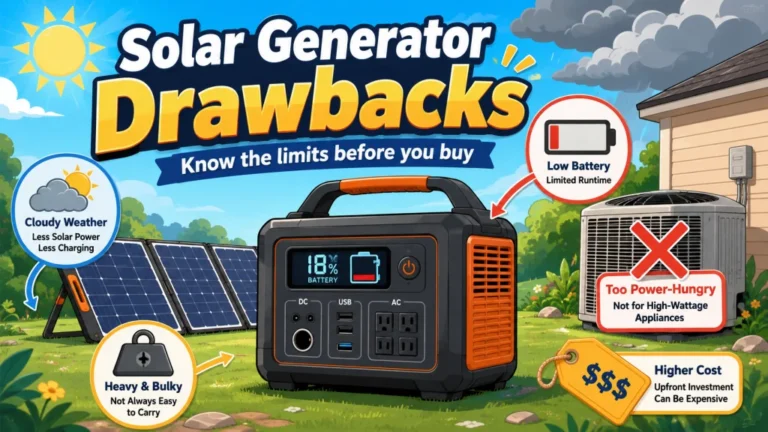
Where these units fall short is worth being just as direct about. Running a whole home through a multi-day winter outage is beyond what most solar generators are sized to handle. A 2,000Wh unit running a typical home’s combined electrical loads, including heating, hot water, cooking, and lighting, could deplete in a few hours under sustained heavy use. Extended cloudy periods also constrain solar recharging sharply. A unit with 100 to 200 watts of panel input will recharge significantly more slowly on an overcast day, and under dense cloud cover, daily recovery can fall well short of what heavy use demands if you have no wall outlet available as backup. And loads above the unit’s inverter wattage rating are simply off the table. A unit with a 2,000-watt continuous inverter cannot run a 2,500-watt electric dryer, even briefly. The inverter will cut the load or trip its protection circuit before the cycle completes.
That last mistake is one of the most common ones I saw. Buyers would check the watt-hour capacity and feel confident about the purchase, then come back frustrated because the unit would not run the appliance they needed. They had sized for energy storage and forgotten to check the inverter rating. Both numbers matter, and they answer different questions. This is the conversation I wish more buyers had before they started comparing prices.

Starting at 2kWh and expandable to 6kWh with two additional batteries, this LFP station reaches 80% in just 43 minutes via combined AC and solar input. Its 3,000-cycle battery outlasts the industry average by 6 times and includes a 5-year service guarantee. With 2,400W output across 15 outlets and X-Boost pushing to 3,400W, it handles 99% of household appliances at a whisper-quiet 30 dB.
Check On AmazonIf you click this link and buy, we earn a commission at no additional cost to you.
Final Thoughts: The Spec Sheet Makes More Sense From Here
Now that you know what a solar generator actually is, the four numbers on every product page start to mean something. Watt-hours tell you how much energy is stored. Inverter wattage tells you how much power can be delivered at once. Solar input wattage tells you how fast the sun can refill the battery. Battery chemistry tells you how many years the unit will stay useful before degradation becomes noticeable. These four specs are what you are actually evaluating when you shop. The word “generator” on the box is a label. The specs are the product.
If this is your first time shopping for a solar generator and you want the full picture before spending anything, the complete solar generator guide covers the full lifecycle: how to size correctly for your actual loads, how battery chemistry affects your real-world decision, how solar vs gas stacks up for different use cases, and what to look for in the product guides once you are ready to compare options. That is the right next step.

This compact plug-in monitor tracks the energy consumption of any AC 115-volt appliance and displays real-time readings of volts, amps, and wattage at 0.2 to 2.0 percent accuracy. Its large LCD screen lets you calculate electricity costs by the day, week, month, or year, making it easy to spot energy-hungry devices and trim your utility bill. It is also compatible with inverters, adding flexibility for off-grid setups.
Check On AmazonIf you click this link and buy, we earn a commission at no additional cost to you.
FAQs
🔋 What is the difference between a solar generator and a portable power station?
Functionally, they are the same product. Both are battery systems with an inverter. “Solar generator” and “portable power station” are different marketing labels for nearly identical hardware. Units marketed as solar generators are typically sold alongside solar panels. Units marketed as power stations often emphasize wall outlet and car charging. The underlying technology is the same.
☀️ Does a solar generator work without sunlight?
Yes. Solar panels are one way to recharge the battery, but most units also charge from a standard wall outlet and from a 12V vehicle port. You are not dependent on the sun to use the product. Solar recharging is an option, not a requirement. The battery runs your devices regardless of how it was charged.
🏠 Can a solar generator power a whole house?
Not indefinitely, and not a typical home under its full electrical load. A solar generator is built to run selected essential loads for a limited time. A 2,000Wh unit running a standard home’s full combined draw will deplete in a matter of hours. It is a backup tool for prioritized appliances, not a permanent grid replacement.
⚡ How long does a solar generator last before the battery needs replacing?
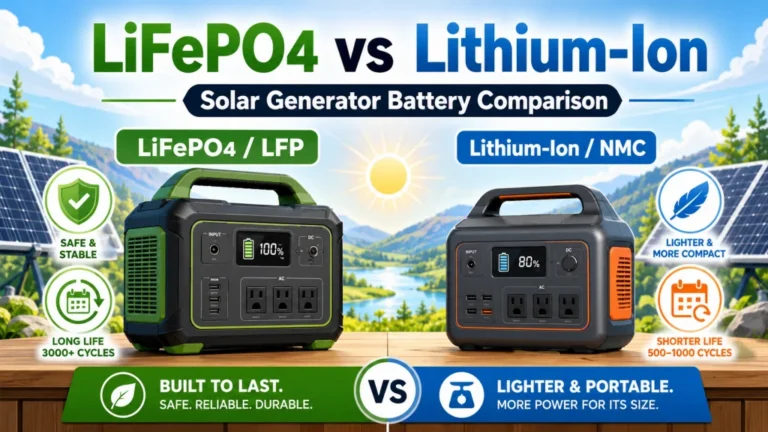
Battery chemistry is the main factor. Units with LiFePO4 chemistry are typically rated for 2,000 to 3,500 charge cycles before reaching 80 percent of original capacity, which translates to many years under moderate use. Units with NMC lithium-ion chemistry usually reach that same 80 percent threshold at 500 to 1,000 cycles, a shorter window under the same use pattern.
🌧️ Do solar generators work on cloudy days?
Yes, at reduced charging rates. Overcast conditions typically cut panel output to 10 to 25 percent of full-sun capacity, depending on cloud density. The battery still stores and delivers power normally. The constraint is how slowly you are refilling it, which matters most if you are relying on solar recharging during a multi-day overcast outage with no wall outlet available.
🔌 Is a solar generator the same as a solar panel?
No, and this confusion is common. A solar panel is one component that feeds power into the system. A solar generator is the full system: battery, inverter, charge controller, and the ability to accept power from solar panels. A solar panel alone stores nothing and powers nothing without additional hardware to store and convert what it collects.