The First Time I Got It Wrong Was About Three Months In
A man came in needing a unit to power his CPAP during outages. I walked him to a mid-range option, explained the watt-hours, told him it would handle two nights comfortably. It would, technically, assuming one detail I had not thought to ask about: whether his CPAP had a sensitive power supply. It did. The unit he bought used a modified sine wave inverter. His machine’s power supply did not tolerate that. He came back two weeks later with a dead adapter and enough patience to explain the situation calmly. I replaced the adapter out of pocket and processed the return. That was the first time what I got wrong about solar generators cost a real customer something real.
It was not the last. But it was the one that made me start asking better questions instead of running through a rehearsed explanation. After that, I stopped treating CPAP as just another low-watt device. I started checking inverter waveform first, then whether the customer had a DC adapter option for their specific machine, then runtime. Those three questions took thirty seconds. They would have saved that customer two weeks of frustration. The four things I am walking through here are not obscure edge cases. They are the solar generator mistakes I made most confidently, which is part of what made them hard to catch.
Wrong Belief 1: Watt-Hours Was the Number That Mattered Most
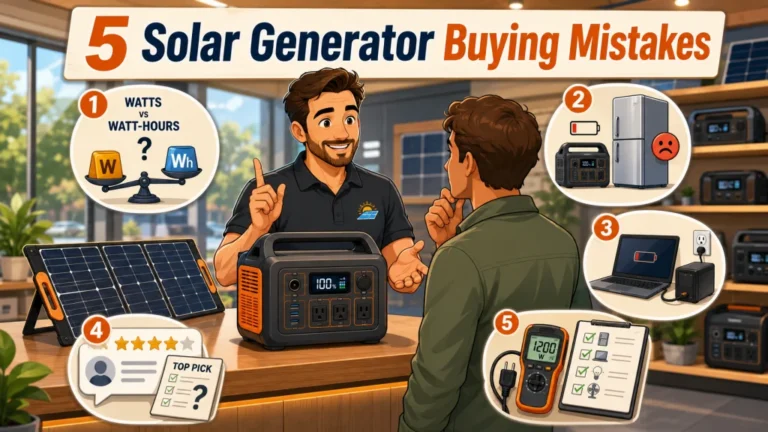
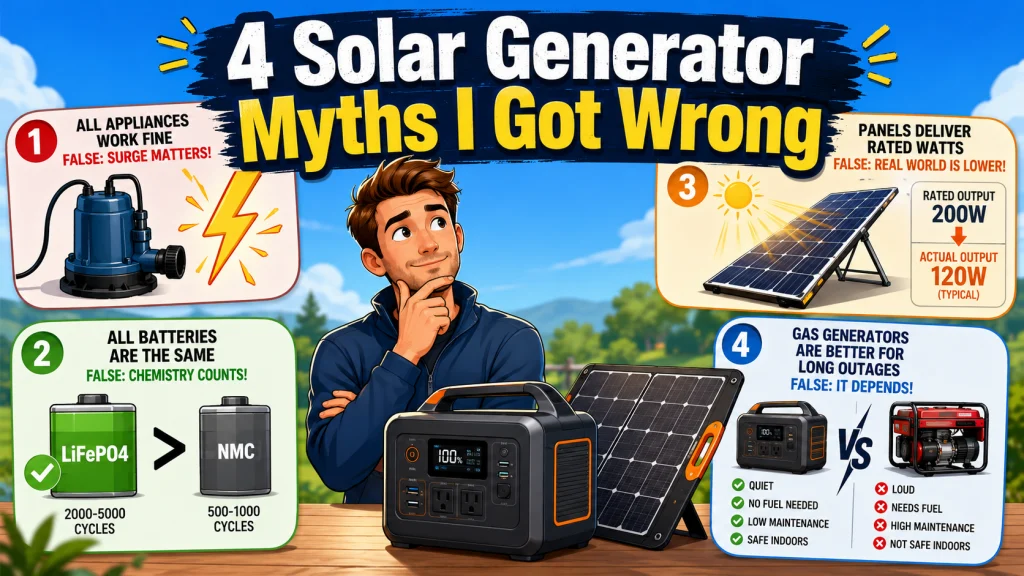
For the first several months, I explained capacity to every customer. How many watt-hours do you need? How long will this run your fridge? How many charges does this give a phone? I was right that capacity matters. I was wrong that it was the most important number for a large portion of the buyers I was talking to. The pattern I eventually noticed: roughly four out of ten customers had a load with a motor, a compressor, or a pump. A refrigerator. A chest freezer. A sump pump. A window air conditioner. For all of those loads, the surge watt rating is the first question, not the capacity.
Surge wattage is the peak power an inverter can deliver for the brief moment a motor is starting. It is almost always higher than the running watt rating, sometimes two to three times higher. Capacity is the tank. Surge is whether you can even turn the engine over. I had the priorities reversed for anyone with a motorized appliance, which was a significant share of the people I was helping.
Field Note: The example that made this click for me was a sump pump buyer. A typical sump pump runs at 800 to 1,200 watts but draws 2,400 to 4,000 watts on startup. I had customers come in with units rated at 2,000 running watts, which sounded like more than enough headroom, and then find out after purchase that the unit’s surge ceiling was 2,200 watts and their pump needed 3,500 on startup. The unit could not start the pump. Returning it was an expensive lesson that had nothing to do with how much battery capacity they had bought. For anyone sizing a unit around a high-surge load, the guide to solar generators for sump pumps and other high-surge appliances works through the startup math in detail.
The capacity conversation still matters and I still have it. But I learned to ask about surge loads first for anyone with anything motorized. Getting the order of questions right changed a lot of outcomes.
Wrong Belief 2: Battery Chemistry Was a Marketing Distinction
When LiFePO4 units started appearing alongside the older NMC lithium-ion units, I treated the chemistry difference as a premium angle. Both were lithium. Both held charge. Both charged from solar. The price difference seemed like a case of a better-sounding name justifying a higher sticker. That changed when the returns and capacity complaints started coming in from customers who had bought NMC units one to two years earlier.
The degradation was not dramatic failure. It was the quieter kind: the unit that used to run the refrigerator through the night now runs it for six hours. One customer had bought a mid-range NMC unit specifically to back up his kitchen fridge during outages, using it once or twice a week. At around 18 months he was back at the counter. Not complaining about a failure, just noting that runtime had dropped noticeably. He was not wrong to notice. The cycle count difference between the two chemistries is not copy on a spec sheet. It is documented electrochemistry. NMC cells are typically rated at 500 to 1,500 full cycles before meaningful capacity loss. LiFePO4 cells are often rated at 2,000 to 6,000, depending on depth of discharge and operating temperature. For a unit that gets used daily or near-daily, that gap can mean the difference between a battery that needs replacing in a few years and one that outlasts the rest of the product.
| Battery Chemistry | Typical Cycle Rating | Estimated Lifespan at Daily Use | Real Cost Over Time |
|---|---|---|---|
| NMC (lithium-ion) | 500 to 1,500 cycles | 1.5 to 4 years | Higher per year of use |
| LiFePO4 | 2,000 to 6,000 cycles | 5 to 16 years | Lower per year of use |
A $600 NMC unit that lasts three years can cost more per year than an $800 LiFePO4 unit that lasts considerably longer, depending on how frequently it is cycled. I had that math backwards for longer than I want to admit. The deeper breakdown of how these chemistries behave differently under heat, cold, deep discharge, and extended storage is covered in the full comparison of LiFePO4 vs lithium-ion solar generator batteries. For anyone who plans to use their unit more than a handful of times a year, chemistry is not a marketing distinction. It is one of the most important long-term cost variables in the purchase.
Wrong Belief 3: Rated Panel Wattage Was a Realistic Charging Estimate
For about a year, when customers asked how long a solar recharge would take, I ran the math from the spec sheet. A 200W panel paired with a 1,000Wh battery: five hours in good sun. Clean division. Accurate arithmetic. Almost entirely useless as a real-world answer.
Rated wattage is a lab number. It represents output under Standard Test Conditions: 1,000 watts per square meter of irradiance, a cell temperature of exactly 25 degrees Celsius, and a controlled light spectrum. Real conditions almost never match that. A customer came back with a screenshot from his monitoring app. His 200W panel was producing 142 watts at noon on a clear summer day with the panel at optimal angle. That is 71 percent of rated. On an overcast day, the same panel was producing 26 watts. Not a defective panel. Not a bad setup. Just actual sunlight in a real location on a real day.
Note: Real-world solar panel output typically runs 70 to 80 percent of rated capacity under good conditions. On overcast or cloudy days, expect 10 to 25 percent of rated output. These are not pessimistic estimates. They match what monitoring data consistently shows in practice, and they are the numbers that NREL uses in realistic performance modeling.
What this means for recharge planning is straightforward but gets skipped constantly. A 1,000Wh battery paired with a 200W panel does not recharge in five hours. Under good conditions it takes closer to seven. On a partly cloudy afternoon it could take twelve or more. That gap is the difference between a customer who plans for two days of outage coverage and actually gets it, and one who runs short at hour thirty because the morning was overcast. I started quoting real-world windows after that conversation.
- Clear day, optimal panel angle: expect 70 to 80 percent of rated wattage
- Partly cloudy: expect 30 to 50 percent, depending on cloud density and how long it lasts
- Overcast or heavy cloud cover: expect 10 to 25 percent of rated output
- Winter, low sun angle: reduced output even on clear days due to the angle of incidence against the panel surface
- Partial shade on a single panel cell: can drag down the entire string output, especially on PWM controllers
The practical fix is simple: use 75 percent of rated wattage as your working number on a good day, and adjust down from there based on your season and latitude. It is a more honest estimate than the spec sheet, and it leads to much better sizing decisions.
Wrong Belief 4: A Solar Generator Could Fully Replace a Gas Generator
I held this belief longer than any of the others, and I held it more firmly. It was partly true, which is what made it sticky. For most outages, in most of the country, during most of the year, a well-sized solar generator handles things without a problem. The word I had wrong was “fully.”
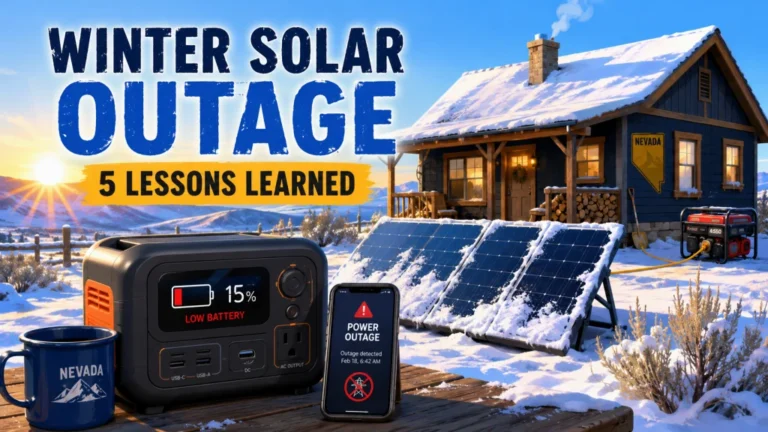
The correction came from a pattern of extended-outage returns, specifically from customers in the Pacific Northwest during winter. Continuous overcast for a week. Not dramatic storm weather, just the low grey sky that settles over that region for months at a time. Diffuse light producing 15 to 20 percent of rated panel output across short days. A 2,000Wh battery running a refrigerator, some lights, and a router would last a day and a half before the charging deficit caught up to it. No sun and no grid connection meant no path to recovery. The unit was not defective. The expectation was.
Warning: For multi-day outages during winter in low-sun climates, solar charging alone may not sustain daily household loads. A supplemental charging source, whether an AC wall outlet between outage periods, a car’s DC port, or a gas generator used briefly, is not a fallback option for some climates and seasons. For some use cases it is the primary plan.
I stopped saying “complete replacement” after the second winter customer came back with a depleted unit and no way to recharge it. The honest version of that answer is more useful anyway: for outages under 48 hours with any reasonable sun available, a properly sized solar generator handles it cleanly. For extended outages during winter in low-sun regions, a solar generator works best as a primary source with a backup charging method already decided on before the outage happens. The question I now ask before any purchase conversation for off-grid or heavy backup use is not “solar or gas?” It is: “what recharges the battery if the grid goes out and the sun disappears for a week?” That question tends to settle things quickly. It is not a knock on the product. It is the information that lets someone use it correctly.
Final Thoughts: The Corrections Are the Useful Part
Each of those four wrong beliefs cost someone something. The CPAP customer got an adapter replaced. Sump pump buyers who sized for running watts and ignored surge came back for exchanges. Customers I gave optimistic recharge windows to planned around numbers that did not hold up in practice. I am not listing those outcomes to make the story more dramatic. I am listing them because the correction attached to each one is the actual information, and that information is worth more than the original confident answer ever was.
The thing about being wrong in a retail environment is that the feedback is fast. A customer who buys the right unit does not come back to tell you. A customer who buys the wrong one shows up in two weeks. That loop is uncomfortable and educational in equal measure. The patterns I recognized over time, about surge ratings, battery chemistry, real-world panel output, and the limits of solar for extended winter outages, came directly from watching those corrections play out and then watching the same solar generator myths repeat themselves in the next customer who walked through the door.
The Checklist I Wish I Had Used in Year One: For medical devices: check inverter waveform type before capacity. For motors, pumps, and compressors: check surge watt ceiling before watt-hours. For regular use: check battery chemistry before sticker price. For solar recharge planning: use 70 to 80 percent of rated panel output as your working number on a good day. For winter or extended outages: decide on the backup charging source before the outage, not during it.
None of this is an argument against solar generators. They are genuinely capable, the technology has improved significantly, and for the right use case they are an excellent tool. But “the right use case” requires the real numbers, not the lab numbers. The margin between “this unit should work” and “this unit works for your specific situation” is where learning about solar generators in practice actually happens. Most of that margin, in my experience, only becomes visible after the first time you get it wrong.
Sources and References
- IEC 61215: Standard Test Conditions for photovoltaic panels, defining rated wattage measurement parameters
- NREL PVWatts Calculator: real-world panel output documentation and irradiance modeling for US locations
- Manufacturer specification sheets: LiFePO4 and NMC cycle ratings across major portable power station product lines
- DIYSolarForum: extended winter off-grid experience documentation, Pacific Northwest, consecutive low-sun conditions over multiple weeks
FAQs
⚡ Does inverter type really matter for CPAP machines?
Yes, it matters. CPAP machines with sensitive power supplies need a pure sine wave inverter. Modified sine wave inverters can damage the power supply or cause the machine to run incorrectly. Always confirm the inverter type before buying a unit specifically for medical equipment. Most current mid-range and higher units use pure sine wave, but verify before purchasing.
🔋 How do I know if a solar generator uses LiFePO4 or NMC chemistry?
Check the spec sheet under “battery type” or “cell chemistry.” LiFePO4, lithium iron phosphate, and LFP all refer to the more durable chemistry. If the listing only says “lithium-ion” without further detail, it is likely NMC. Contact the manufacturer directly if the spec sheet does not specify, especially for any unit you plan to use regularly over several years.
☀️ Why does my solar panel produce less than its rated wattage?
Rated wattage is a lab measurement under controlled conditions that rarely exist in the field. Heat, panel angle, cloud cover, shading, dust, and panel age all reduce output. Expect 70 to 80 percent of rated on a clear day with good angle. On overcast days, expect 10 to 25 percent. This is normal behavior, not a product defect.
🌩️ Can a solar generator fully replace a gas generator?
For most outages under 48 hours with reasonable sun available, yes. For extended outages during winter in low-sun climates, a solar generator works best with a supplemental charging source already planned. The honest answer depends on your region, your season, and how long the outage lasts.
🔌 What is surge wattage and why does it matter more than I thought?
Surge wattage is the peak power an inverter can deliver for the brief moment a motor or compressor starts up. It is typically two to three times the running watt draw. If a unit’s surge ceiling is lower than the startup surge of your appliance, the unit cannot start that appliance regardless of how much battery capacity it has. Check surge ratings first for any load with a motor, compressor, or pump.
📉 How quickly do solar generator batteries degrade with regular use?
It depends heavily on chemistry. LiFePO4 cells typically retain around 80 percent of original capacity at 2,000 cycles or more. NMC cells can reach the same degradation threshold in 500 to 1,000 cycles. For a unit used daily, that translates to a meaningful difference in years of useful life. The chemistry choice matters most for anyone who plans to rely on the unit regularly, not just occasionally.