Two Very Different Problems, One Search Term
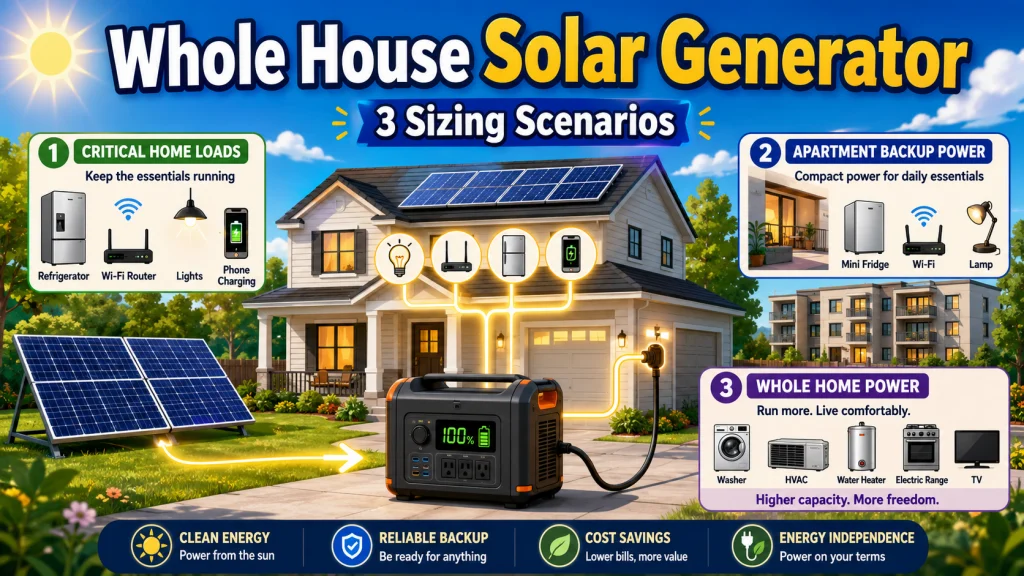
The phrase “whole house solar generator” covers two fundamentally different things, and the marketing in this space rarely separates them clearly. The first is covering your whole house’s critical loads during a short outage: the refrigerator, a router, some lights, and device charging. A 2,000 to 3,000Wh portable unit handles that for 12 to 18 hours. The second is covering your whole house’s normal consumption continuously, including HVAC, electric range, water heater, and everything else drawing power at once. That is a different calculation, and the Wh numbers it produces are not in the same ballpark.
From what I have seen, most of the buyer frustration in this space comes from people who went in expecting the second thing and got the first. They saw “powers your home” on a box, bought a 2,000Wh unit, and discovered it does not run central air conditioning for three days. That is not a product failure. It is a framing failure that happens before the purchase. The table below separates the three scenarios using raw 12-hour Wh consumption and the minimum rated unit capacity after accounting for efficiency losses and a safety buffer.
| Scenario | Raw Wh (12 hrs) | Min Rated Capacity Needed | Practical Unit Size |
|---|---|---|---|
| Critical loads (home) | ~1,520Wh | ~2,235Wh | 2,000 to 3,000Wh unit |
| Apartment critical loads | ~1,100 to 1,440Wh | ~1,600 to 2,100Wh | 1,500 to 2,500Wh unit |
| Whole home normal use | 14,400 to 18,000Wh+ | 21,000 to 26,500Wh+ | Multiple large units plus daily recharge |
Note: “Min Rated Capacity Needed” is the battery size required to cover the raw Wh after dividing by 0.85 for lithium efficiency losses and adding a 25 percent safety buffer. It is not the same as the raw energy your loads consume.
The first two scenarios are realistic with portable solar generators available today. The third requires both significant battery capacity and a disciplined daily recharge plan. Each scenario is covered in its own section below.
Critical Loads: The Scenario That Works for Most Homeowners
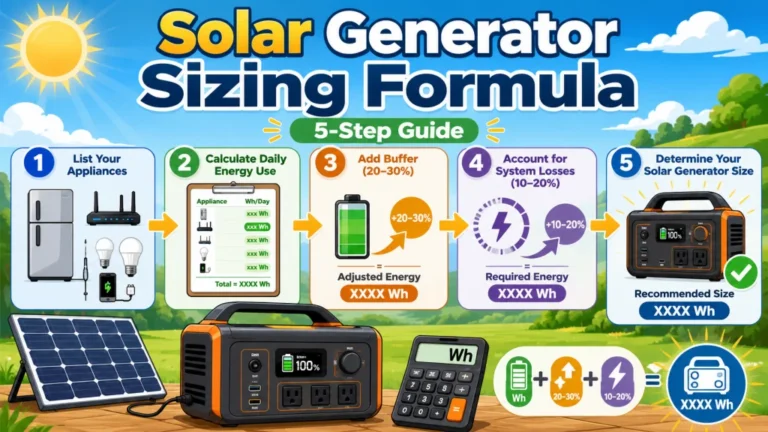
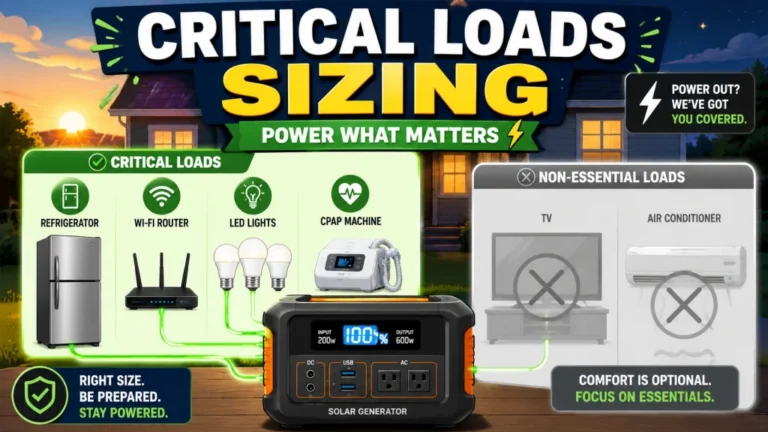
The key detail in the critical loads calculation that most buyers miss is that it is not a flat wattage times 12 hours. A frost-free refrigerator draws about 150W, but the compressor only runs for roughly 8 of every 12 hours. That brings the fridge’s actual 12-hour energy use to around 1,200Wh, not 1,800Wh. Add a router at 10W running continuously (120Wh), four LED lights at 5W each for 6 hours (120Wh), and device charging at 20W for 4 hours (80Wh), and the realistic 12-hour total is about 1,520Wh. Divide by 0.85 for efficiency, add a 25 percent buffer, and the minimum rated capacity you need is around 2,235Wh. A 2,000Wh unit is marginal. A 2,500 to 3,000Wh unit is comfortable for most households.
That is a $700 to $1,500 problem for most people, not a $5,000 problem. The reason it feels bigger is that sizing estimates often start with the wrong list. Space heaters, window AC units, and electric cooking appliances are comfort loads, not critical loads, and including even one of them changes the size class completely. A 1,500W space heater running for eight hours adds 12,000Wh to the raw requirement. That is not a minor adjustment. It turns a manageable sizing problem into an entirely different category of system.
Field Note: I had this conversation at the counter more times than I can count. A buyer comes in with a reasonable list: fridge, router, lights. Then near the bottom: “and I’d like to run the space heater in the bedroom at night.” That one line doubles or triples the unit size they need. Critical loads sizing works when “critical” actually means critical. The list has to be honest before the math produces anything useful.
The full methodology for identifying what genuinely belongs on your critical loads list and working through the sizing calculation step by step is in the solar generator critical loads sizing guide. It covers both the identification framework and the specific math from load list to minimum unit size.

At 3,072Wh with 3,600W output and 7,200W surge capacity, this CTB-built station powers a household for up to 15 hours and keeps a fridge running 1 to 2 days. Its UL-certified UPS switches in under 20 milliseconds, LiFePO4 batteries last 4,000 cycles, and a full recharge takes just 1.7 hours via hybrid input. It is 47% smaller and 43% lighter than comparable 3kWh units.
Check On AmazonIf you click this link and buy, we earn a commission at no additional cost to you.
Apartment Use: A Smaller Load Profile and a Simpler Decision
Apartment renters have a backup power situation that is genuinely more manageable than most of them assume. The load is smaller by nature: a studio or one-bedroom typically runs a mini-fridge or dorm fridge at 50 to 80W average, a router at 10W, a couple of LED lights at around 5W each, and device charging at roughly 20W. Combined draw is approximately 90 to 120W. At 100W sustained on a 1,500Wh unit at 85 percent efficiency, you get around 12 hours of runtime. A 2,000Wh unit extends that further and provides real margin for most short outages without any recharge needed.
There is also a factor that makes the decision structurally simpler for renters: gas generators are not an option. Building policies eliminate them. That removes the comparison between solar and gas that sends a lot of homeowners into extended research loops. For apartment renters, a portable solar power station is the practical choice, not one option among several. The tradeoff shows up on the solar recharge side: many apartments have no outdoor space for a ground-mounted panel, and north-facing balconies produce limited output regardless of panel size. For most apartment users, wall outlet charging is the primary method, with solar as a supplement when conditions allow.
- A south-facing balcony with a single 100W panel in five peak sun hours generates about 500Wh per day, enough to fully recharge a 500 to 600Wh unit daily.
- Two 100W panels or one 200W panel on that same balcony brings a 1,000Wh unit back to full on a good sunny day.
- North-facing balconies produce significantly less output. If your only outdoor space faces north, treat wall outlet charging as your primary method and solar as an occasional supplement.
- Window-mounted panels are possible but output varies with glass tint, angle, and distance from direct sunlight. Real-world efficiency is lower than a balcony deployment in most cases.
The full apartment-specific breakdown, including how to size for wall outlet recharge as the primary method and what panel setup makes sense when balcony space is limited, is in the solar generator for apartment guide.

Starting at 2kWh and expandable to 6kWh with two additional batteries, this LFP station reaches 80% in just 43 minutes via combined AC and solar input. Its 3,000-cycle battery outlasts the industry average by 6 times and includes a 5-year service guarantee. With 2,400W output across 15 outlets and X-Boost pushing to 3,400W, it handles 99% of household appliances at a whisper-quiet 30 dB.
Check On AmazonIf you click this link and buy, we earn a commission at no additional cost to you.
Portable Solar Generator vs Whole-Home Battery System
The phrase “whole house solar generator” gets applied in marketing to two different product categories, and mixing them up in your research is one of the faster ways to end up confused or over-budget. A portable solar generator is a self-contained unit: battery, inverter, and charge controller in one box, designed to be moved and connected directly to the loads you want to run. Capacity typically ranges from a few hundred to a few thousand watt-hours. A whole-home battery system is a different category: installed, connected to your electrical panel with a transfer switch or smart panel, capable of backing up multiple circuits at once including high-draw appliances, and typically sized in multiple to tens of kilowatt-hours. Both appear when you search “whole house solar generator,” which is a significant part of why expectations around the term get so mismatched.
This article and the three guides it routes to cover portable solar generators only. If your goal is to keep a refrigerator running, maintain a router, run some lights, and charge devices during a short outage, a portable unit is the right category for that job. If your goal is near-normal home operation across multiple circuits including HVAC or electric range for multi-day events, that becomes a whole-home battery system decision that goes beyond the scope of any portable generator. Knowing which category you are shopping for before you look at spec sheets saves a significant amount of confused research time. Before you shop, settle these things for your specific situation:
- Which scenario applies: critical loads only, apartment backup, or extended whole-home coverage with a daily recharge strategy
- Your target rated Wh, based on the load math for your scenario and your planned outage duration
- The continuous watt output you need, which must cover your combined running load at peak simultaneous use
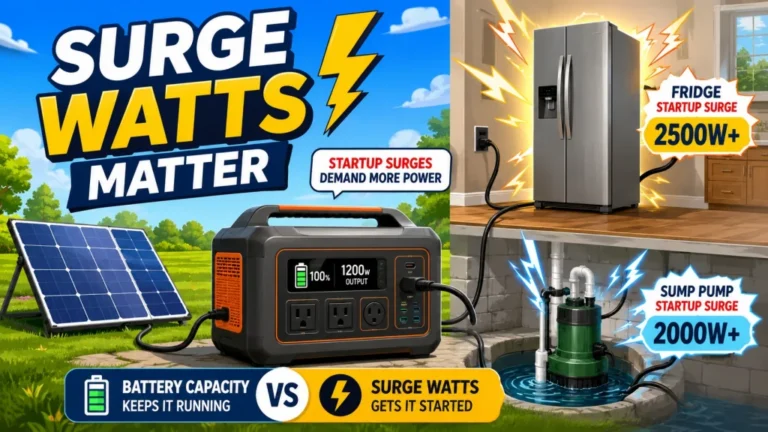
- The surge watt rating you need, which must exceed the startup draw of your highest-surge appliance
- Whether you have a realistic daily solar recharge plan if you are sizing for multi-day outages
The duration math that shows what rated Wh you actually need for 8-hour, 24-hour, and 72-hour scenarios with real numbers for each is covered in full in the home backup watt-hour sizing guide.
What Genuine Whole-Home Consumption Actually Requires
If you want to power your house at its normal consumption level, not just critical loads but everything, the math stops being comfortable quickly. A typical US home runs an average of 1.2 to 1.5kW of continuous draw when HVAC, refrigerator, lighting, and general appliance use are active simultaneously. Over 12 hours that is 14,400 to 18,000Wh of raw consumption. After the efficiency factor and safety buffer, you are looking at 21,000 to 26,500Wh of rated capacity needed to cover a single 12-hour block on battery alone. No single portable solar generator handles that, and the daily recharge requirement to extend it over multiple days is equally significant.
Where it becomes more workable is in partial whole-home coverage built around a daily solar recharge plan. A 3,000 to 5,000Wh unit paired with 600 to 800W of solar panels can sustain critical loads indefinitely in good sun, or cover a broader set of loads for a portion of each day if you are deliberate about what you run and when. In my experience, the buyers who get the best results from larger portable units go in with a realistic daily energy budget, not an expectation of running the house exactly as normal. The battery is one half of the equation. For extended outages, the recharge strategy is the other half and it matters just as much.

With a 3,600Wh LFP battery expandable up to 25kWh via extra batteries or smart generators, this station delivers 3,600W across 15 output ports, boosted to 4,500W with X-Boost or 7,200W when two units are paired. A full recharge takes just 1.8 hours via 240V or 2.8 hours with 1,600W of solar input. It may also qualify for the 30% Residential Clean Energy Tax Credit.
Check On AmazonIf you click this link and buy, we earn a commission at no additional cost to you.
Final Thoughts: Scenario First, Size Second
The mistake I see most often with whole-home solar generator sizing is starting with a unit instead of a use case. A buyer sees a 3,000Wh unit marketed as home backup ready, decides that sounds about right, and tries to fit their actual needs around it after the fact. That occasionally works out, but it also produces a lot of buyers who discover real limitations during an actual outage. The scenarios are different enough that the same battery capacity can be exactly right for one situation and significantly short for another. Identify your scenario, do the load math, then evaluate units.
If you have not yet worked through the broader framework explaining how watt-hours and continuous watts work together as the two numbers behind any sizing decision, the solar generator sizing guide is the right place to build that foundation before going deeper into any individual scenario.

Powered by IBC bifacial cells at up to 26.7% conversion efficiency, this panel outperforms conventional PERC panels and maintains strong output in low-light conditions. Six panels together can fully charge a 2,042Wh power station in just 2.5 hours, and 10-second setup with an ergonomic handle makes deployment effortless. IP68 waterproofing and an operating range of -4 to 149 degrees Fahrenheit ensure year-round reliability across all weather conditions.
Check On AmazonIf you click this link and buy, we earn a commission at no additional cost to you.
FAQs
🏠 Can a solar generator actually power a whole house?
It depends on what you mean by whole house. A portable solar generator can cover critical loads, meaning refrigerator, router, lights, and device charging, for 12 to 18 hours on a 2,000 to 3,000Wh unit. Covering normal whole-home consumption including HVAC and electric appliances requires significantly larger capacity, a daily solar recharge strategy, and in many cases is better addressed by a whole-home battery system rather than a portable unit.
⚡ What size solar generator do I need for home backup?
For critical loads only, a 2,000 to 3,000Wh unit covers most homes for 12 to 18 hours. For a 24-hour outage, a 2,000Wh unit paired with 400W of solar panels can manage lean critical loads in good sun with careful load management, but does not provide much margin. For multi-day outages, your recharge strategy matters as much as the battery size you choose.
❄️ Will a solar generator run my central air conditioning?
Central HVAC systems typically draw 3,000 to 5,000W continuously with a startup surge well above that. Most portable solar generators cannot sustain this load, and attempting it would deplete a 3,000Wh unit in under an hour. A small window AC unit drawing around 500W is a more realistic option and can run for three to four hours on a 2,000Wh unit.
🔋 How many watt-hours do I need for 24-hour home backup?
At a sustained critical load of roughly 150 to 200W, 24 hours consumes 3,600 to 4,800Wh raw. After the 85 percent efficiency factor and a 25 percent buffer, you need around 5,300 to 7,100Wh of rated capacity to cover it entirely on battery. Most people pair a 2,000 to 3,000Wh unit with daily solar recharge rather than sizing a single unit for the full 24-hour battery-only scenario.
🏢 Can apartment renters use a solar generator for backup power?
Yes, and the math is more manageable than for homeowners. Typical apartment critical loads draw 90 to 120W combined. A 1,500 to 2,000Wh unit covers most 12-hour outage scenarios comfortably. Gas generators are already ruled out by building policy, which makes the portable solar choice more straightforward for renters than for homeowners weighing multiple backup options.
🌞 How many solar panels do I need to recharge a home backup unit?
For recharging a 2,000 to 3,000Wh critical loads unit, 400 to 600W of panels in five to six peak sun hours generates 2,000 to 3,600Wh per day. That covers partial to full daily recharge depending on conditions and location. Genuine whole-home consumption requires far more panel capacity than portable solar setups can realistically provide.