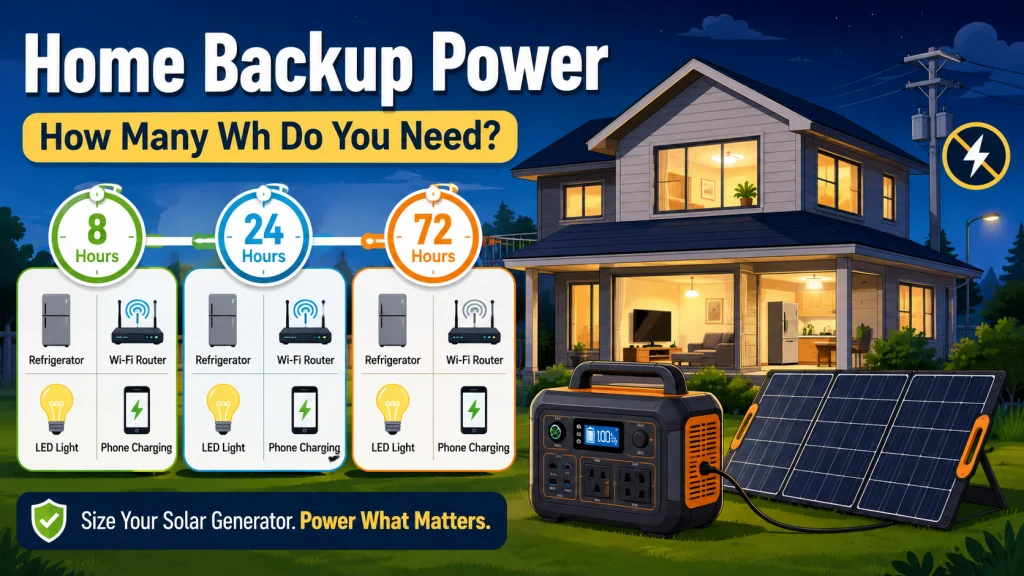
Your Load, Your Duration, Your Number
The question I hear most often is some version of “is 2,000Wh enough for home backup?” It’s not a question I can answer without two numbers: what loads you’re running and how many hours you need them to run. Those two numbers multiplied together give you the raw watt-hour requirement. Everything else follows from there: the efficiency adjustment for real-world battery output, the safety buffer for degradation over time, and the recharge plan if the outage lasts longer than one charge.
If you want to work through the full sizing methodology from scratch, from appliance list to unit class, the calculation is covered in detail at how to determine what size solar generator you need. This article is more specific. If you’ve already decided you want home backup capability and need to know what Wh class matches a specific outage duration, here is the duration math.
The 200W Baseline and Where It Comes From
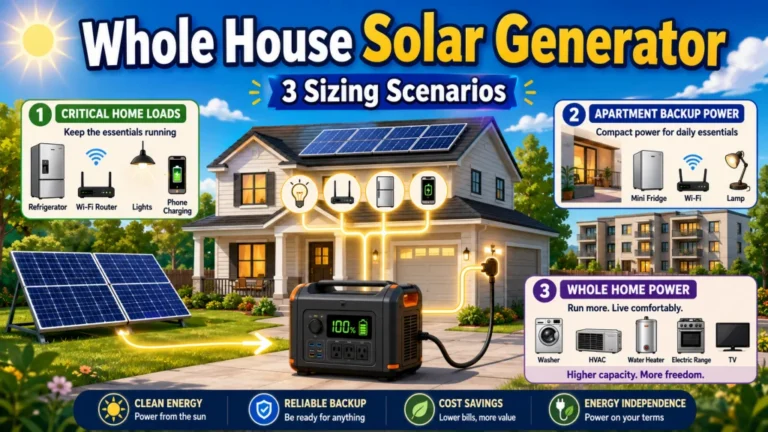
Every calculation below uses 200W as the average combined draw. This is not an arbitrary number. It comes from adding up the loads most homeowners consider essential during a power outage, measured at their real average draw rather than the nameplate maximum, which produces a combined figure that lands consistently around 200W for a standard critical load profile.
- Frost-free refrigerator: approximately 150W average draw. The compressor cycles at roughly 30-50 percent duty, meaning the nameplate wattage significantly overstates what the unit actually consumes per hour of real operation.
- Router: 10W continuous with no cycling.
- Four LED lights running approximately 6 of every 12 hours: roughly 10W average across the full period.
- Phone and device charging: approximately 20W average across a household during an outage.
Combined average: approximately 200W. This is the steady-state figure that determines how many watt-hours the unit burns per hour of operation. The momentary surge when the refrigerator compressor starts is a different number entirely and does not factor into watt-hour duration calculations because the surge lasts less than one second.
If your household runs a CPAP machine, a chest freezer, or a medical device, your actual average draw will be higher. A CPAP without a heated humidifier adds roughly 30-60W. A chest freezer with normal cycling adds 50-100W. The same math below applies with your actual combined draw substituted in for the 200W baseline, and the results scale proportionally.
The 8-Hour Outage: The Scenario a Single Charge Handles
At 200W for 8 hours, the raw energy consumed is 1,600Wh. Applying the standard 85 percent efficiency factor to account for real-world battery output: 1,600 divided by 0.85 equals 1,882Wh of required rated capacity. Adding a 25 percent safety buffer for battery degradation over time and variance in actual draw: 1,882 multiplied by 1.25 equals 2,353Wh minimum. A 2,000Wh unit covers this with thin margin. A 2,500Wh unit covers it with room to spare before the battery reaches an uncomfortably low state of charge.
Field Note: One of the more consistent things I watched repeat at the shop was buyers who planned correctly for 8 hours and then ran into a 20-hour outage. The unit handled the first night fine. By the next morning it sat at 15-20 percent capacity, and with limited sun that day it did not fully recharge before dark. The second overnight period was where it fell short. An 8-hour plan is sound. An 8-hour plan with no fallback for a second overnight stretch is where undersizing actually shows up in real use.
This is the scenario where battery-only operation is a realistic and practical plan. No solar recharge required during the outage, no supplemental charging source needed. The unit runs the loads, depletes at a predictable rate, and gets recharged once power returns or when sufficient sun arrives the following day. Most homeowners planning for short grid faults or storm-related outages are sizing for exactly this window, and the calculation is as clean as it gets. Where the math shifts substantially is when the outage extends to 24 hours or beyond.

Built with monocrystalline cells and a 22.4% conversion rate, this 400W panel delivers market-leading efficiency and pairs with EcoFlow power stations to maximize output through MPPT algorithm optimization in any weather. Layered EVA and fiberglass construction earns it an IP68 waterproof and dustproof rating for true all-conditions durability. At 35.3 pounds, it folds into an adjustable carry case for straightforward transport to campsites, job sites, or off-grid locations. It is one of the most capable portable solar options available for high-demand charging needs.
Check On AmazonIf you click this link and buy, we earn a commission at no additional cost to you.
The 24-Hour Outage: Battery Size Alone Does Not Solve This
At 200W for 24 hours, raw energy consumed is 4,800Wh. With the 85 percent efficiency factor applied: 5,647Wh of required rated capacity. With a 25 percent buffer: 7,059Wh minimum. That is the battery-only number. It tells you what it would take to cover the full 24 hours without meaningful recharge, not what most homeowners should automatically buy.
Most single-unit portable setups in the common buyer range do not comfortably cover a buffered 7,000Wh requirement on battery alone. Once you move into 24-hour backup, the decision becomes less about buying one bigger box and more about pairing battery capacity with a realistic recharge strategy. A 2,000Wh unit starting fully charged delivers roughly 1,700Wh of usable capacity at 85 percent efficiency. At a 200W average draw, that gives you about 8.5 hours before depletion if nothing recharges it.
Solar can extend that window, but it has to be treated honestly. With 400W of solar panels generating approximately 2,400Wh across 6 peak sun hours, you have enough production on paper to recover a large part of the day’s consumption. In practice, some of that energy is used while the loads are still running, and charging losses reduce what actually lands in the battery. A 2,000Wh unit with 400W of solar can stretch a 24-hour plan in good sun, especially if the real load is below 200W or you stagger nonessential loads. It should not be treated as a guaranteed 24-hour solution at a continuous 200W draw in every condition.
For a more comfortable 24-hour plan, either increase the solar input, increase the battery class, reduce the average load, or build in a supplemental charging option. A 2,000-2,500Wh unit can still be the right class for many homes, but only when the panel setup and outage timing make sense. If you want to understand what different home backup configurations actually require at larger scales, what a whole house solar generator setup would actually take covers the math for more substantial load and duration scenarios.

At 39.5 lbs with 2,042Wh capacity and 2,200W output, this CTB-built station is 41% lighter and 34% smaller than typical 2kWh units. It charges from 0 to 80% in just 66 minutes via AC, operates at under 30 dB in silent mode, and switches to UPS backup in under 20 milliseconds. The LiFePO4 battery is rated for a full 10-year lifespan.
Check On AmazonIf you click this link and buy, we earn a commission at no additional cost to you.
Why the Start Time of the Outage Changes the Math
A 24-hour outage that starts at 9 a.m. is not the same sizing problem as a 24-hour outage that starts at 6 p.m. The total watt-hours may look identical on paper, but the longest no-sun stretch is different. That no-sun stretch is what determines whether the battery makes it through the night before solar has a chance to help.
If the outage starts in the morning, solar can begin offsetting daytime loads almost immediately, assuming the panels are deployed and conditions are good. If the outage starts in the evening, the unit has to carry the load through the entire night before the first meaningful recharge window arrives. At 200W for a 14-hour overnight stretch, the raw consumption is 2,800Wh. After the 85 percent efficiency adjustment, that becomes 3,294Wh. With a 25 percent buffer, the safer planning number is about 4,118Wh.
This is why a panel setup that looks adequate by daily watt-hour production can still feel undersized during real outages. For home backup, do not only ask whether your panels can generate enough energy across a full day. Also ask whether the battery can survive the longest expected gap without sun. Once that overnight gap is covered, solar recharge becomes a recovery strategy instead of a rescue plan.
The 72-Hour Outage: A System Plan, Not a Battery Problem
At 200W for 72 hours, the raw energy requirement is 14,400Wh. With efficiency and buffer applied, the minimum rated capacity required exceeds 21,000Wh. That pushes beyond a normal portable battery-only plan for most homeowners. At that point, trying to solve the entire outage with stored energy alone becomes the wrong way to frame the problem.
The 72-hour scenario is a system design question. You need enough battery to cover overnight loads and short-term interruptions, enough solar input to recover meaningful capacity during the day, and a fallback charging source for poor weather. The combination that actually works for a multi-day outage looks like this:
- A 2,000-3,000Wh unit handles each overnight load period and provides daytime power for critical devices.
- 400-600W of solar panels in good sun conditions generates roughly 2,000-3,000Wh per day before real-world losses, enough to recover a large portion of the unit’s capacity during daylight.
- On cloudy days or in northern winters, solar output may drop to 10-25 percent of rated daily production, making a supplemental charging source necessary rather than optional.
- A gas generator used once per day for 1-2 hours of dedicated charging handles the cloudy-day recharge gap without the fuel cost and noise of running it continuously for direct load coverage.
More battery capacity helps, but it does not solve the absence of a recharge source. A 10,000Wh battery system at 200W average draw lasts roughly 42 hours before depletion after efficiency losses. That is much better than a small unit, but it is still not a complete 72-hour plan if there is no reliable way to recharge. The practical path is a unit sized for overnight coverage paired with a daytime recharge method that accounts for your region’s worst-case sun conditions.
Note: In northern latitudes during winter, peak sun hours per day may be 1-3 instead of 5-6. At that output, 400W of panels generates 400-1,200Wh daily instead of the 2,000-2,400Wh available in summer. For extended winter outages, a supplemental charging source is not an upgrade to add later. It is the primary strategy that makes the plan viable.
That is the seasonal reality of solar recharge. It shifts the 72-hour scenario from a capacity question into a system design question that needs to account for worst-case sun conditions from day one. Once you have the duration math established at 200W, the next useful step is understanding how that minimum capacity number changes when your actual load is higher.

With a 3,600Wh LFP battery expandable up to 25kWh via extra batteries or smart generators, this station delivers 3,600W across 15 output ports, boosted to 4,500W with X-Boost or 7,200W when two units are paired. A full recharge takes just 1.8 hours via 240V or 2.8 hours with 1,600W of solar input. It may also qualify for the 30% Residential Clean Energy Tax Credit.
Check On AmazonIf you click this link and buy, we earn a commission at no additional cost to you.
How Your Actual Load Shifts Every Number Above
Every calculation above uses 200W as the average combined draw. That assumption changes the required capacity significantly at higher loads, and the error compounds over duration. Here is what each 50W addition to the baseline does to the minimum required capacity at the two most commonly planned outage lengths:
| Average Draw | 8-Hour Minimum | 24-Hour Minimum |
|---|---|---|
| 200W (baseline) | 2,353Wh | 7,059Wh |
| 250W | 2,941Wh | 8,824Wh |
| 300W | 3,529Wh | 10,588Wh |
| 350W | 4,118Wh | 12,353Wh |
A 50W addition at 8 hours adds roughly 600Wh to the minimum requirement, which is manageable and may not shift the unit class you’re shopping in. At 24 hours, that same 50W addition adds nearly 1,800Wh. That’s the difference between staying near one unit class and needing a meaningfully larger setup based on a single 50W adjustment. A CPAP machine at 60W, a chest freezer at 100W average, or a medical device at 150-300W each can push the 24-hour requirement into a much higher range. Getting the average draw right before running the duration math matters more at longer outage durations than it does at 8 hours.
Key point: A 50W error in the load estimate produces a 600Wh error at 8 hours and a 1,765Wh error at 24 hours. Measure what you actually run during a normal evening rather than relying only on the nameplate of each appliance.
With the load multiplier understood, the three duration scenarios and how they scale together give you the framework to identify the right unit class and recharge strategy for your specific situation. The next step is applying your actual draw to whichever duration scenario matches your planning horizon.

This wall plug meter tracks nine electrical parameters including wattage, voltage, current, apparent power, energy consumption in kWh, frequency, power factor, usage time, and electricity cost, all navigated with a single button. The backlit LCD screen offers a 160-degree viewing angle for clear readings in any lighting condition. Data storage retains all non-real-time information through sudden power outages, and cumulative data can be reset with a 3-second button hold. Rated at 125V, 60Hz, and up to 15 amps and 1,875 watts, it is straightforward and safe to use with any standard outlet.
Check On AmazonIf you click this link and buy, we earn a commission at no additional cost to you.
Final Thoughts: What the Duration Math Actually Shows You
The three duration scenarios point to one consistent finding. For 8-hour outages, a 2,000-2,500Wh unit is the right class and battery-only operation is a realistic plan. For 24-hour outages, do not shop by battery size alone. Compare the battery capacity, solar input, AC recharge speed, and whether the unit can keep critical loads running while it charges. For 72-hour outages, treat the purchase as a system: battery, panels, and a backup charging source for days when solar output is insufficient.
From what I’ve seen, most homeowners planning for backup power are targeting the 8-24 hour window. That might mean a significant storm, a grid fault, or a utility switching event. That’s a problem a mid-range portable solar generator handles well when paired with adequate panel capacity and a realistic recharge plan. If multi-day outages are a real risk in your region because of hurricanes, ice storms, or unreliable regional infrastructure, build the supplemental charging plan into the setup from the start. Adding it later is possible, but planning for it upfront produces a more capable and less expensive overall system.
The numbers above use 200W average draw as the baseline. Substitute your actual combined load and the math scales proportionally. The formulas stay the same; only the inputs change.

Starting at 2kWh and expandable up to 8,448Wh with compatible expansion batteries, this LiFePO4 station delivers 2,400W across 11 ports including a 30A TT-30 RV port, dual 100W USB-C, and a dedicated 48V RV charging port. It reaches 80% in just 60 minutes via AC input and fully charges in under 4 hours with 1,200W of solar. The battery is rated for 3,000 plus cycles across a 10-year lifespan.
Check On AmazonIf you click this link and buy, we earn a commission at no additional cost to you.
FAQs
⚡ How many watt-hours do I need for a 24-hour power outage?
At a 200W average critical load, a 24-hour outage requires roughly 7,059Wh minimum on battery alone after efficiency and buffer. The practical approach is usually not battery alone. A 2,000-2,500Wh unit with solar input can stretch the plan in good sun, but 400W of panels should be treated as a recovery strategy rather than a guaranteed 24-hour solution at a continuous 200W draw in all conditions.
🔋 Is 2,000Wh enough for home backup?
For an 8-hour outage at 200W average draw, a 2,000Wh unit covers it with minimal margin. A 2,500Wh unit is more comfortable. For anything longer, you need a recharge plan. Solar panels can extend runtime in good conditions, but extended cloudy stretches or winter outages require a supplemental charging source to stay viable.
⏱️ How long will a 2,000Wh solar generator last on home backup loads?
At 200W average draw, a 2,000Wh unit delivers roughly 8.5 hours at 85 percent efficiency. At 300W draw, that drops to about 5.7 hours. At 150W draw, it extends to about 11.3 hours. Runtime scales directly with how much your actual combined load differs from the baseline you calculate with.
🌙 How many watt-hours do I need to run a refrigerator overnight?
A frost-free refrigerator often averages 100-150W because the compressor cycles instead of running continuously. Over a 12-hour overnight period, that’s 1,200-1,800Wh of raw energy consumed. After efficiency adjustment and a 25 percent safety buffer, the planning range is roughly 1,765-2,647Wh. A 2,000Wh unit can cover the lower end with limited margin, while a 2,500Wh unit is the safer minimum if the refrigerator averages closer to 150W. If you also want to run a router, lights, or device charging overnight, plan above the refrigerator-only number.
☁️ Does solar recharge work in winter for home backup?
It works, but output drops significantly. In northern latitudes during winter, peak sun hours may be 1-3 per day instead of 5-6. That reduces 400W of panels from generating 2,000-2,400Wh per day down to 400-1,200Wh before additional real-world losses. For extended winter outages, a supplemental charging source is a required part of the plan, not an optional upgrade to consider later.