
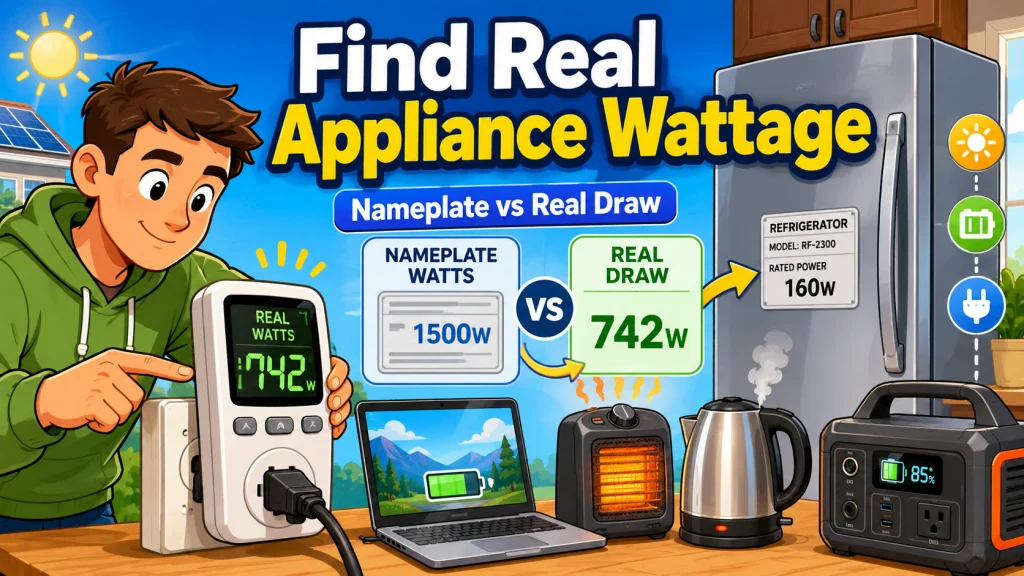
What the Nameplate Tells You, and What It Does Not
How to find appliance wattage accurately is the step that determines whether the rest of your sizing math holds up. Every appliance has a label, usually on the back or underside, showing a maximum watt or amp rating. For some loads, that number and the actual draw are close enough to use directly. For others, building your calculation around the nameplate figure means sizing for a scenario that will never exist in normal operation, which leads you either to over-buy or, worse, to believe a smaller unit will carry a load longer than it actually can.
The distinction matters most for the appliances with the highest watt-hour impact on your load list. Knowing the real draw of your router and a couple of LED lights is not going to change your unit size. Getting the refrigerator wrong can shift your minimum watt-hour requirement by several hundred watt-hours, which is the difference between two adjacent unit classes. If part of your goal is figuring out what size solar generator you actually need, this is the input that determines whether that calculation gives you an honest answer or an inflated one.
Note: If your appliance label shows amps instead of watts, convert it using this formula: watts = amps x volts. Most North American household appliances run on 120V, so a 2.5A label means 2.5 x 120 = 300W. For 240V appliances like electric dryers or large air conditioners, multiply by 240V, not 120V. On a charger brick with separate input and output ratings, use the input rating for sizing your solar generator draw from its AC outlet. One important point: this formula gives you the maximum rated draw, the same as reading the nameplate directly. For cycling loads like refrigerators, it still does not replace a 24-to-48-hour watt meter measurement.
Method 1: When the Label Works Fine
Resistive loads convert electricity directly into heat or light at a fixed rate, and they do it consistently every time they run. A 1,500W space heater draws 1,500W whenever it is on. A toaster pulls its rated wattage from the moment the element heats up to the moment the bread pops. A hair dryer on high runs at whatever the label says for that setting. For these appliances, the nameplate is accurate, and you can plug it directly into your watt-hour calculation without any adjustment.
The defining characteristic of a resistive load is that it does not cycle. It runs at full rated watts or it is off. There is no compressor starting and stopping, no variable-speed motor, no standby state drawing a trickle. A 1,500W space heater running for 4 hours consumes 6,000Wh, and you can trust that number. The same applies to incandescent bulbs, electric kettles, plug-in oil radiators, and most heating elements. The category of loads where the label works is actually fairly limited, but the ones that qualify are easy to identify: if it makes heat or light at a steady fixed rate, the nameplate is your number.
Method 2: Measuring Real Draws with a Plug-In Watt Meter
For cycling and variable loads, direct measurement is the only way to get a number you can actually use. A plug-in watt meter sits between the wall outlet and the appliance and tracks real-time draw, cumulative watt-hours consumed, voltage, and current. These devices cost $20 to $30 for a reliable model and the process is straightforward: plug the appliance in through the meter, run it for 24 to 48 hours under normal conditions, and read the total watt-hours. Divide by the number of hours and you have the true average draw. That is your sizing input, not the nameplate.
The 24-to-48-hour window matters because of how cycling appliances actually operate. A refrigerator compressor does not run continuously. It kicks on, cools the interior down to the target temperature, then shuts off until the temperature drifts up again. A reading taken during a 15-minute window will catch you at either peak draw or the off-cycle idle, and neither reflects what the unit actually consumes over time. Let it run through multiple cycles and the measured average settles into something stable and usable. The same logic applies to a chest freezer, an air conditioner, or any appliance with a thermostat-controlled compressor.
Ambient temperature adds a layer that the label will never warn you about. I tested a chest freezer on my homestead and found it drawing around 60W average in cool weather and nearly 110W during a summer heat wave. Same unit, same nameplate, about 50 percent more consumption once the ambient temperature climbed. A separate real-world monitoring example showed a similar pattern: a garage refrigerator drawing 142W average in peak summer heat versus 87W in mild spring conditions, a 63 percent difference from the same unit under different seasonal conditions. If you measure in spring and size for that reading, you will be short when summer hits and the compressor has to work harder.
Field Note: One of the more consistent patterns I saw at the shop was customers who had measured their refrigerator draw and come in with a confident number, only for it to be a summer measurement taken in a cool kitchen. Once they moved the unit to an outdoor shed or garage for backup food storage during an outage, the draw climbed significantly. If you plan to use a refrigerator in a warmer-than-usual location during an outage, take your measurement there, not in the kitchen under normal conditions.
Variable loads follow the same principle but for a different reason. A laptop draws 20 to 30W on idle and 70 to 90W running a demanding task. A variable-speed fan has a wide range depending on the setting. For sizing purposes, the right number is not the minimum and not the label maximum. It is whatever you plan to actually run during an outage. If you plan to use your laptop for light work and streaming, measure under those conditions. If you plan to run it hard, measure under load. The point of the exercise is to get a number that reflects your real use case, not the appliance’s theoretical capabilities.

This compact plug-in monitor tracks the energy consumption of any AC 115-volt appliance and displays real-time readings of volts, amps, and wattage at 0.2 to 2.0 percent accuracy. Its large LCD screen lets you calculate electricity costs by the day, week, month, or year, making it easy to spot energy-hungry devices and trim your utility bill. It is also compatible with inverters, adding flexibility for off-grid setups.
Check On AmazonIf you click this link and buy, we earn a commission at no additional cost to you.
Three Load Types and Which Approach Each Needs
The correct measurement method depends entirely on what type of load you are dealing with. Applying the same approach to every appliance on your list is where the numbers start to go wrong. These three categories cover the vast majority of what a typical backup load list contains, and the approach to each is different enough that mixing them up will cost you accuracy in the places that matter most. The foundation of how to size a solar generator correctly is getting accurate input numbers for each load type before you run any calculation.
| Load Type | Common Examples | Use Nameplate? | Recommended Method |
|---|---|---|---|
| Resistive (constant) | Space heater, toaster, hair dryer, electric kettle | Yes | Label is accurate; use directly |
| Cycling | Refrigerator, chest freezer, air conditioner, sump pump | No | Plug-in watt meter, 24 to 48 hours |
| Variable | Laptop, variable-speed fan, dimmer-controlled lights | Partially | Measure at expected use conditions |
Most outage load lists contain at least one cycling appliance, usually the refrigerator, and that single appliance tends to have the biggest gap between nameplate and actual draw. A refrigerator compressor runs approximately 30 to 50 percent of the time under normal kitchen conditions. A unit with a 300W nameplate might average 120 to 150W over a full day. That gap is not trivial when you are calculating how many watt-hours your solar generator needs to deliver over a 12-hour overnight period. Getting the fridge number right often has more impact on your final sizing calculation than any other appliance on the list.
The one rule that applies across all three categories: match the measurement method to the behavior, not to the category name. A cycling appliance running in a consistently warm garage needs a summer measurement, not just a 48-hour measurement. A variable appliance used mainly for video streaming needs a streaming-load measurement, not an idle-state measurement. The number you put into the sizing formula should reflect the actual conditions you plan to run the appliance under, because that is the scenario your solar generator will have to cover.

This 1kWh LFP battery station charges from 0 to 80% in just 50 minutes via AC input, and its LiFePO4 chemistry delivers a 3,000 plus cycle lifespan that is roughly 6 times longer than standard lithium batteries. Capacity is expandable up to 3kWh with additional batteries, making it well suited for camping, RVs, or off-grid living. Its 1,800W output powers across 15 outlets, handling around 90% of household appliances, and accepts up to 500W of solar input for clean, fuel-free charging. The package includes a 5-year customer service guarantee.
Check On AmazonIf you click this link and buy, we earn a commission at no additional cost to you.
Method 3: Reference Tables as a Cross-Check
Several types of published sources maintain average watt draw tables for common household appliances: government energy efficiency agencies, solar generator brand runtime charts (most major brands publish appliance draw references to support their own sizing calculators), home energy monitoring databases, and manufacturer spec sheets for specific appliance categories. Each reflects aggregated real-world data across many units and use cases, which makes any of them more useful than nameplate values for cycling and variable loads. A reference table will tell you that a frost-free refrigerator typically averages 100 to 200W, that a router draws 10 to 20W, or that a 60W-equivalent LED bulb draws 8 to 10W. For appliances where you do not have access to a watt meter or where you are planning a hypothetical load list for a setup that does not yet exist, a reference table gives you a reasonable starting point.
The limitation is specificity. A reference range covers a category, not your particular unit in your particular environment. An older refrigerator in a warm garage draws more than a newer, efficient model in a cool basement, and both might fall within the same published range. Use reference tables to sanity-check your measured numbers, not to replace them. If your measured refrigerator average comes out at 130W and the reference range is 100 to 200W, your measurement is plausible and you can proceed with confidence. If your measurement is 280W on a frost-free fridge, something went wrong with the reading. The reference gives you context that a raw measurement alone cannot.
Where reference tables are most useful is for planning future setups or estimating loads you cannot yet measure. If you are sizing for a cabin that does not have appliances in it yet, or planning a backup system for an outage scenario involving a dorm fridge you have not purchased, a reference range is the right tool. In those cases, use the upper end of the range for any cycling appliance and add your usual efficiency buffer. Conservative assumptions at the planning stage are easier to absorb than unexpected shortfalls during an actual outage.

Weighing just 23.8 lbs with a foldable handle, this 1,070Wh LFP power station delivers 1,500W of pure sine wave AC output with a 3,000W surge capacity, capable of running AC units, fridges, and electric pots. Its LFP battery sustains over 70% capacity after 4,000 cycles, translating to a lifespan of more than 10 years. Via the Jackery App, you can enable a full charge in as little as one hour, or switch to a whisper-quiet 30 dB overnight mode. Six output ports including two USB-C with 100W PD charging cover nearly any device simultaneously.
Check On AmazonIf you click this link and buy, we earn a commission at no additional cost to you.
Final Thoughts: The One Input That Drives Everything Downstream
A watt draw number is not just one line in a spreadsheet. It is the multiplier for every watt-hour estimate on your load list, and the refrigerator entry alone can shift your final unit class if you get it wrong. The methods here are not difficult. Resistive loads: use the label. Cycling loads: run a 24-to-48-hour meter test, preferably under warm-season conditions. Variable loads: measure under the conditions that reflect your actual intended use. Cross-check against a reference table if anything looks off. That process produces real numbers, and real numbers produce a sizing calculation you can rely on.
Once you have taken the time to find the wattage of each appliance on your list with the right method, the numbers change how you shop. Instead of comparing solar generators by inverter watt rating, you start comparing them by usable watt-hours against your real load. A unit that looks undersized on the spec sheet might be exactly right because your refrigerator actually pulls 130W, not the 300W on its label. The unit that looks right based on nameplate math might be significantly more than you need. The measurement step is what closes that gap between the spec sheet and the real-world calculation.
The difference between a buyer who gets their sizing right and one who does not almost always comes down to whether they measured their cycling appliances or just read the label and moved on. From what I have seen, most people skip the measurement step entirely because no article tells them it matters. Now you know it matters, and you know exactly how to do it. The rest of the calculation is arithmetic from there.

At 23.8 lbs with 1,070Wh capacity and 1,500W output, this LFP station runs AC units, fridges, and electric pots with a 3,000W surge rating. Emergency charging via the Jackery App fills it in just 1 hour, while the default 1.7-hour mode protects long-term battery health across a 10-year, 4,000-cycle lifespan. Includes a 200W solar panel and 5-year coverage straight out of the box.
Check On AmazonIf you click this link and buy, we earn a commission at no additional cost to you.
FAQs
🔌 What is the difference between nameplate watts and running watts on an appliance?
Nameplate watts are the maximum rated draw under peak load conditions. Running watts, or average draw, is what the appliance actually consumes during normal operation. For resistive loads like space heaters, the two numbers are nearly identical. For cycling loads like refrigerators, the real average draw is often 40 to 60 percent lower than the nameplate figure, because the compressor only runs a portion of the time.
🧊 How do I find the real watt draw of my refrigerator for solar generator sizing?
Use a plug-in watt meter for 24 to 48 hours under normal operating conditions and read the total watt-hours consumed, then divide by hours. Do not use the nameplate wattage. The compressor in a frost-free refrigerator cycles on and off continuously, and the true average draw is typically 30 to 50 percent of the rated maximum. The measurement is worth the two days it takes.
🌡️ Does temperature affect how much power a refrigerator uses?
Yes, significantly. A refrigerator in a warm garage or near a heat source works harder and draws more power than the same unit in a cool interior space. Real-world measurements confirm consumption increases of 40 to 60 percent in summer heat compared to mild conditions. For conservative sizing, measure during the warmest conditions the unit will actually experience.
📋 Can I use an appliance watt draw reference table instead of measuring directly?
Reference tables give useful ranges and are better than nameplate values for cycling appliances. They work well as a starting point or sanity check, and they are the right tool when you are sizing for appliances you cannot yet measure. For the refrigerator specifically, a direct measurement is worth the effort if sizing accuracy matters, since published ranges are wide enough to span two adjacent unit classes.
💻 How do I find the wattage of a laptop for solar generator sizing?
Measure it with a plug-in watt meter under the conditions you plan to use it during an outage. The charger brick label shows maximum input, not typical consumption. A laptop on idle draws far less than one under load, so size for your expected use, not the minimum and not the peak. Light browsing, heavy video work, and charging other devices all pull different amounts.