The Two Numbers That Determine Whether a Solar Generator Actually Fits Your Loads
Most approaches to sizing a solar generator treat it as a single-number decision: find the output watts you need, pick a unit that matches, and move on. That framing misses the entire second half of the problem. A unit can have exactly the right watt-hour capacity and still shut down every time you plug in a refrigerator. It can have a surge rating large enough to start any appliance in your house and run out of stored energy in two hours. Both numbers need to be right, independently, for the unit to work for your specific situation.
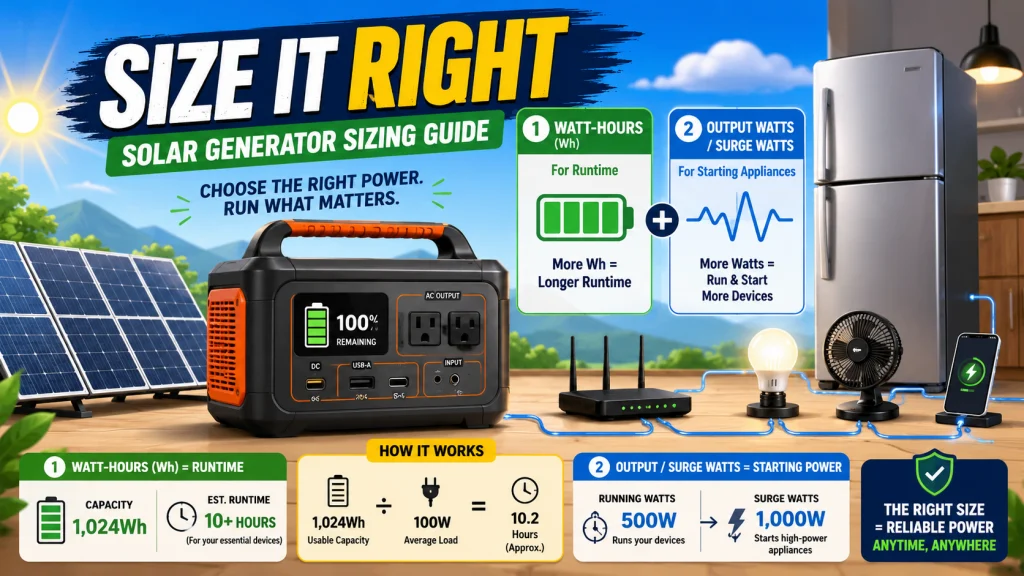
The first number is watt-hours. Think of it as the size of the fuel tank. A 2000Wh unit stores 2000 watt-hours of energy before any losses are applied. Under real operating conditions, inverter and conversion losses reduce that to roughly 85 percent of the rated capacity, so the usable energy is closer to 1700Wh. That 1700Wh is what actually powers your appliances. As a quick reference: a refrigerator averaging 150W draw, a router at 10W, and two LED lights at 5W each run simultaneously at 170W combined. On 1700Wh of usable capacity, that load runs for about 10 hours before the unit needs a recharge. That is the watt-hour check: does the tank hold enough energy for your loads and the duration you need them to run?
The second number is the output watt rating, and it comes in two parts: continuous watts and peak surge watts. Continuous watts is what the unit can deliver for as long as the battery and thermal limits allow. Peak surge watts is the brief spike the unit can handle for under a second when a motor-driven appliance starts. For resistive loads like space heaters, hair dryers, and toasters, surge is irrelevant. These devices draw their rated wattage from the moment they turn on and hold it steady. A 1500W space heater draws 1500W continuously. Confirm the unit’s continuous rating exceeds that number, and the watt check is done for that appliance.
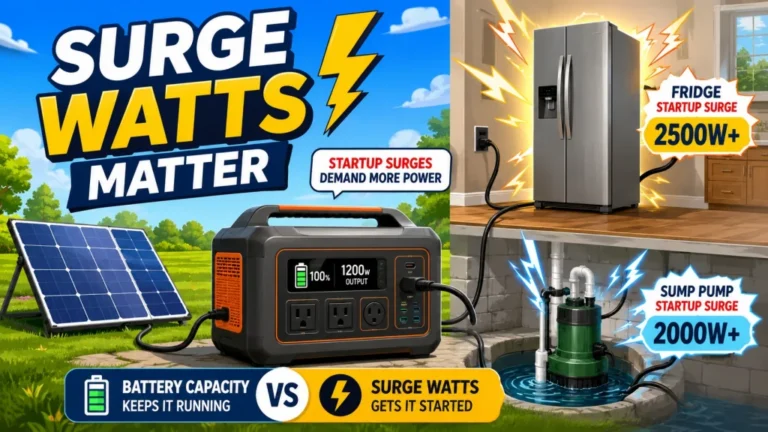
Motor-driven appliances are different, and this is where most sizing calculations fall short. A refrigerator compressor needs a brief spike of power at startup, well above its running wattage, before settling into its normal cycling draw. A fridge that averages 150W while running may need 600 to 900W at the moment the compressor kicks on. A sump pump running at 800W continuous may need 3500 to 4000W to get the motor turning. If the unit’s peak surge rating does not exceed that startup draw, the inverter trips as a protection response. It does not break. It protects itself by shutting down. But it will not run the appliance, and checking watt-hours was irrelevant because the unit never got past the startup test.
These two checks are separate problems with separate solutions, and the sizing methodology below addresses each in turn.
How to Build the Calculation From Your Own Appliance List
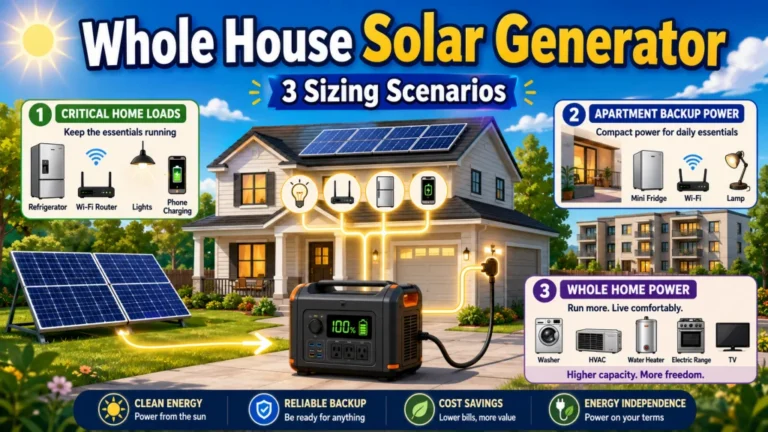
Before running any numbers, I always ask three questions: what loads do you plan to run, for how long, and does anything on that list have a motor? The answers tell me immediately whether the sizing is a straightforward Wh calculation, a surge check, or both. Everything in the five-step process flows from those three questions.
The sizing process runs in five steps. None of them require an engineering background, but each depends on the previous one. Skipping step two makes step three unreliable. Skipping step five leaves the calculation incomplete regardless of how carefully you did steps one through four.
- Step 1: List every appliance you plan to run during the outage or off-grid scenario you are sizing for. Not everything in your house. The specific loads you actually need for your specific use case. A critical outage load list looks very different from a weekend camping list, which looks very different from a full-time off-grid setup.
- Step 2: Find the real running watt draw for each appliance. Not the nameplate maximum. For cycling appliances like refrigerators, the nameplate shows the compressor’s peak rating, not the average draw. A frost-free fridge rated at 300W on the label may average 100 to 150W in practice because the compressor only runs 30 to 50 percent of the time. Using the nameplate for a cycling appliance will overstate the load by a factor of two or more.
- Step 3: Identify simultaneous versus staggered loads. A microwave draws 1000W but runs for two minutes at a time. A router draws 10W constantly. A refrigerator compressor cycles. The combined simultaneous draw during an outage is what matters for both the watt check and the runtime math, not the peak draw of every appliance added together as if they all run at once.
- Step 4: Calculate total watt-hours needed. Multiply each appliance’s average running draw by the hours you need it to run, then sum all loads. Divide the result by 0.85 to account for inverter and conversion losses. Add a 20 to 25 percent safety buffer on top of that. The final number is the minimum rated Wh capacity to look for.
- Step 5: Run the surge check separately. Identify every motor-driven appliance on the list: refrigerators, sump pumps, air conditioners, well pumps, power tools with motors. Find the startup surge requirement for each. Confirm the unit’s peak surge rating exceeds the highest startup draw, with all other running loads added on top of it simultaneously.
Here is what that calculation looks like with a real load list. A typical critical outage setup: a frost-free refrigerator at 150W average running 8 of every 12 hours (1200Wh), a router at 10W for 12 hours (120Wh), four LED lights at 5W each running 6 hours (120Wh), and phone charging at 20W for 4 hours (80Wh). Total: 1520Wh. Apply the 85 percent efficiency factor: 1520 divided by 0.85 equals 1788Wh. Add a 25 percent buffer: 2235Wh minimum required capacity. A 2000Wh unit is marginal for this load profile at this duration. A 2500Wh unit handles it comfortably with room to spare.
That is the watt-hour check done. The surge check still needs to happen. The refrigerator on this list needs its startup draw verified against the unit’s peak surge rating before the sizing is complete. A 2500Wh unit with a 4000W peak surge rating handles a fridge compressor startup of 900W easily, with the router, lights, and phone charging all already running at the same time. A 2500Wh unit with a 500W peak surge rating, which some compact budget units carry, will trip on the compressor startup regardless of how much battery capacity it has.
Note: Step 2 is where most sizing calculations fall apart before they even reach the math. Finding the real average watt draw of a cycling appliance requires either a plug-in watt meter reading over 24 to 48 hours, or a reliable reference lookup. The nameplate number is not the right input for cycling loads. The full methodology for measuring and looking up real appliance watt draws is covered in the appliance wattage article below.
Key point: Once the calculation is done, shopping becomes a filter, not a comparison. Ignore any unit below your calculated Wh requirement. Ignore any unit below your required continuous watt rating. Ignore any unit whose peak surge rating falls short of your highest-surge appliance’s startup draw. A unit that passes all three checks is a candidate. One that fails any single check is the wrong unit, regardless of price or how impressive the headline spec looks.

At 39.5 lbs with 2,042Wh capacity and 2,200W output, this CTB-built station is 41% lighter and 34% smaller than typical 2kWh units. It charges from 0 to 80% in just 66 minutes via AC, operates at under 30 dB in silent mode, and switches to UPS backup in under 20 milliseconds. The LiFePO4 battery is rated for a full 10-year lifespan.
Check On AmazonIf you click this link and buy, we earn a commission at no additional cost to you.
The Surge Watt Check: The Step Most Buyers Skip
Field Note: One of the most consistent patterns I saw at the shop was buyers calling back after getting the unit home because the refrigerator kept tripping the inverter. They had done the watt-hour math correctly. The unit had more than enough battery capacity for their load profile. The problem was always the same: the compressor needed 800W at startup, and the unit’s peak surge was listed at 600W. The watt-hour check passed. The surge check was never done. A return was the outcome every time.
Motor-driven appliances pull a brief spike of power when the compressor or motor starts, well above their steady running draw. The spike lasts under a second, but if the unit’s peak surge rating falls short of it, the inverter shuts down before the appliance ever gets going. The table below is a quick reference for the appliances most commonly involved in this failure, compared against resistive loads that have no startup surge at all.
| Appliance | Running Watts | Startup Surge | Sizing Note |
|---|---|---|---|
| Frost-free refrigerator | 100-200W avg | 600-900W | Compressor cycles roughly 30-50% of the time |
| Window AC (5,000 BTU) | 400-500W | 1,350-2,250W | Surge scales significantly with BTU class |
| Sump pump (1/3 HP) | 400-800W | 2,000-4,000W | Highest startup demand among common household loads |
| Circular saw | 1,400-1,800W | 2,100-3,600W | Intermittent use but surge must be checked |
| Space heater | 750-1,500W | None significant | Resistive load, no surge check required |
| Microwave | 700-1,100W | None significant | Running watts equals nameplate watts |
The rule for the surge check: the unit’s peak surge rating must exceed the startup wattage of the single highest-surge appliance you plan to run, with the combined running watts of everything else already operating added on top. If a refrigerator needs 900W to start its compressor, and the router (10W), lights (20W), and phone charging (20W) are already running simultaneously, the total demand at the moment of startup is 950W. A unit with a 3000W peak surge rating handles that with substantial margin. A unit with an 800W peak surge rating trips at startup regardless of how large its battery is. The full surge sizing methodology is in the article below.

At just 41.7 lbs and measuring 18.1 by 9.8 by 10.1 inches, this station is 25% lighter and 29% more compact than comparable units while still delivering 2,400W of continuous output and 4,000W peak power, enough to run window and RV air conditioners. It charges to 100% in as little as 58 minutes via combined AC and solar, or to full in 3 hours through alternator charging at 8 times the speed of a standard car socket. Standby draw of only 9W keeps a dual-door fridge running for up to 32 hours, and capacity expands to 4kWh with an optional battery for up to 64 hours of refrigeration runtime.
Check On AmazonIf you click this link and buy, we earn a commission at no additional cost to you.
Where the Calculation Goes Wrong: Five Patterns That Cause Sizing Failures
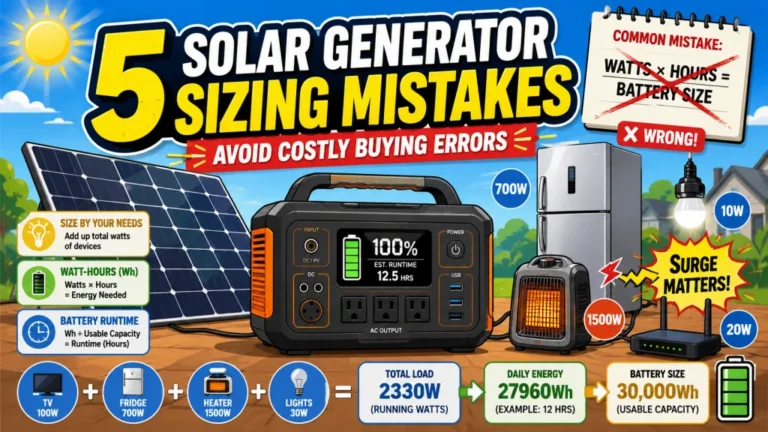
In my experience, solar generator sizing mistakes are not random. They follow five patterns and they repeat across every buyer type and every price point. The most common is treating output watts and watt-hours as the same measurement. A buyer sees a 2000W inverter rating and concludes the unit will run a 1500W space heater for most of the day. The actual math: at 1500W continuous draw from a 2000Wh battery at 85 percent efficiency, the unit depletes in roughly 1.1 hours. The watts rating describes how much power the unit can deliver at a single moment in time. The watt-hours rating describes how much total energy is stored. These are not the same number, and they are not interchangeable in a sizing calculation.
The second pattern is using nameplate wattage for cycling appliances. A refrigerator nameplate shows 300W. The buyer multiplies 300W by 12 hours, arrives at 3600Wh, and buys a large and expensive unit. The same fridge, measured over a 24-hour period with a plug-in watt meter, averages 120W, which puts the actual 12-hour need at 1440Wh, well within the range of a mid-size unit at a fraction of the cost. The nameplate number is useless for sizing any appliance with a cycling motor, and using it leads to systematic over-buying at the high end and systematic under-confidence at the low end.
The remaining three patterns: forgetting surge requirements entirely (addressed in the previous section), ignoring simultaneous loads and sizing for each appliance in isolation instead of all concurrent draws together, and assuming the solar panels will deliver full rated output for a daily recharge regardless of season, cloud cover, or panel placement. Winter at northern latitudes can cut actual solar output to 15 to 25 percent of summer rated output. A sizing plan that requires a full daily recharge to sustain critical loads through a multi-day winter outage is not a realistic plan.
All five patterns, with the correction math for each and examples of what the wrong calculation looks like versus the right one, are in the sizing mistakes article below. If you have already run the numbers and the result feels off, that article is the fastest path to finding where the estimate went wrong. And if you are working through the solar generator sizing framework from the start, the mistakes article is worth reading as a final review after the formula and surge checks are done.

This compact plug-in monitor tracks the energy consumption of any AC 115-volt appliance and displays real-time readings of volts, amps, and wattage at 0.2 to 2.0 percent accuracy. Its large LCD screen lets you calculate electricity costs by the day, week, month, or year, making it easy to spot energy-hungry devices and trim your utility bill. It is also compatible with inverters, adding flexibility for off-grid setups.
Check On AmazonIf you click this link and buy, we earn a commission at no additional cost to you.
The Complete Sizing Methodology: What Each Article Covers
Each of the four articles below covers a specific component of the two-number sizing method. They are designed to work as a sequence for a first-time calculation or individually if you already know which step is giving you trouble. The formula is the right starting point for most readers. The wattage article and the surge article are the two places where first-time buyers most often need to stop and work through the detail before the formula makes practical sense.
| Article | What it covers |
|---|---|
| Solar generator sizing formula | The complete five-step calculation from appliance list to minimum Wh and watt requirements, with a worked example using real load numbers and buffer math |
| How to find real appliance wattage | Why nameplate wattage misleads on cycling loads, how to use a plug-in watt meter for accurate measurement, and when published reference tables are a reliable substitute |
| Surge watts and solar generator sizing | How to find startup surge requirements by appliance type, how to read a unit’s peak watt spec correctly, and the simultaneous-load rule for the surge check |
| Common solar generator sizing mistakes | The five patterns that cause buyers to undersize or oversize, with the corrected calculation for each and where to look in an existing estimate to find the error |
If you are not sure which article applies to your specific question, start with the sizing formula. It references the other three articles at the exact steps where they become relevant, so you can follow the calculation linearly and branch out only where you need more detail.

Starting at 2kWh and expandable to 6kWh with two additional batteries, this LFP station reaches 80% in just 43 minutes via combined AC and solar input. Its 3,000-cycle battery outlasts the industry average by 6 times and includes a 5-year service guarantee. With 2,400W output across 15 outlets and X-Boost pushing to 3,400W, it handles 99% of household appliances at a whisper-quiet 30 dB.
Check On AmazonIf you click this link and buy, we earn a commission at no additional cost to you.
Final Thoughts: Three Numbers Before You Choose a Size Class
Before settling on a unit, three numbers should be confirmed. The minimum Wh capacity: calculated load in watt-hours divided by 0.85, plus a 25 percent buffer. The continuous watt rating: high enough to cover the peak simultaneous running draw of everything you plan to operate at once. The peak surge rating: high enough to cover the startup requirement of the single most demanding motor-driven appliance, with the other running loads added on top. Those three numbers are the filter. A unit that meets all three is sized correctly. A unit that misses any one of them will fail in exactly the way that number predicts.
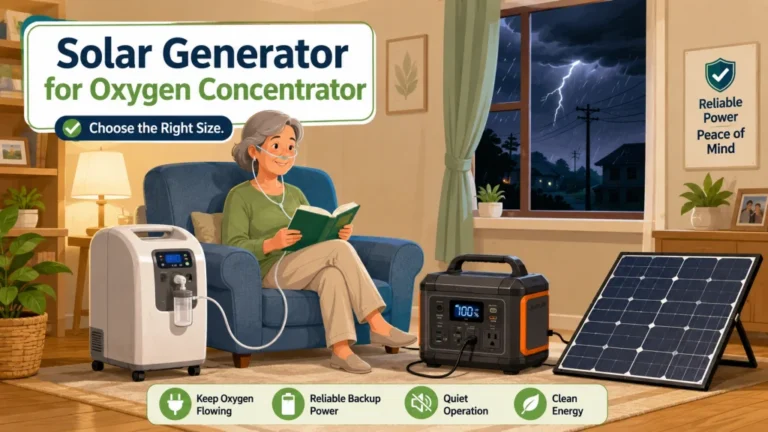
Size class also has two thresholds worth distinguishing. The minimum size is the number the calculation produces after efficiency and buffer math. The comfortable size is one step above that, and it matters when loads include anything medical, any motor-driven appliance with a high surge draw, extended outage durations beyond 12 hours, or winter use where solar recharge cannot be assumed. Buying to the minimum makes sense when the load is simple and predictable. Buying above the minimum makes sense when the load involves uncertainty or consequences.
The sizing formula article below is the right place to run the full calculation. Use the surge watts article if any appliance on the list has a motor. Use the mistakes article as a final check after the numbers are done.

Starting at 2kWh and expandable up to 8,448Wh with compatible expansion batteries, this LiFePO4 station delivers 2,400W across 11 ports including a 30A TT-30 RV port, dual 100W USB-C, and a dedicated 48V RV charging port. It reaches 80% in just 60 minutes via AC input and fully charges in under 4 hours with 1,200W of solar. The battery is rated for 3,000 plus cycles across a 10-year lifespan.
Check On AmazonIf you click this link and buy, we earn a commission at no additional cost to you.
FAQs
🔢 What are the two numbers you actually need to size a solar generator correctly?
Watt-hours (Wh) and the output watt rating (both continuous and peak surge). Wh tells you how long the unit will run your loads before it needs a recharge. The output watt rating tells you whether it can start your appliances, particularly motor-driven ones, without tripping. Both checks have to pass independently. A unit that passes one and fails the other is the wrong unit.
⚡ Why does my solar generator trip when I plug in the refrigerator?
Almost always a peak surge issue. The refrigerator compressor needs a brief startup spike, typically 600 to 900W, even though it runs at 100 to 150W after it starts. If the unit’s peak surge rating falls below that startup draw, the inverter shuts down as a protection response. More battery capacity does not fix this. The solution is a unit with a higher peak surge rating that exceeds the compressor’s startup requirement.
📐 How do I calculate the watt-hours I need for a 12-hour outage?
Multiply each appliance’s average running watt draw by the hours you need it to run, then sum all loads. Divide the total by 0.85 to account for inverter efficiency losses. Add a 25 percent buffer on top of that result. The final number is the minimum rated Wh capacity to look for. Using the nameplate wattage for a cycling appliance like a refrigerator will significantly overstate the load. Use the real average draw, not the label.
🔋 Does a higher watt-hour rating always mean a better fit for my needs?
Not necessarily. A unit with twice the capacity you need adds weight, cost, and longer recharge time without any practical benefit for your load profile. The right Wh capacity is the one that covers your specific loads for your specific required duration, with a reasonable 20 to 25 percent buffer. Sizing accurately beats sizing large every time.
🌤️ Can I count on solar panels to fully recharge the unit during a multi-day outage?
In ideal conditions, yes. A 400W panel setup producing 6 peak sun hours per day generates roughly 2000 to 2400Wh of recharge daily. In winter, at northern latitudes, during overcast stretches, or with suboptimal panel orientation, actual output can drop to 15 to 25 percent of that. Any outage plan that requires a full daily solar recharge is not reliable for winter or storm scenarios. A supplemental charging strategy is part of the plan, not an afterthought.
🧮 Should I size for each appliance separately or calculate my total load as one number?
Both, but for different purposes. The watt-hour calculation adds up all your loads together to get the total energy storage you need. The surge check looks at each motor-driven appliance individually, because each has its own startup requirement that must be compared against the unit’s peak surge rating on its own. The Wh check is a total load problem. The surge check is an appliance-by-appliance problem. Running them separately is the method.