Tailgating Is the Easiest Solar Generator Use Case There Is, and the One Buyers Overbuy Most
The best solar generator for tailgating is rarely the one most review sites point you toward, because most review sites are not writing for tailgating as its own use case. They fold it into general outdoor power or camping coverage, and the sizing logic follows accordingly. Recommendations built around multi-day camping trips or extended outage prep trend toward 2000Wh and above, because those use cases require overnight discharge recovery and cloudy-day solar recharge. Tailgating requires neither. You start with a full battery charged at home, you run a fixed set of appliances for four to eight hours leading up to kickoff, and when the game starts, you pack up. It is the most self-contained solar generator situation there is.
What that means in practice is that the planning is straightforward. There is no solar recharge math to run, no multi-day energy budget to work through, no worst-case cloudy afternoon to build around. You have a specific load. You have a specific session length. You need enough battery to cover both with a reasonable buffer on top. That is the entire problem, and it has a much smaller answer than most buyers expect.
Field Note: The version of this I ran into most often at the shop was a buyer coming in after a night of online research, carrying a printout recommending a 2000Wh unit for outdoor events. The math behind that number was built for a camping trip with overnight use and morning solar recharge. For a six-hour tailgate that ends at kickoff, that same buyer was about to pay for 1,000 extra watt-hours he would never use and carry 25 extra pounds across the parking lot to do it. I saw it play out constantly, and it almost always started with the same source: a camping guide that lumped tailgating in with everything else.
The fix is to start from your actual load, not the load someone else sized for a different situation entirely. Running the numbers takes about two minutes and produces a tighter answer than any general recommendation. That is exactly what the next section covers.
The Actual Watt-Hour Math Behind a Real Tailgate Setup
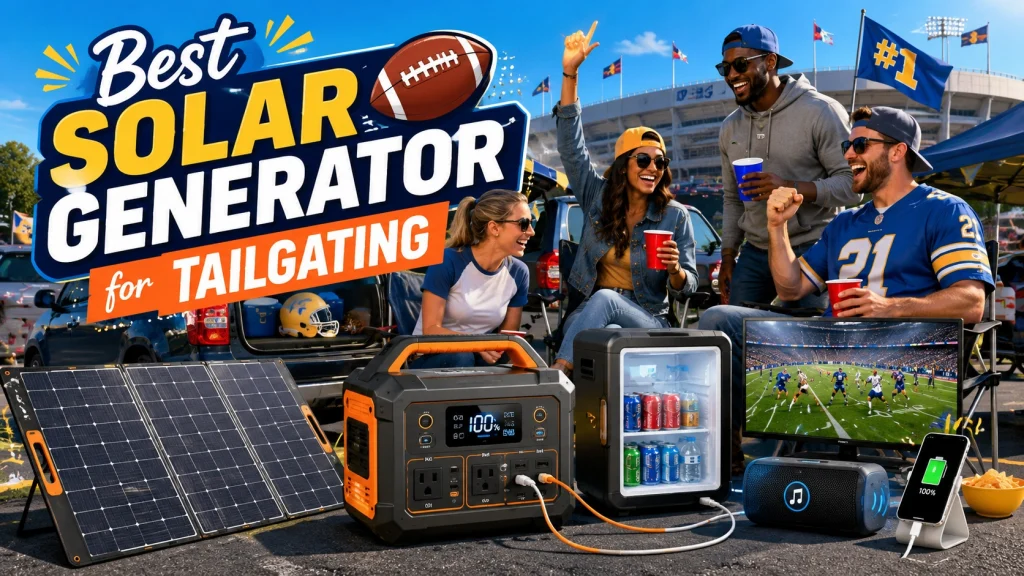
A standard tailgate load is not a complicated draw. A portable mini fridge runs at around 50 watts when the compressor is cycling. A 40-inch TV pulls about 80 watts at typical brightness. A Bluetooth speaker lands around 20 watts at conversation-level volume. Two device chargers running at the same time add roughly 10 watts combined. Added up, that is 160 watts of simultaneous draw across everything running at once.
Over a six-hour session at 160 watts, total consumption comes to 960Wh on paper. A 1000Wh unit can cover that if the fridge compressor cycles normally and the TV does not run at peak brightness for the full session, since real-world draw tends to land lower than the static numbers suggest. If you want a genuine buffer rather than relying on those assumptions, 1200Wh is the cleaner target. The 960Wh figure is the ceiling, not the floor.
| Appliance | Running Watts | Draw Over 6 Hours |
|---|---|---|
| Mini fridge | ~50W | ~300Wh |
| 40-inch TV | ~80W | ~480Wh |
| Bluetooth speaker | ~20W | ~120Wh |
| Device chargers (x2) | ~10W | ~60Wh |
| Total | ~160W | ~960Wh |
Pro Tip: Pre-chill the mini fridge and any drinks before you leave home. The 50W estimate reflects a fridge maintaining temperature, not one pulling warm beverages down to serving temperature in a hot parking lot. If you load it warm, treat the fridge as a heavier draw and target 1200Wh rather than assuming 1000Wh will finish the full session.
The math shifts if cooking appliances enter the picture. A blender at full speed pulls 300 to 600 watts depending on the motor, and a portable induction cooktop draws 1,200 to 1,800 watts at its operating setting. Even at short bursts, these add meaningful watt-hours quickly. If a blender or cooktop is part of your setup, size up to at least 1500Wh and verify that the unit’s surge watt rating clears the blender’s startup draw, which often spikes significantly above its running wattage for a second or two when the motor starts. For the TV, fridge, and speaker setup that most tailgates run, 1000Wh to 1200Wh is the practical answer and anything above 1500Wh is capacity you are unlikely to touch.
Key point: You are starting every tailgate with a full charge from a wall outlet. Solar recharge during the event is not part of the equation. Size for the load duration, and if you want a real buffer above the 960Wh calculated total, 1200Wh is the safer starting point.

This 1kWh LFP battery station charges from 0 to 80% in just 50 minutes via AC input, and its LiFePO4 chemistry delivers a 3,000 plus cycle lifespan that is roughly 6 times longer than standard lithium batteries. Capacity is expandable up to 3kWh with additional batteries, making it well suited for camping, RVs, or off-grid living. Its 1,800W output powers across 15 outlets, handling around 90% of household appliances, and accepts up to 500W of solar input for clean, fuel-free charging. The package includes a 5-year customer service guarantee.
Check On AmazonIf you click this link and buy, we earn a commission at no additional cost to you.
Why Most Buyers End Up Carrying Twice the Unit They Actually Need
The overbuy pattern comes from a consistent source: applying multi-day camping logic to a single-session event. General outdoor power guides recommend 2000Wh and above because the use cases they are sizing for involve overnight discharge, morning solar recharge, and potentially two or three days without a wall outlet. None of that applies to a tailgate that starts full, runs six hours, and ends when it is time to pack up. The recommendations are not wrong for their intended use case. They are just aimed at a different problem than the one you are solving.
Weight is where the difference becomes physical and immediate. A well-built 1000Wh unit comes in at around 20 to 25 pounds. Step up to 2000Wh and you are typically at 40 to 50 pounds. At 3000Wh, most units run 60 to 70 pounds, which is a meaningful carry from the vehicle to your spot, especially if you are making multiple trips. For a setup you are loading and unloading every game day, that weight compounds across a season in a way that makes a lighter unit feel like a better decision with every trip.
Cost follows the same pattern. Moving from a 1000Wh unit to a 2000Wh unit typically adds $300 to $500 to the purchase price, depending on chemistry and brand. That premium buys you capacity you will not use at a tailgate, on a battery cycle that still counts toward the unit’s lifetime cycle rating. Paying for capacity you never discharge is not a safety margin. It is just an overspend.
If you are planning to use the same unit for camping trips where overnight runtime actually matters, the sizing logic shifts considerably. A dedicated guide on the best solar generator for camping covers what multi-day outdoor use requires, and the Wh targets there look quite different from a single parking lot session. If tailgating is the primary use case, the right answer is almost always smaller and lighter than the general recommendations suggest.

This 220V monitor handles up to 16 amps and reads down to 0.01W resolution at Class 1.0 accuracy, detecting loads as low as 0.20W to catch even standby draw. A backlit LCD with built-in memory retains cumulative kilowatt-hour data through power interruptions. Fire-retardant ABS housing and a 1-year warranty round out a reliable package.
Check On AmazonIf you click this link and buy, we earn a commission at no additional cost to you.
Three Specs That Actually Matter Once You Have the Capacity Right
After capacity, three practical details separate a unit that works well at a tailgate from one that is technically sufficient but annoying in use. None of these are buried specs. They show up clearly in product listings, and they matter more than most capacity-focused reviews acknowledge. Getting all three right alongside the Wh rating is what makes the difference between a unit that fits the situation and one you end up not wanting to bring back.
The first is AC outlet count. A mini fridge, TV, speaker, and two chargers running at the same time can easily need four simultaneous AC connections. A meaningful number of 1000Wh units carry only two AC outlets, which means you are making choices about what to plug in and what to leave out. Check the outlet count before buying. It is one of the easiest things to overlook in a spec sheet and one of the most frustrating to discover in the parking lot.
The second is weight, which I already covered above, but it is worth treating as a primary spec rather than an afterthought. Under 30 pounds is a comfortable single-person carry for most people. Units in the 1000Wh range typically land between 20 and 27 pounds. Once you cross into 1500Wh territory, weight climbs to 35 pounds and above. That range is still manageable, but it is worth knowing before you commit if your tailgate spot involves any distance from the vehicle.
The third is fan noise, which most buyers do not think about until they are already sitting next to the unit trying to hear the broadcast. Some units run their cooling fans at constant speed regardless of load. Others modulate fan speed based on how hard the unit is actually working. A combined 160-watt draw on a unit rated for 2000 watts continuous is a very light workload, and units with variable fan speed management will typically run quietly or nearly silently at that level. The difference between a unit cycling its fan continuously at full speed and one that barely activates under partial load is noticeable when you are four feet away from it for six straight hours.
- AC outlet count (reject if under 3 to 4): a fridge, TV, speaker, and two chargers need four simultaneous connections. Confirm the outlet count before buying, not after unpacking. If the unit carries USB-A or USB-C ports, use those for phone and earbud charging to free up AC slots for higher-draw appliances.
- Weight (target under 30 lbs): manageable as a single-person carry without assistance. Units in the 1000Wh range typically land between 20 and 27 pounds. The weight adds up across a full season of game days in a way that makes a lighter choice feel like the better one by November.
- Fan speed management (reject if constant-speed): units that modulate fan output based on load run quietly at partial draw. A 160-watt tailgate is a light workload for most units in this class, and one that blasts its cooling fan at full speed regardless of load is noticeable when you are sitting four feet from it for six straight hours.
All three are verifiable in any spec sheet before you buy. They narrow the practical field quickly once Wh is sorted, and between two units of equal capacity they often determine which one you will actually keep bringing to games.

This 6-outlet surge protector expands a single wall outlet and delivers 800 joules of protection against voltage spikes, backed by an integrated circuit breaker and indicator light. The 10-foot cord gives flexible reach in any room, while the flat angled plug fits neatly behind furniture without blocking the second outlet. Keyhole slots allow wall or desk mounting, and twist-to-close safety covers protect unused outlets. ETL certified with a lifetime replacement plan and an 80,000 dollar connected equipment warranty.
Check On AmazonIf you click this link and buy, we earn a commission at no additional cost to you.
Final Thoughts: A Right-Sized Unit Carries Better, Costs Less, and Does the Job Just as Well
The most common mistake I see in this use case is not choosing a low-quality unit. It is choosing a well-built unit that is simply too large for what tailgating requires. A 1000Wh to 1200Wh solar generator sized around a 960Wh tailgate load costs less, weighs less, and delivers exactly the same performance across six hours as a unit twice its size would. The extra capacity does not cool the fridge faster or sharpen the picture on the TV. It adds weight to the carry and cost to the purchase and sits unused until you get home.
If you are buying one unit to cover multiple situations, thinking through what the most demanding use case actually requires will give you a clearer answer. The best solar generator for your situation depends on the largest real demand you plan to place on it, and that ceiling determines whether a 1000Wh unit or something larger makes sense. For buyers whose main use is game day power, the ceiling is rarely above 1500Wh unless a cooktop or blender is involved.
Charge it the night before. Show up full. Run the event. The math behind tailgating is genuinely that simple, and the unit that fits it is lighter and cheaper than most general recommendations will tell you.

Weighing just 23.8 lbs with a foldable handle, this 1,070Wh LFP power station delivers 1,500W of pure sine wave AC output with a 3,000W surge capacity, capable of running AC units, fridges, and electric pots. Its LFP battery sustains over 70% capacity after 4,000 cycles, translating to a lifespan of more than 10 years. Via the Jackery App, you can enable a full charge in as little as one hour, or switch to a whisper-quiet 30 dB overnight mode. Six output ports including two USB-C with 100W PD charging cover nearly any device simultaneously.
Check On AmazonIf you click this link and buy, we earn a commission at no additional cost to you.
FAQs
⚡ What size solar generator do I need for tailgating?
For a standard setup with a mini fridge, TV, speaker, and device charging over six hours, a 1000Wh unit can work under normal cycling loads, while 1200Wh is the cleaner target if you want a real buffer. If you are adding a blender or induction cooktop, size up to at least 1500Wh and confirm the surge watt rating handles the blender motor startup draw.
🔌 Do I need solar panels for a tailgate?
No. Tailgating is a single daytime session and you start with a full charge from a wall outlet at home. Solar recharge during the event is not needed. Panels make sense for multi-day camping or outage situations where you need to recover capacity between uses, not for a parking lot event that starts and ends the same day.
📺 Can a solar generator run a TV and mini fridge at the same time at a tailgate?
Yes. A 40-inch TV at 80 watts and a mini fridge at around 50 watts draw only about 130 watts combined, which is a light load for most solar generators. The more important thing to verify is AC outlet count. A full tailgate setup with fridge, TV, speaker, and chargers can need four simultaneous connections, and not every unit in the 1000Wh range carries four AC outlets.
🍹 Can I run a blender at a tailgate with a solar generator?
Yes, but check the unit’s surge watt rating first. A blender motor draws 300 to 600 watts running and can surge significantly higher for a second or two at startup. Confirm the surge watt rating on the unit clears that startup draw, and factor the blender’s watt-hours into your total when sizing capacity before you buy.
🔇 Are solar generators quiet enough to use at a tailgate?
Most are. Solar generators operate at 0 to 30 decibels under normal load, compared to 60 to 80 decibels for a gas generator. Units with variable fan speed management run even quieter at partial loads. A 160-watt tailgate draw is a light workload for any reasonably sized unit, so the fan often stays quiet or barely activates at all.
🏟️ How long will a 1000Wh solar generator last at a tailgate?
Running a mini fridge, 40-inch TV, speaker, and two chargers at a combined 160 watts, a 1000Wh unit lasts approximately six hours before hitting a low reserve. Real-world duration is often slightly longer because the fridge compressor cycles rather than drawing continuously. Add cooking loads and that runtime drops, which is why a blender or induction cooktop calls for at least 1500Wh.