What the Sticker Price Doesn’t Tell You
The solar generator vs gas generator cost comparison almost always starts with one number: the purchase price. On that single metric, gas wins. A 2,000-watt portable gas generator runs $300 to $500. A solar generator with comparable output and a 1,000 to 2,000 watt-hour battery typically starts at $800 and often exceeds $1,500. That gap is real, and I am not going to pretend otherwise. What I will tell you is that the purchase price is the one cost that stops growing the moment you pay it. Fuel and maintenance do not stop.
I have been on both sides of this conversation. At the retail counter, the price difference was the first objection that came up every time. Someone would look at a $350 gas unit next to a $1,000 solar unit and want to know what justified the difference. Sometimes solar made sense for them; sometimes it did not. The math is not complicated once you lay it all out, but almost nobody does the full calculation before they buy. The complete solar generator guide on this site covers everything from how these units work to which scenarios each type handles best. This article covers only what each option actually costs over time.
What You Pay on Day One
A portable gas generator in the 2,000 to 4,500 watt range costs $250 to $600. At the lower end you get basic units that produce rougher AC power. At the upper end you reach inverter-style generators that run quieter and push cleaner electricity to sensitive devices. Either way, the upfront number is accessible for most buyers without much deliberation.
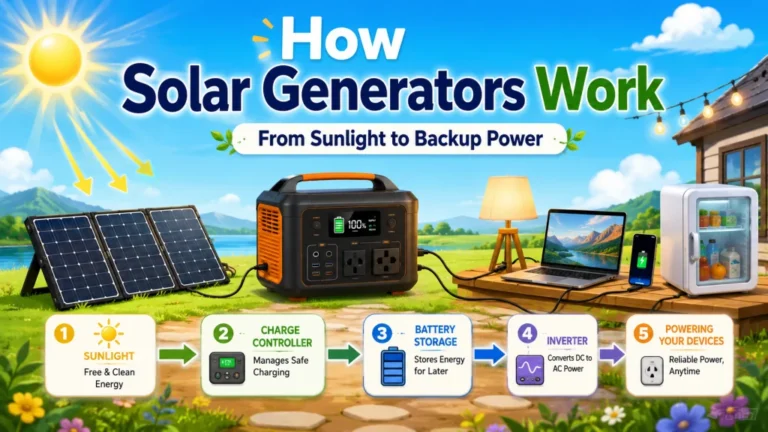
A solar generator in a comparable power range costs $500 to $3,000, depending on battery capacity and inverter output. That spread exists because a solar generator packages three major components into one unit: the battery, the inverter, and the charge controller. A gas generator has an engine and a fuel tank. Battery technology carries a manufacturing cost that engine components do not, and that cost shows up in the price from the moment you pick it up off the shelf.
Buyers regularly want to know why solar generators cost so much compared to gas. The short answer is energy storage. A LiFePO4 battery large enough to run household appliances is expensive to manufacture. The inverter that converts stored DC power into the 120V AC current your appliances actually use adds to that cost. A gas generator sidesteps the storage problem entirely by using fuel supplied externally, so the hardware cost is limited to the mechanical engine. When the energy storage is what you are paying for, the purchase price reflects it. Prices have come down significantly over the past several years as production has scaled, but the fundamental gap between engine cost and battery cost has not disappeared.

This 1kWh LFP battery station charges from 0 to 80% in just 50 minutes via AC input, and its LiFePO4 chemistry delivers a 3,000 plus cycle lifespan that is roughly 6 times longer than standard lithium batteries. Capacity is expandable up to 3kWh with additional batteries, making it well suited for camping, RVs, or off-grid living. Its 1,800W output powers across 15 outlets, handling around 90% of household appliances, and accepts up to 500W of solar input for clean, fuel-free charging. The package includes a 5-year customer service guarantee.
Check On AmazonIf you click this link and buy, we earn a commission at no additional cost to you.
The Ongoing Cost of Running on Gas
Fuel is where the total cost comparison starts shifting. A mid-size portable gas generator consuming 0.5 gallons per hour at $3.50 per gallon costs $1.75 per hour to operate. At 100 hours of use per year, that is $175 in fuel annually. Over five years it reaches $875. Over ten years, $1,750, not counting whatever gas actually costs during those years, which has not trended downward consistently over long periods.
That 100-hour-per-year figure represents moderate use: a power outage or two per season plus some weekend outdoor use. Push it to 200 hours per year and the five-year fuel cost doubles to $1,750. At that rate, the fuel bill alone roughly matches the original purchase price of a mid-range gas unit by year five. The machine that looked cheap at the register has been billing you monthly ever since.
A figure that came up in buyer conversations more than once stuck with me: a gallon of gasoline contains roughly 36 kilowatt-hours of energy. At 50 percent generator efficiency, you get about 18 usable kilowatt-hours per gallon. At $3.50 per gallon, that works out to roughly $0.19 per usable kilowatt-hour, before a single dollar of maintenance is counted. Add oil, spark plugs, stabilizer, and the occasional carburetor service and the real cost per kilowatt-hour climbs higher. Solar panels charge the battery for free. The grid charges it at your standard electricity rate, typically $0.12 to $0.18 per kilowatt-hour. Either way, the per-kilowatt-hour cost of solar is lower than gas, and the gap does not close with time.
Field Note: The buyers who came back most frustrated at the shop were not the ones who had trouble during outages. They were the ones who started adding up three winters of fuel and maintenance receipts and realized the total had exceeded what they originally paid for the unit. At that point the conversation always shifted toward solar. The math had done what math eventually does.

This 220V monitor handles up to 16 amps and reads down to 0.01W resolution at Class 1.0 accuracy, detecting loads as low as 0.20W to catch even standby draw. A backlit LCD with built-in memory retains cumulative kilowatt-hour data through power interruptions. Fire-retardant ABS housing and a 1-year warranty round out a reliable package.
Check On AmazonIf you click this link and buy, we earn a commission at no additional cost to you.
The Maintenance Reality Most Buyers Forget to Price In
Fuel is the visible cost. Maintenance is the one that surprises people, especially buyers who have not owned a small engine before. A gas generator is an internal combustion engine, and small engines require consistent upkeep if you expect them to start reliably when you actually need them. Skipping this tends to show up at the worst possible moment: during the next outage.
Here is what routine maintenance looks like for a gas generator used at a moderate rate:
- Oil changes every 50 to 100 hours of runtime. Skipping this shortens engine life and degrades performance over time. Oil and the time to change it costs $5 to $15 per change. Pay a shop and the number goes up.
- Spark plug replacement annually or every 100 hours. Worn plugs cause hard starting and rough operation. A replacement set runs $5 to $20 depending on the engine.
- Carburetor cleaning for units stored with fuel. Ethanol-blended gasoline left in a carburetor for more than 30 days begins to varnish and gum the internal passages. A professional carburetor cleaning runs $50 to $100. This was one of the most common repair calls I saw from people who stored their unit at the end of summer with a full tank and tried to start it six months later.
- Air filter replacement each season or every 100 hours. A clogged filter reduces efficiency and causes the engine to run rich, increasing fuel consumption. Filters cost $5 to $15 and take five minutes to swap.
- Fuel stabilizer for any storage longer than 30 days. Adding stabilizer to the tank before storing is not optional for reliable seasonal use. A bottle runs $8 to $12 and prevents the carburetor problem above.
In practice, a moderate user spends $50 to $150 per year on parts, supplies, and occasional professional service. Over five years that adds $250 to $750 to the total cost, entirely separate from fuel. Stack that on top of the fuel bill and the true five-year cost of a gas generator has climbed well past what the purchase price suggested.
A solar generator has no oil, no spark plugs, no carburetor, and no air filter. The inverter and charge controller are solid-state electronics. The battery management system handles its own protection automatically. Barring a warranty claim or a battery replacement far down the road, the ongoing cost after purchase is as close to zero as consumer electronics gets.
Running the Five-Year Numbers
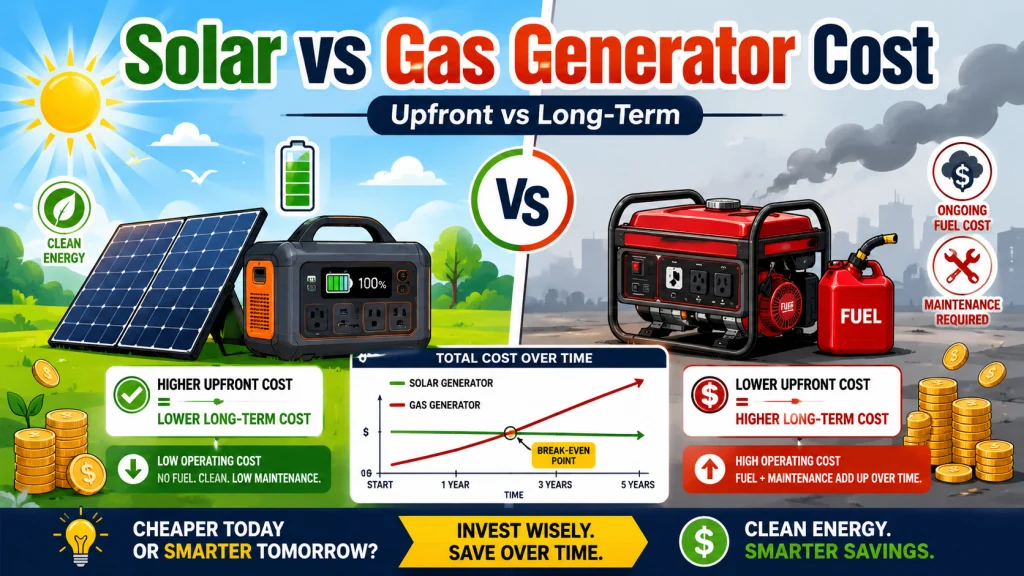
Here is the solar vs gas generator cost comparison with actual numbers at moderate use of 100 hours per year. The gas unit is a mid-range model at $600. The solar generator is a mid-range LiFePO4 unit at $1,200. These reflect realistic purchase prices for units operating in a comparable power output range. The table assumes the solar unit is recharged primarily from panels already purchased with the system. Wall outlet charging still costs far less than gasoline, but it is not literally zero.
| Cost Component | Gas Generator (5 Years) | Solar Generator (5 Years) |
|---|---|---|
| Purchase price | $600 | $1,200 |
| Fuel (100 hrs/yr at $1.75/hr) | $875 | $0 |
| Maintenance (parts and service) | $250 | $0 |
| Total over 5 years | $1,725 | $1,200 |
That table uses 100 hours per year. Change that number and the outcome changes too. Here is how the five-year total shifts at different usage levels, using the same fuel and maintenance rate assumptions:
| Annual Use | 5-Year Fuel Cost (Gas) | 5-Year Gas Total (Est.) | Lower Cost |
|---|---|---|---|
| 10 hrs/year | $88 | ~$850 to $1,000 | Gas |
| 50 hrs/year | $438 | ~$1,250 to $1,400 | Close call |
| 100 hrs/year | $875 | $1,725 | Solar |
| 200 hrs/year | $1,750 | $2,600+ | Solar |
The table makes the usage question concrete. If you recognize your situation in the 10-hour row, the math favors gas and no amount of long-term reasoning changes that. If you are closer to the 100-hour row, the calculation inverts and solar comes out ahead before the unit is halfway through its useful life.
At this usage level, the solar generator comes out $525 cheaper by year five. The math on the break-even is straightforward: solar costs $600 more upfront, but gas costs $225 more per year in fuel and maintenance combined. Divide the gap by the annual difference and the crossover lands late in year two or early in year three. If maintenance comes in lighter than estimated or fuel prices run lower, that crossover slides a few months toward year three. Either way, solar is the cheaper option from year three onward at this usage level.
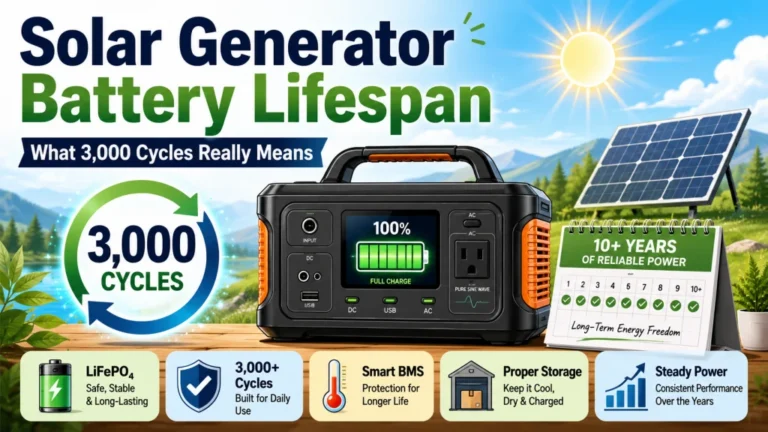
One honest caveat belongs here. A quality LiFePO4 battery rated at 3,000 cycles, used 100 times per year, still has a decade of useful life before approaching end-of-life, and capacity at that point does not drop to zero. It reaches roughly 80 percent of original capacity, meaning shorter runtime per charge rather than a dead unit. The gas generator at that same usage rate may face engine work or parts replacement before ten years is up. Neither unit runs free indefinitely. For the five-year window most buyers are actually thinking about when they make this decision, solar wins on total cost at moderate use.
Cost is one dimension of this comparison. If you are still weighing factors like whether solar handles your appliances during a multi-day outage or how the two types compare on raw power output, those angles require a broader look. The full solar vs gas generator comparison covers power output, noise levels, indoor safety, and the specific scenarios where each type has a real advantage over the other.

Weighing just 23.8 lbs with a foldable handle, this 1,070Wh LFP power station delivers 1,500W of pure sine wave AC output with a 3,000W surge capacity, capable of running AC units, fridges, and electric pots. Its LFP battery sustains over 70% capacity after 4,000 cycles, translating to a lifespan of more than 10 years. Via the Jackery App, you can enable a full charge in as little as one hour, or switch to a whisper-quiet 30 dB overnight mode. Six output ports including two USB-C with 100W PD charging cover nearly any device simultaneously.
Check On AmazonIf you click this link and buy, we earn a commission at no additional cost to you.
When Gas Still Wins on Cost
The break-even math above assumes 100 hours of annual use. Drop that to five or ten hours per year and the picture changes substantially. At very low usage, fuel and maintenance over five years might total $100 to $200 combined. The solar generator at $1,200 never recovers the purchase premium through fuel savings at that rate. For buyers who pull a generator out once or twice a year during a storm and store it the other 50 weeks, the lower gas purchase price holds up over time and solar does not close the gap.
The other scenario where gas wins is high wattage demand. A portable solar generator in the $1,000 to $2,000 range delivers 2,000 to 4,000 watts of continuous output. A central air conditioner draws 3,500 to 5,000 watts. An electric dryer runs at 5,500 watts. These loads are simply beyond what portable solar generators can deliver at any reasonable price point. Gas generators at 5,000 to 10,000 watts run $600 to $1,500 and handle loads that solar cannot match. In that situation, cost per hour becomes a secondary concern because one option cannot do the job at all.
For buyers who want a realistic inventory of what solar generators cannot do before committing, including output ceilings, cloudy-week vulnerabilities, and the situations where the limitations genuinely matter, the honest breakdown of solar generator disadvantages covers them without a brand-sponsored perspective. It is worth reading before the purchase, particularly for anyone with high-draw appliances or extended outage scenarios in mind.

Built around high-efficiency SunPower cells reaching up to 24% efficiency, this compact solar kit outperforms most panels in its class. The all-in-one suitcase includes a 100W panel, a 20A waterproof PWM charge controller with multiple safety protections, and alligator clips for a true plug-and-play setup. Compatible with most 12V battery types, it fits easily into existing systems. A rugged canvas case and low iron-tempered glass keep it durable and travel-ready.
Check On AmazonIf you click this link and buy, we earn a commission at no additional cost to you.
Final Thoughts: Run the Math on Your Actual Usage
Most buyers make this decision based on purchase price and stop there. At the register, gas looks like the obvious choice. Run the numbers forward three to five years, accounting for fuel consumption and maintenance, and the comparison often reverses. That is not a knock on gas generators. They are the right tool for specific situations, particularly very low-frequency use and high-wattage loads that solar cannot reach. But the assumption that gas is simply cheaper across the board does not hold up once the full cost is on paper.
The solar generator long-term cost, at moderate use, tends to be lower than most buyers expect when they first see the purchase price. The premium is front-loaded. The savings accumulate in the background, in every tank of gas not bought and every oil change not scheduled. For buyers still deciding whether the investment makes sense for their specific situation, including the scenarios where the honest answer is no, the are solar generators worth it breakdown works through the decision from a full cost-and-value perspective.

Reaching 80% charge in just 43 minutes via UltraFast AC recharging and a full charge in under an hour, the SOLIX C1000 is one of the fastest-charging stations in its class. Its LiFePO4 battery supports 3,000 cycles over a projected 10-year lifespan, while SurgePad technology delivers 2,400W of output across 11 ports to power 99% of appliances. Solar input tops out at 600W for a full recharge in about 1.8 hours, and the unit runs 15% smaller than comparable 1kWh models.
Check On AmazonIf you click this link and buy, we earn a commission at no additional cost to you.
FAQs
❓ Why are solar generators so expensive compared to gas generators?
The cost is almost entirely the battery. Storing enough electricity in a LiFePO4 pack to run household appliances is expensive to manufacture at any scale. Gas generators sidestep this entirely by using fuel you supply externally, so the hardware cost is limited to the engine. As battery production has grown, solar generator prices have dropped significantly, but the fundamental cost difference between energy storage and an internal combustion engine has not gone away.
💰 How long does it take for a solar generator to break even vs a gas generator?
At moderate use of around 100 hours per year, the math works out to a crossover late in year two or early in year three. Solar costs $600 more upfront, but saves $225 per year in fuel and maintenance combined. Divide the gap by the annual savings and that is where the lines cross. At very low usage, under 20 hours per year, the break-even may never arrive.
⛽ How much does it cost to run a gas generator per hour?
At $3.50 per gallon and 0.5 gallons per hour consumption for a mid-size unit, the fuel cost runs about $1.75 per hour. That number rises at full load and varies with current gas prices. Over 100 hours of annual use, that is $175 per year in fuel alone, separate from oil, spark plugs, and carburetor service.
🔋 Does a solar generator cost anything to operate after you buy it?
No gasoline or engine fuel cost. Solar panel charging costs nothing after the panels are paid for. Wall outlet charging costs your standard electricity rate for the kilowatt-hours going in, which is still far below equivalent gasoline cost. At $3.50 per gallon and 18 usable kilowatt-hours per gallon, gasoline power costs roughly $0.19 per usable kilowatt-hour before maintenance. Residential electricity typically runs $0.12 to $0.18 per kilowatt-hour, and solar is free. There is no scheduled maintenance, no oil, no filters, and no service bills.
📉 At what point does gas make more financial sense than solar?
Very infrequent use, around five to ten hours per year, means the fuel savings on solar may never recover the higher purchase price. The break-even calculation requires enough usage hours to accumulate meaningful savings. Buyers who pull a generator out once or twice a year for a short outage often find that gas costs less over the full ownership period.
🔧 What gas generator maintenance costs are most often overlooked?
Carburetor cleaning after sitting with fuel in the tank is the most commonly missed expense. Ethanol-blended gas left in the carburetor for more than 30 days varnishes the internal passages, and a professional cleaning runs $50 to $100. Combined with oil changes, spark plugs, and air filters, the annual maintenance bill for a moderately used gas generator typically runs $50 to $150 per year.