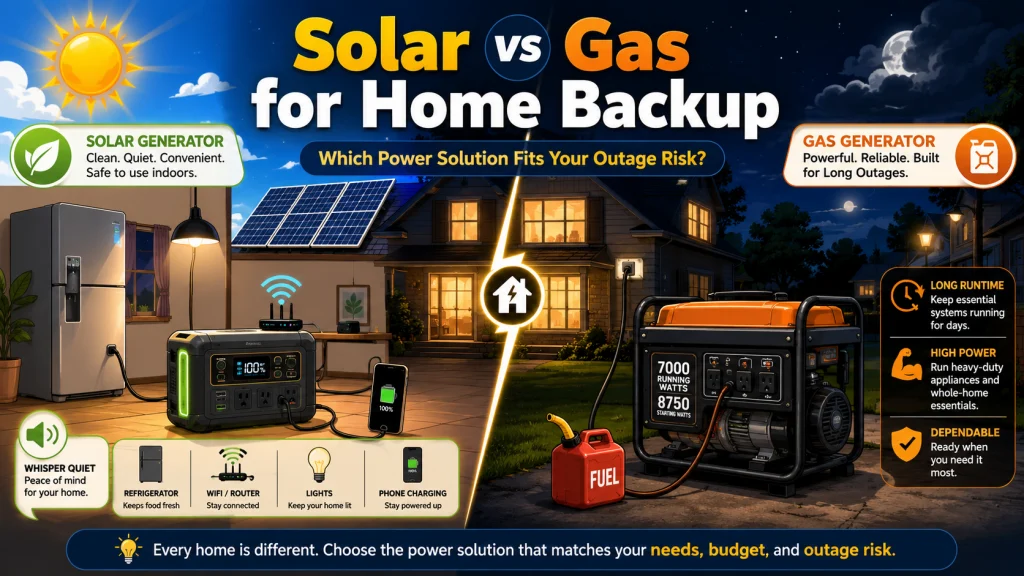
What Your Outage History Actually Tells You
During an 8-hour outage, a solar generator handles your essentials with zero noise and zero fuel. During a 5-day ice storm with no sun, the same unit sits at 20 percent charge by day 3 with no realistic way to replenish it from panels. The right answer depends entirely on the outage scenario you are actually preparing for, not the one on the product page.
The most useful thing you can do before comparing specs is think honestly about your outage history. If outages in your area are typically weather-related, run 4 to 12 hours, and happen a handful of times a year, that is a completely different problem than a region where winter ice storms knock power out for 5 to 7 days at a stretch. Both situations are real. Both are common. Solar solves one of them cleanly and struggles with the other in ways that matter before you spend money.
I have sold backup power solutions and run my own home exclusively on solar long enough to see both failure modes play out in real conditions. The buyers who came back satisfied were almost always the ones who matched the tool to their actual outage reality. The ones who came back frustrated had bought for a situation that turned out to be slightly different from what they assumed. That mismatch is preventable, and the math that prevents it is not complicated.
The 12-Hour Outage: Read the Math Before You Assume Solar Wins This One
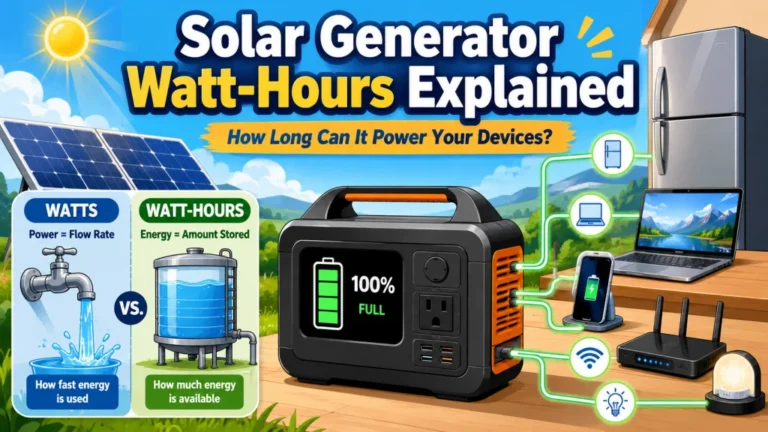
A 2,000Wh solar generator can handle a typical overnight outage, but the number of hours it actually covers depends on what you are running and whether you protect the battery reserve. Here is the calculation that matters. A standard refrigerator draws roughly 100 to 150W on average when you account for compressor cycling. Add a Wi-Fi router at 10W, a few LED lights at 20W, and phone charging at 10W, and you are at approximately 140 to 190W of combined load. At 160W, once you account for inverter losses and leave a 20 percent charge reserve to protect battery health, practical runtime lands around 8.5 hours.
That is enough for a 6 to 8 hour overnight outage, which covers the majority of residential outages in the United States. But if you are planning for a true 12-hour run at a 200W combined load while preserving a 20 percent reserve, a 2,000Wh unit falls short. The math works out to needing roughly 3,000 to 3,500Wh of rated capacity for that scenario. Alternatively, if you keep your overnight load to around 115W, which means running just the refrigerator and router with the lights and charging set aside, a 2,000Wh unit gets you to 12 hours on a single charge. The point is that the math determines the answer, not the label on the unit.
Field Note: One of the most consistent things I ran into at the shop was buyers who came back after their first short outage saying the unit ran out faster than expected. Almost every time, the culprit was a load they had not counted, usually a chest freezer running alongside the kitchen refrigerator, that doubled their actual draw. A 2,000Wh battery with a 400W combined load gives you roughly 3.5 hours after inverter losses and reserve, not 7. The runtime math only works if you count every load you actually plan to run.

At 39.5 lbs with 2,042Wh capacity and 2,200W output, this CTB-built station is 41% lighter and 34% smaller than typical 2kWh units. It charges from 0 to 80% in just 66 minutes via AC, operates at under 30 dB in silent mode, and switches to UPS backup in under 20 milliseconds. The LiFePO4 battery is rated for a full 10-year lifespan.
Check On AmazonIf you click this link and buy, we earn a commission at no additional cost to you.
The 72-Hour Outage: Where the Decision Gets Complicated
Three days is where solar backup starts showing its limits, and those limits are almost entirely determined by the weather that caused your outage. If your region gets reliable winter sun even when temperatures drop, a solar generator can cycle through a 72-hour outage and stay functional. Cold temperatures reduce panel output somewhat and affect battery efficiency at the margins, but not catastrophically. Four or five sun-hours per day with 200W of panels will replenish most of what you use overnight on an essential load setup.
The problem is that the storm causing your outage is often the same one blocking your solar input. In heavy cloud cover, a 200W panel delivers only 20 to 50W. At that rate, recharging a 2,000Wh battery from 20 percent to full requires 40 to 60 hours of panel time. You are not recovering overnight losses between nights. You are slowly drawing down a battery with no reliable solar path to refill it. For that specific scenario, a gas generator wins on raw reliability because fuel is the primary variable. One caveat worth noting: in a serious regional outage, gas stations may lose power too, run low on supply, or have long lines. If gas is your plan for extended outages, stored fuel kept safely at home is the more reliable access strategy than assuming the nearest station is open.
This is an honest draw rather than a failure of solar technology. If extended winter outages with persistent overcast are your real risk, gas is the more dependable primary solution. A solar unit as the only backup requires an honest look at your local weather patterns during the season when you are most likely to need it.

Built with N-Type cells at 25% conversion efficiency, this 15.9 lb foldable panel includes a 30 to 60 degree adjustable bracket with an integrated angle guide for optimal sun tracking throughout the day. ETFE coating and an IP68 waterproof rating ensure durability in harsh weather, and the included protective bag makes transport straightforward for camping, trekking, or road trips.
Check On AmazonIf you click this link and buy, we earn a commission at no additional cost to you.
The Week-Long Outage: Where Solar Becomes Support, Not the Primary Backup
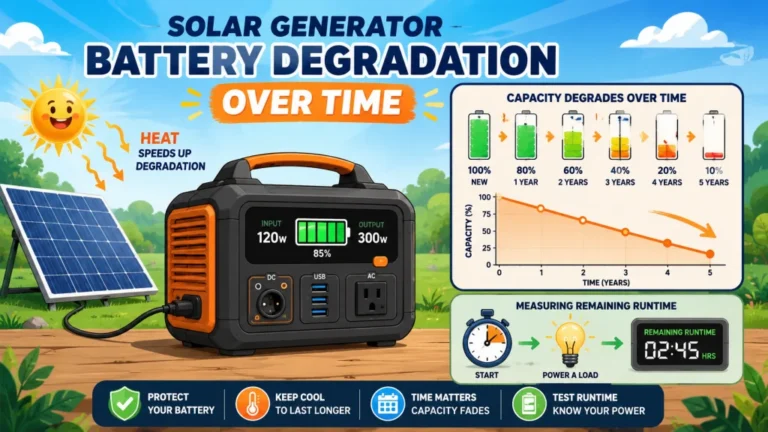
Seven consecutive days without grid power is a different problem entirely, and the math makes the case clearly. Running essential loads overnight at 160W for 10 hours draws approximately 1,600Wh per night. With 200W of solar panels in heavy cloud cover, you recover roughly 200 to 400Wh per day from panels. That leaves a daily deficit of 1,200 to 1,400Wh with no way to close the gap from solar alone. By day 3, your battery is depleted. By day 5, it has been at or near zero for two days, which accelerates degradation regardless of chemistry.
Even in thin overcast at 25 percent panel output, a 200W array produces around 400 to 500Wh per day. You are still 1,100Wh short of what one overnight run consumes. The only solar-based solution that genuinely works for week-long outages is a much larger panel array, a significantly larger battery bank, or both, typically in the range of systems that cost $8,000 to $20,000 and involve permanent installation. A portable solar generator in the $800 to $2,500 range is not sized for this problem.
For a week-long outage, gas is the reliable primary option. A solar generator still plays a useful supporting role: run essentials during daytime when solar is charging, reduce the hours per day the gas generator needs to run, and provide silent indoor power for overnight device charging and medical equipment. The practical hybrid approach is a gas generator for high-draw and extended coverage, with a solar unit handling the quiet, indoor, low-draw work. That combination is what I would actually recommend to anyone facing a genuine multi-day outage risk.
Note: If you go the stored fuel route for gas backup, verify the safe storage limits and shelf life guidelines for your area. Ethanol-blended fuel degrades in 3 to 6 months without a stabilizer. Treated fuel stored properly lasts considerably longer, but always follow local fire code for storage quantities.
What a Portable Solar Unit Can and Cannot Power
The load question is where a lot of buyers discover they bought for a different problem than the one they actually have. Portable solar generators in the practical purchase range typically deliver 1,500 to 3,000W of continuous AC output. That covers the loads most people need during an outage. It does not cover every load in the house, and several of the loads it cannot handle are the ones buyers most commonly assume it can.
| Appliance | Typical Draw | Runs on a 2,000Wh Unit? |
|---|---|---|
| Refrigerator (standard) | 100 to 150W average | Yes, all night on essential load setup |
| Wi-Fi router | 5 to 15W | Yes, multiple days without issue |
| LED lighting (4 to 6 bulbs) | 20 to 40W total | Yes |
| CPAP machine (no heated humidifier) | 30 to 60W | Yes, 8-plus hours overnight |
| Laptop and phone charging | 20 to 60W total | Yes |
| Portable electric space heater | 750 to 1,500W | Possible, but drains battery in 1 to 2 hours |
| Window air conditioner (small) | 500 to 1,200W | Possible depending on unit’s AC output rating |
| Central air conditioner | 3,500 to 5,000W | No, exceeds portable unit output capacity |
| Electric range or oven | 2,000 to 5,000W | No, or extremely brief |
| Well pump (1/2 HP) | 750 to 1,000W running, 2,000W+ starting surge | Marginal, depends on unit’s surge watt rating |
The appliances that fall outside portable solar range are consistent: central HVAC, electric ranges, and well pumps with high starting surges. Running those loads during an extended outage requires either a gas generator or a purpose-built whole-home battery system. A portable solar unit is not the right tool for those loads, and adding more battery capacity does not change that if the inverter output ceiling is the binding constraint. For the appliances above the output threshold, gas wins on capability. For everything below it, solar handles the job more conveniently.
- Solar is the right fit if your outage plan centers on keeping the refrigerator running, staying connected, maintaining lighting, and powering medical devices like a CPAP.
- Gas is the right fit if your plan includes running whole-home HVAC, a high-draw well pump, or electric cooking appliances for extended periods.
- Both together is the practical answer for anyone facing week-long outages who wants solar for quiet daily essentials and gas on standby for the high-draw or extended-duration moments.
Most buyers who fall into the first category end up satisfied with solar backup. The ones who come back frustrated are almost always in the second or third category but sized for the first. Knowing which category your situation belongs to is the most useful pre-purchase work you can do.

This compact plug-in monitor tracks the energy consumption of any AC 115-volt appliance and displays real-time readings of volts, amps, and wattage at 0.2 to 2.0 percent accuracy. Its large LCD screen lets you calculate electricity costs by the day, week, month, or year, making it easy to spot energy-hungry devices and trim your utility bill. It is also compatible with inverters, adding flexibility for off-grid setups.
Check On AmazonIf you click this link and buy, we earn a commission at no additional cost to you.
The Noise Factor in a Residential Setting
This gets left out of most comparison articles, but it matters more in practice than buyers expect until they experience it. A gas generator at 70 to 80 decibels is not a background hum. It is the constant sound of a vacuum cleaner running for hours from your driveway or backyard. At midnight during an outage, that is a noise ordinance problem in many suburban areas, and it is not a sound that you or nearby neighbors sleep through easily.
A solar generator at rest produces zero decibels. No engine, no combustion, no moving parts during discharge. The internal cooling fan runs during AC wall charging at 30 to 50 decibels, roughly equivalent to a quiet conversation in the same room. During overnight discharge, the unit is completely silent. You can run it anywhere indoors, with no exhaust, no fumes, and no air quality concern. For anyone in a dense neighborhood or an HOA with noise restrictions, that practical advantage is real and significant.
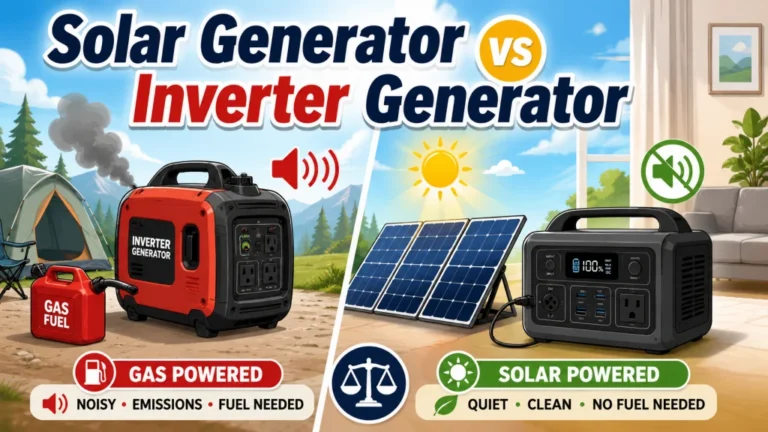
For a fuller picture of how solar and gas generators compare across all the key decision factors, including noise levels with decibel data, fuel cost over time, and the specific scenarios where each type genuinely outperforms the other, that breakdown goes well beyond the home backup use case covered here.
How You Will Actually Connect Appliances During an Outage
One thing that surprises buyers: neither a solar generator nor a portable gas generator automatically powers your home’s circuits. You are not flipping a breaker and watching the lights come back on. A portable solar generator is designed to power appliances individually, by plugging them directly into the unit’s AC outlets using standard extension cords. You run a cord to the refrigerator, another to a lamp, another to the router. It is hands-on, not seamless, but it is also simple and requires no installation.
A portable gas generator works the same way unless you have a transfer switch installed by an electrician, which disconnects your home from the grid and allows the generator to feed your household circuits safely. Without a transfer switch, gas backup is also extension cords to individual appliances. The difference is that gas generators are typically used outdoors due to exhaust, which means running cords under a door or through a window, with all the inconvenience that comes with it.
If you picture “home backup” as pressing a button and having the house run normally, that expectation requires a permanent installed system. Portable solar and gas both require you to think in terms of which specific appliances matter most, then power those. That is not a flaw in either product. It is just the reality of portable backup power, and understanding it before you buy prevents a lot of disappointment.

This 1kWh LFP battery station charges from 0 to 80% in just 50 minutes via AC input, and its LiFePO4 chemistry delivers a 3,000 plus cycle lifespan that is roughly 6 times longer than standard lithium batteries. Capacity is expandable up to 3kWh with additional batteries, making it well suited for camping, RVs, or off-grid living. Its 1,800W output powers across 15 outlets, handling around 90% of household appliances, and accepts up to 500W of solar input for clean, fuel-free charging. The package includes a 5-year customer service guarantee.
Check On AmazonIf you click this link and buy, we earn a commission at no additional cost to you.
Final Thoughts: Matching the Tool to Your Actual Outage Risk
If your outages typically run under 24 hours, your essential loads are a refrigerator, lights, a router, and device charging, and you are not in a region known for multi-day winter storms with persistent overcast, solar is the more practical and convenient choice. No fuel logistics, no noise ordinance concerns, no exhaust. The math supports that use case cleanly.
If your outages regularly exceed 48 hours, or if your load list includes central HVAC or a well pump, gas handles those scenarios better. For week-long outages without sun, gas is the only portable option that genuinely keeps up. A solar unit plays a useful supporting role in that scenario but cannot carry the full load on its own at portable price points.
If you are still working through the broader decision before committing, the complete solar generator guide covers the full lifecycle from understanding the technology to sizing for your specific location and use case. That is a good place to start if any part of the capacity math or buying criteria still feels unclear.

This 12AWG, 15-amp cord handles up to 1,875 watts and stays flexible from -40 to 130 degrees Fahrenheit, with a weather-resistant jacket built for tools, generators, and chargers. Three lighted outlets with a triple-tap design work as a built-in power splitter, and high-visibility yellow coloring plus molded strain relief make it job-site ready for shops, garages, and campsites.
Check On AmazonIf you click this link and buy, we earn a commission at no additional cost to you.
FAQs
⚡ Can a solar generator run a refrigerator during a power outage?
Yes, in most cases. A standard refrigerator draws 100 to 150W on average. A 2,000Wh solar generator running only the refrigerator plus a router and lights can cover 7 to 8 hours before reaching a 20 percent charge reserve. For a true 12-hour overnight run at that load level, plan for a 3,000Wh or larger unit, or reduce combined load to around 115W.
🌧️ What happens if the outage lasts several days with no sun?
This is where solar backup shows its main practical limit. In heavy cloud cover, solar panels deliver 10 to 25 percent of rated output. A 200W panel produces only 20 to 50W in those conditions, which is far less than what one overnight run consumes. For multi-day cloudy outages, a gas generator with stored fuel is the more reliable primary option. A solar unit can still reduce how many hours the gas generator needs to run.
🔇 Is a solar generator quiet enough to use indoors at night?
Yes. During discharge, a solar generator produces zero noise because there are no moving parts. The internal cooling fan runs during AC wall charging at 30 to 50 decibels, similar to a quiet conversation. Overnight discharge is completely silent and safe to run anywhere indoors, including a bedroom.
🏠 Can a portable solar generator run central air conditioning?
No, not with a standard portable unit. Central air conditioners draw 3,500 to 5,000W, which exceeds the continuous AC output of most portable solar generators. A window unit at 500 to 1,200W is possible depending on the solar generator’s rated output. For central HVAC during an outage, a gas generator or a permanently installed whole-home battery system is required.
🔌 Do I need an electrician to use a solar generator for home backup?
Not for a portable solar generator. You plug appliances directly into the unit’s AC outlets using standard extension cords, no installation required. A transfer switch, which does require an electrician, is only necessary if you want to power household circuits rather than individual appliances. Most portable solar generator users run extension cords directly to the refrigerator, router, and lights they need.
🌤️ How long does recharging take after an overnight outage?
With 200W of solar panels on a clear day, a 2,000Wh battery charges from 20 percent to full in roughly 8 to 10 hours. Cloud cover can extend that significantly, sometimes to 40 or more hours in heavy overcast. AC wall charging is typically faster than solar input and brings a 2,000Wh unit from empty to full in 5 to 8 hours depending on the unit’s input wattage rating.