The Question Worth Answering Honestly Before You Write the Check
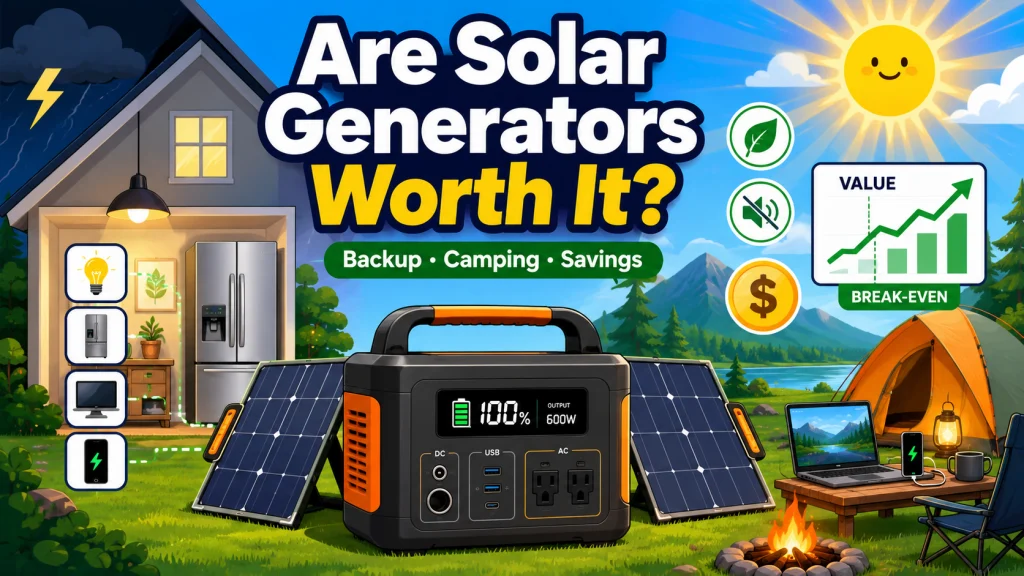
Are solar generators worth it? I have sold enough of these to know the answer is almost never a clean yes or no. It depends on three things: what you need to run, how long your typical outages last, and what your local weather looks like when those outages happen. Get all three aligned and a solar generator is genuinely worth the investment. Get one of them wrong and you end up with a unit that works as designed but does not actually solve your problem.
If you are still in the early research phase of this decision, the complete solar generator guide is worth reading before diving into the worth-it question. It covers how these units actually work, how to read the specs, and what battery chemistry means for long-term value. Once you have that foundation, deciding whether a solar generator is right for your situation becomes significantly clearer. For now, here is the honest framework.
Quick verdict: Worth it if your outages typically run under 48 hours, your loads are essentials like a fridge, router, lights, and devices, and you have a clear path to recharge. Probably not worth it if your outages regularly run five or more days, you need to run central air, an electric dryer, or electric heat, or you are expecting whole-home backup without any supplemental power source.
The Use Cases Where a Solar Generator Pays for Itself
Short outages of one to two days running essential loads are the clearest case. A 2,000 watt-hour unit with a refrigerator at 150 watts average, a router at 10 watts, basic lighting at 30 watts, and phone charging at 15 watts totals roughly 205 watts combined load. At 85 percent real-world efficiency, that runs about 8 hours on a full charge. For many routine outages, that window covers exactly the scenario most buyers are actually preparing for. Recharge from a wall outlet the next morning or from solar panels once daylight returns and you have covered the standard outage scenario without fuel, noise, or exhaust.
Camping and RV use is the second strong case. Weekend camping loads are light: phones, a laptop, lighting, and sometimes a CPAP machine. A 1,000 watt-hour unit covers two to three days of that comfortably per charge cycle. Add a 100-watt solar panel and you extend runtime indefinitely on sunny trips. Most organized campgrounds now restrict or ban gas generators during quiet hours. A solar unit runs effectively silent during discharge and under 35 decibels when the internal cooling fan activates, which means no noise complaints and no ordinance issues regardless of the hour.
Beyond those two, there are a few other scenarios where solar wins without much debate:
- CPAP overnight backup, where consistent quiet power matters and fan noise from a gas generator would be disruptive to sleep
- Apartment and condo use, where gas is not permitted indoors and a solar generator running off wall charge is the only practical backup option
- Remote outdoor work, where AC power for a laptop, lighting, or small tools is needed without a fuel supply chain
- Boating and van life, where a silent, odorless power source eliminates both fuel storage risk and exhaust in enclosed spaces
All of these share a common characteristic: they are short to medium duration, moderate power loads, with a clear path to recharging. That is the sweet spot where solar justifies its cost. The moment you move outside those conditions, the calculation starts to shift.

Built with IBC cells at 25% conversion efficiency, this bifacial panel absorbs sunlight from both sides and bends up to 221 degrees to conform to curved surfaces like car roofs and balconies. At just 4.52 lbs it is 56% lighter than rigid panels, and IP68 waterproofing plus IEC TS 63163 certification across 19 international tests ensure reliable output from -40 to 85 degrees Celsius. A 3-meter flat cable enables flexible installation in under 5 minutes.
Check On AmazonIf you click this link and buy, we earn a commission at no additional cost to you.
What the Solar Generator Value Looks Like Over Five Years
The solar generator value equation is more straightforward than most buyers expect. Take a homeowner using a $1,000 unit 15 to 20 times per year: a few short outages, several camping trips, and routine CPAP backup. A comparable gas generator running 0.5 gallons per hour at $3.50 per gallon costs $1.75 per hour in fuel. At 75 to 100 hours of annual use, that adds up to $131 to $175 per year in fuel alone. Over five years that is $650 to $875 in fuel, plus $50 to $100 per year in oil changes, spark plug replacement, and carburetor maintenance. The five-year operating cost for gas: $900 to $1,375. For solar: effectively zero.
Food spoilage is a real avoided cost that buyers often forget to factor in. A full refrigerator and freezer warming to room temperature over 24 hours typically costs $200 to $400 in lost food. Preventing that once or twice over three years covers a meaningful portion of the unit’s purchase price. Hotel stays during extended outages in warm months add to the avoided-cost picture as well. None of these are theoretical savings. They are costs gas generator owners continue to pay that solar owners do not.
| Annual use | 5-year gas operating cost (fuel + maintenance) | 5-year solar operating cost |
|---|---|---|
| 10 hours per year | ~$338 to ~$588 | ~$0 to $25 |
| 50 hours per year | ~$688 to ~$938 | ~$0 to $50 |
| 100+ hours per year | ~$1,125 to ~$1,375 | ~$0 to $50 |
These figures assume $3.50 per gallon and $50 to $100 per year in maintenance. They do not include the gas generator purchase price, which starts around $400 for a basic 2,000-watt unit. Add that in and solar breaks even against total gas ownership cost within three to four years at moderate use. At heavier use, the gap widens faster.
What Actual Ownership Confirms
The numbers above are predictive. What real owners report in practice lands right in line with them. The most direct confirmation I keep seeing in buyer communities is the person who runs a full-size French door refrigerator through an 8 to 10 hour outage on a 1,000 watt-hour unit, provided the doors stay closed. That is exactly what the math predicts. It is also exactly the kind of use case where buyers come back and say the purchase was worth it.
Field Note: The return-buyer pattern I saw most at the shop was not people coming back to complain about the unit. It was people coming back to buy a bigger one. They had sized for the lightest possible use case, the unit delivered on that without issue, but the moment they tried to add a fridge or run longer than three or four hours, they hit the capacity wall. The unit did not fail. The sizing did. And upgrading mid-ownership costs more total than buying the right capacity the first time.
That pattern repeats so consistently that it deserves its own section. Are solar generators worth buying in smaller capacities to save money upfront? Only if the smaller capacity genuinely matches your actual use case. And most buyers underestimate what their actual use case turns out to be once they have the unit and start relying on it.

This 1kWh LFP battery station charges from 0 to 80% in just 50 minutes via AC input, and its LiFePO4 chemistry delivers a 3,000 plus cycle lifespan that is roughly 6 times longer than standard lithium batteries. Capacity is expandable up to 3kWh with additional batteries, making it well suited for camping, RVs, or off-grid living. Its 1,800W output powers across 15 outlets, handling around 90% of household appliances, and accepts up to 500W of solar input for clean, fuel-free charging. The package includes a 5-year customer service guarantee.
Check On AmazonIf you click this link and buy, we earn a commission at no additional cost to you.
The Sizing Mistake That Makes a Good Investment Feel Like a Waste
Buying too small is the most predictable way to feel like a solar generator was not worth the money. A 500 watt-hour unit costs $300 to $500 less than a 2,000 watt-hour unit. That gap is genuinely appealing when you picture yourself charging phones and running a lamp during a short outage. Add a refrigerator to that picture and a 500 watt-hour unit runs two and a half to three hours at typical combined draw, then it is done.
The upgrade math is what makes the original saving painful. Buy a 500Wh unit for $400, sell it six months later for $200 when it proves too small, then buy a 2,000Wh unit for $1,100, and you have spent $1,300 total instead of $1,100 bought correctly the first time. That $200 penalty does not include the frustration of two failed outages in between. The right approach is to size for the 90th percentile use case, not the minimum. If there is any real chance you will need to run a refrigerator during a 12-hour summer outage, size for that scenario, not for the two-hour phone charging scenario you experience more often.
The calculation is not complicated. Add up the wattage of every appliance you want to run simultaneously, multiply by the hours of coverage you need, and divide by 0.85 for real-world efficiency loss. If that result is 1,600 watt-hours, buy a 2,000 watt-hour unit, not a 1,000 watt-hour unit on sale. A unit that barely handles your needs in ideal conditions is not a deal. It is a unit waiting to disappoint you at the worst possible time.

Starting at 2kWh and expandable to 6kWh with two additional batteries, this LFP station reaches 80% in just 43 minutes via combined AC and solar input. Its 3,000-cycle battery outlasts the industry average by 6 times and includes a 5-year service guarantee. With 2,400W output across 15 outlets and X-Boost pushing to 3,400W, it handles 99% of household appliances at a whisper-quiet 30 dB.
Check On AmazonIf you click this link and buy, we earn a commission at no additional cost to you.
Should I Buy a Solar Generator? When the Honest Answer Is No
There are real scenarios where a solar generator is not the right tool, and I would rather say that plainly than let a buyer find out after spending $1,500. If your outages regularly run five to seven days, your January weather averages two to three hours of usable sun, and your heating setup runs on electricity, a portable solar unit will be depleted before the sun can restore it. The Pacific Northwest in winter, the Great Lakes during an ice storm, and parts of the Northeast through a sustained multi-day nor’easter are the clearest examples of where solar alone breaks down without a supplemental wall-charging strategy or a gas backup.
High-draw appliances are the other hard limit. These are the loads that exceed what any portable solar generator under $3,000 can handle on a sustained basis:
- Central air conditioning: 3,500 to 5,000 watts continuous draw
- Electric water heater: 4,500 watts
- Electric dryer: 5,500 watts
- Electric range or oven: 7,000 watts
- Well pump: 750 to 1,500 watts continuous, often with a high starting surge that exceeds inverter capacity
If your backup plan depends on running any of these for extended periods, a portable solar unit is not a sufficient standalone solution. That is not a knock on the technology. It is just an honest statement about what these units are designed to do. In those situations, a gas generator handles the high-draw loads and a solar unit handles the quiet indoor loads such as a router, CPAP, device charging, and lighting. That combination costs more upfront but covers the full range of what most extended outage scenarios actually demand. For a detailed look at how the two approaches compare across specific outage scenarios and load types, the comparison between solar and gas generators works through the practical tradeoffs in detail.

Weighing just 23.8 lbs with a foldable handle, this 1,070Wh LFP power station delivers 1,500W of pure sine wave AC output with a 3,000W surge capacity, capable of running AC units, fridges, and electric pots. Its LFP battery sustains over 70% capacity after 4,000 cycles, translating to a lifespan of more than 10 years. Via the Jackery App, you can enable a full charge in as little as one hour, or switch to a whisper-quiet 30 dB overnight mode. Six output ports including two USB-C with 100W PD charging cover nearly any device simultaneously.
Check On AmazonIf you click this link and buy, we earn a commission at no additional cost to you.
Final Thoughts: The Straight Verdict
Most buyers who match the right capacity to their actual use case are satisfied with a solar generator. The buyers who are not almost always fell into one of two patterns: they bought too small, or they expected the unit to handle something outside its designed capability. Neither of those is a solar generator failing. Both are expectation and sizing problems that are straightforward to avoid if you do the math before purchasing rather than after.
If you want to go deeper on the numbers, the solar vs gas generator cost breakdown covers the full five-year math including upfront price, fuel, and maintenance in detail. If you want the complete list of limitations before committing, what solar generators cannot do covers the honest list of things brands tend to leave out of their marketing. Going in with clear expectations on both sides of the equation is how buyers end up satisfied with this purchase years later.
FAQs
🏠 Is a solar generator worth it for home backup?
For most homeowners dealing with outages under 48 hours, yes. A 2,000 watt-hour unit handles a refrigerator, router, lighting, and device charging for 8 to 12 hours on a full charge. For week-long outages with high-draw appliances or electric heat, a portable solar unit alone is not sufficient without a supplemental charging strategy.
💰 Is a solar generator worth the money compared to gas?
At moderate use of 50 or more hours per year, solar typically breaks even within three to four years once you account for fuel and gas generator maintenance costs. The higher upfront cost is real, but the ongoing operating cost is close to zero. At very light use under 10 hours per year, the break-even period extends significantly and gas may hold the upfront edge longer.
🧊 Can a solar generator run a refrigerator?
Yes. A full-size refrigerator draws 100 to 200 watts on average depending on the model and age. A 1,000 watt-hour unit runs a typical fridge for roughly 5 to 8 hours. A 2,000 watt-hour unit extends that to 8 to 14 hours. Keeping the door closed as much as possible is the single most effective way to stay within the rated runtime.
⚡ What appliances can a solar generator not run?
Most portable solar generators under $3,000 cannot sustain central air conditioning (3,500 to 5,000 watts), electric dryers (5,500 watts), electric ranges (7,000 watts), or electric water heaters (4,500 watts). These loads exceed both the continuous watt output and the effective battery capacity of standard portable units.
🏕️ Are solar generators worth it for camping?
Yes, for most camping scenarios. A 1,000 watt-hour unit handles phones, a laptop, lighting, and a CPAP machine for two to three days per solar recharge cycle. The noise advantage is significant at campgrounds with quiet hours, where solar runs silently and gas generators routinely violate posted decibel limits.
🔋 How long before the battery needs replacing?
For LiFePO4 chemistry, which is standard in most current units, expect 8 to 15 years of regular use before meaningful capacity loss. A unit rated for 3,000 cycles used 50 times per year still has decades of useful life ahead of it. Older NMC lithium-ion batteries found in budget and legacy models degrade significantly faster, often showing real capacity loss within 3 to 6 years at similar use frequency.
📦 What is a realistic break-even timeline for a $1,000 solar generator?
At 15 to 20 uses per year mixing outages and camping, most buyers break even within three to four years when compared against gas generator ownership costs including fuel and maintenance. Add avoided food spoilage and the occasional avoided hotel stay and the timeline shortens further. At fewer than 10 uses per year, plan for five to seven years before the math fully balances.