Your RV’s Electrical System Tells You More Than Any Spec Sheet
Before you make any decision about the best solar generator for an RV, the starting point is understanding your rig’s electrical system and, specifically, what amperage it runs on. Most solar generator reviews skip this step entirely. They compare battery capacity and inverter wattage without asking what the rig being powered actually demands. That omission produces recommendations that are technically accurate but practically useless for a significant portion of RV owners.
I watched this play out at the shop more times than I can count. A buyer with a large Class A motorhome would come in, look at a well-regarded mid-range unit rated at 2,000 continuous watts, and ask if it would run their whole RV. The short answer was no, not everything at the same time. Their rig was wired for 50-amp service, meaning the electrical system was designed to draw up to 12,000 watts when everything was running simultaneously. The solar generator they were looking at covered about 17 percent of that capacity. It was still a genuinely useful tool for that rig. It just was not the whole-system solution they were picturing when they walked in.
Understanding amperage before you compare units is not an extra step. It is the first step. If you are still at the stage of evaluating whether solar is even the right direction versus a conventional generator, the overview of solar generators by situation covers that broader question first. For buyers who have already decided on solar and just need the right match, the amperage question is where this starts.
The 30-Amp vs 50-Amp Wattage Reality
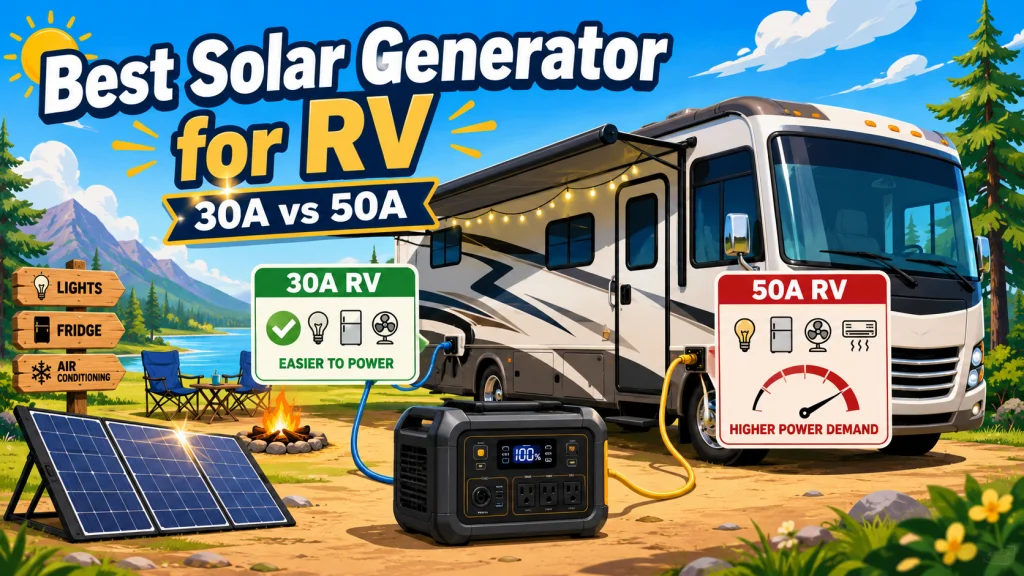
The math behind RV electrical service is simple once you have the formula. A 30-amp RV service runs on a single 120-volt leg. Thirty amps multiplied by 120 volts gives you 3,600 watts as the maximum simultaneous draw the system supports. A portable solar generator with 3,600 watts of continuous output can, in principle, supply everything a 30-amp RV is capable of drawing at once. That is the entire electrical ceiling of the rig, and it sits within range of what the high end of the portable solar generator market currently delivers.
A 50-amp system is different in structure, not just scale. It runs on two separate 120-volt legs at 50 amps each, for a total of 12,000 watts maximum. A portable solar generator peaks somewhere between 2,000 and 3,600 watts of continuous output. At best, that covers about 30 percent of a 50-amp system’s full capacity. That is not a marketing failure on the part of any particular unit. It is a physics gap between what portable battery-inverter systems can currently deliver and what a 50-amp RV was designed to draw.
| RV Service Type | Voltage | Max Amperage | Max Wattage | Portable Solar Coverage |
|---|---|---|---|---|
| 30-amp | 120V single leg | 30A | 3,600W | Full system capable |
| 50-amp | 120/240V split-phase (two 120V legs) | 50A per leg | 12,000W | Selective loads only (~30%) |
This does not mean solar generators are useless on a 50-amp rig. It means the right question shifts from “will this power my whole RV” to “which loads do I actually want to run from solar.” Most 50-amp RV owners run their high-demand loads like the air conditioner and the convection range off shore power or a conventional generator when those are available. Solar covers the quieter, continuous loads: refrigerator, lighting, device charging, router, entertainment. That split strategy works well in practice and does not require a unit anywhere near 12,000 watts.
For 30-amp owners, the choice is genuinely more straightforward. Match your solar generator’s continuous output to the 3,600-watt service ceiling and you have full system capability. Battery capacity, measured in watt-hours, then determines how long you can run before the unit needs recharging.
What a 30-Amp RV Actually Runs on Solar
The practical side of this is worth walking through with real numbers. A typical 30-amp RV running its standard combination of loads pulls far less than the 3,600-watt ceiling most of the time. A residential-style refrigerator draws about 150 watts on average. The water pump cycles at 60 watts when it runs. Interior LED lighting adds 30 to 50 watts. A flat-screen TV draws around 80 watts. Two device chargers together add 30 watts. That is a combined simultaneous draw of roughly 350 to 370 watts, which any solar generator in the 2,000-watt inverter class handles without difficulty. At that draw rate, a 2,000Wh unit runs approximately four and a half hours before hitting 20 percent reserve, and that is with no solar input adding back during daylight hours.
The loads that push toward the ceiling are the microwave and the air conditioner. A microwave running at 1,000 to 1,200 watts added to the 370-watt base load brings the total to 1,400 to 1,600 watts, still well within a 2,000-watt inverter. Adding the air conditioner at 1,200 to 1,500 watts running pushes the combined draw to 2,600 to 3,100 watts, which requires at least 3,000 watts of continuous inverter output from the solar generator. Running the microwave and air conditioner simultaneously is the scenario where 30-amp pairings get tight. It is the main reason I generally recommend a solar generator with at least 3,000 watts continuous output for any 30-amp owner who plans to run full loads rather than carefully selected ones.
Field Note: The buyers who ended up with the right unit the first time were almost always the ones who added up their real loads before asking about a solar generator. The ones who came back frustrated had usually picked on battery capacity alone without looking at inverter output. A 2,000Wh unit with a 1,500-watt inverter is a very different product than a 2,000Wh unit with a 2,000-watt inverter, even though the battery number is identical. That distinction disappears in most product listings, which is why it catches people off guard.
For RV camping in mild conditions with no air conditioning and selective load use, a 1,500 to 2,000Wh unit in the 2,000-watt inverter class covers most practical weekend needs. The math shifts significantly once the air conditioner or any other high-draw appliance enters the picture, which is covered in the next section.

With a 3,600Wh LFP battery expandable up to 25kWh via extra batteries or smart generators, this station delivers 3,600W across 15 output ports, boosted to 4,500W with X-Boost or 7,200W when two units are paired. A full recharge takes just 1.8 hours via 240V or 2.8 hours with 1,600W of solar input. It may also qualify for the 30% Residential Clean Energy Tax Credit.
Check On AmazonIf you click this link and buy, we earn a commission at no additional cost to you.
The Air Conditioner Question Gets a Direct Answer
Yes, a solar generator can run an RV air conditioner. No, it cannot run one overnight. Both of those statements are true, and most articles about the best RV solar generator will give you the first without the second. The omission produces a lot of disappointed buyers who charged their unit to full, plugged it into the RV, and woke up in a hot camper at 2 a.m.
A standard 13,500 BTU rooftop RV air conditioner starts with a surge that can reach 3,500 watts before the compressor settles into a running draw of 1,200 to 1,500 watts. That startup surge is the first obstacle. A solar generator rated at 2,000 watts continuous typically carries a surge rating between 3,000 and 4,500 watts. Some units in this class handle the RV AC startup. Others trip their protection circuit and shut down. The difference comes down to the specific surge watt rating of the unit, not the continuous output number, which is why surge capacity belongs on the checklist alongside Wh when you are shopping for an RV application.
Even when a unit handles the startup cleanly, the runtime math closes the door on overnight use. At 1,300 watts average draw, a 3,000Wh solar generator runs the air conditioner for about two hours before hitting 20 percent reserve. That is genuinely useful for cooling the RV before sleep or during a midday stop. It is not a replacement for overnight climate control. There is a hardware solution worth knowing about: a soft starter device reduces the RV air conditioner’s startup surge by 60 to 70 percent, bringing a 3,500-watt startup down to around 1,000 to 1,400 watts. This expands compatibility with units in a lower inverter class without solving the runtime limit. The unit still depletes in two to three hours of continuous AC use.
The full breakdown of RV air conditioner power requirements, confirmed startup data, and the complete soft starter option is in the dedicated article on running an RV air conditioner on solar. If the AC question is driving your buying decision, that is the right next stop.

Now 40% smaller than previous versions, this 100% waterproof soft start device fits all low-profile RV air conditioner units and allows two A/Cs to run on a 30-amp connection or one on a small 2,200W generator. It supports up to 36,000 BTUs including 15,000 BTU rooftop units, while also reducing compressor noise and vibration for a quieter, more restful experience. Installation is beginner-friendly with free support from certified technicians, and every purchase includes a 30-day satisfaction guarantee.
Check On AmazonIf you click this link and buy, we earn a commission at no additional cost to you.
The Adapter Most RV Buyers Forget to Order
Connecting a portable solar generator to an RV requires one inexpensive piece of hardware that rarely appears in solar generator product pages or reviews. Most 30-amp RV shore-power connections use the TT-30 format. A solar generator’s AC outputs usually use standard household-style receptacles. Those two connection types do not physically match, so you need the correct adapter between the generator output and the RV connection. It usually costs $15 to $20 at any RV supply store or online, it is not proprietary to any brand, and it has no effect on the available power delivered through the connection.
When the adapter is in place, the setup is straightforward. The solar generator connects to one side of the adapter, and the RV’s shore-power connection uses the other side. From there, the rig’s main distribution panel receives power the same way it would from an external power source. Every circuit in the rig is live. The solar generator’s inverter wattage is the only ceiling on simultaneous load. One thing worth stating clearly: the adapter does not change what the solar generator can deliver. A unit with a standard 15-amp or 20-amp household outlet does not become a 30-amp source just because it is wired through a TT-30 adapter. The adapter resolves the physical connector mismatch only. The inverter’s rated output and the output port’s amperage rating remain the actual limits.
For 50-amp rigs, a 30-to-50-amp dogbone adapter allows the solar generator to connect through the 50-amp RV connection. The RV’s electrical system handles the service difference internally. The result is 30-amp-style capacity delivered to a 50-amp system, which produces the selective load coverage described above. Both adapter types together cost under $50 and remove the physical connection obstacle between a solar generator and an RV’s shore power system.
Key point: The correct TT-30 adapter is a $15 to $20 item that most buyers do not know to order until they are standing in a campground with a solar generator and an RV that will not connect. Buy it before the first trip.
RV connection checklist before you buy:
- Confirm whether your RV is wired for 30-amp or 50-amp shore power service.
- Check your solar generator’s output port amperage rating, not just the total inverter wattage on the box. These are different numbers and both matter.
- Confirm the adapter matches your RV’s shore power connection.
- Keep in mind: the adapter makes the physical connection possible. It does not increase the available wattage or amperage from the solar generator.

This 12-inch adapter lets you connect a 30-amp RV to a 15-amp power source, rated at 125 volts and 1,875 watts with 100% copper 10/3-gauge wiring for reliable conductivity. The flexible cord is wrapped in a weather-resistant, heat-resistant, and flame-retardant PVC jacket built to handle outdoor conditions. Ergonomic Power Grip handles and 90-degree connector heads make plugging and unplugging easy even in tight spaces. The adapter carries ETL certification to CSA and UL standards and features a patented design for added confidence.
Check On AmazonIf you click this link and buy, we earn a commission at no additional cost to you.
Five RV Situations, Five Different Buying Decisions
Finding the best RV solar generator for your setup depends entirely on how you actually use the rig. This is not a hedge. It is the thing most product roundups miss because they treat all RV buyers as a single audience. From what I have seen, the buyers who end up satisfied are almost always the ones who identified their actual use case before they started comparing units. The five situations below each have genuinely different answers, and the right one for you changes which specs to prioritize.
- 30-amp RV power: The most tractable case. Match the solar generator’s continuous output to the 3,600-watt service ceiling and you have full system capability. Battery capacity in watt-hours then determines how long you run between recharges. Primary spec to prioritize: continuous inverter output relative to your actual load ceiling.
- Running the air conditioner: A separate decision from general RV power. Surge watt rating and total watt-hours both become critical, not just inverter output. Short cooling sessions are achievable on the right unit. Overnight air conditioning is not realistic on any current mid-range portable solar generator without a midnight recharge. Primary specs to prioritize: surge watt rating and usable watt-hours.
- Boondocking: Dry camping without shore power changes the primary spec. When the sun is your only recharge source, maximum solar input wattage matters more than battery size alone. A unit with large capacity but limited solar input can starve itself over three days of dry camping, even in reasonable weather. Primary spec to prioritize: maximum solar input wattage, not battery capacity.
- Travel trailer power: Travel trailers have a practical advantage that most reviews overlook entirely. When you unhitch and take the tow vehicle elsewhere, the solar generator can continue charging at the campsite. Portability and panel placement flexibility matter in ways that do not apply to a motorhome where the whole rig moves as a unit. Primary specs to prioritize: portability and panel deployment options.
- Full-time RV living: Daily cycling changes the economics. A solar generator that depletes and recharges every day runs approximately 290 to 365 cycles per year. Battery chemistry and expandability become primary filters when the unit operates year-round, because the math on cycle life over three to five years changes which unit class makes financial sense. Primary specs to prioritize: LiFePO4 cycle life rating and expandability.
Each of these situations has its own sizing math, its own priority specs, and its own honest assessment of where portable solar works well and where it reaches its limits. The dedicated articles below address each one specifically.
Final Thoughts: Amperage First, Then Situation
The 30-amp versus 50-amp question does more work than it appears to. It determines whether a portable solar generator can serve as a complete electrical source for your rig or whether it works best as a selective load tool. Getting that right before comparing units saves time and avoids a costly return.
For 30-amp owners, the path is practical. Full system coverage is achievable without going to the most expensive units on the market. For 50-amp owners, the honest approach is load planning: identify the circuits that matter most to you on solar and size to those, not to the full 12,000-watt service ceiling.
Go in with accurate expectations about the air conditioner and it stops being a disappointment and becomes a planning input. The correct TT-30 adapter resolves the physical connection obstacle before the first trip. What comes next depends on which of the five situations below matches how you use your rig.

Featuring 16BB N-Type cells at 25% efficiency, this panel outperforms standard 200W panels and folds down to backpack size at just 13.89 lbs, with a magnetic closure for tool-free setup. Three built-in ports including USB-C PD 45W, and two USB-A ports charge devices directly, while MC4 output connects to most power stations and 12V battery systems. Four adjustable kickstands offer 40, 50, and 60 degree angles, and IP65 rating plus UL 61730 certification ensure durability and safety backed by a 2-year warranty.
Check On AmazonIf you click this link and buy, we earn a commission at no additional cost to you.
RV Solar Generator Guides by Situation
Each article below addresses one specific RV power situation with its own sizing math, real-owner data, and honest assessment of what portable solar can and cannot do in that context. The right starting point is the one that matches how you actually use your rig.
| Guide | What it covers |
|---|---|
| Best Solar Generator for 30-Amp RV | How to match a solar generator’s continuous output to the 3,600-watt service ceiling, with load math and the minimum watt-hour class that handles common 30-amp use reliably. |
| Running an RV Air Conditioner on Solar | Honest runtime calculations, confirmed startup surge data, the soft starter option, and why overnight cooling on a portable unit is not currently realistic in the mid-range class. |
| Best Solar Generator for Boondocking | Why solar input wattage outranks battery capacity as the critical spec for dry camping, and the multi-day recharge math that tells you whether a setup stays net positive over three consecutive days. |
| Best Solar Generator for Travel Trailers | Why portable solar is often more practical than a fixed rooftop install on a travel trailer, and the panel placement and portability factors specific to towed rigs. |
| Best Solar Generator for Full-Time RV Living | Daily cycle wear math, battery chemistry choices at annual cycling rates, and the expandability threshold where a platform upgrade pays off over a right-sized fixed unit. |
FAQs
🔌 Can I plug a solar generator directly into my RV’s shore power connection?
Yes, with the correct TT-30 adapter for a 30-amp RV setup. Your RV’s 30-amp shore power connection uses the TT-30 format, which does not directly match a solar generator’s standard AC outlets. The adapter usually costs $15 to $20 at any RV supply store. Once connected, the rig’s distribution panel receives power normally, and every circuit is live up to the solar generator’s inverter capacity and output port rating.
❄️ Can a solar generator run my RV air conditioner overnight?
No. A standard 13,500 BTU RV air conditioner draws 1,200 to 1,500 watts running. At that rate, a 3,000Wh solar generator depletes in roughly two hours before hitting 20 percent reserve. Overnight cooling at 6 to 8 hours of runtime is not achievable on any current mid-range portable solar generator without a midnight recharge. Short pre-sleep cooling sessions are realistic on the right unit.
⚡ What is the difference between a 30-amp and 50-amp RV for solar power?
A 30-amp system delivers a maximum of 3,600 watts. A 50-amp system delivers a maximum of 12,000 watts. A portable solar generator with 3,600 watts continuous output covers a 30-amp system fully. On a 50-amp system, that same unit covers about 30 percent of total capacity, so it works as a selective load tool rather than a full replacement for shore power.
🧊 How long will a solar generator run my RV refrigerator?
At 150 to 200 watts average draw, a modern compressor refrigerator running from a 2,000Wh solar generator uses approximately 8 to 11 hours of runtime before hitting 20 percent reserve. At lower average draws, closer to 100 watts on a highly efficient model, that range extends toward 14 hours. Solar input during daylight hours extends all of these figures significantly. Running additional loads alongside the refrigerator shortens runtime in proportion to their combined draw.
🚗 Can I charge my solar generator while driving in my RV or tow vehicle?
Yes, through the vehicle’s 12V DC port. Charging speed is typically 100 to 200 watts, adding roughly 600 to 1,200 watt-hours over a 6-hour drive depending on the vehicle’s output and the solar generator’s DC input limit. Check the unit’s specification for maximum DC input wattage before assuming a particular charge rate.
🔋 Is LiFePO4 better than NMC lithium for RV use?
For RV use, LiFePO4 is generally the better choice. It tolerates deeper discharge cycles better over time, handles the heat and vibration of an RV environment more consistently, and carries a significantly higher cycle life rating, typically 2,000 to 3,500 cycles versus 500 to 800 for NMC. For full-time RVers cycling the unit daily, the chemistry difference has a real impact on how long the battery lasts before capacity degrades.
☀️ What happens when my solar generator runs out of power mid-trip?
The inverter shuts off and any load running from the solar generator loses power. The shutdown is abrupt rather than gradual. Recharge options on the road include the vehicle’s 12V DC port, solar panels if there is daylight and adequate sun, and shore power if you are at a campsite with hookups. For loads that cannot tolerate interruption, like a CPAP machine during sleep, sizing the unit to cover the full overnight draw with reserve margin is the only reliable approach.