The Number That Makes the Whole Decision Straightforward
If you’re looking for the best solar generator for a 30-amp RV, start here before you look at a single spec sheet: a 30-amp circuit at 120 volts delivers a maximum of 3,600 watts. That is the total simultaneous draw your RV’s electrical system can handle before the breaker trips. Every question about inverter size, output wattage, and battery capacity flows from that one number.
What I find in practice is that once buyers actually understand what 3,600 watts means in plain terms, the rest of the decision gets considerably simpler. The confusion usually comes from treating “30 amps” as an abstract spec on a campground pedestal rather than a real wattage ceiling on your RV’s system. From my time selling these units, the pattern I’ve watched repeat is this: buyers either assume they need a solar generator rated to the full 3,600 watts, or they buy something well under 1,500 watts without thinking about it at all. Neither approach matches reality.
A solar generator does not need to hit 3,600 watts of continuous output to be useful. What it needs to handle depends on what you’re actually running at the same time, and for most 30-amp RV trips, that number is lower than you might think.
What a 30-Amp RV Actually Draws During a Typical Trip
The most useful thing I can do is show you what a real RV day looks like in watts. Not the theoretical peak where every appliance is running at once, but the actual usage pattern most RV owners recognize when they think about it honestly.
| Appliance | Typical Running Draw |
|---|---|
| Residential refrigerator | 150W |
| Microwave (full power) | 1,200W |
| Television (40-inch) | 80W |
| LED lighting (whole coach) | 50W |
| Device chargers (phones, tablets, laptop) | 30W |
| Small fan | 20W |
| Everything except the microwave | 330W |
| Microwave running simultaneously | 1,530W total |
That 1,530-watt total, with the microwave running alongside everything else, is still less than half the 3,600-watt ceiling. The fridge, TV, lights, fan, and device chargers running together without the microwave lands around 330 watts. The only load that seriously pushes the total toward the service limit is the air conditioner, and that’s a different problem I’ll address toward the end of this guide.
What the table tells you, practically speaking, is that a solar generator with 2,000 to 2,400 watts of continuous output covers the realistic day-to-day load mix for most 30-amp RV owners. You don’t need 3,600 watts unless you’re deliberately trying to replicate full simultaneous shore power across every outlet in your coach at once. Most people aren’t. Before connecting the solar generator to your RV’s system, though, there’s one small part almost every guide skips.
Field Note: The most common complaint I dealt with from RV customers wasn’t that their solar generator couldn’t power their appliances. It was that they’d bought a 1,500-watt unit, plugged it into the RV inlet with an adapter they found online, and got a tripped breaker the first time they ran the microwave. A standard microwave at full power pulls 1,200 watts before surge. A 1,500-watt continuous unit has essentially no headroom for anything else running at the same time. They didn’t need a bigger battery. They needed 500 to 1,000 more watts of inverter output, and nobody had explained that distinction to them before they bought.

This compact plug-in monitor tracks the energy consumption of any AC 115-volt appliance and displays real-time readings of volts, amps, and wattage at 0.2 to 2.0 percent accuracy. Its large LCD screen lets you calculate electricity costs by the day, week, month, or year, making it easy to spot energy-hungry devices and trim your utility bill. It is also compatible with inverters, adding flexibility for off-grid setups.
Check On AmazonIf you click this link and buy, we earn a commission at no additional cost to you.
The Adapter Most Buyers Don’t Know They Need
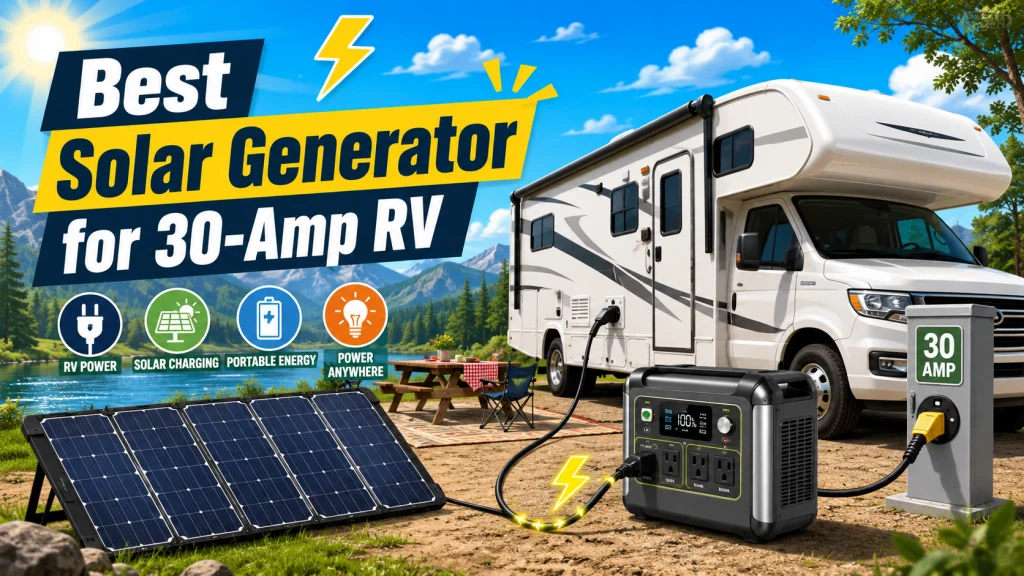
A solar generator outputs power through standard household outlets, typically 20-amp NEMA plugs. Your RV’s shore power inlet uses a 30-amp TT-30 connector, which has a different shape and pin configuration. To connect a solar generator to your RV’s inlet, you need a TT-30P adapter that bridges the gap between the generator’s standard outlet and the RV’s 30-amp inlet. These run between $15 and $20 at any RV supply store, and most of the big hardware chains carry them as well.
I cannot count how many customers came back the day after a purchase confused about why their solar generator wouldn’t connect to their RV. The adapter is not included in the box with any solar generator I’ve ever sold. It’s sold separately, and most product listings don’t mention it. If you’re heading out on a trip where you plan to rely on the solar generator as your shore power, buy the adapter before you leave, not from a gas station convenience store the night you arrive.
One thing the adapter setup makes clear is how the solar generator functions in this context: it’s acting as a portable shore power source. Your RV’s internal 30-amp wiring handles distribution exactly as it would from a campground pedestal. Your circuit breakers, outlets, and appliances all operate normally. The only ceiling that changes is the inverter output rating of the solar generator rather than the service amperage of a campground panel.
Note: The TT-30P adapter connects a standard household outlet on the solar generator’s output to the 30-amp inlet on your RV. It does not change the power delivery capacity. If the solar generator’s inverter is rated to 2,400 watts continuous, that remains the ceiling regardless of what’s printed on the adapter or the RV’s inlet.
Pro Tip: One hidden load worth accounting for: when you feed power to your RV through the shore power inlet, the RV’s onboard converter or charger may automatically start charging the house battery. That can add 30 to 80 watts of background draw depending on the converter model and how depleted the house battery is. It won’t trip the solar generator, but it will reduce your effective runtime. If you want to isolate the solar generator to appliances only and avoid charging the house battery simultaneously, check your RV’s breaker panel for a converter or charger breaker you can disable while the solar generator is in use.

This compact adapter measures roughly 2.4 by 2 by 2.6 inches and lets you plug a 30-amp RV directly into a standard 15-amp home outlet, rated at 125 volts and 1,875 watts. It features a NEMA 5-15P male and NEMA TT-30R female connector setup with durable 14/3-gauge wiring for reliable performance. The contoured non-slip body makes connecting and disconnecting straightforward, and the patented design carries ETL certification to both CSA and UL standards for added safety confidence.
Check On AmazonIf you click this link and buy, we earn a commission at no additional cost to you.
Matching the Right Solar Generator to a 30-Amp RV System
There are two separate specs that matter for a 30-amp RV solar generator setup: continuous inverter output wattage and battery capacity in watt-hours. They solve different problems. The inverter output determines what loads you can run simultaneously. The battery capacity determines how long you can run them before needing a recharge. Buyers commonly focus on one and ignore the other, and both decisions end up mattering.
Continuous Output: Matching the Wattage Tier to Your Use Pattern
For a 30-amp RV solar generator, the useful range of continuous inverter output sits between 2,000 and 3,600 watts. Where you land in that range depends on what you’re running and how comfortable you are with managing simultaneous loads.
- 1,500W continuous: Covers lighting, device charging, the TV, and the refrigerator without trouble. Cannot run the microwave at full power simultaneously without risking an overload trip. Works only if you commit to managing loads carefully and avoiding high-draw appliances while other things are running.
- 2,000W continuous: The realistic starting point for comfortable 30-amp RV use. Runs the microwave with modest other loads active and handles everything in the typical usage table with buffer. This is the floor I’d recommend for most buyers.
- 2,400W continuous: The practical sweet spot. Covers the full range of normal 30-amp RV loads, handles the surge from a refrigerator compressor cycling on, and leaves enough headroom for a second moderate-draw item running at the same time.
- 3,600W continuous: Matches the theoretical maximum of 30-amp service. Worth considering if your use is unpredictable, you’re running multiple high-draw appliances at once, or you want the confidence of full service coverage without load management. Overkill for weekend camping trips with typical loads.
Most buyers end up in the 2,000 to 2,400 watt range and find it covers everything they actually run. The full 3,600-watt continuous units exist for situations where the complete service envelope matters, but the real-world usage data for a 30-amp RV camping trip rarely justifies the additional cost and weight.
Watt-Hour Capacity: How Long You Can Actually Run
Battery capacity determines runtime. A 2,000Wh unit running a total load of 330 watts, which is the fridge, TV, lights, fan, and chargers without the microwave, gives you roughly 4 hours of usable runtime once you account for the 20 percent reserve most manufacturers recommend keeping and the conversion losses at the inverter. Add morning solar recharge from a 200-watt panel in good sun conditions and you recover 800 to 1,000Wh during daylight hours. That math works cleanly for a one-night dry camp without shore power access, especially when you’re not running any high-draw appliances through the night.
A weekend trip without any hookups shifts the math. Averaging 500 watts across the day and night, a 2,000Wh unit depletes in roughly 3.5 hours of continuous draw. For two nights without shore power, you need either more capacity, a higher solar input rate, or both. The broader variables for multi-night dry camping trips, including how to size the solar recharge side and what to expect across different weather conditions, are covered in the guide on choosing the right solar generator for your RV situation.
For a practical capacity starting point: 2,000Wh is the reasonable floor for weekend trips with occasional shore power access. For longer trips or setups with higher average draws, 3,000Wh gives meaningful buffer and supports a more robust solar recharge strategy across multiple days.
Key point: For the majority of 30-amp RV use cases, a solar generator in the 2,000Wh and 2,400W continuous output class handles the full typical load mix without requiring careful management of simultaneous appliances. Size above that for extended boondocking trips or heavier draw patterns.

Starting at 2kWh and expandable to 6kWh with two additional batteries, this LFP station reaches 80% in just 43 minutes via combined AC and solar input. Its 3,000-cycle battery outlasts the industry average by 6 times and includes a 5-year service guarantee. With 2,400W output across 15 outlets and X-Boost pushing to 3,400W, it handles 99% of household appliances at a whisper-quiet 30 dB.
Check On AmazonIf you click this link and buy, we earn a commission at no additional cost to you.
The Air Conditioner: Why This Is Its Own Question Entirely
Every RV owner asks about the air conditioner eventually. The short version: a standard 13,500 BTU RV air conditioner draws 1,200 to 1,500 watts while running and surges to 1,800 to 3,500 watts at startup. That startup surge is what ends most solar generator pairings before they begin. A unit that handles your microwave, fridge, TV, and lights without any trouble may not survive the compressor starting on the air conditioner.
Running RV air conditioning from a solar generator is technically possible, but it requires a specific combination of inverter surge rating, continuous output, and watt-hour reserve to be practical for more than a short window of time. There’s also a hardware shortcut, in the form of a soft starter device installed on the AC unit itself, that dramatically reduces the startup surge and makes compatible units viable that would otherwise trip. None of that is part of the standard 30-amp RV solar generator question. The full breakdown of what it actually takes, what fails in practice, and which setups have been confirmed to work is in the guide on running an RV air conditioner on a solar generator.
For everything else on a 30-amp system, the math works cleanly. Keep the air conditioner as a separate planning decision and the rest of the sizing exercise becomes straightforward.
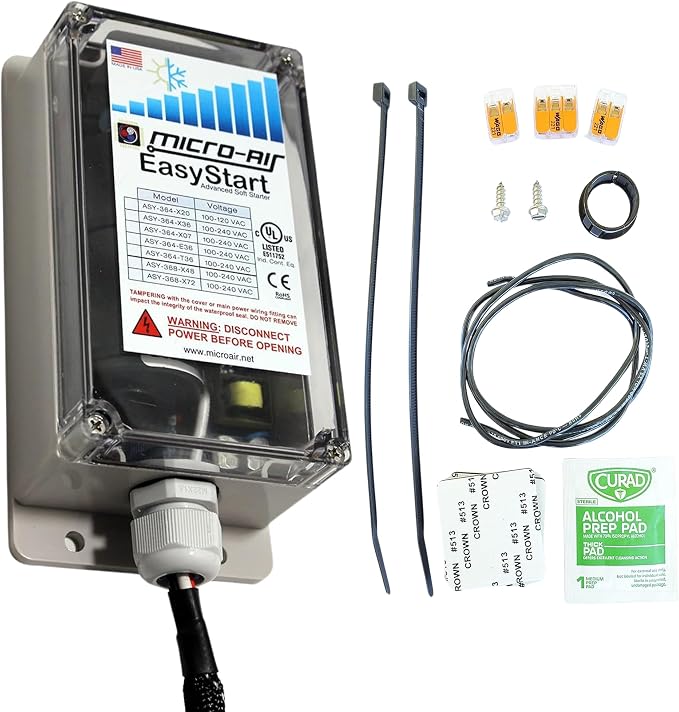
Designed for RV air conditioners up to 13,000 to 15,000 BTU, this compact soft start kit reduces compressor startup current enough to run on a 2,200-watt generator or support two A/C units under 30 total amps on a 30-amp cord. Its smaller footprint compared to similar models makes installation easier and leaves more space inside the unit. Compatible with inverter generators, heat pumps, and refrigeration compressors, it also delivers noticeably quieter startups. Detailed guides and video tutorials are included to simplify setup for all experience levels.
Check On AmazonIf you click this link and buy, we earn a commission at no additional cost to you.
Final Thoughts: One Number, Three Specs, One Adapter
The 30-amp RV solar generator question has a cleaner answer than most buyers expect. Your service ceiling is 3,600 watts. Your real daily loads typically run well under 2,000 watts. You need a TT-30P adapter to connect the unit to your RV’s inlet. You want a continuous inverter output of at least 2,000 to 2,400 watts to handle the realistic load mix without micromanaging appliance use. And 2,000Wh of battery capacity is a reasonable floor for a weekend trip with occasional hookup access. Treat the air conditioner as its own decision and the rest of the selection process becomes manageable.
If you’re still working out which category of solar generator actually fits your broader RV situation before committing to a specific class of unit, the overview of matching a solar generator to your actual use case is a useful starting point. The 30-amp math is one input into that decision, not the whole picture.

Built with N-Type cells at 25% conversion efficiency, this 15.9 lb foldable panel includes a 30 to 60 degree adjustable bracket with an integrated angle guide for optimal sun tracking throughout the day. ETFE coating and an IP68 waterproof rating ensure durability in harsh weather, and the included protective bag makes transport straightforward for camping, trekking, or road trips.
Check On AmazonIf you click this link and buy, we earn a commission at no additional cost to you.
FAQs
⚡ Can a solar generator fully power a 30-amp RV?
Yes, for most typical loads. A 30-amp service delivers a maximum of 3,600 watts simultaneously, and a solar generator with 2,400 watts of continuous output handles the common non-AC loads covered in this guide without much load management. If you need to use the RV’s full 3,600-watt capacity at once, you’d need a unit rated to that output level, but most real-world RV trips never approach that simultaneous draw.
🔌 What adapter connects a solar generator to a 30-amp RV?
You need a TT-30P adapter. It bridges the standard 20-amp household outlet on the solar generator to the 30-amp TT-30 inlet on your RV. These cost between $15 and $20 at RV supply stores, hardware stores, and online retailers. They are sold separately and are not included with any solar generator.
🏕️ How many watt-hours do I need for a 30-amp RV weekend trip?
For a weekend trip with occasional hookup access, 2,000Wh is a practical starting floor. It covers a typical overnight load of fridge, lights, fan, TV, and device charging for roughly 4 to 5 hours at average draw, after accounting for the recommended 20 percent reserve. For a full weekend without any shore power, 3,000Wh with 200 to 400 watts of solar panel input gives you a realistic daily recharge cycle to sustain across two nights.
🌡️ Can a solar generator run an RV air conditioner?
It’s possible with the right unit and setup, but it’s not straightforward. A standard 13,500 BTU RV air conditioner surges to 1,800 to 3,500 watts at startup, which kills most solar generator pairings immediately. A soft starter device installed on the AC unit reduces the startup surge significantly and makes mid-range inverter units viable. The full breakdown of what actually works is in the dedicated guide on running RV air conditioning from solar.
🔋 Does a solar generator actually output 30-amp power to my RV?
Not in the traditional sense. A solar generator outputs standard household AC power through its outlets. The TT-30P adapter physically connects that output to your RV’s 30-amp inlet, but the ceiling on power delivery is still the solar generator’s inverter rating, not the 30-amp label on the adapter. A 2,400-watt continuous inverter delivers 2,400 watts regardless of the connector type used to plug it in.
☀️ Can I recharge a solar generator while camping in my RV?
Yes. You deploy portable solar panels outside the RV, connect them to the solar generator’s solar input port, and the unit charges while parked. A 200-watt panel in 5 to 6 good sun hours adds roughly 800 to 1,000Wh per day. For a weekend trip with modest overnight draw, that daily cycle covers a meaningful portion of what you used the night before. For multi-day boondocking, higher solar input wattage and more battery capacity both become important factors.