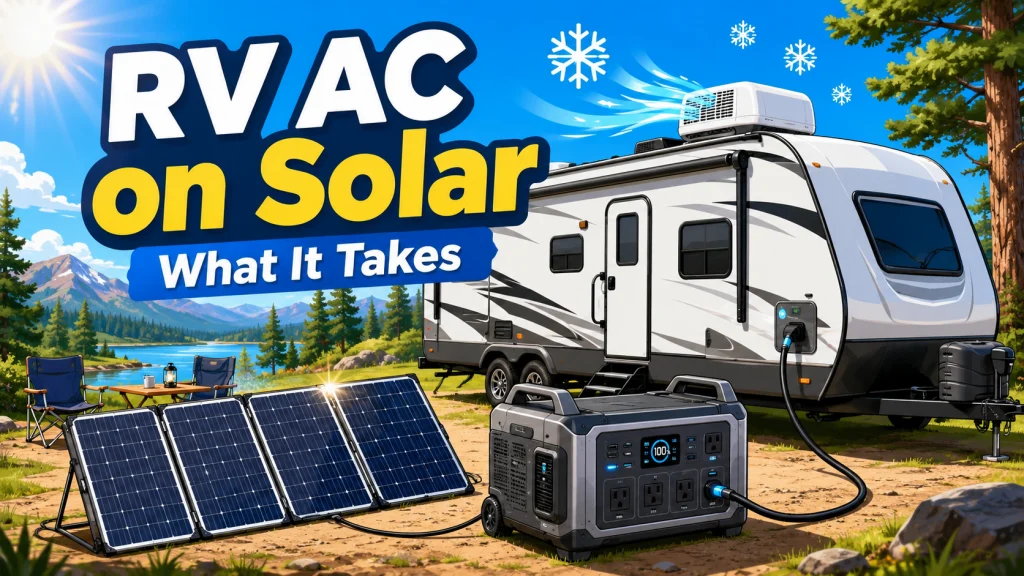
What It Actually Takes to Run an RV Air Conditioner on Solar
Finding the best solar generator to run an RV air conditioner is not a brand question. It is a physics question, and the math is the same regardless of which unit you choose. Two specs determine whether your pairing works at all: the inverter’s surge watt rating and the battery’s usable watt-hour capacity. Get either one wrong and you will trip the inverter on the first startup attempt and spend an afternoon wondering what went wrong.
RV communities with real long-term experience in this space have been consistent on this point. Owners who have tried to run AC from portable solar units report that the power demands are higher than they expected and the runtime shorter than anything the product page suggested. That matches what I saw at the shop. Buyers who came in asking about a solar generator for RV AC were almost always surprised by how much the startup surge alone required, before we even got to how long they wanted to run it.
If you are still working through your overall RV power setup, the guide to choosing the right solar generator for RV use covers the broader electrical context, including the 30-amp vs 50-amp distinction that shapes every buying decision in this category. The air conditioner question is specific enough to deserve its own treatment, which is what this article covers.
The Startup Surge: Why Most Pairings Fail Before Runtime Enters the Picture
A standard 13,500 BTU RV air conditioner, which is the size found on most travel trailers and Class C motorhomes, surges to 1,800 to 3,500 watts when the compressor kicks on. That spike lasts only two to three seconds. But it is enough to trip the inverter on any unit that cannot handle it, and the solar generator shuts down before the AC ever reaches its steady running state. This is not a capacity problem. It is a peak output problem, and they require different solutions.
This was the failure mode I ran into consistently with buyers who had already tried the pairing at home before coming in. The unit looked adequate on paper: a 2,000-watt inverter and 2,000 watt-hours of storage. The problem was the inverter’s surge rating. If it tops out at 4,000 watts and the AC spikes to 3,500 watts on a hot day with a warm compressor, the margin is thin enough that the fault protection can trigger on startup, especially when ambient temperature is high, voltage sags under load, or other loads are running simultaneously. Buyers would come back convinced the unit was defective. In most cases it was not.
Once past the surge, the steady running draw is a different number entirely. After startup, a 13,500 BTU unit runs at 1,200 to 1,500 watts continuously. A 15,000 BTU unit runs closer to 1,500 to 1,800 watts. Those are the figures that determine how long your battery lasts, assuming you successfully start the compressor in the first place.
| AC Size | Startup Surge (no soft starter) | Running Watts | Min Inverter Capacity Needed |
|---|---|---|---|
| 9,000 BTU | 1,300 to 2,200W | 800 to 1,000W | 2,000W continuous, 4,000W surge |
| 13,500 BTU | 1,800 to 3,500W | 1,200 to 1,500W | 3,000W continuous, 5,000W surge |
| 15,000 BTU | 2,500 to 4,500W | 1,500 to 1,800W | 3,500W continuous, 6,500W surge |
These figures assume no soft starter is installed. With a soft starter in place, the surge column drops by 60 to 70 percent across every row, which substantially changes which inverter classes are compatible. That is covered in detail below.
The Runtime Math for Two to Three Hours of RV AC
Assume the surge problem is solved and the AC is running. Runtime becomes the next hard limit. At 1,300 watts average draw for a 13,500 BTU unit, a 3,000Wh battery at 85 percent usable efficiency holds 2,550 usable watt-hours. Divide that by 1,300 watts and you get just under two hours of continuous AC before the battery hits its reserve floor. A 2,000Wh unit at the same efficiency gives approximately 1.3 hours. Neither of those numbers is generous, and they assume the AC is the only load running.
The real-world picture is somewhat better in moderate conditions. When temperatures are reasonable and the RV interior is already somewhat pre-cooled, the compressor does not run at full duty cycle continuously. It cycles on and off to maintain the set temperature, operating at maybe 50 to 70 percent of the time. In those conditions, a 3,000Wh unit stretches to closer to three hours of actual cooling. In a dark-roofed trailer sitting in direct afternoon sun with the compressor running flat out to keep up, you are back near the 1.8-hour figure. Geography and color of your roof matter more than most buyers realize.
To reliably cover two to three hours of RV air conditioner use from a solar generator with a realistic buffer, the minimum usable capacity needed is approximately 2,800 watt-hours. That means a rated battery of at least 3,000Wh to account for efficiency losses and the reserve floor the battery management system enforces. A 2,000Wh unit is not enough for comfortable use with any margin. Buyers who purchase in that capacity class expecting afternoon cool-down sessions in warm weather consistently find themselves cutting the session short or manually shedding other loads to buy a few more minutes.

With a 3,600Wh LFP battery expandable up to 25kWh via extra batteries or smart generators, this station delivers 3,600W across 15 output ports, boosted to 4,500W with X-Boost or 7,200W when two units are paired. A full recharge takes just 1.8 hours via 240V or 2.8 hours with 1,600W of solar input. It may also qualify for the 30% Residential Clean Energy Tax Credit.
Check On AmazonIf you click this link and buy, we earn a commission at no additional cost to you.
Overnight Cooling on a Portable Unit Is Not Realistic
This is the point that needs to be clear before purchase. Running an RV AC through the night at 50 percent duty cycle for eight hours consumes 4,200 to 6,000 watt-hours, depending on unit size and ambient temperature. No single portable solar generator in the category most buyers are considering can sustain this. Most portable units RV buyers realistically shop for sit in the 3,000 to 5,000 watt-hour range, and running nothing but the AC through the night would leave the battery depleted well before 2 a.m.
Long-term RV community members who have run extensive experiments on this have confirmed it consistently. The conclusion across experienced owners is the same: running AC for extended periods is not realistic on any portable unit in the mid-range class. This is not a critique of any particular product. It is a physics constraint that applies equally across every portable solar generator at any price point below a permanently installed battery system. The capacity simply is not there in portable form.
Overnight solar recharge does not solve this either. If you deplete a 3,000Wh battery running the AC, you need to recover the full capacity before the next evening. A 600-watt panel setup in six peak sun hours the following day produces approximately 3,600 watt-hours in ideal conditions. That recovers the battery, but only if you run nothing else on it during the day, and only if the sun cooperates. Several cloudy or humid days can eliminate solar recovery right when you most need predictable cooling. The hybrid approach of a fast AC recharge from shore power or a brief gas generator run is far more reliable for anyone who needs consistent nightly use.

At 3,072Wh with 3,600W output and 7,200W surge capacity, this CTB-built station powers a household for up to 15 hours and keeps a fridge running 1 to 2 days. Its UL-certified UPS switches in under 20 milliseconds, LiFePO4 batteries last 4,000 cycles, and a full recharge takes just 1.7 hours via hybrid input. It is 47% smaller and 43% lighter than comparable 3kWh units.
Check On AmazonIf you click this link and buy, we earn a commission at no additional cost to you.
The Soft Starter: The One Change That Expands What Is Possible
A soft starter is an add-on device installed at the AC unit’s compressor that limits the electrical spike at startup. On a 13,500 BTU unit that normally surges to 3,500 watts, a soft starter brings that initial spike down to approximately 1,100 to 1,400 watts. That single change moves the pairing from incompatible with most portable inverters to workable with any inverter in the 2,000 to 3,000-watt continuous class. It does not change what the AC unit can do. It changes what the solar generator has to absorb in order to start it.
The soft starter does not extend runtime. The running draw stays exactly the same at 1,200 to 1,500 watts. What it eliminates is the inverter fault on compressor startup, which is the barrier that stops most solar generator and RV AC combinations from functioning at all. Without it, buyers with perfectly sized batteries find themselves unable to start the compressor reliably. With it, the same battery and inverter combination is far more likely to start reliably, and continues to do so across the AC’s normal on-off cycling, assuming the inverter and battery are otherwise sized correctly.
Field Note: The most consistent complaint I heard from buyers who had tried running their RV AC on a portable solar generator was that the unit tripped on startup, not that it ran out of capacity partway through. Every time I looked at the specific pairing with them, the issue was the startup surge exceeding the inverter’s peak rating by a margin the spec sheet did not make obvious. In every case I followed up on where the battery and inverter were otherwise large enough, adding a soft starter resolved the startup-trip issue. It was a modest add-on cost compared with the several-thousand-dollar setup people had already bought.
Installation requires accessing the AC unit’s electrical components, which for most RV owners means a short service shop visit or a focused DIY afternoon. Compatibility depends on your specific AC model, so confirm that before purchasing. The time and cost are modest relative to how significantly the change improves the overall setup. For anyone serious about using a solar generator for RV AC on a consistent basis, a soft starter is the foundation the rest of the setup depends on.
For context on how to evaluate solar generators across different use cases beyond RV air conditioning, the full overview at finding the right solar generator for your situation walks through the comparison by use case and what to prioritize at each capacity class.
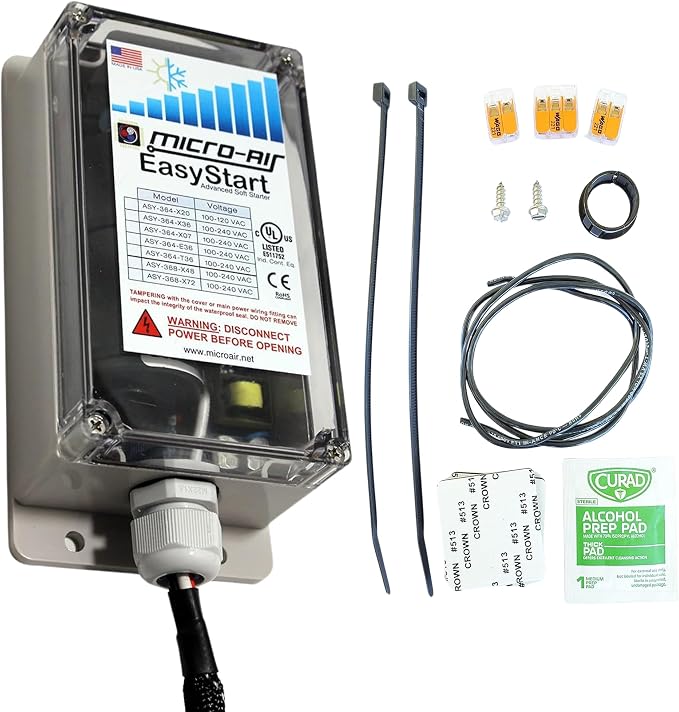
Designed for RV air conditioners up to 13,000 to 15,000 BTU, this compact soft start kit reduces compressor startup current enough to run on a 2,200-watt generator or support two A/C units under 30 total amps on a 30-amp cord. Its smaller footprint compared to similar models makes installation easier and leaves more space inside the unit. Compatible with inverter generators, heat pumps, and refrigeration compressors, it also delivers noticeably quieter startups. Detailed guides and video tutorials are included to simplify setup for all experience levels.
Check On AmazonIf you click this link and buy, we earn a commission at no additional cost to you.
Check Your Own RV AC Before You Buy Anything
Before narrowing down any solar generator purchase, a ten-minute check of your own RV AC unit eliminates a lot of guesswork. The specs you need are usually on the nameplate sticker on the unit itself, inside the access panel, or in the installation manual. Most buyers skip this step and end up sizing to general estimates rather than their actual equipment.
Here is what to verify before comparing units:
- BTU rating. 9,000, 13,500, and 15,000 BTU are the three standard sizes in the RV market. The surge and running watt figures are substantially different between them, so this number drives everything else.
- Running amps or watt draw. Some nameplates list this directly. If yours does, use it rather than the general range estimates in this article.
- Whether a soft starter is already installed. Certain newer RV AC units ship with a built-in soft start function. If yours does, the startup surge is already reduced, and you may be able to run a smaller inverter class than the table above suggests.
- When comparing solar generators, verify that the spec sheet lists both continuous watts and peak surge watts. Reject any listing that only shows one number. Both figures are necessary to determine compatibility with your AC size.
Running the first AC test with all other RV loads switched off is also worth doing. It isolates the AC draw and confirms whether the pairing works before you add back the fridge, fans, and device chargers that will compete for inverter headroom in normal use.

This versatile clamp meter measures AC and DC current, AC and DC voltage, resistance, capacitance, frequency, duty cycle, DC microamps, diode, continuity, and temperature via thermocouple, covering virtually every common electrical measurement in one tool. Non-contact voltage testing is built directly into the clamp jaw for quick and safe circuit checks. Auto-ranging and True RMS technology ensure accurate readings across varying conditions, while a high-visibility reverse-contrast LCD keeps measurements easy to read in any lighting. A side-mounted test lead holder and optional magnetic hanger allow for convenient hands-free use.
Check On AmazonIf you click this link and buy, we earn a commission at no additional cost to you.
Final Thoughts: What a Workable RV AC Solar Setup Looks Like
The setup that actually works looks like this. A solar generator with at least 3,000Wh of rated capacity and a 3,000-watt continuous inverter with an adequate surge ceiling for your AC size. A soft starter installed on the AC unit. In those conditions, two to three hours of real cooling per charge is a reasonable expectation. That covers an afternoon stop with the AC running while you eat, a pre-sleep cooling window before bed, or a mid-drive rest in a parking lot on a hot day. It does not cover sleeping through the night in warm weather on battery alone.
If your situation involves regular dry camping without shore power hookups and you need to think through daily energy balance across multiple days, the article on what a solar generator needs to handle boondocking covers the solar input rates and battery math that apply when no hookups exist. And if you want to understand the full 30-amp system picture before narrowing down to the AC question specifically, the breakdown of what 30-amp RV service actually means for solar generator selection gives the complete electrical context.
The honest answer to whether a solar generator can run an RV AC is yes, for limited sessions, with the right components, and with expectations set correctly before purchase. Here is the short version of what a working setup requires:
- A soft starter installed on the AC unit. Without it, startup surge disqualifies most portable inverters regardless of battery capacity.
- At least 3,000Wh of rated battery capacity. Below that threshold, a 13,500 BTU unit runs less than two hours before hitting the reserve floor.
- An inverter rated for at least 3,000 watts continuous with a surge ceiling appropriate to your AC size. Check the spec sheet for both numbers, not just one.
- Realistic expectations of two to three hours per charge, not overnight. Plan your recharge accordingly.
- A backup recharge plan for cloudy days or full-depletion sessions. Solar alone is not guaranteed recovery after an AC run.
Miss any one of those five elements and the setup will underperform or fail outright. Hit all five and it works consistently within its honest limits.

Built with monocrystalline cells and a 22.4% conversion rate, this 400W panel delivers market-leading efficiency and pairs with EcoFlow power stations to maximize output through MPPT algorithm optimization in any weather. Layered EVA and fiberglass construction earns it an IP68 waterproof and dustproof rating for true all-conditions durability. At 35.3 pounds, it folds into an adjustable carry case for straightforward transport to campsites, job sites, or off-grid locations. It is one of the most capable portable solar options available for high-demand charging needs.
Check On AmazonIf you click this link and buy, we earn a commission at no additional cost to you.
FAQs
❄️ Can a solar generator run an RV air conditioner?
Yes, with conditions. You need at least 3,000Wh of battery capacity, a 3,000-watt continuous inverter with an adequate surge rating, and a soft starter installed on the AC unit. Without the soft starter, the startup surge trips most portable inverters before runtime is ever a factor. Expect two to three hours of cooling per charge, not overnight operation.
🔋 How many watt-hours does a 13,500 BTU RV air conditioner use per hour?
At full continuous draw, a 13,500 BTU RV AC consumes approximately 1,200 to 1,500 watt-hours per hour of clock time. In moderate conditions where the compressor cycles at 50 to 70 percent duty cycle, real-world consumption is closer to 700 to 900 watt-hours per hour. Higher ambient temperatures push duty cycle toward 100 percent and increase consumption accordingly.
⚡ Why does my solar generator trip every time I try to start the RV AC?
The startup surge is almost certainly the cause. A 13,500 BTU RV AC spikes to 1,800 to 3,500 watts for two to three seconds when the compressor starts. If that exceeds your inverter’s peak surge rating, the fault protection trips and the unit shuts down. The fix is a soft starter at the AC unit, which reduces the startup spike by 60 to 70 percent and brings it within range of most portable inverters.
🌙 Can I run my RV air conditioner overnight on a solar generator?
Not on any single portable solar generator that most RV buyers are realistically shopping for. Overnight AC at 50 percent duty cycle for eight hours consumes 4,200 to 6,000 watt-hours. Most portable units sit in the 3,000 to 5,000 watt-hour range and would be fully depleted before morning with no other loads running. Overnight cooling requires a permanently installed battery system with significantly higher capacity.
🛠️ How much does a soft starter reduce RV AC startup surge?
A properly matched soft starter reduces startup surge by 60 to 70 percent. On a 13,500 BTU unit that normally spikes to 3,500 watts, a soft starter brings that down to approximately 1,100 to 1,400 watts. That change makes a 2,000 to 3,000-watt inverter class compatible with AC startup. Check compatibility with your specific AC model before purchasing, as not all soft starters fit all units.