The Spec That Changes When Shore Power Is Gone
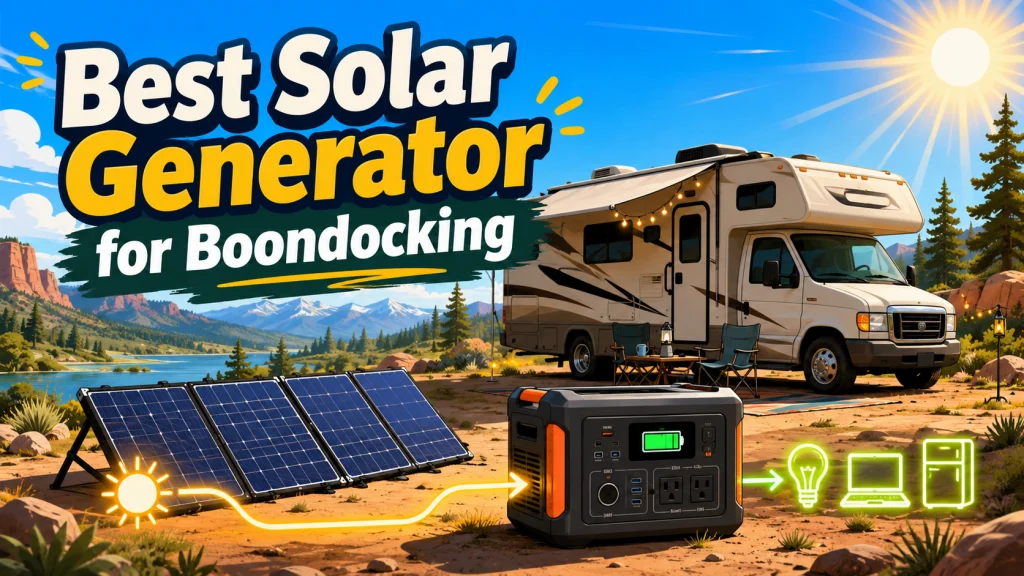
The best solar generator for boondocking is not necessarily the one with the largest battery. That surprises most buyers, because watt-hours is the number everyone focuses on. But when you are dry camping without any hookup and your only recharge source is sunlight, the real constraint is how fast your unit can absorb that energy. That number is maximum solar input wattage, and it is the one most buyers do not check until they are already stuck on day two watching the battery slowly lose ground.
Here is the math that makes this concrete. A 2,000Wh unit that accepts a maximum of 200W solar input takes 10 hours to fully recharge at rated panel output. Real-world panel output runs at 70 to 80 percent of rated due to heat, panel angle, and weather haze, which pushes the actual recharge window closer to 12 to 13 hours of direct sun. You do not get 12 hours of usable direct sun at a campsite. In most of the US, a good summer day gives you 5 to 6 peak solar hours. That means a 200W-limited unit is recovering 1,000 to 1,200Wh on a good day, not 2,000Wh. If your daily draw exceeds that number, you are losing ground from the first morning.
Field Note: The most common boondocking mistake I ran into was buyers comparing units by watt-hours and stopping there. Someone would come in having done their homework on capacity and completely missed the solar input spec. A 3,000Wh unit with a 200W solar input cap performs worse on a five-day boondocking trip than a 2,000Wh unit with 400W input. The higher-input unit keeps up with daily draw. The other unit is just a larger tank that empties more slowly, and it still empties.

Starting at 2kWh and expandable to 6kWh with two additional batteries, this LFP station reaches 80% in just 43 minutes via combined AC and solar input. Its 3,000-cycle battery outlasts the industry average by 6 times and includes a 5-year service guarantee. With 2,400W output across 15 outlets and X-Boost pushing to 3,400W, it handles 99% of household appliances at a whisper-quiet 30 dB.
Check On AmazonIf you click this link and buy, we earn a commission at no additional cost to you.
What a Self-Sustaining Setup Actually Looks Like
The goal for multi-day boondocking is a net-positive daily energy balance: what you gain from solar during the day exceeds what you drew through the previous night and day. When you hit that balance, the trip is theoretically indefinite, constrained only by weather and your loads. When you fall short of it, you are on borrowed time, burning through battery reserve a little further each day.
Work through the numbers on a realistic no-fridge setup. A CPAP running without the humidifier draws around 25 to 30W for eight hours of sleep: 200 to 240Wh overnight. LED lighting for four hours in the evening adds 120Wh. A small fan running through the night and into the afternoon adds another 200Wh. Phone and laptop charging across the day adds roughly 90Wh. Total daily draw: around 600 to 650Wh. Now check what 400W of solar produces in five peak sun hours: 2,000Wh rated, 1,400 to 1,600Wh real-world at 70 to 80 percent efficiency. Net gain on a good sun day: 750 to 1,000Wh. That is a genuinely self-sustaining setup with substantial buffer.
| Solar Input (Rated) | Real-World Output/Hour | Daily Gain at 4 Sun Hours | Daily Gain at 6 Sun Hours |
|---|---|---|---|
| 200W | 140 to 160W | 560 to 640Wh | 840 to 960Wh |
| 400W | 280 to 320W | 1,120 to 1,280Wh | 1,680 to 1,920Wh |
| 600W | 420 to 480W | 1,680 to 1,920Wh | 2,520 to 2,880Wh |
| 800W | 560 to 640W | 2,240 to 2,560Wh | 3,360 to 3,840Wh |
The table shows why 400W-plus input is the practical minimum for multi-day boondocking with real loads. At 200W and four peak sun hours, you are recovering 560 to 640Wh on a good day. If your daily draw is 650Wh, you are barely covering it at 200W on a four-hour sun day, and falling behind on anything less. At 400W in the same conditions, you are comfortably ahead even on an average sun day.
Cloudy days shift the math significantly and are where battery capacity becomes the backstop. On a heavily overcast day, panel output drops to roughly 15 to 20 percent of rated, roughly 60 to 80W from a 400W array instead of 320W. That gets you 300 to 400Wh for the whole day rather than 1,600Wh. This is what your battery reserve exists to cover. A 3,000Wh unit can absorb two consecutive poor-sun days at a 650Wh daily draw without hitting the 20 percent floor. A 1,000Wh unit may survive one poor-sun day, but it has very little margin if the weather stays bad into the next morning.

This compact plug-in monitor tracks the energy consumption of any AC 115-volt appliance and displays real-time readings of volts, amps, and wattage at 0.2 to 2.0 percent accuracy. Its large LCD screen lets you calculate electricity costs by the day, week, month, or year, making it easy to spot energy-hungry devices and trim your utility bill. It is also compatible with inverters, adding flexibility for off-grid setups.
Check On AmazonIf you click this link and buy, we earn a commission at no additional cost to you.
What to Look for in a Boondocking Unit
Boondocking creates a specific spec hierarchy that is different from emergency home backup or even general camping. Home backup buyers can afford to weight capacity heavily because they have wall-outlet recharging between events. Boondockers cannot. If you are shopping with dry camping specifically in mind, here is the order things actually matter, based on watching buyers come back after their first trip did not go as planned.
- Maximum solar input wattage: This is the ceiling on how fast you recover each day. Look for 400W minimum for modest loads, 600W or higher if you run a continuous 12V compressor fridge or want meaningful buffer in partly cloudy conditions. It must match or exceed what your panel array can produce, and adding more panels than the unit’s input limit generates zero additional benefit. Most portable camping units cap out at 200 to 400W. Some larger off-grid-oriented units accept 600W to 1,600W. Check the spec sheet and not the marketing summary.
- Battery capacity for cloudy-day buffer: After input rate, capacity determines how many poor-sun days you can absorb before hitting the reserve floor. For a daily draw of 650Wh, a 3,000Wh battery gives you roughly four days of cloudy-day buffer at a 20 percent reserve. A 1,500Wh battery gives you under two days.
- LiFePO4 chemistry: A boondocking unit cycles hard. It charges and discharges every day across the trip. LFP handles this better than NMC on several fronts: more rated cycles over the battery’s lifetime, better thermal performance in heat, and a flatter discharge curve that gives you more usable capacity at the low end of the charge range. For a use case defined by daily cycling, chemistry is not a secondary consideration.
- DC output for 12V fridge: If you run a 12V compressor fridge, connecting it via the unit’s DC output bypasses the inverter. No inverter means no inverter conversion loss, and no inverter idle draw running in the background. In a boondocking setup where the fridge runs 24 hours a day, eliminating those losses makes a real difference across a week-long trip.
- Confirmed pass-through efficiency: Some units run hotter during simultaneous charge-and-discharge than others, and that heat represents energy lost before it ever reaches your loads. Look for units with confirmed low pass-through loss if you plan to run loads while solar is actively charging, which is most of the daylight hours on a boondocking trip.
None of these specs appear prominently on most product pages. They are buried in the technical specs tab, listed in footnotes, or absent entirely, which means you need to dig before you buy. The buying process for a boondocking-specific unit is more research-intensive than for home backup, where you can make a solid decision by looking at Wh and inverter watts. Take the extra time here. It saves a ruined trip.
If you are still working out how your RV’s electrical system interacts with a portable solar setup, the guide on matching a solar generator to your RV’s power requirements covers the 30-amp and 50-amp amperage realities and what a portable unit can and cannot replace in an RV context.

Featuring 16BB N-Type cells at 25% efficiency, this panel outperforms standard 200W panels and folds down to backpack size at just 13.89 lbs, with a magnetic closure for tool-free setup. Three built-in ports including USB-C PD 45W, and two USB-A ports charge devices directly, while MC4 output connects to most power stations and 12V battery systems. Four adjustable kickstands offer 40, 50, and 60 degree angles, and IP65 rating plus UL 61730 certification ensure durability and safety backed by a 2-year warranty.
Check On AmazonIf you click this link and buy, we earn a commission at no additional cost to you.
Portable Panels vs Roof Mounting
Most boondockers running a portable solar generator opt for ground-deployed panels rather than a permanent roof mount. The reason is practical. A fixed roof install on a travel trailer or camper van requires unobstructed south-facing roof space, weather sealing around penetrations, cable routing from roof to interior, and a charge controller wired into the system. That is a legitimate installation project, not an afternoon setup.
Two 200W foldable panels give you 400W input, deployable anywhere on the campsite for optimal angle, without any modification to the vehicle. You set them on the ground facing south, tilt them toward the sun, and run the input cable into the unit. For boondockers rotating through different sites with varying layouts and tree cover, the flexibility often outperforms a fixed install. The one issue worth taking seriously is wind. Foldable panels at ground level will fall over in sustained wind if they are not weighted or staked, and panels falling mid-day cut directly into your daily gain. Use a weighted base or tent stakes through the panel legs before you walk away from the setup.
Pro Tips: Panel angle matters as much as panel count. Facing due south at an angle roughly equal to your latitude captures significantly more energy than a flat-on-the-ground deployment. A 400W array properly angled often outperforms a 600W array lying flat. Spend two minutes adjusting the tilt when you set up camp and you gain measurable watt-hours across the day without adding a single panel.
Sizing for Your Specific Boondocking Use Case
The right unit depends on what you actually run at camp. Boondocking is not one thing. A couple using a camper for weekend trips with lighting, device charging, and a CPAP without the humidifier has fundamentally different power needs than a family running a compressor fridge continuously across a ten-day stretch in July. Sizing for the average boondocker means sizing for your loads, not someone else’s.
Modest loads with no continuous fridge
Lighting, device charging, CPAP without humidifier, and occasional small fan use comes to roughly 300 to 500Wh per day for a typical two-person trip. A 2,000Wh unit with 400W maximum solar input handles this comfortably in average US sun conditions. You recover overnight draw on a normal sun day, build buffer on a good one, and have a full 2,000Wh reserve to absorb a cloudy stretch. This is the most common boondocking setup and the easiest to size for. The main thing to verify before buying is that the unit actually accepts 400W of solar input, because not all 2,000Wh units do.
Running a 12V compressor fridge continuously
A 12V compressor fridge averaging 50W across 24 hours adds 1,200Wh to your daily energy budget. That pushes total daily demand for a typical boondocking load set to 1,500 to 2,000Wh per day. At that level, you need at least 600W of solar input to stay net positive in average conditions, and 3,000Wh or more of battery to absorb two consecutive cloudy days without hitting the reserve floor. The math works at this scale, but it requires a unit in the higher input tier, and not all 3,000Wh units hit that threshold. A 3,000Wh unit with a 200W input cap is still losing ground at a 1,500Wh daily draw. Check the input spec before assuming a large battery means a large recharge rate.
For anyone considering boondocking as part of a full-time RV lifestyle, the sizing math shifts again. Running a portable solar generator through daily charge cycles year-round puts different demands on battery chemistry and expandability than a weekend trip does, and the unit selection that makes sense for occasional dry camping may not hold up as a full-time solution.

This 22.27 lb compressor fridge cools from 77 to 32 degrees Fahrenheit in just 15 minutes and reaches -5 degrees in 50 minutes, with no ice needed. ECO mode draws under 36W and MAX mode stays below 45W, consuming less than 1kWh per day. Three-level battery protection prevents vehicle battery drain, and a 45 dB noise level plus 30-degree incline tolerance make it reliable for RVs, trucks, and off-road use. Includes AC and DC power cords with 2-year tech support.
Check On AmazonIf you click this link and buy, we earn a commission at no additional cost to you.
Final Thoughts: Size Both Numbers, Not Just One
The practical takeaway from all of this is that solar input wattage and battery capacity serve different functions in a boondocking setup, and you need both sized correctly. Capacity is your buffer for bad weather and overnight draw. Input rate is your daily recovery. If the input rate cannot match your daily draw, more capacity just delays the outcome. It does not change it.
The framework I use is straightforward. Estimate your daily draw. Find a unit whose maximum solar input can realistically recover that draw across four to six peak sun hours in your typical camping region. Then size the battery to cover two days of that draw at the 20 percent reserve floor. If you are buying your first boondocking unit and are not confident in your load estimate, round up on both specs. The penalty for oversizing is a heavier unit. The penalty for undersizing is a dead battery on day three with three days left on the trip.
One thing boondocking cannot sustainably support on portable solar, regardless of unit size, is air conditioning. An RV rooftop AC unit draws 1,000 to 1,500W continuously. Running it for eight hours overnight consumes more than most portable solar generators hold, and solar cannot replenish that in a day. If hot-climate cooling is central to the plan, that is a permanently installed battery bank conversation, not a portable solar one. Everything else in a typical boondocking load set is solvable with the right unit and the right panel setup. If you are still working out which solar generator category fits your situation overall, understanding how solar generator sizing applies across different use cases gives you the broader context before drilling into boondocking specifically.

Delivering 3,600W of continuous output with 7,200W surge capacity, the DELTA 3 Ultra runs refrigerators, microwaves, heaters, and power tools with near-silent operation at just 25dB under load. Its under-10-millisecond UPS switching keeps sensitive devices like PCs, routers, and medical equipment running seamlessly during outages with no manual setup required. Four charging options including wall outlet, solar, car input, and EcoFlow Smart Generator keep it topped up and ready. Built on an LiFePO4 battery with EV-grade construction and 24/7 battery protection, it is rated for 10 years of daily use in extreme conditions.
Check On AmazonIf you click this link and buy, we earn a commission at no additional cost to you.
FAQs
⚡ What size solar generator do I need for boondocking?
For modest loads without a continuous fridge, a 2,000Wh unit with at least 400W maximum solar input handles most boondocking setups in average conditions. If you run a 12V compressor fridge full-time, step up to 3,000Wh with 600W-plus of solar input capacity to stay net positive across multiple days.
☀️ How many solar panels do I need for boondocking?
Two 200W panels (400W total) is the practical minimum for multi-day boondocking with real loads. At 400W and five peak sun hours, you recover 1,400 to 1,600Wh per day at real-world efficiency, which is enough to recover overnight draw and build a daily buffer. Check that your unit’s maximum input limit actually accepts 400W before buying the panels.
🌥️ What happens if it is cloudy while boondocking?
Heavy overcast drops panel output to roughly 15 to 20 percent of rated, about 60 to 80W from a 400W array. Your battery reserve covers the shortfall. A 3,000Wh unit gives you two-plus days of buffer at a typical boondocking draw before hitting the 20 percent reserve floor. A 1,000Wh unit runs out of margin after one poor-sun day.
🧊 Can I run a 12V fridge while boondocking on solar?
Yes, if the math supports it. A 12V compressor fridge averaging 50W draws about 1,200Wh per day. Add your other loads and you are typically looking at 1,500 to 2,000Wh daily. That requires 600W-plus of solar input and 3,000Wh-plus of battery to stay self-sustaining in average conditions. Running the fridge via DC output also eliminates inverter conversion losses, which helps the numbers.
❄️ Can a solar generator run an RV air conditioner while boondocking?
Not sustainably for extended periods. A standard 13,500 BTU RV AC draws 1,200 to 1,500W running and surges higher at startup. Running it overnight consumes more than most portable solar generators hold and more than most solar arrays can replace in a day. Boondocking with full AC cooling reliably requires a permanently installed battery bank.
🏕️ Do I need to permanently mount solar panels on my RV for boondocking?
No. Ground-deployed portable panels work well for most boondocking setups and offer better flexibility for optimizing sun angle at each campsite. The main thing to watch for is wind, as lightweight foldable panels need to be weighted or staked at the base or they will fall over. A roof mount makes sense if you want a set-and-forget solution and have the unobstructed roof space for it.
🔋 Is solar input wattage really more important than battery capacity for boondocking?
For multi-day trips, yes. Battery capacity determines your buffer for cloudy days and overnight draw. Solar input rate determines whether you can recover that buffer each day. A large battery with a low input ceiling slowly depletes over a multi-day trip regardless of available sun. Both specs matter, but input rate is the one most buyers miss.