What Six Years Behind the Counter Taught Me About the Big Four
When I was running the retail floor, customers would arrive clutching a phone with a browser tab open to one of four brand names: Jackery, EcoFlow, Bluetti, or Anker. By 2023, those four brands accounted for the overwhelming majority of what buyers came in already knowing about. The opinions they had formed were mostly based on affiliate list articles, and almost all of those articles had a commission riding on what they recommended.
What I could offer that those articles could not was context from watching these units come back. Customers who bought from us returned with questions, issues, and real-world numbers from their monitoring apps. I saw failure patterns, customer service experiences, and what the spec sheets did not predict. That is what I am writing from here.
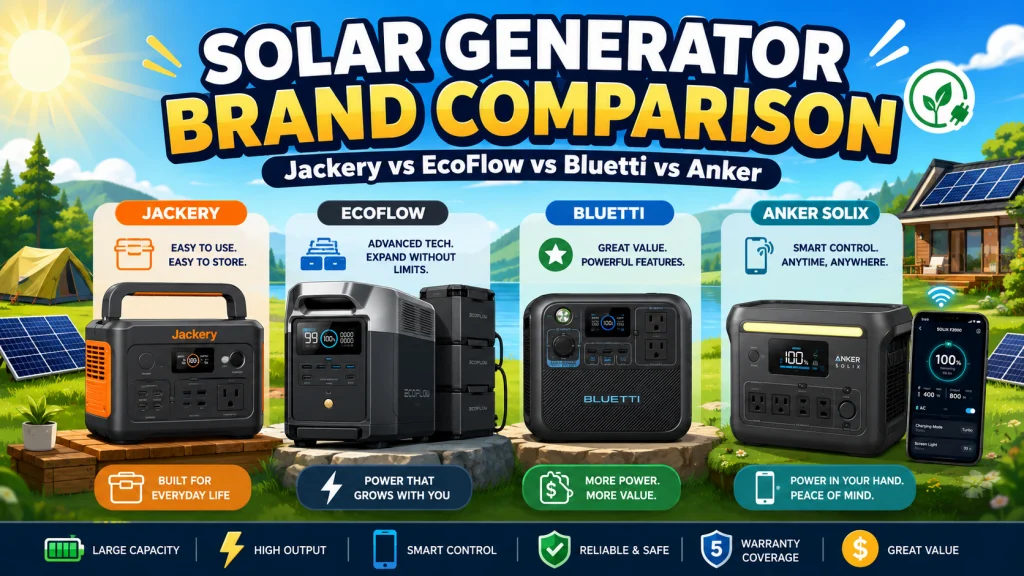
All four brands are worth considering. None of them is right for everyone. Here is what distinguishes each one in practice, starting with the brand most buyers encounter first.
Jackery: The One Most People See First for a Reason
Jackery is the most widely available solar generator brand in the US by a meaningful margin. If you have walked through a Home Depot, a Costco, or a Best Buy in the last four years, you have seen a Jackery unit on the shelf. That retail presence is not an accident, and it is not nothing. For buyers who want to see the product in person before purchasing, or who want a straightforward return process through a major retailer, Jackery’s distribution network is a genuine advantage that none of the other three brands match at this scale.
The technology feature I watched register most with returning customers was ZeroDrain, Jackery’s standby mode that the company rates at holding 95 percent of charge after a full year of storage. For emergency preparedness buyers who charge a unit and put it away for months at a time, that matters in a way that day-to-day users might not appreciate. Seasonal cabin owners and people keeping a unit in the garage as outage insurance consistently appreciated this more than any other spec I showed them.
The price pattern worth knowing: Jackery tends to list at or near MSRP between major sales events and discount more aggressively than almost any other brand during those windows. Black Friday, Prime Day, and pre-hurricane-season promotions have consistently produced the largest absolute price drops on Jackery units. If you are not in a hurry, waiting for one of those windows and then buying at a major retailer with a solid return policy is the play most informed buyers make.
Field Note: The most common Jackery buyer complaint I saw at the counter was not about the product itself. It was about buying at regular price and then seeing the same unit on sale three weeks later. If you are considering Jackery, set a price alert and be patient. The discount will come.
Where Jackery Stands on Features vs the Competition
Jackery’s units are reliable and well-built, but the brand has historically been more conservative on software features than EcoFlow, and the expandable ecosystem, while it exists at the higher end, is less developed than EcoFlow’s. For buyers whose primary question is “will it work, can I get it locally, and what happens if something goes wrong,” Jackery answers all three more directly than its competitors. For buyers who want the most technology features at a given price point, the calculation is different.

Weighing just 23.8 lbs with a foldable handle, this 1,070Wh LFP power station delivers 1,500W of pure sine wave AC output with a 3,000W surge capacity, capable of running AC units, fridges, and electric pots. Its LFP battery sustains over 70% capacity after 4,000 cycles, translating to a lifespan of more than 10 years. Via the Jackery App, you can enable a full charge in as little as one hour, or switch to a whisper-quiet 30 dB overnight mode. Six output ports including two USB-C with 100W PD charging cover nearly any device simultaneously.
Check On AmazonIf you click this link and buy, we earn a commission at no additional cost to you.
EcoFlow: The Technology Leader, With a Specific Ecosystem Advantage
EcoFlow is the brand I would point to first for buyers whose priority is technology features. The UPS switchover time on their mid-to-upper-range units, I have seen the DELTA 2 Max confirmed at 20 milliseconds, is the best documented among the major brands for home office and sensitive electronics use. If you need a solar generator to act as a genuine uninterruptible power supply for a NAS drive, a work desktop, or a router that cannot tolerate a restart, EcoFlow’s switchover specification is the one to compare against. I cover the full UPS comparison in detail in my breakdown of solar generators with UPS capability.
The expandable ecosystem is the other area where EcoFlow leads the category. Their DELTA Pro platform accepts dedicated EcoFlow expansion batteries that stack capacity in a way no competitor currently matches at the same level of integration. The maximum solar input rating on their higher-end units, confirmed at 1,600W on the DELTA Pro, is also the ceiling I reach for when I explain how to size a solar input array. For buyers who want to build toward a larger off-grid capable system over time, EcoFlow’s platform architecture is the most developed among the four brands.
The app is consistently rated well by real users, and the remote monitoring capability, being able to see real-time draw, state of charge, and input wattage from a phone, is genuinely useful for anyone managing a system rather than just plugging things in. I have used EcoFlow’s monitoring app on my own homestead and it gives me data I could not get otherwise without dedicated monitoring hardware.
Field Note: The one EcoFlow quirk worth knowing before purchase: their expandable ecosystem uses fully proprietary connections. EcoFlow expansion batteries work only with EcoFlow base units. If you build into this platform and later want to switch brands, the expansion batteries do not transfer. That is worth pricing in before committing. I cover the expansion cost math in more detail in my guide to expandable solar generator platforms.
EcoFlow and Customer Service
EcoFlow’s US service infrastructure is solid, and their warranty process is generally handled without the friction patterns I saw more consistently with Bluetti. That said, their pricing at MSRP runs high, and the discount pattern is less predictable than Jackery’s. If EcoFlow is the right fit for your use case, buying at a confirmed sale event is advisable.

Starting at 2kWh and expandable to 6kWh with two additional batteries, this LFP station reaches 80% in just 43 minutes via combined AC and solar input. Its 3,000-cycle battery outlasts the industry average by 6 times and includes a 5-year service guarantee. With 2,400W output across 15 outlets and X-Boost pushing to 3,400W, it handles 99% of household appliances at a whisper-quiet 30 dB.
Check On AmazonIf you click this link and buy, we earn a commission at no additional cost to you.
Bluetti: The Features-Per-Dollar Leader, With a Customer Service Caveat
Bluetti is the brand where the product and the support experience diverge most clearly. At purchase time, Bluetti units consistently offer more specifications per dollar than Jackery or EcoFlow at equivalent price points: more capacity, more input ports, more output options. For buyers who are comparing spec sheets and want the most hardware for a given budget, Bluetti often comes out ahead on paper. The Elite 200 V2 was named the best premium solar generator for 2025 by SolarReviews.com, and that designation is based on product quality, not support experience.
The support experience is where I would set expectations carefully. In the retail environment, Bluetti generated more customer service complaints than any other brand we carried. The Ford Transit USA forum documented this pattern as recently as September 2024, with Bluetti getting the worst customer service reviews among the big four, consistently, over time. That does not mean every support interaction goes badly, but it means the variance is higher and the floor is lower than with Jackery or EcoFlow when something does go wrong.
The buyer profile where Bluetti makes the most sense: someone who has done enough research to understand what they are buying, is buying a size class they are unlikely to need support on, and is primarily optimizing for features and capacity at a given price point. For that buyer, Bluetti is genuinely competitive. For someone buying their first solar generator and wanting the full support safety net, the calculus is less clear.
| Brand | Strongest at | Customer service track record | Price-to-spec ratio |
|---|---|---|---|
| Jackery | Retail availability, ZeroDrain storage, seasonal discounts | Solid, US infrastructure | Mid: premium MSRP, strong sale pricing |
| EcoFlow | UPS switchover, expandable ecosystem, solar input ceiling | Good, US infrastructure | High MSRP, less predictable discounts |
| Bluetti | Features and capacity per dollar at purchase | Worst documented among big four | Best spec-per-dollar, especially mid-range |
| Anker Solix | App quality, remote monitoring, idle drain efficiency | Mixed; shortest warranty (verify current terms) | Competitive mid-range pricing |

At 1,024Wh with 2,000W continuous output and 3,000W peak, this station powers up to 10 devices at once across a full suite of ports. HyperFlash charging fills it in just 49 minutes via AC, or 1.8 hours with 600W of solar. The UPS switchover triggers in under 10 milliseconds, and the LiFePO4 battery holds 80% capacity after 4,000 cycles for a 10-year lifespan.
Check On AmazonIf you click this link and buy, we earn a commission at no additional cost to you.
Anker Solix: The App and Monitoring Leader, With Two Known Quirks
Anker Solix is the newest of the four brands to reach serious scale in the solar generator market, and it shows in both directions. The app and remote monitoring experience is the best of the four brands by most real-owner accounts. The interface is cleaner, the data is more granular, and the OptiSave idle drain management is genuinely notable. As of May 2026, ESS News confirmed Anker’s idle drain at 6W in active standby mode and 2W with outputs disabled, which is competitive with the best low-drain figures in the category. For buyers who care about parasitic draw during extended storage or light-use periods, that is meaningful.
The two known quirks are worth documenting before purchase. The first is a confirmed Wi-Fi issue on certain units: after a full discharge-to-zero followed by solar recharge, the Wi-Fi module on some configurations does not come back online automatically and requires a manual reset. This was documented on Slickdeals in October 2025 and is not universal, but it is real. If you are relying on remote monitoring during an off-grid period and the unit discharges fully, this matters.
The second is the return and purchase channel consideration. A Slickdeals commenter in October 2025 noted that some Anker listings carry non-returnable terms and preferred buying through eBay over direct purchase for that reason. Always verify the return and warranty terms before committing to an Anker Solix purchase, since these can vary by sales channel.
Key point: Anker Solix carries a shorter standard warranty than EcoFlow or Jackery on most units. This is a real difference, not a minor footnote. Check the current warranty terms on the specific unit you are considering before treating it as equivalent to the competition in this regard.

This 1152Wh LiFePO4 station outputs 1800W across 8 outlets and can be boosted to 2700W through the BLUETTI app for demanding appliances. A full AC charge takes just 1 hour at 1440W input, or 2.8 to 3.3 hours with up to 500W of solar. It doubles as a home UPS with a 20-millisecond switchover for emergency backup. Comes with a 5-year warranty and all essential charging cables included.
Check On AmazonIf you click this link and buy, we earn a commission at no additional cost to you.
Customer Service Across All Four Brands: What the Data Says
Customer service is one of those categories where the story in retail is different from the story in online reviews. In online reviews, all four brands look roughly similar because unhappy customers over-index and the distribution of complaints is hard to weight. In a retail environment where you watch the return patterns and hear from the same customers over time, the picture is more specific.
EcoFlow and Jackery both have meaningful US-based service infrastructure, and the majority of warranty interactions I observed with those two brands resolved without extended friction. That does not mean problems never occur, but the floor is consistently higher. Bluetti, as noted, is the outlier on the downside. The pattern of poor service experiences is documented across multiple communities and multiple years, and is worth weighing explicitly against the spec-per-dollar advantage. Anker is newer to this scale and their service track record is still developing; the warranty terms being shorter than competitors is the structural concern, regardless of how any individual interaction goes.
My general observation: for a unit you are counting on during a real outage, the post-purchase support reality matters more than it does for a discretionary purchase. A solar generator that fails during a three-day ice storm with a slow-resolution support process is a worse outcome than paying slightly more for a brand with faster resolution. That weighting is personal, but it is worth making deliberately rather than assuming all four brands are equivalent here.
How to Use This Comparison to Make a Decision
The practical shortcut I used at the counter was a four-question filter. First: does retail availability and in-person support matter to you? If yes, Jackery wins that category by a large margin. Second: are you running home office equipment, a NAS, or anything that requires seamless UPS-grade power switching? If yes, look at EcoFlow’s switchover specs first. Third: is maximizing capacity and features per dollar the primary objective and you are comfortable buying from an online-only channel? Bluetti is worth a close look, with the support caveat fully priced in. Fourth: is app quality and remote monitoring central to how you want to manage your setup? Anker Solix is the strongest answer there, with the warranty and Wi-Fi quirk known in advance.
Most buyers are not purely in one category. A car camper who also wants emergency home backup has a different weighting than an off-grid cabin owner who will never be near a service center. That is why I wrote this as a differentiator breakdown rather than a ranking. Rankings collapse the distinction between use cases in a way that does not serve the buyer.
If you are still working out which price tier makes sense before you settle on a brand, the overview of solar generators by value tier covers where the different brands compete within budget ranges. For buyers whose ceiling is around $1,000, the specific options in the under-$1,000 category show how the brand differentiation plays out at that specific price point.
Field Note: The single most useful question you can ask yourself before picking a brand is: what happens to my situation if this unit fails after 14 months and I need support? If the answer is “that would be a serious problem,” let that weight your brand decision toward the stronger service track records. If the answer is “I have enough margin that I can absorb the inconvenience,” the spec-per-dollar calculation opens up more options.

This 220V monitor handles up to 16 amps and reads down to 0.01W resolution at Class 1.0 accuracy, detecting loads as low as 0.20W to catch even standby draw. A backlit LCD with built-in memory retains cumulative kilowatt-hour data through power interruptions. Fire-retardant ABS housing and a 1-year warranty round out a reliable package.
Check On AmazonIf you click this link and buy, we earn a commission at no additional cost to you.
Final Thoughts
I have sold and lived on units from all four of these brands. None of them has earned its reputation by accident and none of them is the right choice for everyone. The honest summary: Jackery for accessibility and long-term storage; EcoFlow for technology features and expandability; Bluetti for maximum specification per dollar if you are a confident buyer; Anker Solix for the best monitoring experience and idle efficiency, with warranty terms verified in advance.
Pick the one that best matches the use case you are actually planning for. That is a more useful frame than any ranking I could hand you.
FAQs
⚡ Which brand is best for home backup power?
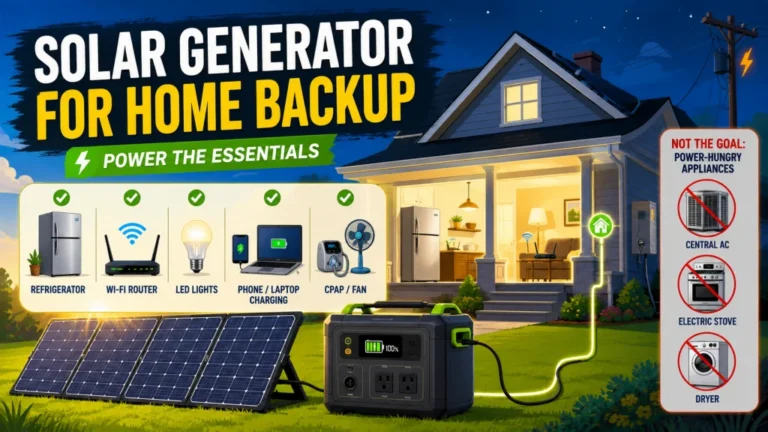
It depends on which aspect of home backup matters most. For seamless switchover during power cuts, particularly relevant for home office equipment and sensitive electronics, EcoFlow has the strongest confirmed UPS performance. For retail availability and ease of return if something goes wrong, Jackery is the most accessible. For maximum capacity at a given budget, Bluetti competes well if you are comfortable with the support trade-off.
🏕️ Which brand is best for camping?
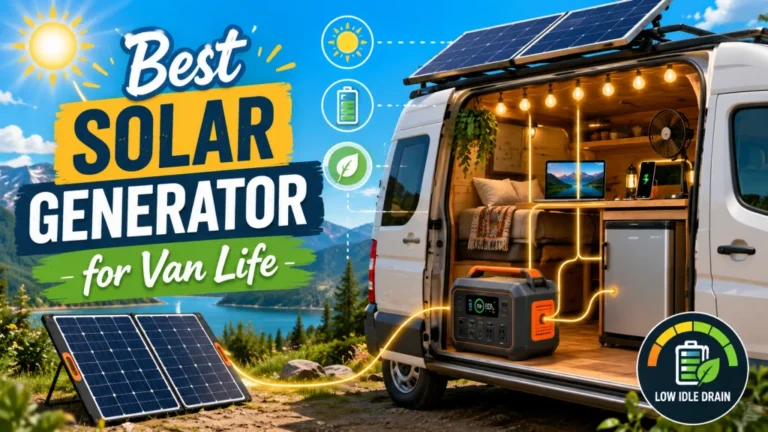
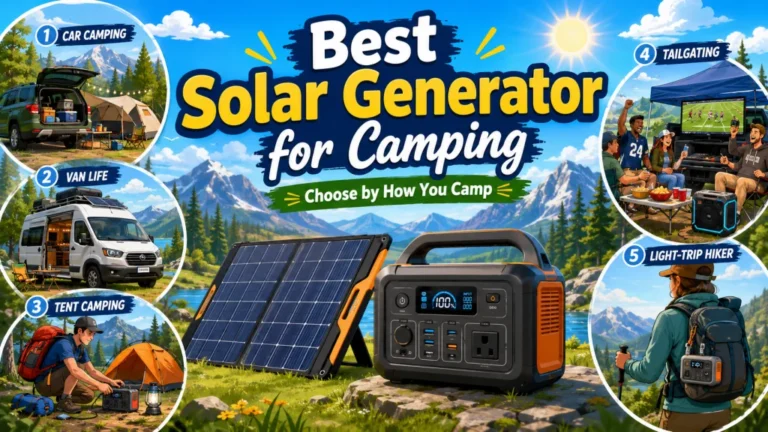
For car camping and weekend trips, all four brands are competitive. Jackery’s retail availability makes in-person comparison possible before buying, which matters for first-time buyers. For van life or extended off-grid use where remote app monitoring is more useful, Anker Solix’s app experience stands out. For weight-sensitive backpacking or tent camping, unit weight within any brand’s lineup varies significantly. That is a model-level question rather than a brand-level one.
💰 Which brand gives the most for your money?
Bluetti consistently offers the most capacity and features per dollar at purchase time. Jackery offers the best sale pricing relative to MSRP during major events. EcoFlow runs highest on a straight MSRP comparison but the ecosystem investment pays off if expandability is part of the plan. Anker Solix is competitive at mid-range price points. The brand with the best spec sheet at the time of purchase is not always the best long-term value. Warranty length and support quality are part of the total cost calculation.
🔋 Can I use expansion batteries from one brand with another brand’s unit?
No. All four brands use proprietary expansion battery connections. EcoFlow expansion batteries work only with EcoFlow units. Jackery expansion batteries work only with Jackery units. If you buy into an expandable platform with the intention of growing capacity over time, you are committing to that brand’s ecosystem. Make sure the base unit price and the expansion battery pricing both fit your total expected budget before committing.
🛠️ Which brand has the best customer service?
EcoFlow and Jackery both have established US service infrastructure and generally resolve warranty issues without significant friction. Bluetti has the most consistently documented poor service experiences across owner communities. The product quality is competitive, but the support track record is the weakest of the four brands by owner-reported data. Anker Solix is the newest at scale and their warranty terms are shorter than the competition; verify current terms before purchase.
📱 Which brand has the best app?
Anker Solix is generally rated highest for app quality and remote monitoring experience among real owners. EcoFlow’s app is also consistently well-reviewed. Jackery’s app is functional but less feature-rich than either EcoFlow or Anker Solix. If granular real-time data, watt-level monitoring, input/output tracking, and remote control are important to how you plan to use the unit, Anker Solix is the answer, with the Wi-Fi post-discharge quirk known in advance.
🏠 Is Jackery actually sold at Home Depot?
Yes. Jackery is stocked at Home Depot, Costco, and Best Buy among major US retailers. This makes it the most accessible of the four brands for in-person evaluation and purchase. None of the other three brands, EcoFlow, Bluetti, or Anker Solix, has equivalent shelf presence at major brick-and-mortar retailers in the US as of 2026.