
Full-Time RV Solar Power Is a Different Problem Than Camping Power
The best solar generator for RV full-time living isn’t the largest unit or the most feature-loaded one. It’s the one whose battery chemistry and capacity match what a 365-day daily cycling workload actually demands. That distinction matters more than any other spec on the sheet, and most buying guides never address it because they’re written for people who camp a few weekends a year.
Weekend camping is a closed event. You start fully charged, run for two or three days, and plug back in at home between trips. Full-time RV living is a continuous cycle: the unit charges during the day and drains through the night and into the next morning, then does it again. Every single day. No rest periods, no weeks sitting at full charge in storage. That single difference changes which units belong in this conversation entirely.
I’ve had this exact conversation at the counter more times than I can count. Someone transitioning to full-time RV life would point to a well-reviewed 2000Wh unit, I’d ask about their daily usage pattern, and somewhere in that exchange the cycle wear math would come up. A handful came back eighteen months later saying their unit wasn’t holding charge the way it used to. It wasn’t a defective product. It was a camping unit running a utility battery workload, and the chemistry wasn’t built for it.
Field Note: The most common full-time RV mistake I saw at the shop wasn’t buying too little capacity. It was buying the wrong battery chemistry for the use case. The watt-hours were adequate for the daily load. The cycle life was not adequate for the repetition.
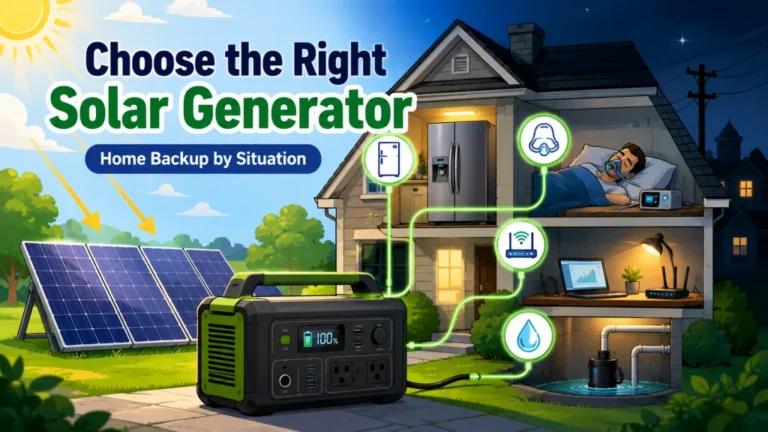
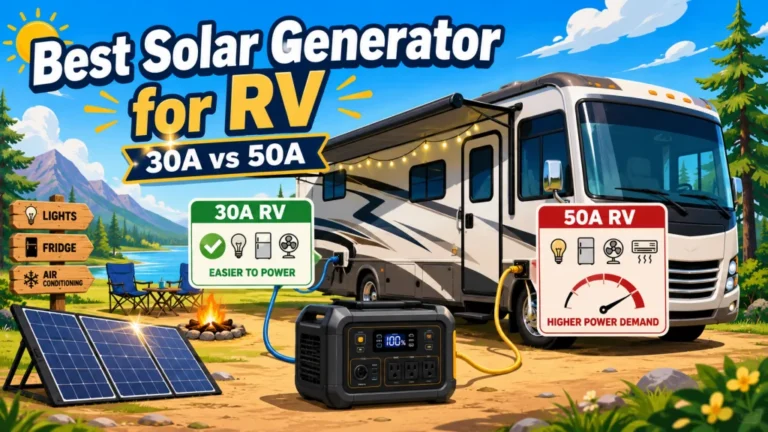
If you’re still working out which RV power situation applies to your setup, the guide on choosing the right solar generator for your RV walks through the different scenarios, from 30-amp weekend trips to full-time setups, and helps narrow down which unit class fits where. Full-time living sits at one specific end of that spectrum, with requirements that don’t overlap much with occasional camping.
The Cycle Math That Separates a Two-Year Battery From a Ten-Year Battery
Rated cycle life is the specification that matters most for full-time use, and it’s the one that gets the least attention in most solar generator reviews. Here is what the numbers actually look like in practice, and why the gap between battery chemistries is the defining buying factor for this specific use case.
A full-time RVer using a 2000Wh unit at 80 percent depth of discharge runs approximately 290 full cycles per year. That number, crossed against the battery’s rated cycle life, tells you almost everything you need to know about how long the unit will last before meaningful capacity degradation sets in.
| Battery Chemistry | Typical Cycle Rating | Expected Lifespan at 290 Cycles/Year | Full-Time RV Verdict |
|---|---|---|---|
| NMC (lithium-ion) | 500-800 cycles | 1.7-2.7 years | Not built for daily cycling workloads |
| LiFePO4 (lithium iron phosphate) | 2,500-3,500 cycles | 8.6-12 years | The right chemistry for sustained daily use |
Key point: For full-time RV use, LiFePO4 is not a premium upgrade. It is the minimum viable battery chemistry for a daily cycling workload. Buying an NMC unit to save money upfront means buying a replacement schedule that kicks in before your second RV registration renewal.
LiFePO4 also handles elevated ambient temperatures better than NMC, which matters when a solar generator is running inside a small enclosed space in summer. NMC chemistry degrades faster under sustained heat. A full-time RVer traveling through the Sun Belt will encounter those conditions regularly, and the battery chemistry that was already marginal at room temperature is meaningfully worse in a 90-degree RV interior.
Wrong approach:
Choosing an NMC unit because the purchase price is lower, then spending more to replace it in under two years when cycle life runs out under daily full-time use.
Right approach:
Paying the LiFePO4 premium at the start and running the same unit for a decade, knowing the chemistry was built for exactly the workload that full-time RV living puts on it.

Starting at 4,096Wh and expandable up to 48kWh with additional batteries or smart generators, the DELTA Pro 3 delivers 4,000W of output scalable to 12,000W with X-Boost, capable of running a 3-ton central AC or a 1 HP water pump on 120V or 240V. It supports 7 individual and 18 combination charging methods including solar, AC wall outlets, EV charging piles, gas generators, and the EcoFlow Smart Home Panel 2, eliminating fuel dependency entirely. Automotive-grade LFP cells with an IP65-rated battery pack and a 10-millisecond switchover protect NAS systems, servers, and sensitive electronics during outages. Whisper-quiet X-Quiet technology keeps operation as low as 30dB, and the whole system is backed by a 5-year warranty.
Check On AmazonIf you click this link and buy, we earn a commission at no additional cost to you.
When Expandability Stops Being Optional
For occasional camping use, an expandable platform is a convenience. For full-time RV living, it can be the difference between a system that grows with your actual needs and one you replace entirely in three years when your load increases. Every full-time RV solar generator setup should include this question before purchase: what happens when I plug in one more appliance six months from now?
The expandability threshold appears when your daily load consistently pushes against what a single unit can deliver. If your morning state-of-charge trends lower week over week even with consistent solar days, you have two choices: add storage or cut usage. For full-time RVers, cutting usage rarely works as a long-term solution. You moved into the RV to live in it, not to manage it.
Every expandable solar generator platform uses proprietary expansion connections, so you commit to an ecosystem when you choose the base unit. That is worth understanding before you buy, because expanding through the same platform typically costs more per watt-hour than buying a standalone second unit. What you get in return is a single integrated system that manages power delivery and state-of-charge as a unified whole. Two separate units running in parallel require manual management and don’t coordinate load distribution the same way.
Before committing to a platform, these are the four things worth confirming:
- Maximum expansion ceiling. Some platforms expand to 7,000-10,000Wh or beyond. Others are capped at 4,000-5,000Wh. Know the ceiling before buying in, particularly if your load is likely to grow as you settle into full-time life.
- Ecosystem lock-in. Every expandable solar generator uses proprietary expansion batteries. One brand’s expansion packs will not work with another brand’s base unit. This won’t change.
- Expansion battery chemistry. Confirm that expansion packs use the same LiFePO4 chemistry as the base unit. Some manufacturers offer mixed chemistries across their product lines, and cycle life comparability matters for a unified system.
- True cost per added watt-hour. Divide the expansion pack cost by the watt-hours it adds, then compare that number against a standalone unit of equivalent capacity. The integration premium should be a deliberate trade-off, not a surprise after you’re already two batteries deep into a particular ecosystem.
None of these points are arguments against expandable platforms. For full-time use, an expandable LiFePO4 system is often exactly the right call. They’re arguments for going in with the full cost picture in front of you, so the lock-in implications aren’t a discovery made after purchase.
A Buying Filter for Full-Time RV Use
Before committing to any unit for full-time RV living, four criteria cut out everything not built for this workload. These won’t narrow the list to a single product, but anything that fails one of them is the wrong choice for daily use, regardless of what the marketing says.
- LiFePO4 chemistry only. No exceptions for full-time use. The cycle math doesn’t work any other way at 290 cycles per year.
- Enough usable capacity for one full overnight draw. Calculate your actual overnight load before picking a number. A unit that hits 20 percent reserve at 5am is already undersized for your real usage pattern.
- An expansion ceiling above your likely future load. Full-time RVers consistently add loads in the first year. Buy for where your usage is heading, not where it starts.
- Solar input high enough to refill the battery during a normal travel day. A large battery that can’t fully recharge before the next night is an expensive way to run short by day three. Check the unit’s maximum solar input wattage before the capacity number.
Solar input wattage is the spec that gets overlooked most often in this context, because most reviews are written for people who recharge from a wall outlet between uses. For full-time RVers who rely on sun for daily replenishment, solar input matters as much as battery capacity. A unit with a low solar input ceiling will throttle your panels no matter how many you deploy.

At 2,042Wh with 3,000W output, this LiFePO4 station runs air conditioners, RVs, and heavy appliances at a whisper-quiet 30 dB. It fully recharges in just 2 hours via solar or AC, and capacity expands from 2kWh up to 24kWh by adding battery packs or pairing two units in parallel. ChargeShield technology boosts battery life by 50% across a 10-year lifespan, backed by a 5-year warranty.
Check On AmazonIf you click this link and buy, we earn a commission at no additional cost to you.
Three Loads That Push Past What Portable Solar Can Deliver
There is an honest line in full-time RV living where a portable solar generator, regardless of capacity or how well-matched it is to a daily cycling workload, is no longer the right tool. That line appears when any of these three loads become part of the daily routine. Most buyers who run into trouble here didn’t miss this in the spec sheet. They simply didn’t do the watt-hour math on their actual habits before buying.
Electric cooking. An induction cooktop or electric range runs at 1,800-3,000W. Running it for two meals a day adds 1,800-3,000Wh to your daily draw before the refrigerator, lighting, or any other load is counted. Even a 5,000Wh expandable platform will not cover this sustainably across multiple days without ideal solar conditions. Most experienced full-time RVers running electric cooking pair it with shore power or a separate generator rather than relying on a battery system to carry it.
Electric space heating. A typical electric space heater runs at 1,500W. Four hours of overnight heating adds 6,000Wh to your nightly draw. That exceeds the total capacity of most portable solar generators before any other load is included, and solar recharge cannot offset overnight draw at this scale.
Sustained air conditioning. A small RV air conditioner running at 1,200W on 50 percent duty cycle overnight consumes roughly 4,800Wh. For pre-cooling an RV cabin before sleep, a 3,000Wh unit with adequate inverter output can handle it. For all-night cooling as a nightly routine throughout summer, no portable solar generator in this class handles it without shore power supplementation.
The practical answer most experienced full-time RVers land on: propane for cooking and water heating, managed AC use limited to cooler months or short pre-sleep sessions, and the solar generator covering refrigeration, LED lighting, device charging, entertainment, and fans. That load profile is well within what a properly sized expandable portable system handles sustainably, day after day. If you’re working through which capacity class fits your actual daily load and budget, the guide on matching the right solar generator to your situation is a useful starting point before narrowing to specific options.

This compact plug-in monitor tracks the energy consumption of any AC 115-volt appliance and displays real-time readings of volts, amps, and wattage at 0.2 to 2.0 percent accuracy. Its large LCD screen lets you calculate electricity costs by the day, week, month, or year, making it easy to spot energy-hungry devices and trim your utility bill. It is also compatible with inverters, adding flexibility for off-grid setups.
Check On AmazonIf you click this link and buy, we earn a commission at no additional cost to you.
The Advantage Full-Time Use Gives You That Weekend Camping Does Not
Weekend campers treat shore power and solar as alternatives. You use whichever is available depending on where you park. Full-time RVers can use both simultaneously, and that changes the daily energy math more than most buyers account for when planning a system.
Most quality solar generators support pass-through charging while actively powering loads. At a campground with a pedestal hookup, the unit stays connected to shore power and holds a full charge throughout the stay. When you transition to a site without hookups, the switch to solar and battery happens without manual intervention. You begin that hookup-free day from 100 percent state-of-charge, not from whatever the battery held at the end of the previous night.
For a full-time RVer who mixes campground stays with occasional dry camping, this setup extends battery lifespan significantly beyond the 290 cycles per year I mentioned earlier. Shore power nights eliminate deep discharge cycles entirely. Solar days handle the gaps between hookups without stressing the battery unnecessarily. Over a full year, actual deep cycles may run well below that 290 figure, which extends real-world battery life past the rated cycle count.
The UPS function also matters more in a full-time context than it does for weekend use. A remote work setup, a home entertainment system, or any equipment your income depends on needs seamless power transfer when shore power drops or when you physically disconnect from a pedestal. Units with sub-20ms switchover time protect electronics the way a dedicated UPS in a home office does. That is not a feature worth paying a premium for on a camping trip. It matters every day when the RV is home.
For full-time setups where hookups are not consistently available and solar becomes the primary recharge source, the loads that can be sustained depend heavily on how much solar input wattage the unit can accept alongside its battery capacity. The two specs work together, and neither one alone tells the complete story for multi-day operation.

Featuring 16BB N-Type cells at 25% efficiency, this panel outperforms standard 200W panels and folds down to backpack size at just 13.89 lbs, with a magnetic closure for tool-free setup. Three built-in ports including USB-C PD 45W, and two USB-A ports charge devices directly, while MC4 output connects to most power stations and 12V battery systems. Four adjustable kickstands offer 40, 50, and 60 degree angles, and IP65 rating plus UL 61730 certification ensure durability and safety backed by a 2-year warranty.
Check On AmazonIf you click this link and buy, we earn a commission at no additional cost to you.
Final Thoughts: The Honest Line Between Portable and Permanent
The best solar generator for RV living at the full-time scale comes down to one question: what does your daily load actually look like when you’re honest about the habits you won’t change?
For a couple in a mid-size RV using propane for cooking and water heating, running a compressor refrigerator, LED lighting, device charging, and occasional small appliances, a 3,000-5,000Wh expandable LiFePO4 system with 400-600W of portable panels is a legitimate, practical solution. The cycle math works. The expandability handles load growth without a full replacement. The hybrid shore-plus-solar setup covers both campground and hookup-free scenarios without manual switching between modes.
For a large motorhome running electric cooking, electric heating, and sustained air conditioning, a portable unit is not the right tool. A permanently installed LiFePO4 battery bank with rooftop solar delivers better cost-per-kilowatt-hour over time and the sustained capacity the load actually requires. The upfront cost is higher. The long-term math is better than buying and replacing portable units on a two-year cycle.
If solar recharge is going to be your primary energy source for a significant portion of your days without hookups, the article on solar generator sizing for dry camping without shore power covers the daily input-versus-draw math in detail and is worth reading alongside this one before finalizing your setup.
If you’re coming to full-time RV living from weekend trips and want to understand how the requirements shift as usage moves from occasional to daily, the article on solar power for a travel trailer covers the middle ground between occasional use and full-time daily life and is a useful transition point between the two conversations.

Starting at 3kWh and expandable up to 11kWh with extra batteries, the DELTA 3 Ultra Plus delivers 3,600W of continuous output with 7,200W surge capacity via X-Quiet 3.0 technology, powerful enough for heavy appliances, power tools, and RV essentials. Six charging options including home outlets, solar panels, car chargers, EV stations, generators, and the EcoFlow Smart Generator keep it ready, with X-Stream fast charging reaching 80% in under an hour. Its under-10-millisecond UPS switching protects computers, medical equipment, and routers during outages with no manual setup, while whisper-quiet 25dB operation runs comfortably indoors or overnight. Built on an LFP battery with EV-grade CTC structure and 24/7 smart battery management, it is rated for 10 years of daily use.
Check On AmazonIf you click this link and buy, we earn a commission at no additional cost to you.
FAQs
🔋 How many watt-hours do I actually need for full-time RV living?
For a load profile that includes refrigeration, LED lighting, device charging, and a small fan, with no electric cooking or space heating, most full-time RVers manage comfortably on 2,000-3,000Wh of usable capacity with reliable daily solar recharge. If your load is larger or your solar access is inconsistent, 3,000-5,000Wh provides more margin before the next recharge is needed.
⚗️ Does battery chemistry really make that big a difference for daily use?
For full-time RV use specifically, yes. At 290 cycles per year, an NMC battery rated for 500 cycles reaches end-of-life in under two years. A LiFePO4 battery rated for 3,000 cycles lasts a decade under the same usage pattern. The chemistry difference is the single largest factor in long-term value for anyone cycling their unit daily.
❄️ Can a solar generator run my RV air conditioner as a regular part of a full-time setup?
For short pre-cooling sessions of 2-3 hours, a 3,000Wh unit with adequate inverter output can handle it. For all-night cooling as a nightly routine throughout summer, no portable solar generator in this class sustains it without shore power supplementation. The energy math simply doesn’t work at that duty cycle for a standalone portable system.
🔌 What does an expandable solar generator actually give me compared to running two separate units?
An expandable platform integrates additional battery capacity into one system with unified state-of-charge management and coordinated load distribution. Two separate units running in parallel don’t communicate with each other the same way and require manual management of which unit is powering which loads. The trade-off is proprietary lock-in and a higher cost per added watt-hour versus buying a second standalone unit of equivalent size.
☀️ How much solar panel wattage do I need for a full-time RV setup?
Divide your battery capacity by your typical daily peak sun hours (4-6 hours for most US regions) to find the panel wattage needed for a full daily recharge. A 3,000Wh battery in a 5-sun-hour location needs 600W of panels, plus 20-25 percent extra to account for real-world panel output running below its rated capacity. Also verify your unit’s maximum solar input limit, because adding panels beyond that ceiling produces no additional benefit.
🏕️ Should I run shore power and solar input at the same time when both are available?
Yes, on any unit that supports simultaneous inputs. Connecting shore power and solar together keeps the battery at full charge during campground stays and means you start hookup-free days at 100 percent state-of-charge. It also reduces the number of deep discharge cycles the battery experiences over the year, which in practice extends real-world lifespan meaningfully beyond the rated cycle count.