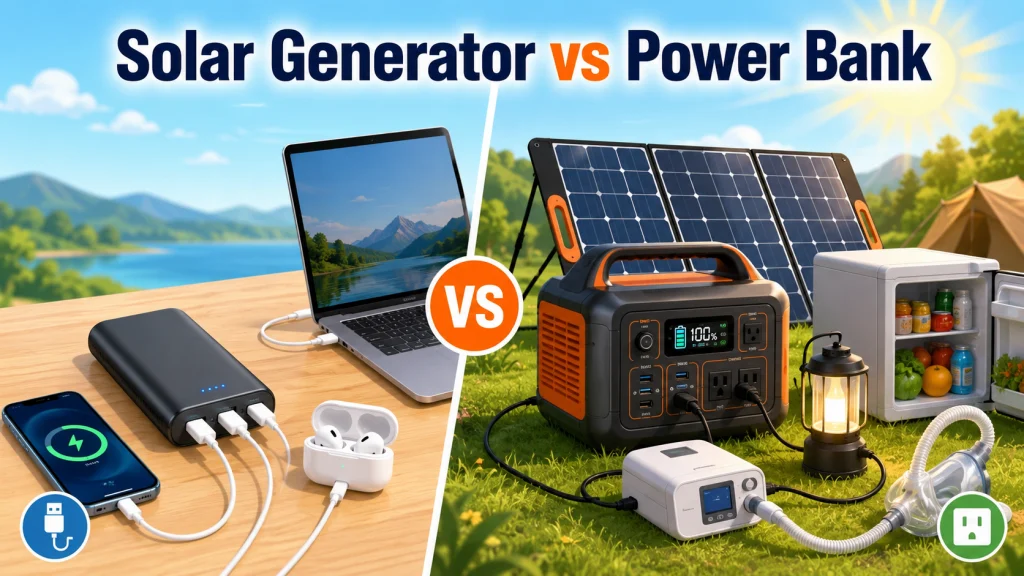
Two Batteries, Two Very Different Jobs
I’ve watched this one play out more times than I can count at the shop. Someone picks up a power bank, reads the watt-hour number on the box, and asks if a solar generator is basically the same thing with a bigger battery. The solar generator vs power bank comparison seems obvious from the outside. Both are rectangular, both have ports, both claim to charge your devices. That’s roughly where the similarity ends.
A power bank pushes low-voltage DC through USB connections. Your phone, your earbuds, your USB-C laptop, a portable fan with a USB cord, all of these are engineered to accept 5V, 9V, 12V, or 20V DC, which is exactly what a power bank delivers. A solar generator pushes 120V AC from standard three-prong wall outlets, the same voltage your home runs on. Refrigerators, many CPAP setups, power drills, coffee makers, and most appliances that plug into a wall outlet need that kind of AC output. A solar generator can power them as long as the wattage is within the unit’s rated output. A standard USB power bank cannot reach that category. The port types alone enforce that boundary.
The most common version of this misunderstanding I ran into at the counter was buyers who assumed that buying a larger power bank was a stepping stone toward running real appliances. It isn’t, because the ceiling isn’t about capacity. It’s about voltage. If you’re still in the early research stage and working out which type of portable power matches your actual situation, the solar generator guide covers the full picture from battery chemistry to use-case planning before you commit to any purchase.
The Voltage Gap That Determines Everything
Capacity is the number buyers focus on. Voltage is the number that actually matters. Power banks output 5V, 9V, 12V, and 20V DC through USB-A and USB-C ports. That covers any device built to charge from USB, which is a long list: phones, tablets, Bluetooth earbuds, most laptops manufactured in the last five years, small USB-powered fans. It does not include standard household appliances that plug into a wall outlet, because those appliances expect 120V AC and will not function on low-voltage DC regardless of how you connect them.
Solar generators output 120V AC from standard three-prong receptacles, identical to what comes from your home’s wall. You can run any appliance whose wattage falls within the unit’s rated AC output. Blender, space heater, CPAP setup with a wall adapter, power tools, LED work lights, a small window air conditioner. These devices are built for 120V AC, and a USB power bank is not an acceptable substitute for that voltage requirement. The physics of how those appliances operate simply require grid-equivalent voltage.
The practical rule is straightforward once you see it: if the device plugs into a wall outlet, a standard power bank cannot run it regardless of how many watt-hours the power bank holds. If the device charges through a USB cable, a solar generator can technically do it, but it costs considerably more and weighs far more for no real benefit. Understanding which side of that line your actual devices fall on tells you exactly which category you’re shopping in, and that decision should happen before you start comparing brands or prices.
The Capacity Difference Is Not Close
The largest consumer power banks available max out at around 26,800 mAh. Converting that to watt-hours, which is how solar generators are rated, gives you roughly 100 watt-hours. That’s the practical ceiling for the power bank category, largely defined by airline regulations that restrict carry-on lithium batteries to 100Wh without special airline approval. You can find oversized power banks that exceed this limit, but they’re not widely stocked and they can’t go on a plane with you.
Entry-level solar generators start at 300 watt-hours. Midrange units that most buyers consider for camping or outage backup land at 1,000 to 2,000 watt-hours. Large home backup units scale to 5,000 watt-hours and beyond. That’s 10 to 20 times more stored energy than the largest practical power bank, and around 50 times more than a typical 75Wh travel power bank. The gap between these two categories isn’t something you bridge by shopping carefully. It’s a structural difference in what the products are designed to hold.
| Specification | Power Bank | Solar Generator |
|---|---|---|
| Output voltage | 5V / 9V / 12V / 20V DC (USB) | 120V AC (wall-style outlets) |
| Typical capacity range | 10,000 to 26,800 mAh (~37 to 100 Wh) | 300 to 5,000+ Wh |
| Appliances supported | Phones, tablets, USB-C laptops, earbuds | Refrigerators, CPAP setups, power tools, appliances |
| Solar charging input | 1 to 25W (built-in panel or accessory) | 100 to 1,400W (dedicated panels) |
| Weight (typical) | 0.3 to 0.7 lbs | 7 to 65+ lbs |
| TSA carry-on compliant | Yes (units under 100 Wh) | No |
| Primary use case | Travel, day hikes, USB device top-ups | Outages, camping appliances, off-grid power |
In practical terms, a 100Wh power bank charges a modern smartphone about six to eight times before running empty. A 1,000Wh solar generator runs a standard 150-watt refrigerator for five to six hours per full charge. A 2,000Wh unit runs that same refrigerator through the night with capacity to spare for a router, lights, and phone charging. These are not products competing on price for the same buyer. They solve problems that don’t overlap.

Weighing just 13.3 pounds with a built-in handle, the RIVER 2 Max delivers 1,000W of output across 11 ports including 300W AC outlets and USB-C, making it a capable companion for off-grid adventures and everyday backup power. X-Stream fast charging via AC refills it fully in just 1 hour, while 220W solar input can do the same in as little as 2.3 hours. Its LFP battery is rated for 3,000 plus charge cycles, equating to nearly 10 years of regular use, with advanced BMS protection continuously monitoring voltage, current, and temperature. The package includes a car charging cable and a 5-year service guarantee.
Check On AmazonIf you click this link and buy, we earn a commission at no additional cost to you.
What Each One Can Actually Power
Power banks handle USB-connected devices reliably and efficiently. Phones, Bluetooth earbuds, tablets, small portable fans with USB connectors, and most laptops through USB-C all fall squarely in this category. A quality 20,000 mAh power bank charges a modern phone five to six times before needing a recharge itself. For travel and everyday carry, that covers most people’s charging needs completely.
Solar generators handle household appliances through AC outlets. A refrigerator at 150 watts average draw. A CPAP setup with a heated humidifier and wall adapter running at 30 to 45 watts overnight. A portable air conditioner at 400 to 500 watts. A power drill pulling 400 to 700 watts during use. A coffee maker at 1,000 watts for the minutes it’s brewing. These are not USB charging jobs. The voltage requirement is baked into the appliance’s motor, compressor, heater, or power supply.
The use cases where the solar generator vs portable charger confusion causes the most expensive mistakes tend to fall into a few specific scenarios:
- Running a CPAP machine while camping: a standard USB power bank is usually not the right tool, especially if your CPAP uses a heated humidifier or wall adapter. Some CPAP-specific batteries and DC adapters exist, but for reliable overnight AC power, a 500 to 1,000Wh solar generator with a pure sine wave inverter is usually the safer category.
- Keeping a refrigerator running during a power outage: power banks cannot do this in any practical sense. The refrigerator compressor requires 120V AC and draws 150 watts or more on average. A 1,500 to 2,000Wh solar generator covers six to nine hours of refrigerator runtime per charge.
- Charging a laptop on a day trip or flight: a power bank with USB-C Power Delivery is the right tool here. A solar generator can do it too, but it’s significant overkill in both weight and cost for this use case.
- Keeping devices charged over a weekend with hotel access at night: power bank wins easily. Lightweight, no setup, no watt-hour math, fits in a jacket pocket.
- Running power tools at a remote work site: solar generator only. Circular saws, drills, and similar tools require 120V AC and draw hundreds of watts. A power bank has no path to this.
The pattern across these examples is consistent. When the device uses USB, the power bank is usually the right tool. When the device uses a wall plug, a standard USB power bank is not the right category.
What “Solar Charging” Actually Means in Each Category
Some power banks include a small built-in solar panel on the back, typically rated at 1 to 5 watts of solar input in direct sunlight. That output is genuinely useful for extending battery life on a long day hike or keeping a phone topped up during outdoor use. It is not meaningful for full recharging. In three full hours of direct midday sun, a 5-watt built-in panel adds about 15 watt-hours to the bank, enough for roughly one phone charge. The marketing language around these panels tends to run well ahead of the actual performance.
Solar generators accept dedicated external solar panels at 100 to 1,400 watts of input depending on the unit. A pair of 100-watt panels connected to a 1,000Wh solar generator can recharge it in roughly six to eight hours of strong sun after normal real-world losses. In practice, that usually means planning around a clear-sky day rather than assuming perfect lab-rated output. That’s the kind of solar charging that supports real off-grid use, multi-day camping trips, and extended outage backup. The difference in solar input between the two categories, from 1 to 5 watts on a power bank versus 100 to 1,400 watts on a solar generator, is why one system genuinely sustains itself on sunlight and the other is primarily a convenience feature on the box.
Both product types use the word solar in their names or descriptions. The only reliable way to compare them is through the rated solar input watts, which tells you how fast the unit actually recharges from panels in the field. Understanding how the naming works across portable power categories helps here. The difference between a solar generator and a portable power station, two names that often describe the same hardware, is explained in the solar generator vs portable power station comparison, which covers the naming landscape for this entire product family.

Built with monocrystalline cells at 23% conversion efficiency, this 9.7 lb panel offers four preset angles at 30, 40, 50, and 80 degrees for optimal sun tracking in any season or location. ETFE coating and IP67 waterproofing ensure durability in rough outdoor conditions, and the stable MC4 connection minimizes energy loss. Includes MC4, MC4-to-XT60, and XT60-to-DC7909 cables for broad compatibility.
Check On AmazonIf you click this link and buy, we earn a commission at no additional cost to you.
Which One You Actually Need
If everything on your charge list connects via USB, phones, earbuds, tablets, a USB-C laptop, and your trips are measured in days rather than weeks, a power bank is the right tool. It’s lighter, dramatically cheaper, TSA compliant, and covers the actual job without any setup. A quality 20,000 mAh power bank in the $40 to $70 range handles the vast majority of travel and day-trip charging scenarios without requiring watt-hour math, solar panel angles, or any planning beyond charging it the night before.
If anything on your list plugs into a wall outlet, a solar generator is the category. A CPAP setup for camping. A refrigerator during a multi-day outage. Power tools at a remote site. Any appliance that expects 120V AC. There is no standard USB power bank configuration that handles these scenarios because the voltage ceiling prevents it. The size of the power bank’s battery is irrelevant if the voltage output can’t drive the appliance.
The only edge cases are devices that accept USB-C Power Delivery or 12V DC directly. A USB-C laptop still belongs in power bank territory. A 12V camping fridge, CPAP DC adapter, or other DC-compatible device depends on the exact plug, voltage, and runtime requirement. But once your setup involves wall outlets, heated humidifiers, appliance motors, compressor loads, or overnight backup with a safety margin, the solar generator category becomes much more practical.
The middle ground is smaller than most buyers expect. A solar generator handles both USB devices and AC appliances through its combination of output ports, so if your situation requires both during the same trip or outage, a solar generator covers it all. A power bank handles USB only, regardless of how large it gets. If you’re at the stage of comparing specific portable power products and want to understand how portable power stations fit into this picture, what a portable power station actually is walks through the category clearly before you start looking at models.

With 20,000mAh of airline-approved capacity, this power bank handles multiple days of charging for phones, tablets, Bluetooth headphones, fitness trackers, and smartwatches without needing a wall outlet. The PD 20W USB-C port supports both input and output, letting you use the same cable that came with your iPhone or iPad to charge in or out, and can revive an iPhone 14 to 50% in around 25 minutes. Smart power detection automatically delivers the right charge level for smaller devices with no manual adjustment needed. Every purchase is backed by a 30-day money-back guarantee, a 3-year warranty, and lifetime technical support.
Check On AmazonIf you click this link and buy, we earn a commission at no additional cost to you.
Final Thoughts: Get the Category Right Before You Get the Brand Right
The most preventable version of this mistake is someone who buys a large power bank expecting it to cover an outage, discovers it can’t run a single appliance through a wall outlet, and ends up buying a solar generator anyway. That’s two purchases when one was needed. The difference between a solar generator and a power bank isn’t a matter of grade or quality. It’s a matter of what the product was built to do, and neither one is wrong for the right use case.
The decision framework is short. If your charging needs are USB devices that fit in a bag, a power bank handles them. If anything on your list requires a wall outlet, extended overnight runtime for appliances, or genuine solar recharging across multiple days, a solar generator is the category. Getting that right before you look at brands, watt-hours, or sale prices is the part that saves you the return trip.

Weighing just 23.8 lbs with a foldable handle, this 1,070Wh LFP power station delivers 1,500W of pure sine wave AC output with a 3,000W surge capacity, capable of running AC units, fridges, and electric pots. Its LFP battery sustains over 70% capacity after 4,000 cycles, translating to a lifespan of more than 10 years. Via the Jackery App, you can enable a full charge in as little as one hour, or switch to a whisper-quiet 30 dB overnight mode. Six output ports including two USB-C with 100W PD charging cover nearly any device simultaneously.
Check On AmazonIf you click this link and buy, we earn a commission at no additional cost to you.
FAQs
🔌 Can a power bank run a CPAP machine?
A standard USB power bank is usually not the right tool for CPAP use, especially if your machine uses a heated humidifier or wall adapter. Some CPAP-specific batteries and DC adapters exist, but ordinary phone-style power banks are not built for reliable overnight medical-device backup. For camping or outage use, a 500 to 1,000Wh solar generator with a pure sine wave inverter is usually the safer and more flexible category.
✈️ Can I take a solar generator on an airplane?
No. TSA restricts lithium batteries in carry-on luggage to 100 watt-hours without prior airline approval, and a maximum of 160 watt-hours with approval. Entry-level solar generators start at 300Wh, well above that threshold. Power banks under 100Wh are carry-on compliant. For air travel, a power bank is the compliant option.
⚡ What is the largest power bank I can actually buy?
The practical ceiling for widely available consumer power banks is around 26,800 mAh, which equals roughly 100 watt-hours. That figure aligns with the TSA carry-on limit for lithium batteries. Some larger units exist but they are not common in retail, cannot fly, and begin approaching the size and weight of entry-level solar generators while offering a fraction of the capacity.
🌞 Do those power banks with solar panels actually work?
For topping up during outdoor use, yes. For meaningful recharging, not really. Built-in solar panels on power banks typically generate 1 to 5 watts in direct sun, which adds 10 to 15 watt-hours over three hours, roughly one partial phone charge. It extends battery life on a sunny hike. It does not replace plugging into a wall or connecting to a proper solar panel setup.
🧊 Can a power bank keep a refrigerator running during a power outage?
No, not in any practical sense. A refrigerator compressor requires 120V AC to operate, while standard power banks output low-voltage DC through USB. Even setting voltage aside entirely, the largest practical power banks hold about 100Wh, enough to run a typical 150-watt refrigerator for less than an hour if voltage were compatible, which it is not. A solar generator with at least 1,000Wh of capacity is the category you need for refrigerator backup.
💡 Does a solar generator have USB ports too?
Yes. Most solar generators include multiple USB-A and USB-C ports alongside their AC outlets, allowing you to charge phones, tablets, and laptops directly without an adapter. A solar generator covers everything a power bank covers, plus AC appliances. The tradeoff is weight and cost, which is why a power bank remains the better choice when AC outlets aren’t needed.