Solar Generator vs Portable Power Station: The Short Answer First
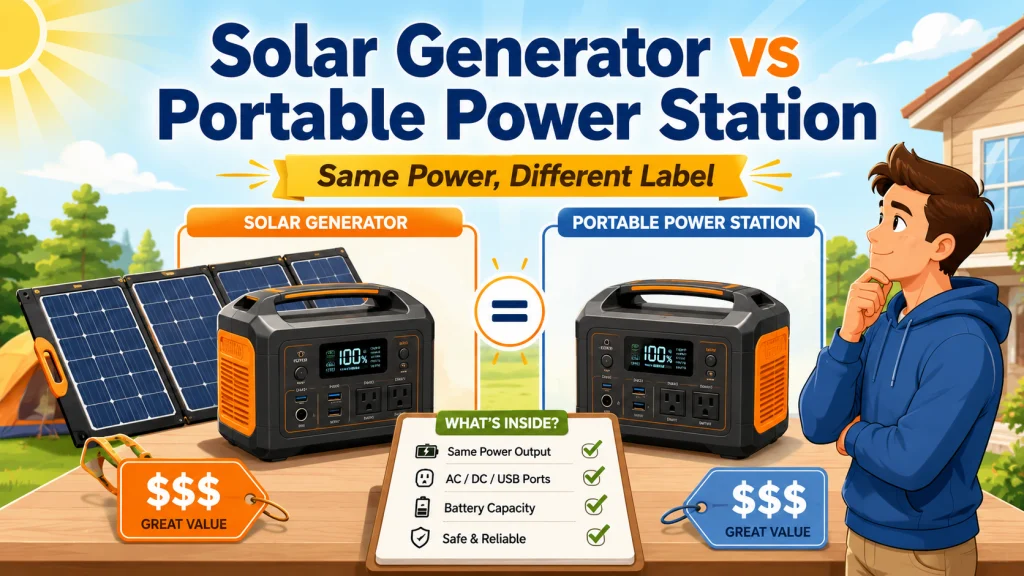
These two labels usually describe the same category of product. Both are lithium battery systems with built-in inverters that store energy and deliver 120V AC power through standard wall outlets. Both charge from the same three inputs: a wall outlet, a 12V car port, or solar panels. Both run the same appliances, from refrigerators to CPAP machines to laptops to power tools. The terminology on the label is a marketing decision, not a technical one.
Manufacturers use both terms deliberately because each one pulls from a slightly different search audience. A buyer preparing for outages types “solar generator.” A buyer who read a tech review types “portable power station.” The brand captures both with what is often identical hardware, sometimes literally the same unit listed twice under different product names. In my time selling these, I watched buyers spend real time debating a distinction that did not exist in the product. The name on the label tells you almost nothing useful. The spec sheet and the box contents list do.
What Both Products Share Under the Label
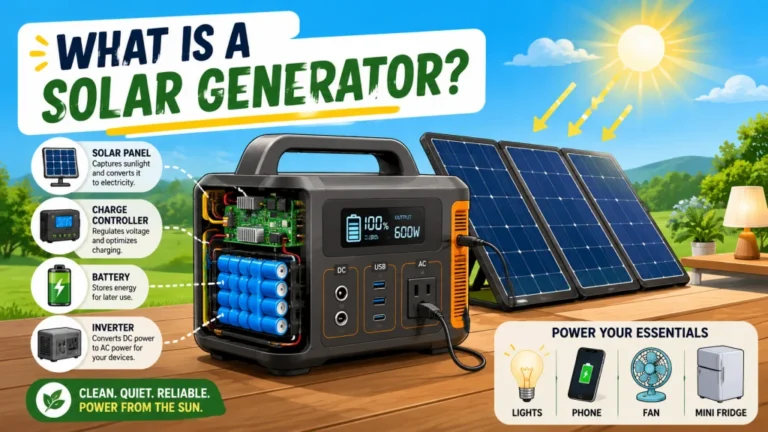
Every solar generator and every portable power station is built from the same core components: a lithium battery pack, a battery management system that protects the cells from overcharge and over-discharge, an inverter that converts stored DC power into AC electricity, and a charge controller that manages incoming power from whatever source you plug in. These four components are what make the unit work. The product name does not change any of them.
The spec sheet is where meaningful variation actually exists, and it has nothing to do with which marketing term appears on the box. Battery chemistry, inverter output rating, solar input wattage, and surge capacity are all spec-sheet numbers. A unit labeled “portable power station” with a higher-quality inverter will outperform a unit labeled “solar generator” with a cheaper one. Reading the specs matters far more than reading the name.
Where the Naming Difference Actually Costs You Money
The financial problem starts when buyers compare prices across product types without checking what is physically included in each package. A solar generator listing priced at $900 and a portable power station listing priced at $650 can look like a $250 gap in what the same battery is worth. In many cases, the solar generator listing includes one or more solar panels bundled in the purchase, and the power station listing is the unit alone. Strip out the panels and the unit prices are often nearly identical. The apparent savings from choosing the cheaper label can disappear as soon as you go to buy the panels separately.
Manufacturers regularly sell the same battery unit under two separate product entries: one as a standalone power station and one as a solar generator kit with panels included. Same battery capacity, same inverter output rating, same BMS. What changes is the package contents and sometimes the marketing copy on the box. I watched this exact situation play out at the shop repeatedly, buyers comparing a bundled kit against a bare unit and treating it as a direct price comparison between equal products.
Field Note: A buyer came in convinced the solar generator was overpriced compared to the portable power station on the shelf next to it. Same brand, similar box size, nearly the same wattage on the label. The solar generator included two 100W panels folded in a compartment at the bottom of the box. The power station was the unit only. Once we pulled both boxes open on the counter, the conversation shifted immediately. He bought the solar generator.
This is the mistake that costs buyers the most in this category. The fix is straightforward: check the box contents section of every listing before comparing prices, not just the unit specs. If the Wh capacity and AC output watts match but the prices differ, the most likely explanation is what else is in the box, not a quality difference between the units.

At 23.8 lbs with 1,070Wh capacity and 1,500W output, this LFP station runs AC units, fridges, and electric pots with a 3,000W surge rating. Emergency charging via the Jackery App fills it in just 1 hour, while the default 1.7-hour mode protects long-term battery health across a 10-year, 4,000-cycle lifespan. Includes a 200W solar panel and 5-year coverage straight out of the box.
Check On AmazonIf you click this link and buy, we earn a commission at no additional cost to you.
Where Else This Naming Confusion Shows Up
The solar generator vs portable power station overlap is the most visible naming confusion in this product space, but it sits at the top of a longer list. There are five related naming questions that come up regularly when buyers research this category. Each one has a dedicated article that covers the specifics without the marketing framing.
What a Portable Power Station Actually Is
Stripping away both brand names and marketing language, a portable power station is a lithium battery with an inverter, multiple output ports, and a charge controller in a carry handle-equipped enclosure. It is not a generator in the traditional sense, it produces no combustion and burns no fuel, and it is not a large power bank, because it outputs 120V AC rather than USB-level DC. What a portable power station actually is covers the product from the ground up, including why the same unit appears under two different names depending on what the manufacturer decided to bundle with it.
Power Station vs Power Bank
These two products are not the same thing at different scales, and treating them as such leads to real purchasing mistakes. A phone power bank outputs 5V to 20V DC through USB ports, designed to charge phones, tablets, and laptops. A portable power station outputs 120V AC through standard wall outlets, designed to run any household appliance the inverter can handle, including refrigerators and power tools. The capacity difference is equally significant: the largest consumer power banks max around 100 watt-hours, while entry-level portable power stations start at 300Wh and scale past 5,000Wh. How solar generators compare to power banks covers the full breakdown of what separates these two product categories and when each one actually makes sense.
Solar Generator in UPS Mode
Some solar generators include a UPS mode, also called pass-through charging, that keeps the unit plugged into the wall and switches to battery power during an outage with minimal interruption. This sounds simple but the details matter significantly for anyone relying on it for a home office setup or medical device. Switchover time varies from zero milliseconds on certain high-end units to 30 milliseconds on standard models, and that gap is meaningful for specific equipment types. What solar generator UPS mode actually means explains how this function works, what it can and cannot replace, and what to check in the specs before buying a unit specifically for this purpose.
Solar Generator vs Inverter Generator
An inverter generator sounds like it might involve solar energy. It does not. An inverter generator is a gas-powered portable generator that uses electronic inverter circuitry to clean up the AC output, making it suitable for sensitive electronics like laptops and medical devices. The naming overlap causes real confusion for buyers comparing fuel and solar options side by side. What separates solar generators from inverter generators covers both product types directly, including the noise levels with real decibel figures, the output capacity difference, and where each one wins for specific use cases.
All-in-One Unit vs DIY Battery Bank Build
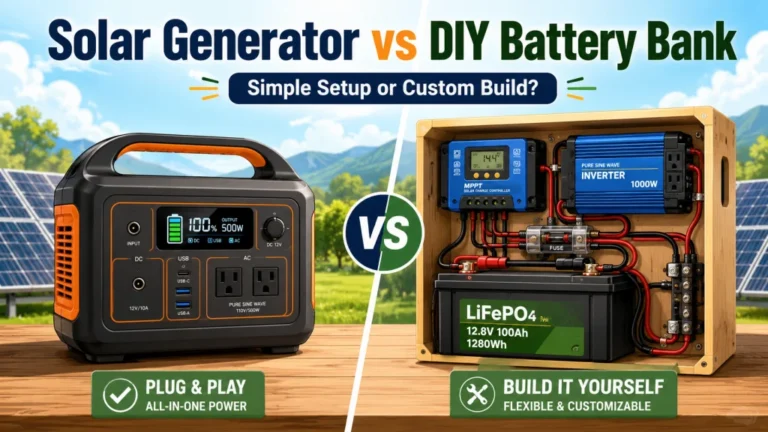
A solar generator is a factory-assembled all-in-one product. A DIY battery bank is a set of components sourced and wired together by the buyer: separate LiFePO4 battery cells, a standalone charge controller, an inverter, and the wiring to connect them properly. DIY builds frequently cost less per watt-hour above 2kWh, but they require a working knowledge of basic DC wiring and the patience to source compatible components. How solar generators compare to DIY battery bank builds lays out the cost math for both approaches and covers the practical tradeoffs honestly, including the repair difference when components fail after the warranty period.

Built with IBC cells at 25% conversion efficiency, this bifacial panel absorbs sunlight from both sides and bends up to 221 degrees to conform to curved surfaces like car roofs and balconies. At just 4.52 lbs it is 56% lighter than rigid panels, and IP68 waterproofing plus IEC TS 63163 certification across 19 international tests ensure reliable output from -40 to 85 degrees Celsius. A 3-meter flat cable enables flexible installation in under 5 minutes.
Check On AmazonIf you click this link and buy, we earn a commission at no additional cost to you.
How to Read Any Listing Without Getting Turned Around by the Name
The product name in a listing title is the last thing worth spending time on. What actually tells you what you are buying comes down to three numbers and one checklist item. Everything else in the marketing copy is secondary to these.
- Wh (watt-hours) capacity: This is how much total energy the battery stores. A 2000Wh unit stores 2000Wh of energy regardless of whether the label says solar generator or portable power station. This number determines how long the unit can run your appliances at any given load level. Two units with the same Wh have the same energy storage, period.
- AC output watts: This is how much power the inverter can deliver simultaneously through the AC outlets. A 2000W inverter can run a 1500W appliance with headroom to spare. An 800W inverter cannot. The product name tells you nothing about this number; the spec sheet does. Check it before assuming a higher-priced unit delivers more power.
- Box contents: This is the line item in the listing, usually in a section called “what’s in the box” or “package contents,” that tells you what is physically included in the purchase. Solar panels in a product photo or hero image do not mean solar panels in the box. The contents list is what matters, not the images.
Once you have those three data points from both listings, you can make a real comparison. If two products show the same Wh capacity, the same AC output watts, and the same box contents, they are equivalent products regardless of what the listing calls them. If the box contents differ, the price difference is expected, and the only remaining question is whether the additional hardware is worth the price delta for your situation.
Key point: The spec sheet and the box contents list are the purchase decision. The product name is the marketing decision. Read them in that order and the naming confusion stops mattering.
When the Unit-Only Listing Is the Better Buy
Not every buyer should choose the bundle. If you already own solar panels that are compatible with the unit’s input port, paying for a bundle that includes more panels you do not need adds cost without adding value. If your primary use is indoor backup power charged from a wall outlet, you may not need solar panels at all right now. A bare portable power station at a lower price point can be the smarter purchase, and you can add compatible panels later if your situation changes.
The bundle makes more sense when you are starting from zero and need solar charging capability immediately, or when the bundled panels are priced below what they would cost sourced separately. In retail, the calculation I walked buyers through was simple: check what the same panels cost on their own, subtract that from the bundle price, and compare the remainder to the standalone unit price. If the remainder is close, the bundle is fair. If it is significantly higher, you are paying a convenience premium. Understanding what the unit alone includes gives you the baseline for making that comparison cleanly.

Weighing just 23.8 lbs with a foldable handle, this 1,070Wh LFP power station delivers 1,500W of pure sine wave AC output with a 3,000W surge capacity, capable of running AC units, fridges, and electric pots. Its LFP battery sustains over 70% capacity after 4,000 cycles, translating to a lifespan of more than 10 years. Via the Jackery App, you can enable a full charge in as little as one hour, or switch to a whisper-quiet 30 dB overnight mode. Six output ports including two USB-C with 100W PD charging cover nearly any device simultaneously.
Check On AmazonIf you click this link and buy, we earn a commission at no additional cost to you.
Final Thoughts: What to Actually Do With This
Most buyers who spend time on the solar generator vs portable power station question are a few minutes away from a listing they actually want to buy. The naming confusion is real, but it dissolves quickly once you check three numbers and the box contents. From there, the decision is about your specific situation, whether you already have panels, how you plan to charge the unit, and what loads you need to run, not about which label appears at the top of the listing.
If you are earlier in the process and want to understand the full product category before narrowing down, the complete solar generator guide covers the technology, the core comparisons, and the sizing framework from the start. The guides in this section are for the specific naming questions that come up once you are already comparing listings.

This 1kWh LFP battery station charges from 0 to 80% in just 50 minutes via AC input, and its LiFePO4 chemistry delivers a 3,000 plus cycle lifespan that is roughly 6 times longer than standard lithium batteries. Capacity is expandable up to 3kWh with additional batteries, making it well suited for camping, RVs, or off-grid living. Its 1,800W output powers across 15 outlets, handling around 90% of household appliances, and accepts up to 500W of solar input for clean, fuel-free charging. The package includes a 5-year customer service guarantee.
Check On AmazonIf you click this link and buy, we earn a commission at no additional cost to you.
Guides in This Section
This naming overlap is only the first layer of confusion in this category. Each guide below covers a specific naming or product comparison in full, with the specs, the real-world performance differences, and the honest tradeoffs that help you decide what actually fits your situation.
| Guide | What it covers |
|---|---|
| What Is a Portable Power Station? | What the unit alone includes, how it differs from products you already know, and why the same hardware appears under two different product names |
| Solar Generator as a UPS | How pass-through charging and switchover time work, and what to verify in the specs before relying on a solar generator for power protection |
| Solar Generator vs Power Bank | The output voltage gap, the capacity difference, and why these two battery products serve completely different needs despite both being portable |
| Solar Generator vs Battery Bank | The full cost math and practical tradeoffs between buying a factory-assembled unit and building a DIY component setup from scratch |
| Solar Generator vs Inverter Generator | Why inverter generator has nothing to do with solar energy, and how the noise levels, output capacity, and real-world use cases compare |
FAQs
❓ Is a solar generator the same thing as a portable power station?
Yes, they belong to the same product category. Both are lithium battery systems with inverters that deliver AC power to your devices and appliances. The practical difference is usually what the manufacturer included in the box. A solar generator listing often bundles solar panels into the purchase; a portable power station listing typically does not. The hardware inside the unit is often identical.
💰 Why is a solar generator listing more expensive than a portable power station with the same specs?
In most cases, the solar generator includes solar panels in the package and the power station does not. Strip the panels out of the bundle and the unit prices are usually close to equal. Always check the box contents section of any listing before comparing prices, not just the headline wattage figures.
🌞 Can any portable power station charge from solar panels?
Most quality portable power stations accept solar panel input through DC or MC4 input ports. The difference from a solar generator kit is that the panels are sold separately rather than bundled in the box. Check the maximum solar input wattage in the spec sheet to know what panel wattage the unit can accept before buying panels to pair with it.
🔋 What is the difference between a power bank and a portable power station?
These are not the same product at different scales. A power bank outputs USB-level DC voltage for charging phones and laptops. A portable power station outputs 120V AC through standard wall outlets for running appliances. Capacity is also very different: large consumer power banks max around 100Wh; entry-level portable power stations start at 300Wh and scale well past that.
⚡ Can a solar generator replace a traditional UPS for a home computer setup?
It depends on the unit and the equipment involved. Some solar generators offer UPS mode with switchover times under 30 milliseconds, which most home computers and routers handle without issue. Sensitive server hardware or certain medical devices may require a faster switchover than a standard solar generator provides. Check the switchover time in the unit’s specs and compare it against your equipment’s tolerance before relying on it for that purpose.
🛒 Does it matter which term I search for when I shop?
Not really. Both terms return the same product category. What matters is filtering by Wh capacity, AC output watts, battery chemistry, and box contents rather than the name in the listing title. Those four filters give you a cleaner comparison than the title of the listing ever will.